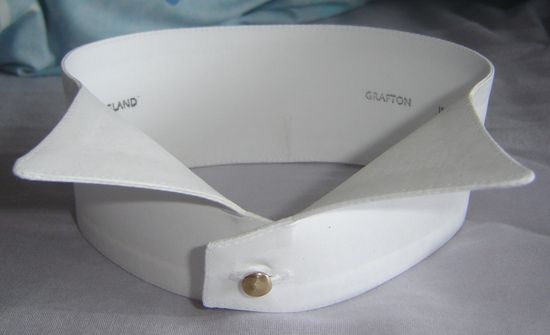
Last weekend we posted a quote by Paula Marantz Cohen on the meaning of the shirt collar. Dozens of readers pounced on the post, criticizing Cohen for her apparent failure to recognize the practical reasons for detachable collars. Jesse Kornbluth made related criticisms a few weeks back. The article appears to have been updated. It now reads (the bolded part is new):
As originally designed, the collar was detachable, like the tie. One could speculate on why this was and why it changed. Ostensibly, the detachable collar (and cuffs) facilitated more targeted starching and cleaning. Given the abundance of Industrial Era dirt and grime, "ring around the collar" (what later detergent advertisers made the bane of serious housewives) could be efficiently mitigated. But more theoretical explanations are also possible. Perhaps the 19th-century man only needed to give emphasis to his head in public settings; at home, he could disregard this part of his anatomy, either because he deferred to his wife’s judgment or, contrarily, because brute force could serve him in lieu of brain power. Whatever the reason, in the 20th century, the collar ceased to be detachable. Public and private became less differentiated.
Dish readers had some great things to add on the subject of shirt collars. One writes:
Once mechanical washers became common, it was just as easy to wash the entire shirt. And by then, our advertising industry insisted that you had to wash the shirt after just one wearing, since that's how they got you to buy ever more soap.
Another:
By the 20th century, mass production of clothing became more common and it became acceptable for men and women to buy premade clothing rather than having it tailor made, and so it became less expensive to replace shirts and dresses when the collar got too dirty or wore out.
Another:
Having grown up as the grandson of a NY clothing manufacturer, I believe the main reason for detachable collars was far more mundane than one might think. That reason was sweat. Before the advent of automatic washing machines and air conditioning, one could get an extra days use from a well-starched dress shirt by changing the collar. In the current HBO series Boardwalk Empire, there is a scene where Arnold Rothstein, wanting to look fresh for dinner, changes his collar (but not his shirt) after a long, and presumable sweaty, game of poker. Air conditioning was an invention which dramatically altered everyday life in America, from population patterns to contemporary fashion.
Another:
The detachable collar and cuffs became fashion in a time, around the 1850s, when most did not have a clean shirt daily. If a man had more than two shirts, he was doing well. If he had more than two suits and an extra pair of pants, he was wealthy.
Nearer the 20th century, the "white collar" office clerk would have paper or celluloid detachable collar and cuffs. A "blue collar" working man or farmer might only have one shirt to go to church on Sunday and was probably his wedding day shirt. The rich may have same fabric detachables. The first washing machines the rich had beat the hell out of clothes, and the poorer or more old fashioned used washboards. All classes replaced just the collars and cuffs in a time where clothes were a larger percentage of incomes, they are the part of a shirt that wears out first and becomes un-cleanable first.
Another:
The fuel of the Industrial Revolution was coal – soft coal, to be specific, which burned dirty. That coal stove in the corner of the office? Multiply it by ten thousand, and you get this 1902 report from a London a fog monitor: "White and damp in the early morning, it became smoky later, the particles coated with soot being dry and pungent to inhale. There was a complete block of street traffic at some crossings. Omnibuses were abandoned, and several goods trains were taken off."
Why did men change their collars – and cuffs – several times a day in London? Because white turned black in a matter of hours.
Another:
Or perhaps becuase 19th century collars, starched to iron stiffness, were basically choking hazards that a reasonable man would only wear as long as necessary.
Another points to the article, "A General History Of Detachable Collars On Custom Made Business And Formal Shirts." Another recommends Kathleen Brown's Foul Bodies: Cleanliness in Early America to "anyone interested in the history of laundry." One last reader:
Paula Marantz Cohen's mention of detachable collars brought back a great memory concerning my dad. I grew up in England during the post-war period and my dad worked at a Harley Street opticians as one of the first contact lens practitioners in the country. For those who are unfamiliar with Harley Street in London, it remains the location where many of the British upper class go to receive medical care from well-known, socially acceptable and expensive medical specialists. As a result, my dad had to dress up to fit the part. That included shirts with detachable and highly starched collars. The collars were attached to the shirt with studs. My mom would wash the shirts by hand (very few homes in England had washing machines in those days) but the collars were sent out to be washed and starched. I believe my dad changed his collar every day but not his shirt. In England, standards of hygiene were not up to North American standards in those days.
As a young boy, I fondly remember my dad walking around our house in Twickenham with his collar partially detached asking my mom if she had any clean collars. Thanks for the memory.
(Photo via Wikipedia)

 The Dish