A small correction. I wrote that 50 million Americans have no access to health insurance. It would be more accurate to say that 50 million have no health insurance. The difference between those who have access but do not use it and those who have no access because they cannot afford it is worth a thousand examinations. Rather than go into all of that, I'll just correct the record.
Author: Andrew Sullivan
Who Owns The Debt?
The Big Lie from the FNC/RNC propaganda machine is that our entire debt has been suddenly created by president Obama who took office in the midst of the steepest downturn since the 1930s, a downturn that began under Bush. Now its true that he hasn't slashed spending in such a crisis – and borrowed to keep the economy from going straight into the abyss; and it's true that the recession so depressed revenues that the short-term debt is unfathomable and the long term debt even less sustainable (which is why the Dish supports Bowles-Simpson). But anyone not blinded by Ailes propaganda knows that these problems are long-standing. Here's a chart, via Fallows, from Chuck Spinney, that shows the direction of the debt under each consecutive president since the Second World War. Including Truman is a little unfair since he presided over demobilization. But the rest is telling:
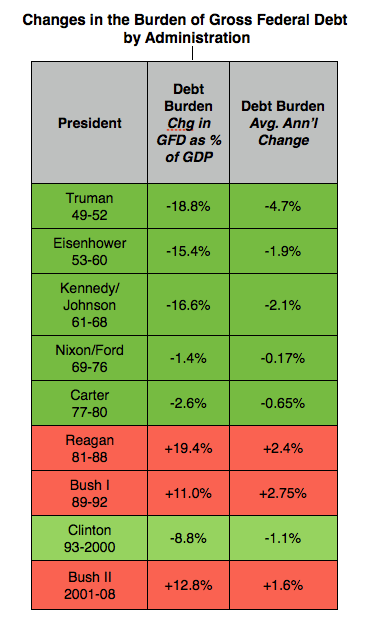
What this doesn't convey, of course, is the impact of recessions, which would mitigate Reagan and Bush I a little. But what you see, I think, is the impact of supply side madness. Eisenhower managed to reduce the debt burden by almost 2 percent a year. George W "deficits don't matter" Bush managed to add 1.6 percent a year without a significant downturn. And yet for some reason, the public still associated the GOP with fiscal conservatism. This is quite simply the biggest mass delusion I've witnessed in the quarter of a century I've lived in America.
How To Empower Moderates
David Frum argues that reforming campaign finance law is one necessity:
Political money now comes in two basic envelopes, one transparent, one opaque. The transparent money is money whose source is disclosed to the Federal Elections Commission. The non-transparent money is raised and spent by political entities that need disclose nothing. You’d think we’d favor the transparent envelope. But no.
The transparent money is hedged with difficulties: you have to raise it in increments of $2400, each donor is subject to a cap of his total giving for the cycle, etc. The non-transparent money is not only secret, but also limitless. The next step to real reform would be to make it easier for donors to give to parties – and for parties to support candidates. If we had a system whereby a wealthy person could give $1 million to the RNC or DNC, which then distributed the money among the most electable candidates, we’d accomplish two things: we’d liberate candidates from spending so much of their time fundraising, and we’d also allow parties to impose some discipline on their weirdos and outliers.
Bush Tax Cut Horse Trading
Erza Klein sketches four possibilities. Number one:
In a few weeks, unemployment benefits will expire for 2 million Americans. An extension of the benefits commands majority support among Democrats, Republicans and independents. But most Hill observers think Congress will fail to act. It would be unconscionable, however, to let unemployment benefits expire even as the tax cuts for the rich are continued. If Republicans aren't willing to come to the table on unemployment benefits, Democrats shouldn't move on tax cuts for the wealthy. And if they're not willing to take that case to the public, what are they good for, exactly?
What's amazing to me is that the core argument of the GOP on taxes is that any sunsetting of tax cuts to those earning over $200,000/$250,000 would hurt demand and the economy. But I know of very few economists who don't think ending extension of unemployment benefits – which are far more likely to be spent – woudn't hit demand and growth more powerfully. You'd think the GOP were hoping to keep the economy from recovering faster (which would benefit Obama) while merely pandering to part of their own base. But they'd never be that cynical, would they?
Mental Health Break
Willy Wonka and the new Tron get mashed:
How New York Can Survive
Ed Glaeser insists that innovation is the only way:
New York’s economy will never recover from the downturn by trying to compete with China’s labor costs or with Houston’s housing costs. Nor can the city continue to rely on finance, which came to dominate it over the last 40 years: as the sad history of Detroit illustrates, one-industry towns rarely succeed in the long run. Rather, New York’s success will depend on its ability to produce a steady stream of new products and ideas.
Indeed, studies have shown that all over the country, entrepreneurship—along with January temperature and education—is one of the three great predictors of urban success. But nowhere is that more the case than in Gotham, whose very history is a tale of entrepreneurship. To survive, New York must continue to bring forth innovators who will reinvent the city—with luck, making it more economically diverse. If they succeed, it will change as much between 2010 and 2050 as it did between 1970 and today.
“The Bathtub Gin of Cannabis” Ctd
A reader writes:
Regarding your reader's comments about JWH-018, a fellow journalist and I were doing some research on a story about how this so-called legal cannabis is manufactured and distributed. We discovered that anyone, even a kid, could buy the stuff at a dozen or more places within 1,000 yards of Fort Hood. It was absolutely all over Killeen, Texas, much like many military towns, because authorities are not testing for it. The town has since banned it. (But when I say "it", I mean the most popular brand, "K2". There's a hundred other varieties.)
We also talked to people who overdosed on the stuff and it is absolutely not safe.
What's worse, it's not the only popular test chemical out there; there's variations on ecstasy, LSD and cocaine too, and even less is known about those. I've personally been inside a lab at an apartment where these legal products were being made, and lemme tell you, a sane person really wouldn't want to eat that sausage once they've seen how it's cranked out.
Another writes:
While there are plenty of crappy legal cannabis alternatives, there are a few good ones that are completely natural. One I'd recommend is "Kanna" (Sceletium tortuosum), a South African herb used for thousands of years by indigenous tribes. It is one of the few natural SSRIs (serotonin re-uptake inhibitors). It's an excellent mood elevator, appetite suppressant, and in larger doses it induces euphoria. It's a different high than cannabis, but in many ways an excellent one, and better for socialization, since it's classified as an empathogen.
Nor does it need to be taken in euphoric doses to be effective. In fact, for a lot of people a small dose is the best. It is non-toxic and there are no known dangerous side effects, regardless of dosage, nor is it hallucinogenic (for most people). The primary effects are simply relaxation, calm, enhanced perception, emotional engagement, and mild euphoria. Vivid dreams are often reported. Using multiple and increasing doses to extend a session too far can lead to a reversal of the positive effects, so simply use it moderately and learn your limits.
It can be smoked for immediate effect, used as a tincture or tea for longer-lasting effects, or chewed if one wants to emulate the aboriginal tradition. It's perfectly legal, and patentable analogs of it have been used in pharmacological anti-depressants for many years. But the original plant is superior, I think.
I'd recommend it to anyone, especially those with mild symptoms of depression or anxiety. You can also use it in conjunction with cannabis for magnified effects. Don't use too much cannabis, however, or it will wash out the kanna effects. Occasional use is best, as tolerance builds up quickly, but 3-4 days of break time is plenty before using it again to get full effects.
Clinton And Israel
It's been quite a transformation. But she is beginning to own the peace-process now – and if she pulls it off, it would be a huge deal. I should say again that, for all my misgivings about the former Senator, her work at State has been spectacular.
“Born A Century Too Soon” Ctd
A reader writes:
Sometimes viewing things through a 21st century lens can be very misleading. I think there is a pretty good chance this young man is just a late bloomer and not a transsexual. Most noticeably, he does not appear to be making any attempt to actually look like a girl. He's just in a dress. Of course I may be wrong, as I'm not an expert on the history of the practice of breeching, but I remember seeing pictures of my grandfather in a dress when he was at least five or six and nobody assumed he was a transsexual.
Or he could be what is sometimes called pre-gay: dressing as a girl in childhood before realizing he's gay in adulthood. But breeching is also a possibility. Details on the practice:
Breeching was the occasion when a small boy was first dressed in breeches or trousers. From the mid-16th century until the late 19th or early 20th century, young boys in the Western world were unbreeched and wore gowns or dresses until an age that varied between two and eight.
The main reason for keeping boys in dresses was toilet training, or the lack of it. Dresses were also easier to make with room for future growth, in an age when clothes were much more expensive than now for all classes. The "age of reason" was generally considered to be about seven, and breeching corresponded roughly with that age for much of the period.
Dogs vs Pigs: Why Do We Eat What We Eat? Ctd
A reader writes:
I think you are missing a big problem with the large-scale eating of dogs in China. To imagine a world where you can both love your pet dog and love to eat dog in a restaurant isn’t too far-fetched. The problem is thieves. In China, if your dog goes missing, there is little doubt of its fate …
Dogs are commonly stolen if chained in public, or even a backyard (you will never see a dog leashed to a post, for instance). Even pet cats are stolen and sent to southern China, where cat meat is widely eaten. My current and former expat friends (of whom include M Scott Brauer, the photographer of this Nanking Yangshuo dog butcher at work) have heard many stories of people having their pets stolen. The photo here exemplifies the cruelty of the business – dogs crammed in a tiny cage being sprinkled with blood from the still-living dog hung from a hook just feet away. It’s all well and good to show a dog-meat hot pot, but it’s leaving out a lot.
With dog ownership on the rise in China, pet thievery is becoming less common and more vilified in the country, but still a horrifying thought, especially if you own dog(s). Ex-pat warnings on the topic are pretty easily googled if you want some horror stories.
 The Dish
