Inherit The Windfall, Ctd

Jared Bernstein “didn’t think [Mankiw] made much of a case” in his defense of inherited wealth:

In fact, in an article based on nervousness over a wealth or inheritance tax—they’re not the same thing but their differences are not germane to what follows—there was a conspicuous lack of any discussion of such taxes in practice.  As with any tax, the question is: given its magnitude and scope, what is its distortionary impact on behaviors relative to the benefits its revenues provide?

In the US case, the current estate tax—a tax on the value of estates at death—is tiny.  As we point out here, because individuals and couples can exempt $5.25 million and $10.5 million, respectively, “fewer than 2 of every 1,000 estates will owe any estate tax in 2013.”  In other words, “everybody dies, but only the richest 0.14% of estates pay the estate tax.” Though the top statutory rate on estates is 40%, because of the exemption and other provisions that to reduce the liability of heirs to the estate, the effective rate—the average share of the estate paid in taxes—is about 16%.

Danny Vinik also knocks Mankiw:

[A]ll of this misses a fundamental argument against substantial sums of inherited wealth: fairness. Kids from wealthy families already have numerous advantages over low-income children, including receiving a better education and having access to more social capital. Huge inheritances only exacerbate those advantages.

A particularly strong point from Vinik:

Not only are these huge disparities unfair, but they also reveal a double standard among conservative policymaking.

Republicans often argue that giving people money – or health insurance – will disincentivize them from working and reduce economic growth. … If [Paul] Ryan is so concerned about Obamacare discouraging low-income Americans from working, he should have the same qualms about huge inheritances discouraging kids from wealthy families from working. But you never hear that argument from Republicans.  Apparently, free money – whether from the government or your parents – only acts as a disincentive to work when poor people receive it.

Krugman joins in:

[T]he larger criticism of Mankiw’s piece is that it ignores the main reason we’re concerned about the concentration of wealth in family dynasties – the belief that it warps our political economy, that it undermines democracy. You don’t have to be a radical to share this concern; not only did people like Teddy Roosevelt openly talk about this problem, so (as Thomas Piketty points out) did Irving Fisher in his 1919 presidential address to the American Economic Association.

A few readers get their say:

Mankiw’s argument that inherited wealth is not something to worry about is dubious at best. The argument assumes that investing in productivity, and the storing of wealth necessary to make those investments (“financing capital”) are desirable pursuits. And I think many of us would agree that this is the lynchpin of civilization. But what is not at all clear from Mr. Mankiw’s argument is that a system of inheritance is an efficient way to both save and invest this wealth in capital. Are those who inherit money more likely than any other entity to invest it in capital, and to do so wisely?

The part about rising wages is even worse. Mankiw’s writes, “[H]eirs induce an unintended redistribution of income from other owners of capital toward workers.” Now, I’m not a professional investor, but I believe the point of investing in capital is to yield a better return on your money then you would get from labor. I mean, sure, some people’s wages will increase. But that will be more than offset by the number of man-hours saved. So in the end there is a smaller share of money going to workers as wages and a larger share going to owners of capital. That is the whole point of owning capital.

Historically, labor has done OK because new capital has created a larger demand for skilled labor. But as automation becomes increasingly sophisticated and better able to replace skilled labor, it is not at all clear that this will continue to be the case. And if the rate of labor replacement outstrips the rate of job creation, what do we do with all of these unemployed people? Wealth that is locked into blood lines by inheritance sure isn’t going to help them.

Another objects to Mankiw’s characterization of Capital in the Twenty-First Century:

He dismisses Piketty’s book as “provocative speculation.” It might be speculative in the sense that it makes some broad assumptions about the future (with equally broad caveats), but its predictions are supported by data. Manikaw’s article is mostly a series of unsupported assertions. For example, he says that “because increased capital raises labor productivity, workers enjoy higher wages,” which is obviously not true if you observe the last 20 years or so – the gains from increased worker productivity don’t necessarily go to workers, especially in an environment of ever-increasing pay for executives.

Mankiw also talks about how the “regression toward the mean” is some sort of natural enemy of inequality. However, part of Piketty’s point is that we’re returning to the historical “mean” rates of growth and return on capital: something like 1-2 percent growth and 5-7 percent on capital annually (with larger fortunes getting higher gains). He goes on to show how this basic mathematical inequality resulted in economic inequality throughout recorded history. For now, we’re still waiting for a rebuttal of Piketty’s book that’s based on data and actual research.

The Genre That Refuses To Ride Into The Sunset

Noah Gittell checks in with the Western:

To try and understand the western’s return, it’s important to understand why it left in the first place. There are many theories out there, but a lot of film critics attribute the decline of the western to the Vietnam War. Most films of the genre are essentially war pictures, detailing combat between American Indians and frontiersmen. J. Hoberman wrote that “save for a handful of releases, the western itself has remained defunct since the fall of Saigon,” noting that the ugliness of the conflict rendered the often blindly patriotic tone of the western obsolete. …

The underlying subject of nearly every western is the tension that erupts when an ascending civilization comes into conflict with the savage wilderness. Whether it is a sheriff chasing an outlaw or a homesteader fighting off an Indian attack, classical westerns depict an America trying to balance its frontier spirit with the need for manmade justice and order. Films like Stagecoach, My Darling Clementineand High Noon show the difficult process of extending a young nation into new territory. Perhaps that’s why westerns resonate less and less: Precious few among us would still call America a country on the rise.

An Abrahamic Turducken

_75635371_floorplan

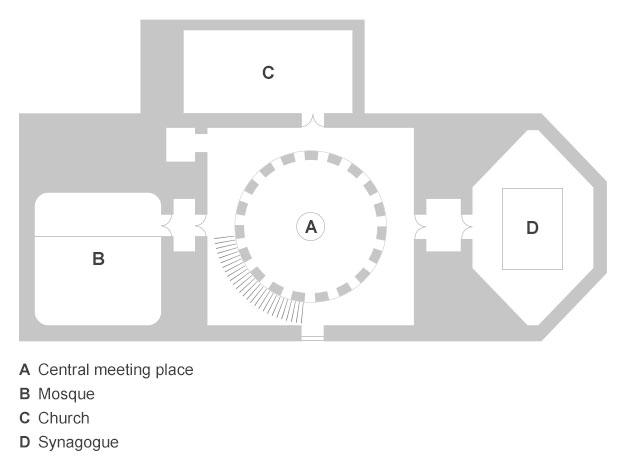
A design has been chosen for the House of One, a project that aims to bring a church, a mosque, and a synagogue under one roof in the heart of Berlin:

Each of the three areas in the House will be the same size, but of a different shape, architect Wilfried Kuehn points out. “Each of the singular spaces is designed according to the religious needs, the particularities of each faith,” he says. “There are for instance two levels in the mosque and the synagogue but there’s only one level in the church. There will be an organ in the church. There are places to wash feet in the mosque.” He and his team of architects researched designs for the three types of worshipping place and found more similarities than expected.

“What’s interesting is that when you go back a long time, they share a lot of architectural typologies. They are not so different,” Kuehn says. “It’s not necessary for instance for a mosque to have a minaret – it’s only a possibility and not a necessity. And a church doesn’t need a tower. This is about going back to the origins when these three faiths were close and shared a lot architecturally”.

Update from a reader:

While never a bad idea, it’s not as new as people seem to think. For example, in Ann Arbor, a Jewish synagogue and an Episcopal church have been sharing space for going on 30 years. Maybe a little easier for two faiths to share the same sanctuary when they have different days of worship, of course, but it’s not a new idea.

Another:

Check out the tri-faith campus in Omaha. It has run into a little bit of controversy that resulted from the anti Muslim people but I know that in the end common sense and good will will win out.

Face Of The Day

Verdicts In Phone Hacking Trial

Former government Director of Communications and News of The World editor Andy Coulson leaves the Old Bailey on June 24, 2014. Coulson has been found guilty of conspiracy to hack phones after an eight month trial at the Old Bailey. Rebekah Brooks, former editor and News International Chief Executive, has been found not guilty of all charges against her. The charges of phone hacking were brought by numerous celebrities and members of the public against the media company and forced the closure of the News of the World newspaper. By Alex Huckle/Getty Images.

Sponsored Content Watch

A reader points up north:

Your watchful eye on the metastasizing world of advertorials and so-called “native ads” is an essential counterpoint to what’s becoming an alarming trend, even outside of US borders. Case in point: a series of unmarked oil industry advertorials that recently made it to print in newspapers owned by Canada’s right-leaning Postmedia. Hawk-eyed readers were able to connect the dots and alerted Advertising Standards Canada (whose webpage is emblazoned with the motto “Truth in Advertising Matters”). After a review, the organization decided not to issue a ruling.

An increasingly desperate oil sands industry is pulling out all the stops to curry public favour with Keystone on wobbly ground and the Northern Gateway pipeline being met with fierce public opposition. It’s discouraging to find that all too many media organizations are willing to undermine the tireless work of their reporters with deceptive advertising practices.

A Canadian economist, Robyn Allan, tried to write a rebuttal to a piece about the oil industry that she read in a Postmedia newspaper:

[She] took issue with the economic claim [that Canada is losing $50-million a day due to limited export markets]. When she submitted an opinion piece in response, she was informed it couldn’t be run because the article she was responding to was actually a paid advertisement.

It wasn’t labeled as such; yet, as our reader noted, Advertising Standards Canada declined to censure Postmedia, which owns nearly every broadsheet daily in the country. Then it happened again – another paid pro-oil-industry piece not labeled as such. It gets better:

Earlier this year, the Vancouver Observer reported on a Postmedia presentation that outlined a content strategy that includes several Financial Post “Special Report” sections, with topics to be arranged by Postmedia and the Canadian Association of Petroleum Producers [CAPP]. … Add to that the tone of the leaked Postmedia presentation, which is graphically designed to follow the route of a cartoon pipeline (snazzy!) and includes this note from Douglas Kelly, the publisher of the National Post:

From its inception, the National Post has been one of the country’s leading voices on the importance of energy to Canada’s business competitiveness internationally and our economic well being in general. We will work with CAPP to amplify our energy mandate and to be part of the solution to keep Canada competitive in the global marketplace. The National Post will undertake to leverage all means editorially, technically and creatively to further this critical conversation.”

Huh. You almost get the impression that Postmedia sees itself as being on the same team as CAPP — which is rather disconcerting.

And the beat goes on.

Thin Skin Deep

1400383770284.cached

As summer-camp season approaches, Alyson Krueger reports from Eden Village, a Jewish organic farming program that has a “no-body-talk” rule for kids:

“The specific rule is while at camp, we take a break from mentioning physical appearance, including clothing,” said Vivian Stadlin, who founded the camp six years ago with her husband, Yoni Stadlin. “And it’s about myself or others, be it negative, neutral or even positive.”

On Friday afternoon, when the campers, girls and boys from 8 to 17, are dressed in white and especially polished for the Sabbath, they refrain from complimenting one another’s appearances. Rather, they say, “Your soul shines” or “I feel so happy to be around you” or “Your smile lights up the world,” Ms. Stadlin said. Signs posted on the mirrors in the bathroom read, “Don’t check your appearance, check your soul.”

Marcotte is wary:

It sounds wonderful on paper to live in “this wonderful, utopian kind of place where you’re not judged on anything except your spirit,” as one parent described Eden Village. But in the real world, there are plenty of legitimate reasons to include the body as part of your overall judgment of a person, such as when you are picking people to be on your tug-of-war team or auditioning potential sex partners. Doing things like covering up mirrors, which one camp does, treads a little too far in the direction of treating the body like it’s a source of shame instead of helping campers embrace their bodies for what they are and what they can do for them.

She offered similar criticism of a New York City ad campaign last year featuring the slogan “I’m a girl; I’m beautiful the way I am”:

No doubt it satisfies adults to pat little girls on the head and tell them they’re perfect and beautiful just the way they are, but kids often have better BS detectors than adults give them credit for. A handful of slogans on local ads will not change the fact that, in the real world, girls and women do suffer relentless judgment about their looks and are, whether they like it or not, frequently treated as if how they look matters more than anything else about them. For kids already picking up on this grim reality, having adults tell them that they’re perfect just the way they are has a strong chance of being read like yet another bit of adult wishful thinking.

Katy Waldman also criticized the campaign:

[W]hat’s with the slogan? As Kat Stoeffel at the Cut notes, “There’s something slightly contradictory about the NYC Girls Project message—‘Don’t worry about how you look. You look beautiful!’ ” Isn’t the point of the program to encourage girls to disassociate their sense of worth from their physical appearance? Why couldn’t the slogan simply be, “I’m Awesome the Way I Am?”

Beating Back the Distortions Of Gay History

While the p.r. juggernaut behind the deceptions and distortions of Ted Olson, David Boies, Jo Becker and Chad Griffin grinds relentlessly forward to mainstream applause, there’s been an extraordinarily gratifying pushback from countless people who actually know something about the subject. We had Mark Joseph Stern weighing in at Slate. Alyssa Rosenberg filets the Becker and Olson books in the Washington Post here. Jamie Kirchick takes a good whack in the Wall Street Journal here. Hank Stuever got the true measure of the documentary here.

Alyssa’s review is particularly strong and I recommend it if you haven’t read enough about this controversy. She rightly sees this egregious p.r. campaign as turning the actual story of this remarkable civil rights struggle into something “less true and less interesting.” And she has a good eye for the motives of Boies and Olson:

Much is made of the fact that Olson and Boies opposed each other in Bush v. Gore, but little of the alternative legacy each man might want to build for himself, Boies as a winner rather than a loser, Olson as a man above politics rather than a partisan operative.

It goes to show that there is, in the end, a riposte to public relations. It’s called journalism. And the rumors of its death – at the hands of Jo Becker – are mercifully exaggerated.

The Poet Laureate Of Hell

Jang Jin-Sung, author of Dear Leader: Poet, Spy, Escapee – A Look Inside North Korea, describes the unpoetic realities of writing verse for the DPRK:

I worked in Section 5 (Literature), Division 19 (Poetry) of Office 101. Despite the uncanny and unintended echo of Orwell’s Room 101, this office was, ironically, so named precisely in order to avoid any hint of the nature of our work. When it was first set up, the department specialized in conducting psychological warfare operations against the South through cultural media such as the press, literary arts, music and film. After the 1970s, it strove particularly to amplify anti-American sentiment and foster pro-North tendencies among the South Korean population, exploiting the democratic resistance movements that had risen against the then military dictatorship.

My task, like all other writers in the system, was to express an institutional line, not an individual message. No writer in North Korea is permitted to act beyond a bureaucratic affiliation that controls the process – from the setting of the initial guidelines for each work to the granting of permission for publication – through strict monitoring, evaluation and surveillance. Our main task was to transform ourselves into South Korean poets who supported Kim Jong-il. … Because I worked under an assumed South Korean identity, I did have some license to experiment with straying from the legal bounds of North Korean art – at least in the exercise of style. This provided the “freedom” in which I composed my work; which, paradoxically, stood out from writing by my more careful and devout peers and led to my being admitted into Kim Jong-il’s inner circle.

Judging By The Book

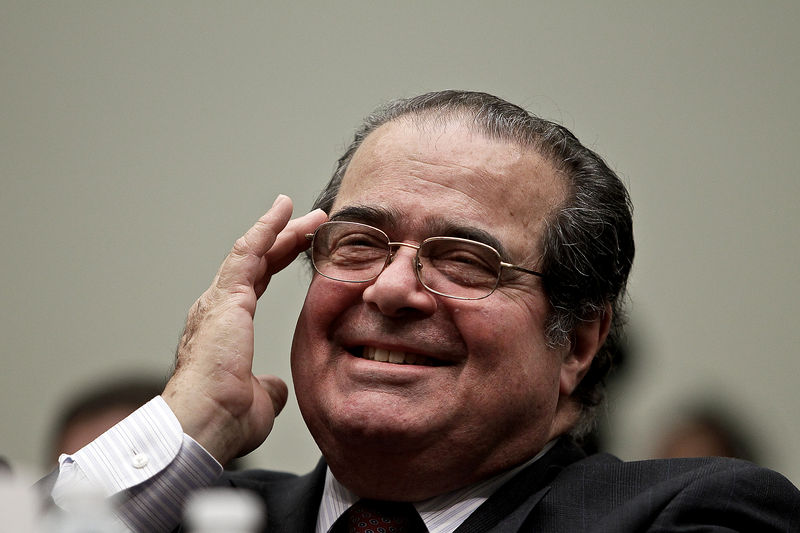
800px-Antonin_Scalia_2010

Jeff Shesol spots a fascinating detail in Bruce Allen Murphy’s new biography, Scalia: A Court of One – his obsession with dictionaries, especially those from the 18th and 19th centuries. Scalia’s penchant for parsing the meaning of words “is apparent—often ostentatiously so—in nearly every opinion that Scalia has put on paper over the past three decades”:

Sometimes, this has yielded a comical result, as in Scalia’s dissent in Edwards v. Aguillard, a 1987 decision overturning a pretty plainly labelled Louisiana law called the Balanced Treatment for Creation-Science and Evolution-Science Act on the grounds that it advanced a particular religious belief.  Scalia, having considered very carefully the phrase in question, insisted, presumably with a straight face, that the term “creation science” had no religious meaning whatsoever. “The Act’s reference to ‘creation,’” he wrote, “is not convincing evidence of religious purpose…. We have no basis on the record to conclude that creation science need be anything other than a collection of scientific data supporting the theory that life abruptly appeared on earth.”

In other instances, Scalia’s word games have had profound, societal implications, leading to—in at least one case—a dramatic shift in constitutional law.

In District of Columbia v. Heller, which Scalia considers his greatest achievement, he relied not on one but on three eighteenth-century dictionaries to “clarify” the Second Amendment, which reads, “A well regulated militia being necessary to the security of a free state, the right of the people to keep and bear arms shall not be infringed.” By the time that Scalia had finished his exegesis, the “prefatory clause” about a militia had been clarified into irrelevance, and “bear arms” had been so scrutinized and squinted at and worked over that Americans awoke to find that they had a new, individual right to carry a handgun—a right that cannot be found in the language, plain or otherwise, of the Constitution. Michael Waldman, who has just published a book on the Second Amendment, observes that Scalia, in his opinion, “has the feel of an ambitious Scrabble player trying too hard to prove that triple word score really does exist.”

(Photo: Supreme Court Associate Justice Antonin Scalia testifies before the House Judiciary Committee’s Commercial and Administrative Law Subcommittee on Capitol Hill May 20, 2010 in Washington, DC, by Stephen Masker via Wikimedia Commons)