Another Bag-And-Forth, Ctd

Readers pile on Katherine Mangu-Ward for overstating the “yuck factor” for canvas grocery bags:

You know what’s gross? Not washing your reusable bags when you put things into them that leak. You know, like any vaguely hygienic person would do. Note that Reason failed to mention that washing bags essentially eliminates bacteria.

On the other hand, you know what isn’t gross?  Being able to bike down the side of the Anacostia and Potomac Rivers and not see huge accumulations of plastic bags.  Not having random bags blowing down the street in front of my house.  Not having a grocery bag full of other grocery bags that “I swear I’ll reuse these someday” that I then throw away.

Wash your damn reusable bags, people. But use them.

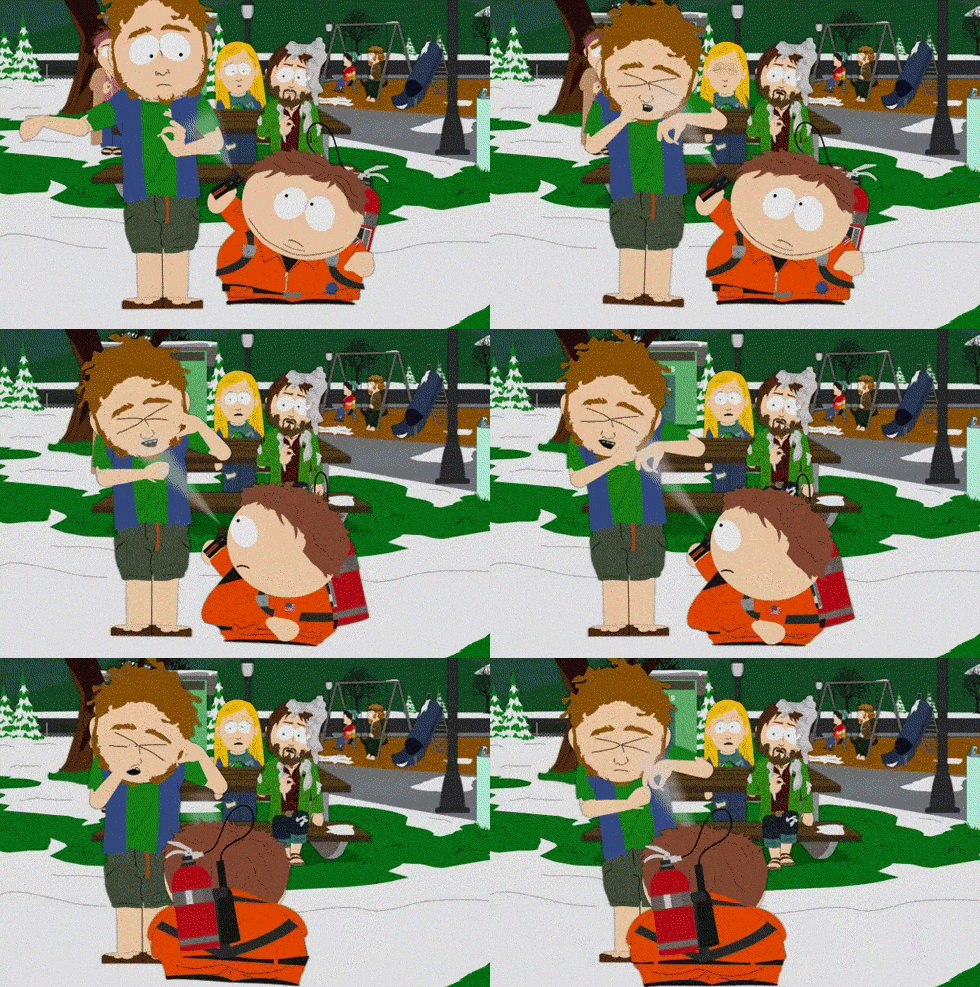
Another agrees – using a GIF:

As to Mangu-Ward’s imaginative anecdote regarding a “leaky package of chicken” – two comments:

1)

tumblr_mltm2fN8DO1qaw9gto4_250

2)

Where does she purchase her incredibly loosely packaged chicken and why wasn’t it placed flat on the bottom of the bag so it doesn’t move around? I’ve never had this leaky meat problem. If I did, I would just throw them in the washing machine.

Another reader lacking a leaky meat problem:

You know what’s gross? Clothes. Think about it: you put pieces of cloth on your body and sweat on them, or get food all over them. Then you take off your clothes, crumple them up, and toss them on the floor in the corner of your closet to fester. A week later, you go wear them again and stick your junk right against the same cloth. Ew.

Oh, what’s that? You can wash clothes? They even have “washing machines” that will wash clothes for you? That’s brilliant. I wonder what else you could wash in a washing machine …

Another dissents:

cartman-hippieI live in Austin, home of hippies who love these bag bans. When these people can’t even wash themselves, how can we expect them to wash the bags? And here in Austin, the bags from the most popular grocery store become useless when you wash them because the cardboard that makes the bag bottoms rigid is destroyed. I see the people in line next to me and they aren’t washing their bags – or their pits.

Update from a subscriber:

love hanging around your readers. They teach me things. But something they just crack me up. It’s like a really good Thanksgiving dinner with relatives you can actually stand and are even proud to be seen with.

Will Uber Pop The Medallion Bubble?

medallions

In a lengthy report, Emily Badger explores what the rise of Uber and Lyft means for taxi medallions, whose value has risen astronomically in recent years:

In New York, taxi medallions have topped $1 million. In Boston, $700,000. In Philadelphia, $400,000. In Miami, $300,000. Where medallions exist, they have outperformed even the Standard & Poor’s 500-stock index. In Chicago, their value has doubled since 2009.

Now, however, a market built on restricted supply is showing cracks with the arrival of start-ups that turn anyone with a car into a driver for hire. In Chicago, those cracks have triggered fears that medallion values are tottering. They have given rise to a high-stakes lawsuit, tentative new regulation and a glimpse of how this same clash between old power and new technology could play out in other cities. Throw open the market — to amateurs, part-timers and the underemployed (and whatever they drive) — and medallions lose their exclusivity. Without which, they lose their value, too. …

That, Uber says, is precisely the point. The five-year-old San Francisco tech company — and the envy of Silicon Valley — has rapidly and strategically infiltrated taxi strongholds by enabling consumers to hail rides electronically from their smartphones. Uber and companies like it argue that regulations intended for taxis don’t apply to a service no one could have envisioned when the laws were written. And consumers don’t seem to care what those laws say. They are piling in and leaving cities to chase after a fast-expanding business.

Meanwhile, Eric Goldwyn considers the conflict between traditionally trained drivers and disruptive tech:

Startups like Uber argue that technology can transform the casual driver into a professional. With G.P.S., anyone can navigate efficiently. Real-time passenger feedback means that drivers who consistently receive low ratings can be dropped from the service. “Tech tools have changed the whole environment,” Josh Mohrer, the general manager of Uber’s New York office, told me. The upstarts can provide a range of ride options at different price points, improve driver efficiency by matching drivers with rides more quickly, and weed out bad drivers. …

There is now talk within the taxi community of developing mobile applications to compete with the T.N.C.s. [transportation network companies like Uber]. [Taxi union leader Bhairavi] Desai sees this as a viable strategy, one that could stitch together the obvious benefits of technology and professionalism. “In cities where ride-share has grown, it’s because professional taxi drivers have switched to the other side,” Desai explained. “The Uber model isn’t sustainable without professional drivers.”

Previous Dish on Uber here and here.

Raging Against Obama – And History, Ctd

A little due diligence on Walter Russell Mead’s sweeping declarations of utter policy “disaster”. He said the same thing in March 2003 about containing Saddam’s Iraq:

We’ve bought the continuing presence of U.S. forces in Saudi Arabia, causing a profound religious offense to a billion Muslims around the world, and accelerating the alarming drift of Saudi religious and political leaders toward ever more extreme forms of anti-Americanism. What we can’t buy is protection from Hussein’s development of weapons of mass destruction. Too many companies and too many states will sell him anything he wants, and Russia and France will continue to sabotage any inspections and sanctions regime.

Morally, politically, financially, containing Iraq is one of the costliest failures in the history of American foreign policy. Containment can be tweaked — made a little less murderous, a little less dangerous, a little less futile — but the basic equations don’t change. Containing Hussein delivers civilians into the hands of a murderous psychopath, destabilizes the whole Middle East and foments anti-American terror — with no end in sight. This is disaster, not policy. It is time for a change.

And we’re all living in its wake, aren’t we?

The Architecture Of Confinement

Panopticon

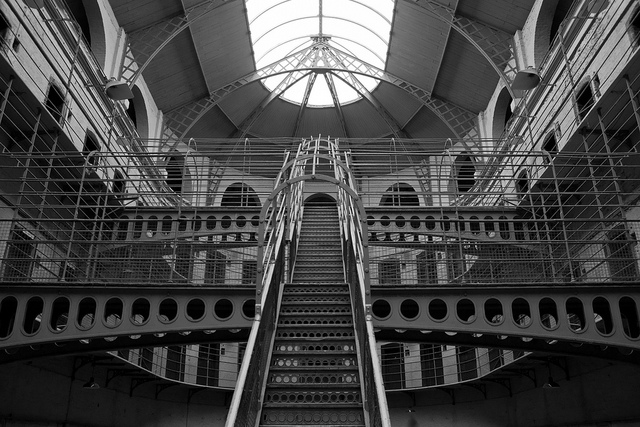
Jeremy Bentham’s utopian prison design appears to have been a big mistake – and its consequences are still being felt after more than two centuries:

Though many scholars focusing on penitentiaries suspect that staff-prisoner relations are molded by institutional architecture, little empirical work has been completed on the topic. Now, a new study led by [researcher Karin] Beijersbergen and published in Crime & Delinquency has concluded that building styles, floor plans, and other design features do indeed have a significant impact on the way Dutch prisoners perceive their relationships with prison staff. …

After controlling for age, ethnicity, intimate relationships at the time of arrest, education level, personality traits, criminal histories, and officer-to-inmate ratios, the authors discovered that their hunch was correct. If the prisoners were housed in leaky dungeon-like panopticons, they tended to feel more estranged from guards. But if they were enjoying campus-style living arrangements or apartment-style high-rises, they perceived the relationships as more supportive.

On a similar note, architect Raphael Sperry – who is working to get the American Institute of Architects’ to change its code to “prohibit the design of spaces that inherently violate human rights” – discusses the business of designing prisons:

A lot of large firms have a unit that designs prisons. Sometimes that expertise overlaps with other high-security business types – military facilities and some other government facilities – but prisons are pretty specialized. The group within a large firm might be five percent of their business, in some cases maybe 15 percent. There are some firms that specialize in prisons and those ones that I’ve encountered really try to be progressive. They are the most forward-thinking, and [are] using evidence-based best practices. …

We are not advocating that we put the firms that do prisons out of business; we would just like if they would foreground human rights in the work that they do, and I think it’s better if they do that collectively. That’s what the code is about. If one or two companies say, ‘We are not going to design prisons that violate human rights,’ those guys are going to go out of business and the product will still be built. It’s important to take a collective stance.

(Photo by Paolo Trabattoni)

Reality Check

Screen Shot 2014-06-24 at 12.13.38 PM

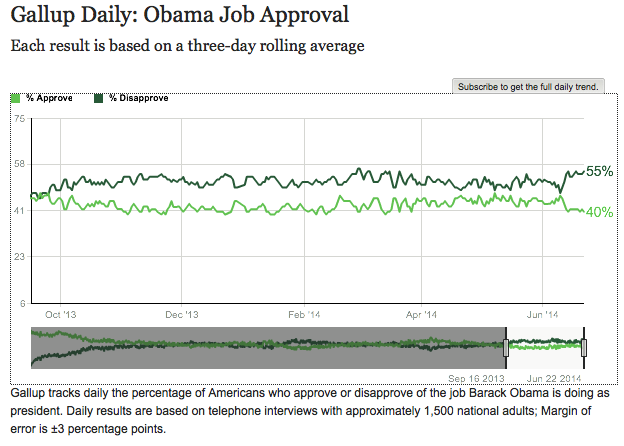
The Gallup daily tracking poll shows a sudden shift in appraisals of the president. On June 8, after a spring in which the gap between approval and disapproval was narrowing slowly, the public was evenly split – 47 – 46. Two weeks later, it’s 55 – 40. That’s one of the more sudden shifts yet in his two terms of office. It puts him close to GWB at this point in his second term:

Screen Shot 2014-06-24 at 12.16.41 PM

The light green line is Obama’s approval ratings; the darker one Bush’s. They look remarkably similar, apart from Bush’s much higher support from Democrats for a long time. That dotted line is the average of all presidents across the years since Truman. On that score, Obama is doing slightly better now than he was for much of his first term, ironically enough. The closest analogy to either of them is Truman’s approval rating (he finished out his presidency at 32 percent), which might give one some hope for a future historical assessment.

Why has this shift occurred so suddenly?

Multi-determined, as my shrink would say. But it has to be Iraq most of all. You can see a fledgling Obama recovery to an even 47-46 split until the Sunni/ISIS insurgency took off. And I think that’s understandable. One of Obama’s great and singular achievements was the withdrawal from Iraq without catastrophe. If that is now in doubt, especially if there is any chance of our getting involved again, then a core step forward looks in hindsight like a chimera. And Iraq is such a nightmare in American minds that any notion that we might be headed back there is abhorrent. Who do you blame for such a situation? The president, of course. What can he do about it? Between a metastasizing, regional sectarian war and US military intervention, it’s a pretty nasty dilemma. But my advice, such as it is, remains: stay out. Let it burn out; let’s see what emerges from the chaos; let’s concentrate on protecting our borders and improving our intelligence. If Obama could muster that message, I think it could resonate. As long as he wrings his hands, and the punditaraiat screams daily about What Must Be Done, and the State Department insists on more and more involvement, he will suffer.

Jailed For Journalism

Jesse Rosenfeld reports the news out of Egypt, where the same judge who sentenced 14 Muslim Brothers to death on flimsy-to-nonexistent evidence has handed down a harsh verdict against Al Jazeera journalists Peter Greste, Mohamed Fahmy and Baher Mohammad:

The three, who already have spent 177 days in jail, will now have to spend a total of seven years in prison. Baher Mohamed had three more years tacked onto his sentence because he had in his possession a bullet fired at a protest. Yet in this highly politicized trial the prosecution never presented any evidence to show that these journalists created “false news” or joined the banned Muslim Brotherhood as charged. Instead, prosecutors laid out a case based on broad conspiracy theories claiming that the Qatar-based Al Jazeera satellite network is responsible for Middle East regional conflicts. …

The evident aim of the prosecution was not just to convict the reporters and a handful of students on trial with them, but to drive home the idea that al-Sisi’s government has a monopoly on truth. Prosecutors described the verdict and the sentencing as a “deterrent.”

The trial reads like an Orwell-Kafka collaboration:

[It] relied heavily on evidence culled from their personal possessions, but prosecutors never made any link between the innocuous-seeming material presented and the charges against the journalists. Making matters worse, in one instance, the defense lawyers were asked to pay a “fee” of about $150,000 to view evidence. …

Because journalists were allowed into the courtroom, there is a record of what was presented as evidence. It includes:

  • A video for the melancholy Gotye song “Somebody that I used to know” that came from a cell phone that allegedly belonged to one of the journalistsBoPLnZ5IUAE5jk-
  • Video footage of a press conference in Kenya that happened in 2013
  • A picture of Greste’s parents from his flash drive.
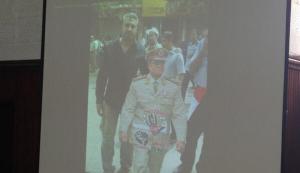
  • And this clearly manipulated picture of former armed forces chairman Mohammed Hussein Tantawi with Fahmy [seen to the right]

Journalists in Egypt have good reason to be afraid:

“It’s a warning to journalists that they could find themselves on trial and convicted for carrying out their duties,” said Mohamed Lotfy, executive director of the Egyptian Commission for Rights and Freedoms who has observed the trial for Amnesty International. Egypt’s prosecutor’s office issued a statement calling the ruling a “deterrent.” …

Most sobering for journalists, the trial also dissected the content of the Al Jazeera English team’s reporting. In his closing remarks, the prosecutor accused the journalists of selecting footage that would portray Egypt in a negative light. Among other examples of such ‘negative’ reporting, he said the three had reported on sexual harassment during demonstrations in Tahrir Square, an explosive issue that numerous foreign and local journalists have covered. In their defense, the journalists and their supporters argued: This was ordinary reporting, a journalistic portfolio similar to other top members of our profession.

Calling the verdict “a case study in all that is wrong with the Egyptian judicial system”, Bel Trew reminds us that the sorry state of press freedoms in Egypt is hardly news:

The Egyptian government has arrested over 40,000 people, according to the independent monitoring group WikiThawra, and sent thousands to trial since last summer’s military coup. Journalists haven’t been immune from this crackdown: Egypt was the third-deadliest country for journalists and among the top jailers of journalists in 2013, according to the Committee to Protect Journalists (CPJ). More than 65 journalists have been detained in Egypt since the coup, and 14 remain behind bars. …

The effect has been an unprecedented level of self-censorship by both the public and private media. “You can see many TV shows, awkwardly trying to stop their interviewees going too far in criticizing the army and the government,” Lotfy said. It was, he added, the worst press environment he had monitored in the last 30 years.

The ruling looked like a goodbye kiss for John Kerry, who had left Cairo hours earlier after announcing the US’ intent to restore military aid to the Sisi regime:

Kerry’s trip to Egypt was the clearest statement yet that President Barack Obama would rather work with al-Sisi than punish him, and his conciliatory words in Cairo before the verdict were not surprising, says Tamara Cofman Wittes, a former State Department official and Egypt expert now with the Brookings Institution. “I think the trajectory has been clear for a while.”

Keating can see why we have set aside our principles in Egypt:

It certainly seems like what’s changed here is not the policies of Abdel Fattah el-Sisi’s government but American priorities elsewhere in the Middle East. Iraq is on the verge of national collapse, Israeli-Palestinian tensions are again reaching the boiling point, and Libya is seemingly consigned to dangerous instability for the foreseeable future. Stable-ish pro-American governments with competent militaries are in short supply in the region right now.

My guess is that, with Sisi’s message now clearly sent to foreign correspondents in Egypt that they’re not immune to the government crackdown, the Al-Jazeera reporters won’t actually serve their sentences. But beyond this particular case, it’s clear that concerns about the country’s democracy have, once again, has been moved to the backburner.

Doug Bandow rightly wants to cut off the regime:

Congress should end all aid. The administration should shut up about democracy.  The Pentagon should be left to cooperate with the Egyptian military on essential tasks, including access to the Suez Canal—after all, Egypt’s generals will want to continue purchasing newer and better toys, as well as acquiring spare parts for existing weapons. There is no good answer to Egypt.  No one knows how a Morsi presidency would have turned out, but skepticism of the Brotherhood in power is understandable, given the abuses of Islamists elsewhere.

Alas, as I point out in my new article on American Spectator online, “we do know how a Sisi presidency is likely to turn out: a rerun of Mubarak’s authoritarian and corrupt reign.”  Repressive rule isn’t even likely to deliver stability, since the Egyptian people will eventually tire of yet another government which delivers arbitrary arrests, brutal torture, and summary punishment rather than economic growth.

The best Washington can do is stay out. Subsidize no one, endorse no one. Work privately to advance important interests. Leave Egyptians to settle their fate.

Is NATO Now Endangering Europe?

Arguing that NATO is obsolete and European countries should take responsibility for their own security again, Justin Logan highlights how the alliance’s post-Cold War expansion may be exacerbating the very Russian aggression it’s supposed to prevent:

The cost of surrounding Russia militarily is that Russia feels surrounded militarily. Allowing NATO to die after it achieved its mission after the Cold War would have left Moscow with a freer hand in Eastern Europe — and some current NATO member states Russian President Vladimir Putin Attends Military Exercise Near Saint Petersburgwould have faced negative consequences. Their relations with Russia would have reflected relative power and geography, and they would have had to defer to Russian prerogatives more than at present.

At the same time, other states, such as Ukraine, have arguably been worse off as a result of NATO’s persistence. Its internal politics have been more consequential to Moscow because not only of its economic orientation, but also because of the threat that it may someday become a NATO member. The downside of drawing lines across Europe, as NATO has, is that lines have two sides. And being on the non-NATO side of the line makes one a particularly appetizing target for predation, incentivizing the Kremlin to act before it’s too late. The choice facing, say, the Baltic states becomes even starker.

NATO expansion has validated the narratives of Russian nationalists and made Russian liberals look like suckers, a nuance that is lost on many in the West.

Once again, the desire to transpose a structure that made sense in the Cold War to a thoroughly different era has led to unintended consequences. The desire to spike the ball came back to haunt us, and the hubris of the neocon and liberal internationalist visions after 1989 eventually blew back, with a vengeance. We either learn this ourselves and adjust or have history teach us this more forcefully. “Creating reality” is a rather elegant term for “denying reality”. And those who in fields Elysian would dwell do but extend the boundaries of Hell.

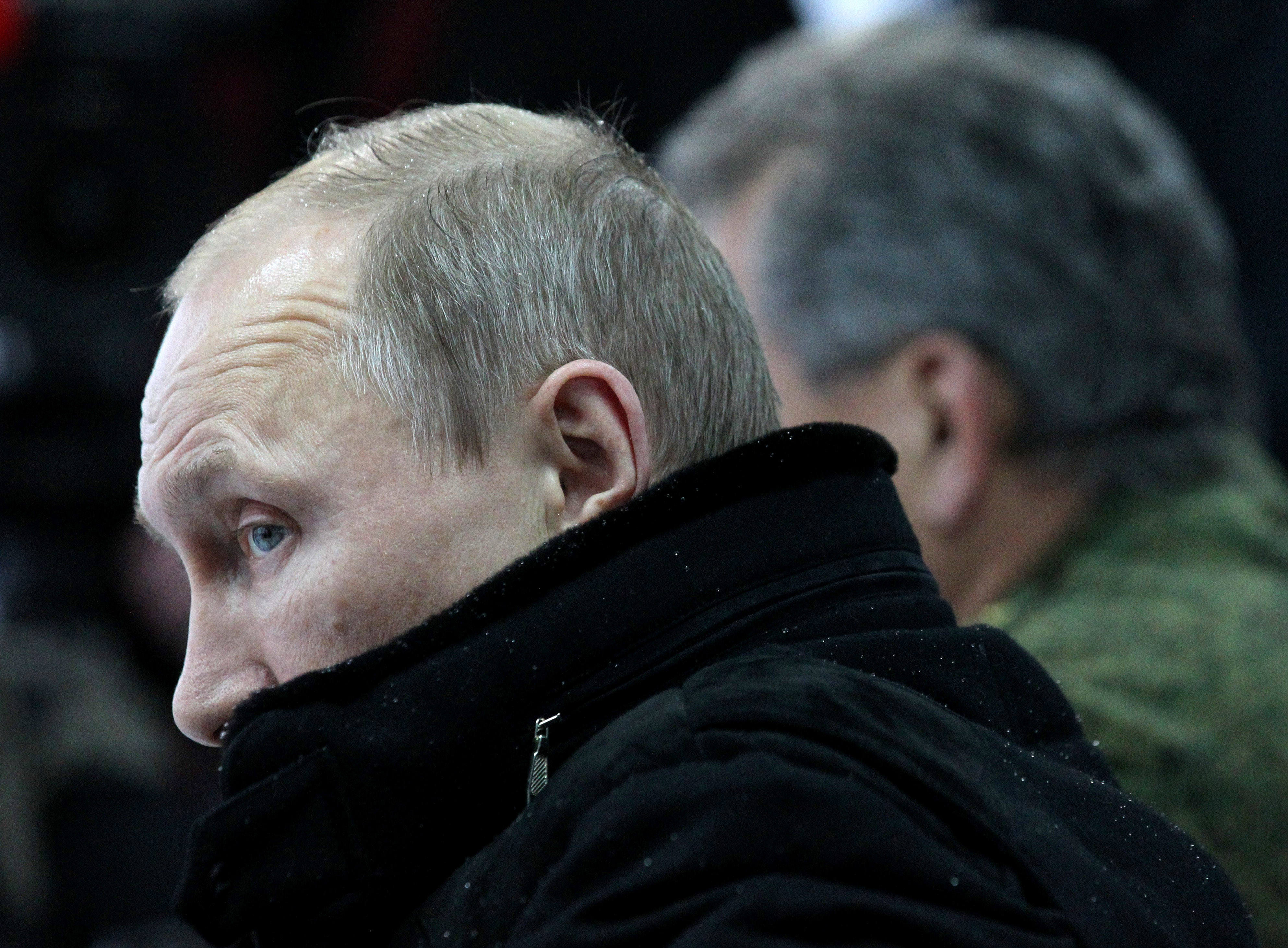
(Photo: Russian President Vladimir Putin watches a military exericises at Kamenka polygon on March 3, 2014 near Saint Petersburg, Russia. Ukrainian forces in Crimea had been issued with a deadline for surrender by the Russian military as it continued to mass equipment and personnel along the border. By Sasha Mordovets/Getty Images)

The View From Your Window Contest: Winner #210

vfywc-200

A reader ventures a guess:

Björlanda, Sweden. I believe that is the Fladen fishing store on the pier.

Another looks east:

This looks very much like the area of Hakone, Japan in which I took an excursion in 2009. Those old-time looking ships are part of the tourist industry. I’m pretty sure this is on Lake Ashi, in the Japanese Alps.

Or the Caribbean?

I’m not entirely sure of the building, but I think this is from the second floor of the DeLugo Federal Building on Veterans Drive in Charlotte Amelie, St. Thomas in the US Virgin Islands. Hassel Island is the island across the water in the foreground, and the building with the tall ship docked in front of it is next to the Legislature of the US Virgin Islands (which is out of the frame to the right). I haven’t been there since 2009, but it was raining then too! Thanks for a great window!

Another goes down under:

This contest is a pain in my ass. I went through chart after chart of tall ship logs (I finally settled on Esplanade_StrahanTasmaniaAustralia/New Zealand and environs). I can’t take it anymore. I finally Googled “Tasmania esplanade” after searching with “quay”, “inlet”, “bay”, “tall ships” and just about every permutation of “port” and “harbor” I could think of … I landed on this painting of Strahan, Tasmania.

That sure as hell looks like the VFYWC, even though I can already tell the dome is missing from the building with the orange roof. I’m out. It’s probably clear on the other side of the world, like the Isle of Man.

Another nails the right island:

I see obvious English signage, a yellow-orange number plate, and double yellow lines, cars parked facing the left side leading me to think it’s somewhere in the UK. All my searches keep pointing back to Falmouth, but I can’t find any place that would match. The surroundings remind me on the gut level more of the area around Edinburgh, but again no dice. Brighton does a Tall Ships festival, but I can’t find any tie.

After looking at thousands of photos, tracing the UK on Google Earth, and going through every company beginning with “Community” I could find, I’m no better off than I was to begin with. I’ve got no more time to give, so I’m registering a frustrated “United Kingdom” as as close as I can get, and I’m even less than certain of that at this point. Grrr. Why do I love this game?!

Because of the drama of near misses? Another reader said the view “screamed” UK because of the “rain and depressed looking tourists”. Another hits the wrong end of the island:

Alrighty, so we have another dismal-ish looking port/harbor/beach view. If I hadn’t seen the little huddle of people bundled up in cold-weather clothing, I would have immediately guessed somewhere warm. However, the vehicles being on the left side of the road, the clearly English sign on the community whatsoever building on the pier, all led me to think that this is somewhere that the British were, or at least had an influence. The numerous blurry masts in the lower left corner suggest a yachting/boating is popular. There’s a sort of castle-y looking building on the waterside to the right, it looks quite old, as in a couple of hundred years or so. The steep slope of the hill at the right leads me to believe that that it probably goes up quite a ways, maybe the hillside buildings comprise a significant part of the landscape we’re not seeing.

All of the above only serves up some rather vague ideas about where this may be. Nonetheless, I’m going to guess somewhere in the Channel Islands or along the British coast.

Another gets the correct (presently non-sovereign) country:

I don’t have any more than this guess: Ullapool, Scotland.

This reader, like most this week, identified the correct city and hotel:

OMG, I FINALLY GOT ONE!

After years of blankly staring at the view from your window photos and wondering how 3778689466_e5f3c5550e_zanyone figured these out, I decided to stop doing anything else until I figured out where this one was. After all, there were plenty of clues: European license plate on a car, UK street markings, and even words on buildings! This would be easy, right?

Um, no … it appears that an insane level of persistence is required to search every possible clue until you get that magical hit. Then you get to obsessively triangulate in on the photo’s precise point of view. But holy cow, this was fun!

The town is Oban, Scotland, and it looks like the photo was taken from a third floor window at the Oban Caledonian Hotel.

Chini chimes in:

Normally it’s a tad disappointing to get an easy view, but between travel for work and Sunday’s World Cup game I’m grateful that this was a near instant find. Plus, it’s a good photo for new players because there’s at least half a dozen different ways to find the location.

Indeed there were:

Northern seaport.
European buildings, license plate.
“Community” on building – aha! Scotland.
Google “Piazza Scotland”: “We are a family friendly pizza/pasta restaurant on a pier in beautiful Oban Bay in Scotland”

Bingo!

Or you could take a more circuitous route:

Google indicated alternative European yellow tags could have been the Netherlands, Cyprus, or Gibraltar (who knew?), but the English word “Community” led me back to the UK.  Web searches for “wharf red metal roof” were totally useless, as was the “Plazen(?)” word by the red-roof building.

Reluctantly, I then circumnavigated the UK, starting near Dover (it was a hunch and not a good one), along the English Channel, then through Ireland, then up to the west coast of Scotland, looking for a bay with a red roof on wharf.  The UK train logos fooled me many times, but the red roof of the Oban North Ferry Terminal finally gave me hope that my efforts had paid off.  There is something really powerful about first seeing the street view confirming this sought-after location.  It’s a really cool feeling.

Below is this week’s OpenHeatMap of everyone’s guesses (zoom in by double-clicking an area of interest, or drag your cursor up and down the slide):

This embed is invalid

Most readers got the right window too, but only one nailed it with a GIF – a first for the window contest:

oban

I found it by googling “fish restaurant on dock scotland.”

A long-time lurker:

Aha! I’ve been following this contest for years and have yet to come any where near guessing correctly. And then finally, this morning, it’s somewhere I’ve been! I almost feel guilty (well no, not really).

The red roofed building on the pier is Ee-usk, a perfectly reasonable seafood restaurant that my wife and I walked out of in favor of fish and chips at a pub down the road. This photo was taken from there:

Oban Caledonian from Ee-usk

Another describes the scene:

The location is familiar because I visited Oban once more than twenty years ago. It was the last family holiday with my parents before I went to university. We stayed in a guest house near St Columba’s cathedral which you can seen in the distance behind the building with the red roof. The island straight ahead is Kerrera. It is a pity the weather was so bad when the picture was taken because the views from here are beautiful. If it had been clearer, to the right of Kerrera you would see across Loch Linnhe to another long low island, Lismore (the most boring place I have ever visited), and the mountains on the mainland again beyond it. Behind Kerrera, to the left, you would see the mountains on Mull.

A first-time player:

I am from Glasgow and first took my wife to Scotland to tour the country in 1999 (we met as students in Canada and started dating the previous year). We stayed for a night in Oban and sailed from there to Mull and went on to Iona. The night in Oban was wet (natch). We sat in our rental car on the seafront (possibly a spot in the photo), listening to “Just A Minute” and watching a diver ease his way out into the bay. Thanks for bringing the memory back to the surface.

Many readers have been there:

Marked up contest photo

Not only is this week’s contest easy, but I’ve had pints at the Oban Caledonian Hotel looking at harbour. My wife and I stayed in Oban with our daughter, then almost two years old. It was our daughter’s first time experiencing the sun setting after 10 pm and she couldn’t sleep. So while my wife rested, I packed my daughter in the stroller walked into town, ordered a beer and rocked the stroller back-and-forth while looking out over the water.

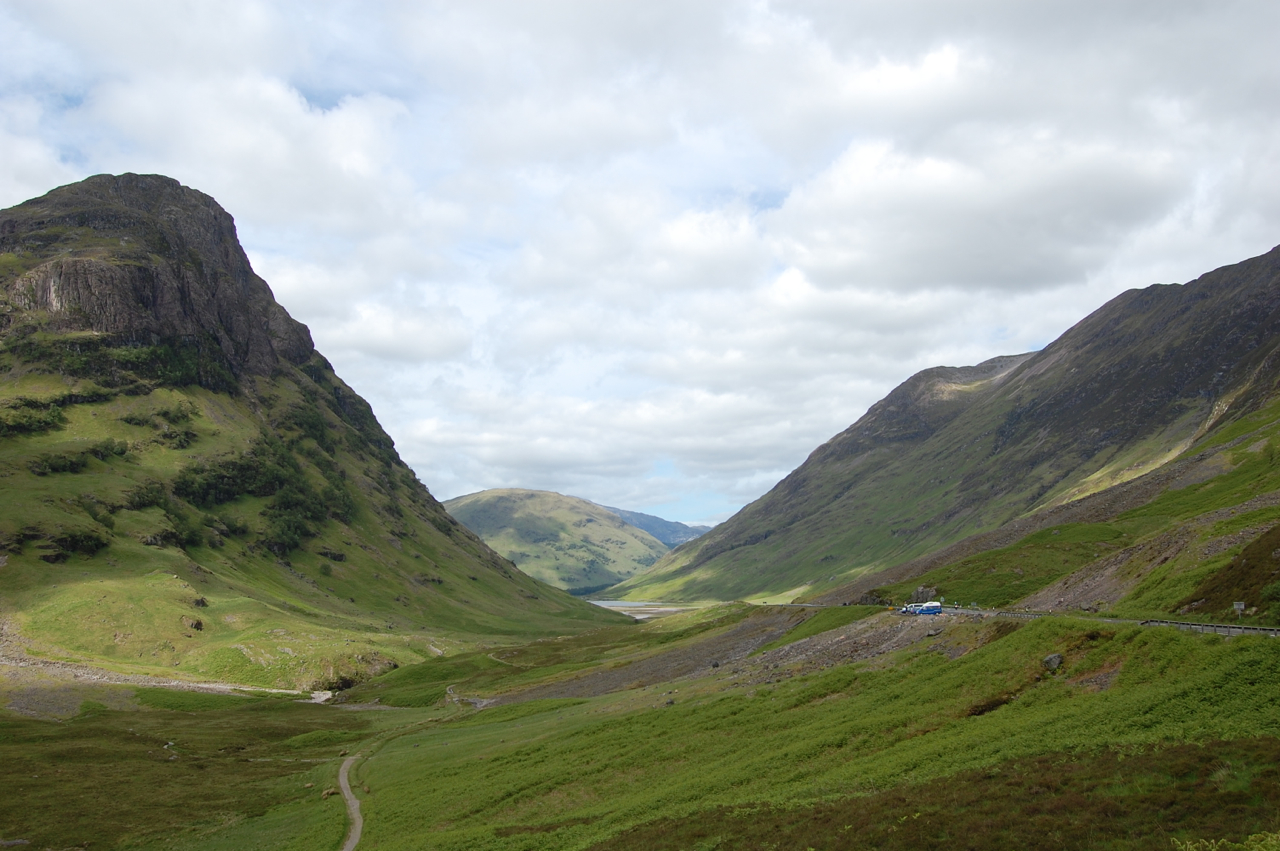
I’ve mentioned this Scottish trip to The Dish before. The first time you posted one of my emails was for Contest 157(tbd) when you also used one of our Glen Coe pictures.

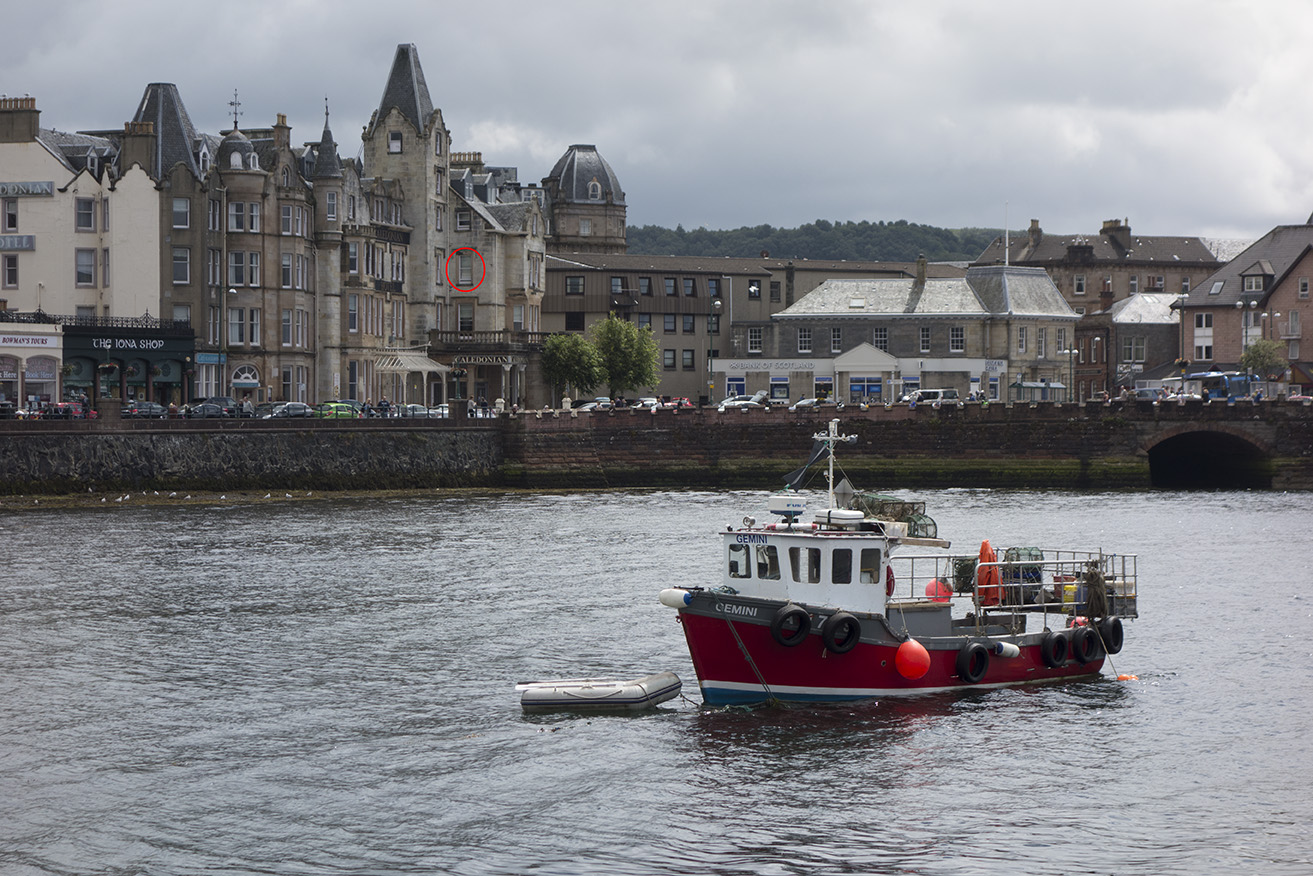
Anyway, back to the window. It is the third floor window over the balcony and labeled in the attached. The angle of the view, the details of the stonework around the window, and the newel post on the balcony below led me to the window.  For the room number, I’ll guess 215.

Old picture

Above is a picture I took several years ago from the B&B we stayed at looking back towards the harbour. Unfortunately, it is not a high enough resolution to label the contest window. For anyone trying to figure out that window, I believe it was room 6 of the Alltavona Guest House.

Another reader:

I recognized Oban Harbour immediately. It is one of those places I felt really “at home”. I did the tourist thing to visit Castle Sween, a castle where some of my MacMillin ancestors were sheriffs for the Campbells. I stayed in Oban/Fort William to explore the western coast. It was November, off season and wonderfully full of locals only.

Screenshot-imac- 2014-06-21 at 04.53.05 PM

Another:

I’ve only been to Oban once, as a child, and I remember nothing but the harbour being full of dead jellyfish. The city was, like my native Cardiff, the hereditary home of the Marquesses of Bute. The 3rd Marquess, who converted to Catholicism, furnished the Cathedral Church of St Columba in Oban, which can be seen in the window, and was originally clad in corrugated iron (known locally as the “Tin Cathedral”). I think my great-great-grandfather was one of his boy choristers.

Another learned some vocab:

This week’s contest taught me the difference between “piers” and “quays”! Specifically, piers are wooden and quays are stone. And more importantly, when you Google “red buildings on piers in the UK,” you get nothing relevant, while the same search for “quays” just might do the trick.

This husband-and-husband team learned about ships:

Rather than brute-force through a zillion possible cities in Google Earth, my husband chose instead to search for sailing ships, first using reference materials found online to identify the brown and tan vessel in mid-frame as a ketch. “There can’t be that many ketches in the world,” he said, but he ended up viewing hundreds of images before finding this one on ship-photographs.com:

MAYBE

Ship-photographs.com (another handy site for window hunters) identifies the ship as Maybe, a 26.13m Bermuda ketch built in 1929. This information led in turn to Maybe’s web site, where an itinerary can be found. I got tangled up in news stories about Maybe’s arrival in Whitehaven such as this one before looking at an earlier stop in Oban, Scotland.

A former winner saw the street markings and was reminded of a “corny old family joke”:

A tourist asks an Irishman what the yellow line on the side of the road means. “Ah, it means you can’t park there at all.” “So what does it mean when there’s a double yellow line?” “That means you can’t park there at all, at all.”

Another reader:

First, as a heavy scotch drinker:

D6D94C32-946F-49D3-8475-D2452FB32482

I thought this was going to be an easy one as there seemed to be tons of clues to go on – left-side driving, European license plate style (but also maybe Australian), distinctive seafood restaurant, some visible text (“community”), but it nonetheless took me a lot of hunting to track it down. I don’t know if that’s because it’s a hard contest this week, or if I was just unlucky or not very clever.

I finally managed to track down a photo of the EE-USK restaurant with the Google query “seafood restaurant pier scotland”, which found this photo showing the restaurant’s recognizable red dome:

210-image

How did I know to search Scotland? I didn’t. I tried “seafood restaurant pier england” and “seafood restaurant pier australia” and so on until I got lucky. The restaurant looks interesting. Its name is a phonetic spelling of “iasg”, Gaelic for “Fish”, which makes sense as they get their fish directly from the fishing vessels and can serve them fresher than pretty much anywhere else. A few hours from swimming in the sea to being served on a plate, as this YouTube video demonstrates: Ee-usk on “Town with Nicholas Crane”

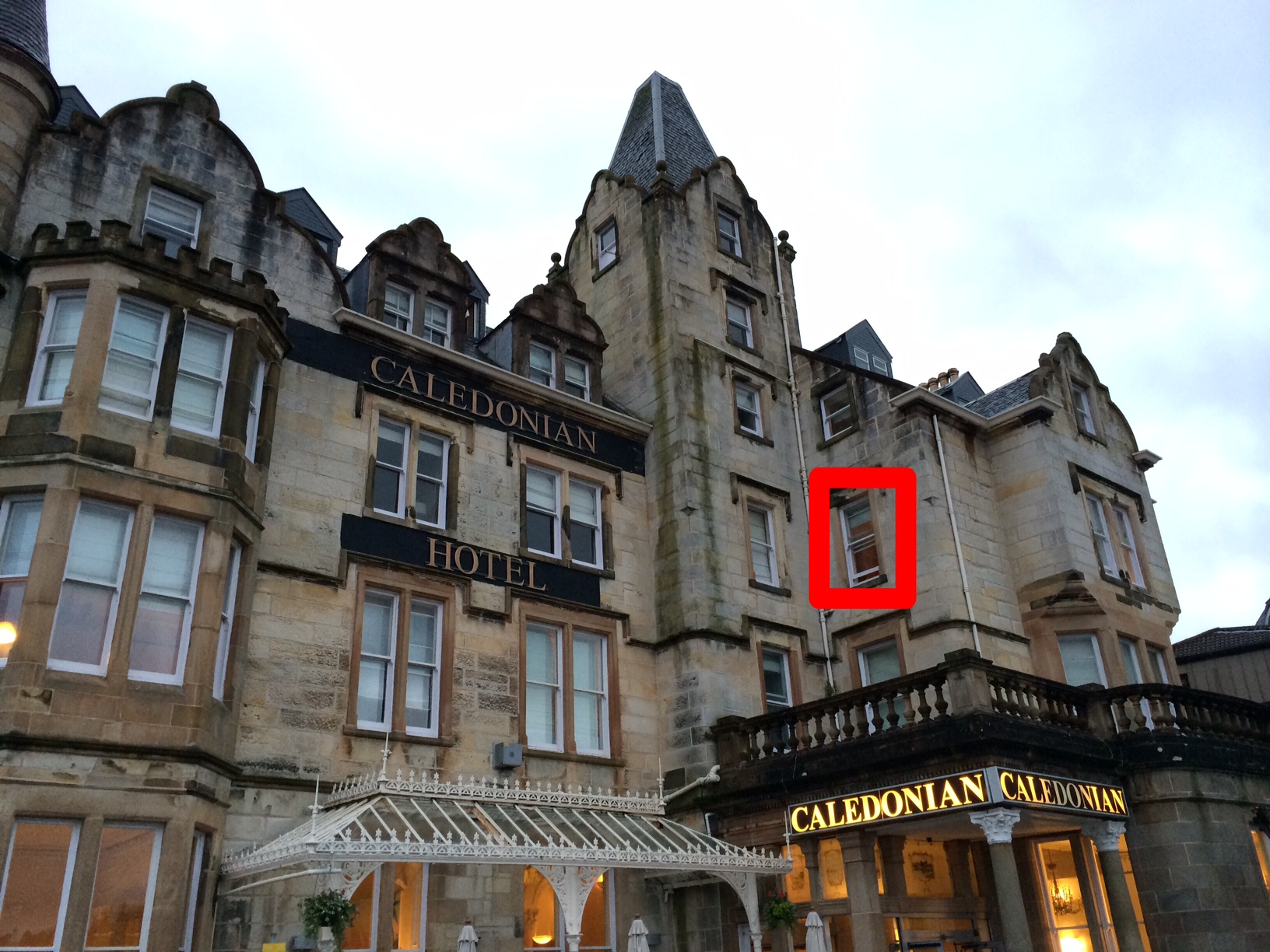
After locating the correct harbor, tracking the view to the Caledonian Hotel was not hard. By my calculations it could only have been taken from one window.
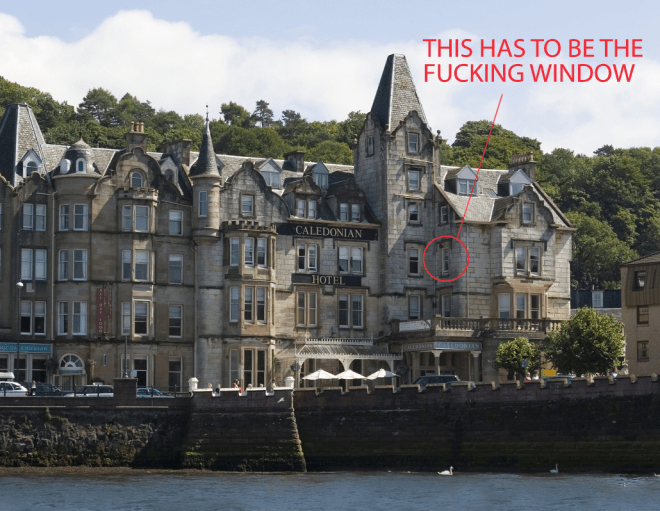
caledonian

My calculations are, however, sometimes wrong. Who knows what room number it is – I’ll take a wild guess at 222.

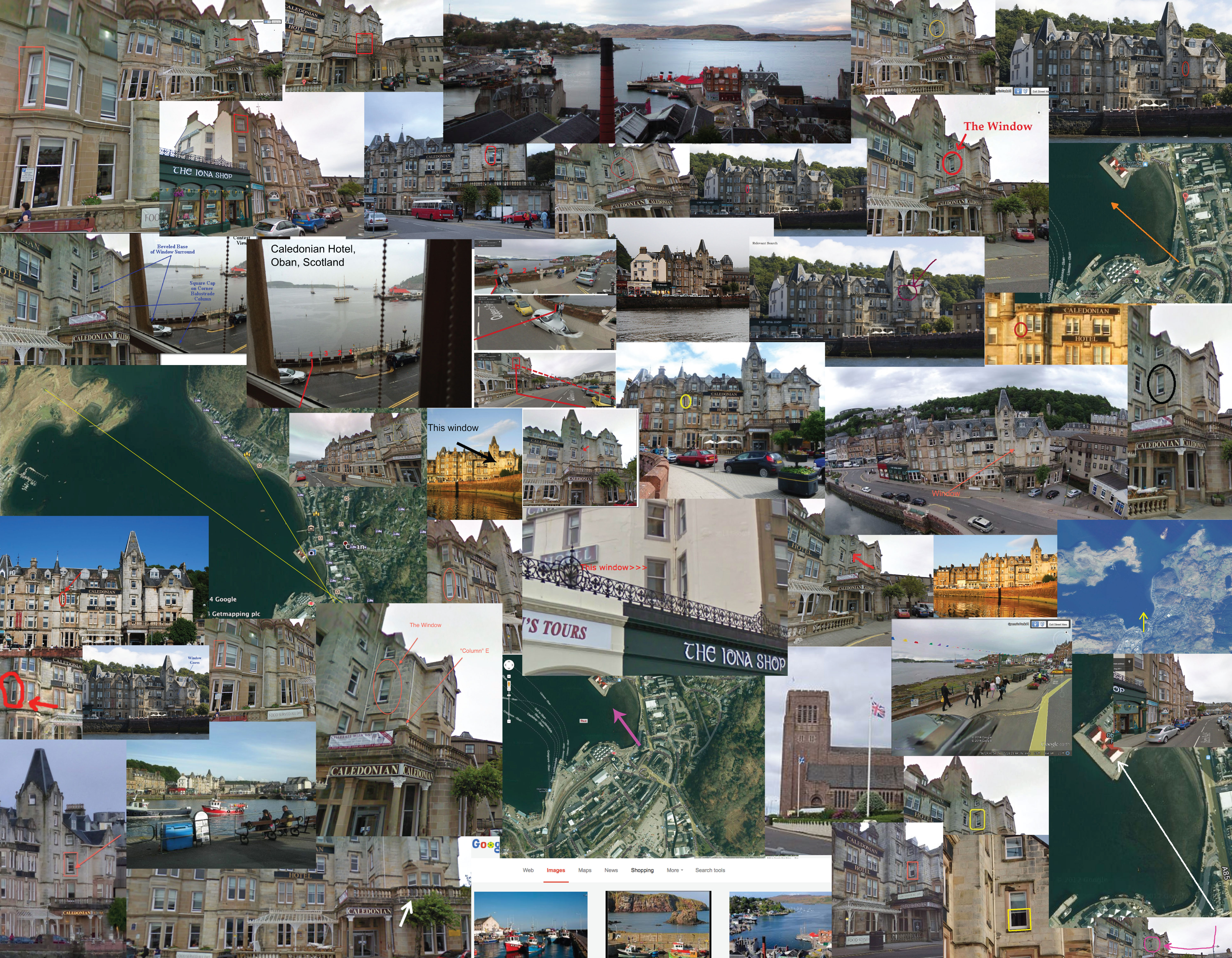
There were so many great entries this week, so see if you can find yours in our collage:

vfywc-210-guess-collage

This week’s winner is a three-year, 19-contest veteran from our esteemed list of players who have correctly guessed difficult views in the past without winning:

My first thought was British Columbia/Alaska, but then I noticed the yellow elongated license plate and figured it must be Scotland. I googled “tall ships Scotland”, found a couple companies offering holidays on tall and small ships, and started looking at the ports mentioned. Oban was the first place I checked out, and the red roof on the Ee-usk Seafood Restaurant on the North Pier made it clear that I had found the right location. Looking for the crenelated seawall and the area with the benches got me to the Caledonian Hotel.

oban-210

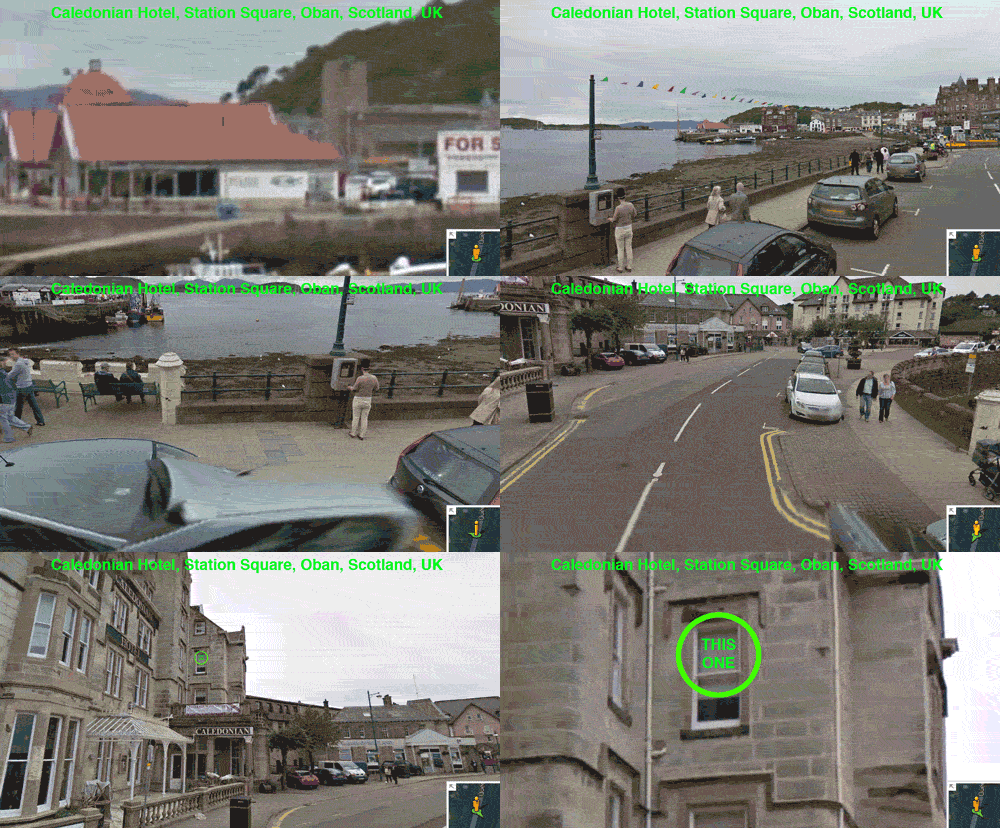
So far, so good. I’ve found the correct building any number of times, but I always lose it on the precise window locations – I’ve decided I have some hereditary problem judging sight lines and angles. After looking through every single customer photo of the Caledonia Hotel on Trip Advisor, I’m guessing the photograph was taken from room 204. I’m inserting a picture with a circle around the (I’m desperately hoping) correct window.

That’s exactly correct. From the photo’s submitter:

We’re terrible at playing VFYW, but we thought our current view would make an excellent submission for an upcoming contest.

image_1

We’re currently staying in room 204 of the Oban Caledonian Hotel in Oban, Scotland. Since their upcoming vote on separating from Britain has been in the news, we thought it would be timely too.

image_2

We snapped the photo upon our arrival this afternoon, being careful not to show any buildings that included “Oban” or other obvious words on them. We’re including Skitched photos from two angles in case someone identifies the window that way vs by room number. We thought it might be extra challenging to get the exact window because it looks out the side of the building rather than the front (which you can see by comparing the two angles.

By the way, this is our very first time on the UK, and we love it so far!

image_3

(Archive: Text|Gallery)

Quote For The Day II

“I repeat the firm condemnation of every form of torture and invite Christians to commit themselves to work together for its abolition and to support victims and their families. To torture persons is a mortal sin. A very grave sin,” – Pope Francis. One wonders whether George W. Bush will ever hear him.