The Scandal Of Cantor And Netanyahu

CANTORJimWatson:Getty

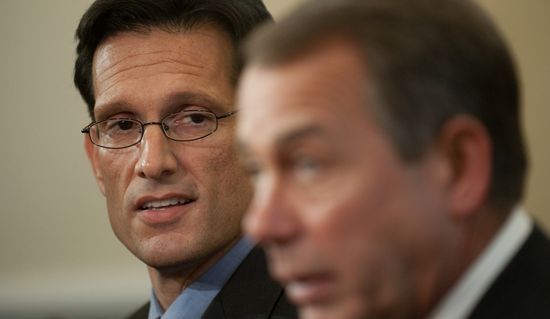
It is not the first time that this kind of direct attack on the president's ability to conduct foreign policy has occurred under this administration. John McCain and Joe Lieberman have gone abroad to assure Israel that they will undermine their own president to advance the interests of a foreign country in a critical diplomatic discussion with the US on that country's soil. But Eric Cantor has gone one further, openly bragging about something he once described as a felony. Kevin Drum Steve Benen:

This is a legitimate scandal worthy of far more attention. When dealing with foreign policy and climate change, Republicans believe in trying to deliberately sabotage the position of the U.S. government. The same is true of U.S. policy towards Iran, and in the case of New START, possibly even U.S. policy towards Russia. Now it's true of U.S. policy towards Israel, too.

It's obviously not unreasonable for Americans to debate whether the Obama administration is pursuing the correct course on foreign policy, and I fully expect members of Congress from both parties to demand accountability of the White House. People can and should speak out when they disagree with the administration's approach to Israel, Iran, Russia, or any other country.

But Cantor's move is something altogether different. Just a few years after he suggested it was literally criminal for an American official to talk to a foreign leader and work against the sitting president, Cantor has done just that.

Where's the outrage?

Where indeed?

(Photo: Jim Watson/Getty.)
Neat Freak Arachnids

Ed Yong recounts how the spider mite Stigmaeopsis longus gets a little OCD with the cleaning:

[H]ygiene is paramount. For example, the colony’s members all use a toilet at the entrance of the nest, never defecating inside. They’re also fastidious cleaners and Miki Kanazawa from Hokkaido University has found that they scrub using the same substance that they build their homes with: silk.

Slate: Senior Blogging Citizen

Nick Summers profiles Jake Weisberg, Slate’s chairman and editor in chief (and former fellow intern and editor at TNR and next door neighbor with yours truly). Summers tries to understand the head start the fourteen-year-old website had and where it finds itself now:

The site’s internal numbers show that page views for October were up just 6 percent, to 83.6 million, and unique visitors were down 21 percent — growing pains as the site weans itself from longtime traffic teat MSN.com and develops its own, more clicky readers. Over the same time period, Gawker has more than doubled its audience, and the Huffington Post has a global readership roughly three times as large. Through October, the Daily Beast racked up publicity with long, will-they-or-won’t-they talks of a merger with Newsweek. When media people talk about the future of publishing online, in other words, they don’t talk about the site with the 12-year-old CMS.

They do, though, talk about how awesome Slate is — editorially. The site’s daily fare — unhysterical political analysis, Farhad Manjoo on iPhone stuff, the impish Explainer column, Doonesbury, TV dissections, Jack Shafer’s bile — is consistently smart, even if none of it seems remotely Webby. 

Josh Green, meanwhile, celebrates TPM’s tenth anniversary here.

To Doubt With Conviction, Ctd

A reader writes:

Your discussion of doubt and America can't sensibly omit C.S. Peirce, the founder of pragmatism, who described himself as a fallibilist, and indeed, as a defender of contrite fallibilism. (He extended this even to mathematics.) Money quote:

"For years [—] I used for myself to collect my ideas under the designationfallibilism; and indeed the first step toward finding out is to acknowledge you do not satisfactorily know already; so that no blight can so surely arrest all intellectual growth as the blight of cocksureness; and ninety-nine out of every hundred good heads are reduced to impotence by that malady — of whose inroads they are most strangely unaware. Indeed, out of a contrite fallibilism, combined with a high faith in the reality of knowledge, and an intense desire to find things out, all my philosophy has always seemed to me to grow. . . ." (A Fragment, CP 1.13-14, c. 1897)


The View From Your Window Contest

Vfyw-contest_11-13

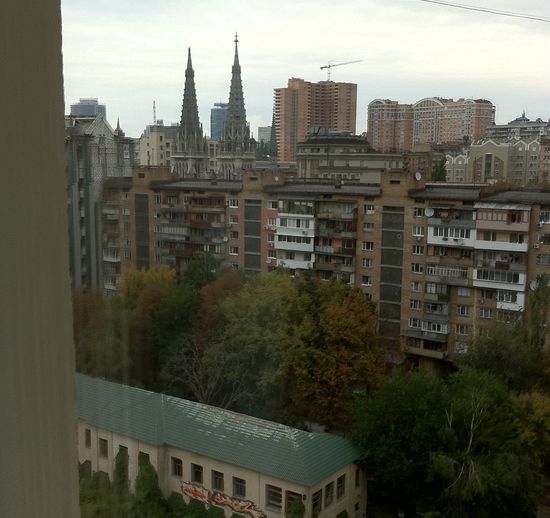
You have until noon on Tuesday to guess it. City and/or state first, then country. Please put the location in the subject heading, along with any description within the email. If no one guesses the exact location, proximity counts.  Be sure to email entries to VFYWcontest@theatlantic.com. Winner gets a free The View From Your Window book, courtesy of Blurb. Have at it.

The Power Of Free

Dan Ariely interviews customers at a nightclub lining up for "free tattoos." He concludes:

When we face a decision about a tattoo, one would hope that the long term permanency of the decision, coupled with the risks of getting different types of infections would cause people to pay little attention to price, and certainly not to be swayed one way or another by the power of free.  But sadly, the reality (at least in the nightclub scene in New York) suggests that the power of free can get us to make many foolish decisions.

A Qualified Defense Of Journalistic Objectivity

Jay Rosen offers it:

…if objectivity means trying to ground truth claims in verifiable facts, I am definitely for that. If it means there’s a “hard” reality out there that exists beyond any of our descriptions of it, I agree. If objectivity is the requirement to acknowledge what is, regardless of whether we want it to be that way, then I want journalists who can be objective in that sense. Don’t you?

If it means trying to see things in that fuller perspective Thomas Nagel talked about–pulling the camera back, revealing our previous position as only one of many–I would second that motion. If it means the struggle to get beyond the limited perspective that our experience and upbringing afford us… yeah, we need more of that, not less. I think there is value in acts of description that do not attempt to say whether the thing described is good or bad. Is that objectivity? If so, I’m all for it, and I do that myself sometimes. The View from Nowhere is my attempt to isolate the element in objectivity that we don’t need, and give a name to it.

Turning The Sky Black

Mark de Silva interviewed Guy Deutscher about his new book Through the Language Glass. De Silva ask what is "the best explanation for Homer’s describing honey as green, oxen as wine-colored, and iron as violet?" He follows up by asking why "the natives of Murray Island call the sky black." Deutscher's anwer:

Well, as for the first question, I can’t explain it better than William Ewart Gladstone did one hundred and fifty years ago: “Colours were for Homer not facts but images: his words describing them are figurative words, borrowed from natural objects. There was no fixed terminology of colour; and it lay with the genius of each true poet to choose a vocabulary for himself.” For Homer, the word that ended up meaning "green" meant something like "fresh" or "pale," and could be applied with perfect sense to fresh and pale looking things of both green and yellow hue.

The distinction in hue between yellow and green was not one that seemed very important in his day. Similarly, in many cultures "blue" is just considered a particular shade of black, and finding a particular name for this particular shade is not a very pressing matter, especially as blue material objects (as opposed to the vast nothingness of sky or even the sea) are extremely rare in nature. So it makes perfect sense, if some nagging anthropologist comes to question you about the color of the sky, to use the nearest color on your palette, and say "black."


A Mirror With A Memory

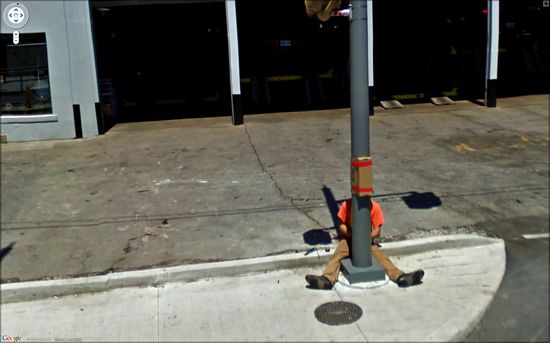
Google_Street_Views

Joanne McNeil waxes poetic on Jon Rafman’s project “Free,” which compiles evocative Google Street Views:

The slightly faded, sometimes blurry look of Google Street View appears without any time signifiers. No time stamps or indication as to what day the cars drove out. Paradoxically, the capacity to capture cities this way is a product of modern technology, but the degraded picture quality looks to come from a digital camera with so low a megapixel range it is no longer sold in stores. The blurred faces only amplify this confusion.

Rafman’s collection is here and his take is here. His tumblr, from where the above picture is drawn, is here

Green Means Go

Richard Eskow ponders a world in which we could pay to turn a red light green:

What if I'm in a hurry and want to pay, but the same is true for the guy approaching in the other direction? Will it be a competitive bidding process?  Then costs could vary dramatically depending on the wealth of the parties.  Since my regular driving route takes me through downtown Beverly Hills, I'd probably lose most of my bids, causing my driving time to go up.