The Market For Foreskins, Ctd

A reader writes:

I know circumcision has been a topic of particular interest and passion for you.  When I saw your latest post, and the incredulity therein, I had to reply.  About two years ago I had foot surgery to remove a juvenile bunion from my foot.

Long story short, my recovery was complicated – I have an auto-immune disorder and I was the one-in-thousands that rejected a tendon graft – and I had an open wound on my foot which would not close on its own.  I was even hooked up to a medical vacuum for several weeks in an attempt to close the wound. 

The thing that finally did it?  A skin graft made from foreskin cells.  As I recall, my doctor informed me that one foreskin could produce over a football field size of these kinds of grafts. But I concede that the face cream is silly.

The GOP’s Lame Horses

Drum sizes up the presidential field:

So to summarize: we've got Romney, who's the obvious frontrunner but also a transparent panderer who has some serious problems with the Republican base (RomneyCare, he's Mormon); a couple of decent but faceless midwesterners; [Haley Barbour] a smart tactician who unfortunately resembles Boss Hogg far too much to be electable; and three bomb throwing social conservatives. I guess somebody has to win the nomination, but it's sure hard to see it being any of these folks (though I know plenty of people disagree with me about Palin's electability).

Frum cheers Romney's early lead:

[T]he interesting background to the poll is the structure of Romney preference: While Palin, Gingrich, and Huckabee divide the votes of conservatives (with further competition perhaps to come from other entrants to the race), Romney holds a big and uncontested lead among party moderates.

Yes, they exist. And it turns out: they matter.

This Zogby poll, which shows New Jersey Gov. Chris Christie (!) in the lead, demonstrates just how flimsy these early polls are. John Zogby's understanding of the result:

Support for Christie shows that some Republican voters may be looking for a new face and believe that neither Palin nor Romney can defeat Barack Obama.

Drop Everything: The Simpson-Bowles Reax

Draftreport

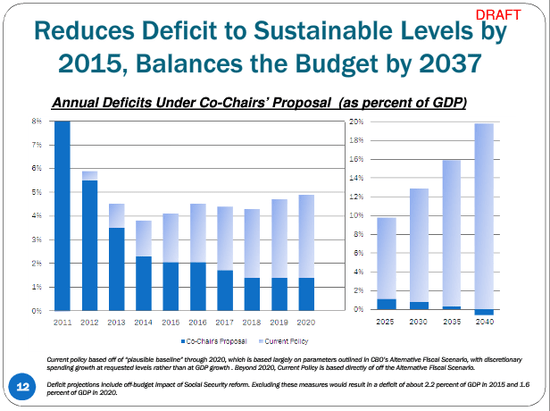
My take (and that of a fiscally conservative mouse) below. The basics:

Their recommendations are more or less a list of the third-rail issues of American politics, including cuts in the number of federal workers; increasing the costs of participating in veterans and military health care systems; increasing the age of Social Security eligibility; and major cuts in defense and foreign policy spending. They also encompass a range of tax system reforms that have been floated by many in Washington for years to little effect, including funding tax rates reductions by eliminating many beloved credits and deductions.

Yay! David Kurtz gives important context:

The commission's final recommendations aren't due until December 1. The commission can basically recommend whatever it wants, but if 14 of the 18 commissioners agree with the recommendations, then Congress has agreed to take them up. So that's basically the key charge of the commission co-chairs: create enough of a consensus plan that 14 commissioners can support it. Without that, the recommendations become just another report gathering dust on a shelf.

So today Bowles and Simpson unveiled their proposal to the commission in a closed meeting. To paraphrase, the reactions of commissioners leaving the meeting ranged from 'over my dead body' to 'like hell we are.' … it appears that the co-chairs are laying down their markers to get the ball rolling on negotiating among the commissioners a series of final recommendations that will achieve a consensus. The commission has been at work now for months, but the real work will be over the next 3 weeks as they try to hammer out some kind of agreement amongst themselves. This appears to be the opening salvo in that effort.

Tyler Cowen:

Mankiw is happy, Krugman and DeLong are upset.  The home mortgage interest deduction goes and income tax rates are 8, 14, and 23 percent.  No one thinks this is the final deal.  I would say evaluate this as you would a movie trailer: will it get people to take the next step of thinking about a ticket purchase? … As a movie preview I judge this as "good enough."  It basically declares that some major deductions have to be on the table and it gets us to the next step.

Ezra Klein:

The co-chairmen have some interesting policy ideas for how to balance the budget, but as of yet, they've not made any discernible progress on the political deadlock preventing us from balancing the budget. And it's the deadlock, not the policy questions, that they were asked to solve.

Yes and no. This draft proposal is part of solving the political problem – and pushing these concrete proposals onto the laps of the public, the administration and the GOP is a great start.

Kate Pickert:

Perhaps the most significant recommendation – and one that health care economists have been making for decades – is a strict cap on the amount of employer-provided health insurance expenses that are tax deductible. The ACA sets an extremely high cap that won't kick in until 2018. The proposal from the debt commission goes much further, recommending that health insurance tax exclusion be capped at the actuarial value of the standard option available to government workers in the Federal Employee Health Benefit Plan.

Jonathan Cohn:

The idea I like is to revisit the tax break for home interest mortgage payments–a tax break that is as misguided as it is large. It gives bigger tax reductions to people with more expensive homes. And it skews government resources away from renters, who, on the whole, need more help than homeowners anyway. It's part of a strategy for tax simplification, a goal that responsible members of both parties can embrace.

The idea I don't like? It's actually a number: 21. The two chairmen recommend that, over the long term, the federal government limit both taxes and expenditures to 21 percent of the gross domestic product. I don't know what makes 21 percent a magic number. I do know that taxes and government spending reach 50 percent in Scandinavian countries. Their economies have not suffered, while their societies are more equal and their citizens have more economic security.

Of course, I love the idea of restraining government to one fifth of the economy. The question will be: why would the Tea Party oppose this? Calculated Risk:

I doubt the mortgage interest deduction will be eliminated, but maybe it could be reduced over time. Same with the exemption for health benefits. I'd prefer if they left Social Security out of this proposal completely, and just addressed the General Fund deficit. Then, after reaching agreement on the General Fund deficit reduction, they could return to Social Security in the future.

Reihan Salam:

It’s worth noting that the co-chairs’ proposal actually goes beyond achieving primary fiscal balance by 2015, and that the plan is focused on spending. The action on the revenue side comes from deep cuts to tax expenditures.

Spencer Ackerman:

The commission’s co-chairmen, former GOP Senator Alan Simpson and Clinton White House Chief of Staff Erskine Bowles, go much further than Defense Secretary Robert Gates in cutting the defense budget. Gates wants to trim out $100 billion in overhead and administrative costs over five years and put that cash back into shipbuilding, gun-buying and plane-purchasing.

But the two chairman, who released their non-binding plan this afternoon, want to put that money “to deficit reduction instead,” with an annual savings of $28 billion. And there’s much more on the chopping block: their plan calls for reducing $100 billion from the Defense Department’s non-war budget, a little less than 20 percent. War-related expenses aren’t touched.

But we get a proposal to cut a third of the forces stationed in Europe. Doug Mataconis:

Already, the knives are out on both sides of the political aisle. Jane Hamsher at FireDogLake has been calling the Debt Commission the “Cat Food Commission” for months now, while conservatives have been berating co-chairman, and long-time conservative Republican, Alan Simpson’s membership on the Commission as being a surrender on tax increases.

If we lived in a country with adult political parties, the release of the Commission’s report would serve as the beginning of a long overdue national conversation about how to get our fiscal house in order. Liberals would recognize that social spending would have to be cut, and conservatives would recognize that defense spending cuts and tax increases would have to be on the table. Instead, what we’re likely to see is more of the same political gamesmanship — liberals accusing the GOP of wanting to starve Grandma, conservatives accusing liberals of just wanting to raise taxes so they can spend more. And the debt will continue to rise.

Not if more and more people get behind the proposals. And by people, I mean the tea-partiers. Are you anti-debt or anti-Obama? We shall soon find out.

Drop Everything: The Simpson-Bowles Breakthrough

I've quickly scanned the Simpson-Bowles draft proposal and find it extremely encouraging. It really does hit what the Dish regards as key themes for a new fiscal order: 1986-style tax reform (largely removing deductions and lowering rates); serious defense retrenchment; focusing social security on the truly needy and raising the retirement age; hard cost-controls in Medicare; a real populist attack on government waste.

It reads like the manifesto the Tea Party never published. Every detail needs thinking through and debate. Much of it is way over my head in terms of the specifics of government programs and the ability to cut them. But the core proposal is honest, real, and vital. I recommend you download and read both documents.

If I were the president, I would embrace this and urge passage of these proposals as the key domestic objective of his next two years in office. If I were the GOP, intent not on politics but on restraining spending and the debt, I would make this a joint endeavor. If I were the Tea Party, I would leap at this as a way past the old two parties toward fiscal sanity.

I am merely a blogger. But the Dish will follow this debate with all the passion that true fiscal conservatives can muster. And, no, that's not ironic. The debt is not a boring issue. It's a profound moral issue – and our current profligacy and partisanship is a disgraceful breach of a core social contract between this generation and the next ones. This matters. And it could be one of Obama's core legacies, if he seizes this opportunity and makes it his simple unifying message for the next two years: ending long-term debt now.

The al-Awlaki Lawsuit

Adam Serwer explains what's at stake:

This point is key, and I think it's been lost in the noise — the ACLU/CCR lawsuit doesn't seek to prevent al-Awlaki's killing as a last resort in the event that he poses an imminent danger to Americans, merely ensure that he only be killed under those circumstances. It is also trying to force the government to disclose the criteria under which American citizens are added to its reported "kill list." The government, responding to this claim, argues that the ACLU/CCR lawsuit relies on speculation that those criteria aren't actually being followed.

Iowa vs Washington

In Iowa, three judges who upheld marriage equality were thrown out; in Washington state, a judge who was the key vote in denying marriage equality is in deep electoral trouble, and in a very tight race, looks like the loser:

Justice Sanders's gay marriage ruling wasn't the only issue in this race, of course. But it was a big issue here in liberal, gay-friendly King County, where more than 58-percent of voters have backed [opponent, Charlie] Wiggins in returns so far. If not for the large pro-Wiggins margin in King County, Justice Sanders, who at present is down by just 3,603 votes, would be headed for six more years on the high court.

Israel To US: Drop Dead (Round II)

Marc Tracy notices the uncanny parallels between now and March:

Biden visit; housing announcement; U.S. pushback. In March, Prime Minister Netanyahu retorted with the defiant declaration: “Jerusalem is not a settlement”; yesterday, Prime Minister Netanyahu retorted with the defiant declaration: … I’ll just let you guess.

There is an aggressive assumption by Netanyahu that all of Jerusalem is unequivocally Israel's, which all but rules out any viable two-state solution (as, one suspects, it is designed to). But instead of resisting this, a classic AJE member, Aaron David Miller, emits this contemptuous remark:

“Building in Jerusalem is as natural as breathing.”

Really? For whom? For those Palestinians who are evicted or see their neighborhoods transformed by a government obviously intent on ethnic social engineering in occupied lands? East Jerusalem, in any case, is not the real obstacle, since Israel's government just permitted a thousand new homes in Ariel, way past the green lines in the West Bank, sabotaging any chance of negotiations, and all but telling the US (and the rest of the world) to go pull a Cheney. The next step will be Netanyahu's meeting with secretary of state Clinton tomorrow.

I remain of the view that Netanyahu believes

he can wait out Obama and get a Republican US president prepared to enable Israel in its doomed occupation (past the point of no return) and eager to bomb Iran as some kind of global power-move.

The mid-terms will only have reinforced that presumption. For that reason, I think it's clear that talks will fail because the Israelis and their supporters have no desire to see them succeed, and now also believe that the US needs them more than they need the US. The response to this should be at some point soon to end the attempt to get both sides to agree, establish the partition that the US believes is the best solution, and move to the UN, bypassing Israel altogether. When you see the much broader and wider challenges to US global power, and the albatross that Israel's occupation places on America's ability to pursue its legitimate interests elsewhere (even Indonesia regards a two-state solution as the core evidence of the US's genuineness in reaching out to the moderate Muslim world), you realize what a burden the Israel alliance is placing on the US.

Attacking DOMA, Again, And Again, And Again

Ari Ezra Waldman notices two more new lawsuits:

This is the latest salvo in a plan that is being executed on multiple fronts. There have been state challenges to state bans on same-sex marriage (e.g., Varnum v. Brien in Iowa and Kerrigan v. Commissioner of Public Health in Connecticut). There are federal challenges to state bans on same-sex marriage (e.g., Perry v. Schwarzenegger, the Prop 8 case) … There are federal challenges to DOMA Section 3 from states (e.g., Massachusetts v. Department of Health and Human Services filed by the much maligned politician, but highly capable Mass. Attorney General Martha Coakley). And, there are individual as-applied challenges to DOMA Section 3, which has the effect of denying federal benefits to gay individuals legally married in those states that have marriage equality. … [T]hese two new cases, Pedersen v. Office of Personnel Management and the ACLU's case on behalf of Edith Windsor, are two more steps with a strong likelihood of success.

Waldman outlines each new case. As the federal Congress now has one branch dominated by Republicans, the chances for any legislation that advances gay equality, or rather reverses federal laws that explicitly make same-sex couples and gay people unequal and stigmatized, the arena for action will increasingly be in the courts. Legislative middle grounds – such as the "civil unions" of many other Western countries – remain impossible because of polarization, and because the Democrats do not have the will even to enact changes that command over 70 percent support in the general public.