Wasilla is a small place, family connections can go back a long way, and BFFs remain BFFs. Bristol's BFF's brother, Jeremy Morlock, is profiled here and here.
Author: Andrew Sullivan
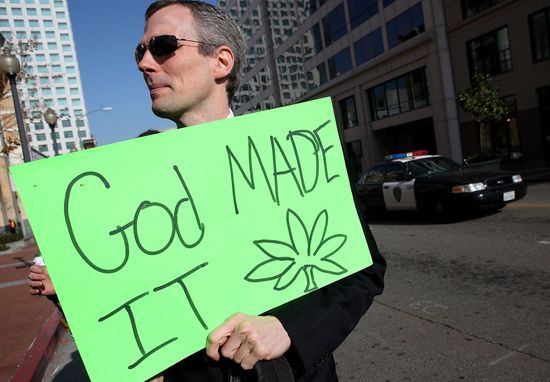
“God Made It”
A reader writes:
In defending the legalization of pot, you rely very heavily on an appeal to nature: "My view – regardless of the arguments back and forth about the effects of marijuana – is simply that it is absurd for any government to prevent people from growing a naturally-occurring plant that requires no processing to provide humans with pleasure."
What does it matter whether or not marijuana is naturally-occurring?
It seems to me that what matters here is the drug's effect on individuals and society, not the purely accidental fact that the drug happens to come from a plant. If marijuana were made in a factory, would you be less in favor of its legalization? Suppose a method was discovered for efficiently producing THC in a lab – should this "synthetic pot" be any less legal than the grows-in-the-ground variety? Why? Or suppose that crack cocaine grew straight out of the ground – would this count as a reason to favor its legality? Or suppose a hypothetical plant that caused people to punch other people in the face. Would the fact that it's naturally occurring make you any more or less inclined to outlaw this plant?
My point, of course, is that the controlling issues in any drug debate are the pleasures and harms caused by the drug – not where the drug originates or how it's produced.
Another writes:
While I support the legalization of MJ, I wonder if you also think this applies to coca plants and opium poppies. You can chew the leaves of coca plants directly for a buzz – should that be legal to grow? Opium poppies need processing to produce opiates. Does it make sense to legalize them and simply make the processing of them illegal?
The case for legalization rests on much firmer ground than the fact that this substance grows naturally. But I do find it interesting when a government tries to ban a resilient, naturally occurring weed that can grow in gardens – just because it can provide pleasure to human beings. And the fact that we have to come up with weird analogies – a plant that caused people to punch others in the face! – reinforces this point. And we do not ban poppies in America, even though some could be processed for opium. We do not ban poisonous mushrooms. We do not ban poison ivy, or inflict legal penalties for those who have it in their yards. I don't know of many crops, like hemp, that are also banned, even though their uses are manifold and were once integral to the US economy.
And yes, I do think that banning certain industrial or chemical procedures that try to turn naturally occurring substances into something more potent is the same thing as banning nature itself. There's something poetic about government's absurd over-reach when it reaches down to the very earth and declares itself master.
(Photo by Justin Sullivan/Getty Images)
The Olbermann Soft Shoe Shuffle
Will Wilkinson excoriates MSNBC:
I know it’s in the interests of big media to pretend money in politics is a huge problem while passing off its own outrageously unequal influence as some kind of noble public service, but who does MSNBC think it’s kidding? Say what you will about Fox News, at least it doesn’t insult our intelligence in this way.
Will will get his wish. Olbermann will be back tomorrow. Doug Mataconis reacts:
The length of the “suspension” leads credence to the theory that the whole thing was a publicity stunt designed to support MSNBC’s assertion that its opinion shows are somehow more pure than the shows on FOX.
It’s never that clever. This was almost certainly a clusterfuck, and an attempt by the boss to exercize public control over a star. The control lasted a few days.
Palin Edits Her Own Reality Show
Yep, Discovery Channel has apparently delegated that function to the whackjob from Wasilla (unless that's another odd lie). Then the continued use of children for political and/or propaganda purposes:
The ostensible premise for the show is to allow Palin to act as tour guide for Alaska, but the real product here is of course the 2008 vice presidential candidate turned Fox News pundit herself. Toward that end she and husband Todd use their kids as props, even staging a cute little scene in which teenage daughter Willow tries sneaking a boy upstairs — without, notably, any reference to how that scenario turned out for Bristol.
And the use of the first episode to smear a journalist as a pedophile. Because he just might have a chance of glimpsing the truth behind the propaganda.
Really?
The quintessential Politico piece, with this page-view-begging lede:
[Obama]’s isolated himself from virtually every group that matters in American politics.
And core indictments of the Obama presidency like this one:
In June, during an East Room reception for top supporters at Ford’s Theatre, several of the attendees were disappointed that they didn’t get to shake the president’s hand and take a photo, as they had in the past. Instead, Obama greeted a few people down front, reaching over a rope line.
And this lovely defense of lobbyists:
While the lobbying community is usually covered by the media like a crime beat, most lobbyists are policy experts who often provide input on commissions and other advisory boards. So lobbyists argue that the White House shunning has cost the president valuable advice, political intelligence and institutional backup.
Look: there is a critique of Obama's presidency thus far, in terms of losing a core narrative. But this blizzard of petty Village resentments a real story? Josh is right. Blech.
A Gay Institution
Mark Vernon, who is in a British civil partnership (CP) himself, argues for keeping CPs gay-only:
[N]ow that we have an institution that affords us the same legal protections as marriage, my sense is that we should allow CPs time to take shape as a gay institution – to toy with the historical and cultural specificities faced by lesbian and gay relationships, and not faced by straight ones… It takes time for institutions to grow the wisdom, as it were, that is good for people. What clearly doesn't help is the over-use of the blunt instrument of equality. It becomes the hammer that sees every issue as a nail.
It's a language that has, in recent times, served gay people well. But now that we have an institution that affords us the same legal protections as marriage, my sense is that we should allow CPs time to take shape as a gay institution – to toy with the historical and cultural specificities faced by lesbian and gay relationships, and not faced by straight ones.
I do not doubt that gay marriages and lesbian civil marriages have very different dynamics than many civil straight marriages. But the range of experience within straight marriages – from open to strictly monogamous, from arranged marriages to consecutive ones, from working mothers and stay-at-home fathers to classic patriarchy – seems to me to make the difference between all these and gay marriage much less impressive. A lesbian couple with kids, for example, seems to me to have more in common with a straight couple with kids, than with a post-boomer, career-driven straight couple with no intention of having children or a male-male partnership based on mutual support, emotional stability and a dog.
And my real point here is that I think we should try not to balkanize society excessively.
If we can bring more people into the same civil institution, we reduce the divisions of identity politics, advance the notion of citizenship and humanity that trumps sexual orientation, and bring gay people into their own families and traditions. This is far preferable in my view to carving out a separate and equal ghettoized institution where gays are required to sequester themselves from their married heterosexual siblings and peer, where their gayness and not their humanity is the most salient fact about them.
Which helps reinforce one conservative case for marriage equality: it is opposed to identity politics. And it is a tragedy that so many conservatives who would otherwise oppose identity politics cannot see this.
Obama On 60 Minutes
"Liberal Reagan" my ass: Andrew Sprung blows his top.
Garry Wills was right. Obama's default mode is "endless placation." When it doesn't work, he keeps doing it.
Draft Mitch! Ctd
A reader writes:
Mitch Daniels is 5'7'', not 5'3'', according to the New York Times (which I'd dare say is a better source than a braindead right-wing commenter).
Quote For The Day
"Will discuss Fed's quantitative easing plan(print $ out of thin air)tmrrw@ tools trade assn speech;then edit addl "Sarah Palin's AK"episodes," – Sarah Palin, over Twitter.
The Future Of Pot, Ctd
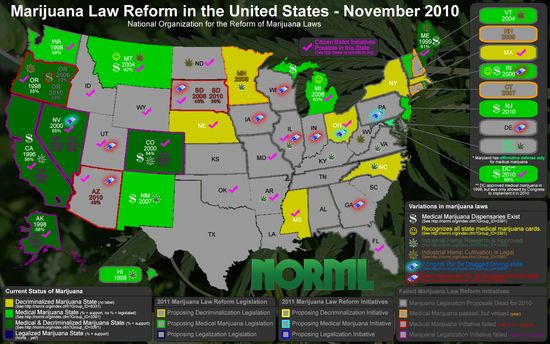
NORML has updated its cannabis map with 2010 election results (click to enlarge):
Ilya Somin defends his position on pot politics:
Megan McArdle and Tyler Cowen emphasize the role of parents in opposing marijuana legalization. It is indeed true that parents are more likely to be against legalization than others. But as Bryan Caplan points out, the impact of parenthood is minor compared to that of other factors such as ideology, gender, and religion. Moreover, parents, like other groups, have become less opposed to legalization over time. Today’s parents are more likely to oppose legalization than today’s childless adults. But they are still more supportive than the parents of 10, 20, or 30 years ago. On balance, therefore, I think the trend towards greater support for marijuana legalization will continue, which cuts against Tyler’s theory that Prop 19 was the “high-water mark” for the legalization cause.
 The Dish