Hallmark Christianity

Scott Nehring rails against the saccharine state of "Christian films" today:

The term Christian film has become synonymous with substandard production values, stilted dialogue and childish plots. Why is Christian film no more than a side note to modern culture? Why are Christians left behind?…

Rather than developing organically, the average Christian film is more pushy and sanctimonious than the global-warming agenda movies. Violence is almost non-existent, salty language never happens, unmarried people never struggle with lust and evil is never very bad, because showing various forms of sin is not allowed. By movie’s end, everyone is converted with no residual issues. Life is reduced to an after-school special with prayer thrown in for good measure. For me, this is where the dry heaving begins. …

It is a tough argument to think modern Christians cannot handle a simple kiss or rough language when God allowed Joshua to slaughter thousands behind the walls of Jericho. .. Christian artists cater to us, give us what we want, what we prefer, and Christians’ expectations have tended to not stress biblical truth, moral clarity or technical achievement, but a watered-down, unrealistic view of the world.

When faith is a kind of neurosis to protect us from modern reality – which a lot of fundamentalism is – its cultural artefacts have to create an alternative reality as well. So we get Hallmark Christianity – that'll make you richer and happier! Nehring understands what the problem is:

the first step toward establishing the groundwork for a vibrant, relevant cultural movement based on scriptural thought is to stop producing “Christian films” or “Christian music” or “Christian art” and simply have Christ-followers who create great Art.
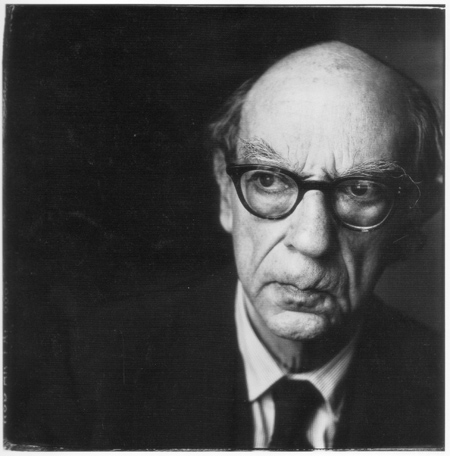

The Face Of Philosophy

ThePhilosophers

Steve Pyke has photographed more than 200 philosophers over the last 20 years:

Most philosophers have spent their entire lives in intense concentration, developing and defending lines of argument that can withstand the fearsome critical scrutiny of their peers. Perhaps this leaves some mark on their faces; to that I leave others to judge.

His NYT gallery is here. His older personal website galleries are here and here.

(Image of Sir Isaiah Berlin, London, 14 June 1990 )

Failures We Need

Actor Rainn Wilson, who plays Dwight Schrute on The Office, gives an interesting if almost combative interview to NY Mag's Grady Hendrix on the roots of his faith, his new book Soul Pancake, and how having a movie bomb in the box office can enhance that faith:

I'm so glad The Rocker bombed, because it taught me one of life's big lessons: You can't control the results. You just have to take care of your work. Your life is a gift and you have to make it your own. I don't know any other way to sum it up that doesn't sound completely corny. I learned that lesson, and I learned it by being in one of the biggest box-office flops in Hollywood history.

A Message With Teeth

Jose Molla tells of recently getting bitten by a shark:

Seeing a fin in the water is not nearly as alarming as not seeing that we spend our lives worrying about what’s irrelevant. I’m convinced that the shark didn’t come to take a piece of me but instead to leave me with something. A kind of wisdom that I will never ever forget, written with eighty stitches and my own blood.

(Hat tip: Brian Morrissey)

What’s In A Shirt

Paula Marantz Cohen contemplates the classic men's collared shirt:

As originally designed, the collar was detachable, like the tie. One could speculate on why this was and why it changed. Perhaps the 19th-century man only needed to give emphasis to his head in public settings; at home, he could disregard this part of his anatomy, either because he deferred to his wife’s judgment or, contrarily, because brute force could serve him in lieu of brain power. Whatever the reason, in the 20th century, the collar ceased to be detachable. Public and private became less differentiated.

The Opposite Of Red Bull

Noreen Malone becomes a guinea pig for "relaxation beverages":

I've racked my brain fruitlessly trying to think of a brand name that is more smarmily of our era than iChill, which conjures Steve Jobs and Jack Johnson hanging out on some Jersey beach together. I ended up taking iChill twice under more prosaic circumstances, once in the afternoon after a box of it arrived for me in my office and my cubicle-mates peer-pressured me into sampling it, and again before bedtime to "unwind from the grind," per its slogan.

Downing a shot of something stiffer would have been less debilitating to my work than that afternoon iChill; within an hour, I was utterly drained and ineffective. Coffee did nothing—it couldn't wake me up, or counteract iChill's disgusting "blissful berry flavor". At night, on the other hand, iChill had no discernible effect.

Perhaps that makes sense: iChill contains a whopping 5 mg of melatonin, hundreds of times the natural dose, and as Dr. Czeisler pointed out, supplemental melatonin is far more likely to be effective if it's taken at a time when your body isn't already producing the substance—the afternoon—than at bedtime.

Stuck In A Box With Strangers

Krystal D'Costa mulls elevator etiquette. Why it's necessary:

There are an estimated 900,000 elevators in the United States, each serving an average of 20,000 people per year (1). That means approximately 18 billion elevator rides are taken every year. With 310,622,223 people in the United States, that amounts to about 58 elevator rides per person per year (2). That number is likely to be far higher if you live in an urban area where elevators are an integral aspect of residential and commercial buildings. 

Let's hope you don't get in one with this commenter:

I do like to stand with my back to the door (blocking the only exit) it freaks people out on some level.

Flashers Among Us

Jessa Crispin reviews Islands of Privacy by Christena Nippert-Eng:

[T]he most disturbing story in Islands of Privacy comes from a woman who moved to a city for the first time and found herself constantly being flashed — as in, that old story of the creepy man in the raincoat. She finally realized that she was somehow inviting this behavior simply by looking passersby in the face. There were enough perverts waiting for such an opening and expression of vulnerability to use the opportunity to reveal all. Once she developed the city “shell” that we all need to survive such close proximity, the flashings stopped. …

Privacy is not simply about personal or financial safety, it’s about how we feel about the outside world. As a person with huge privacy boundaries, I look at the personal revelators and marvel at their comfort levels. If what we hide reveals what we value, what are we to think about the people who hide nothing but their social security numbers?

This is a free association on my part but if you haven't read Zadie Smith's critique of The Social Network, you should. Speaking of people who hide nothing but their social security numbers:

[Zuckerberg is the] type of kid who would think that giving people less privacy was a good idea.

What’s striking about Zuckerberg’s vision of an open Internet is the very blandness it requires to function, as Facebook members discovered when the site changed their privacy settings, allowing more things to become more public, with the (unintended?) consequence that your Aunt Dora could suddenly find out you joined the group Queer Nation last Tuesday. Gay kids became un-gay, partiers took down their party photos, political firebrands put out their fires. In real life we can be all these people on our own terms, in our own way, with whom we choose. For a revealing moment Facebook forgot that. Or else got bored of waiting for us to change in the ways it’s betting we will. On the question of privacy, Zuckerberg informed the world: “That social norm is just something that has evolved over time.”

Smith misses, however, the liberating part of the end of online privacy. This from one of my recent now-paywalled columns on the subject:

When I look at Zuckerberg, I do not see Sorkin's caricature. I see the man who remembered hanging out at a pizza joint at Harvard with friends, as he recalled to the New Yorker, "We’d say, ‘Isn’t it obvious that everyone was going to be on the Internet? Isn’t it, like, inevitable that there would be a huge social network of people?’ It was something that we expected to happen."

And what excited him about it was its openness, the way it instantly connected people, removed barriers of time and space. In the bio section of his own Facebook page, Zuckerberg writes: “I’m trying to make the world a more open place.” The privacy controversies that Facebook has recently had – its code changed to reveal more about yourself as the default option, and it had access to private details of interest to advertisers – is an extension of this philosophy. What do we really have to fear from total honesty and transparency? Because the more transparent we are, the likelier we are to see the truth about ourselves.

And find the things we want to buy. If you don't tense up so much, it hurts less.