Hitler Before Hitler

Who embodied evil before the Nazi dictator? Tyler Cowen highlights an answer from Tim O’Neill:

People were generally very familiar with the Bible pre-1900, so the figures usually cited as the Head_of_Rameses_II.,_the_Pharaoh_who_persecuted_the_Israelites._(1884)_-_TIMEAepitome of evil tended to be Judas Iscariot, Herod the Great or, most commonly, the Pharaoh of the story of Moses in Exodus. In Common Sense, Thomas Paine wrote: “No man was a warmer wisher for reconciliation than myself, before the fatal nineteenth of April, 1775 [the date of the Lexington massacre], but the moment the event of that day was made known, I rejected the hardened, sullen Pharaoh of England forever.”  The Confederates referred to Abraham Lincoln as “the northern Pharaoh” and abolitionists in turn called slaveowners “modern Pharaohs”.  Americans also referred to all tyrants by comparing them to King George III and Napoleon was often cited as the ultimate bogeyman in Britain.  But generally it was Pharaoh who was used the way we use Hitler.

Quote For The Day II

“There is no man … however wise, who has not at some period of his youth said things, or lived in a way the consciousness of which is so unpleasant to him in later life that he would gladly, if he could, expunge it from his memory. And yet he ought not entirely to regret it, because he cannot be certain that he has indeed become a wise man—so far as it is possible for any of us to be wise—unless he has passed through all the fatuous or unwholesome incarnations by which that ultimate stage must be preceded. I know that there are young fellows, the sons and grandsons of famous men, whose masters have instilled into them nobility of mind and moral refinement in their schooldays. They have, perhaps, when they look back upon their past lives, nothing to retract; they can, if they choose, publish a signed account of everything they have ever said or done; but they are poor creatures, feeble descendants of doctrinaires, and their wisdom is negative and sterile.

We are not provided with wisdom, we must discover it for ourselves, after a journey through the wilderness which no one else can take for us, an effort which no one can spare us, for our wisdom is the point of view from which we come at last to regard the world. The lives that you admire, the attitudes that seem noble to you are not the result of training at home, by a father, or by masters at school, they have sprung from beginnings of a very different order, by reaction from the influence of everything evil or commonplace that prevailed round about them. They represent a struggle and a victory,” – Marcel Proust, Within a Budding Grove.

(Hat tip: John Benjamin)

No God, No Problem?

Peter Watson rejects the view that “there is something missing in our lives” when we try to live without religion. He turns to his own recent book, The Age of Atheists, for examples of those who didn’t get down about the death of God:

I surveyed a raft of playwrights, poets, philosophers, psychologists and novelists who have been active since Nietzsche made his fateful pronouncement, many of whom did and do not share this view that there is something missing in modern life. Some did – Ibsen, Strindberg, Henry James and Carl Gustav Jung would all be cases in point. But far more did not see any reason to mourn the passing of God – George Santayana, Stéphane Mallarmé, Wallace Stevens, Stefan George, Sigmund Freud of course, and, not least, the Impressionist and Post-Impressionist painters. Alfred Sisley and Gustave Caillebotte, Degas, Pissarro and Renoir were each very different in artistic style but they did have something in common. As the art critic Robert Hughes writes in The Shock of the New, “It was a feeling that the life of the city and the village, the cafés and the bois, the salons and the bedrooms, the boulevards, the seaside and the banks of the Seine, could become a vision of Eden – a world or ripeness and bloom, projecting an untroubled sense of wholeness.”

Rabbi Jonathan Sacks, reviewing Terry Eagleton’s Culture and the Death of God, tells a less happy story:

We are meaning-seeking animals. And if we can no longer believe in God we will find other things to worship.

Eagleton’s book is a brisk, intelligent, and provocative tour of Western intellectual history since the Enlightenment, understood as a series of chapters in the search for a God-substitute. The Enlightenment found it in reason, the Idealists in the human spirit, the Romantics in nature and culture, the Marxists in revolution, and Nietzsche in the Übermensch. Others chose the nation, the state, art, the sublime, humanity, society, science, the life force, and personal relationships. None of these had entirely happy outcomes, and none was self-sustaining. …

The result is that we are witnesses to the advent of the first genuinely atheist culture in history. The apparent secularism of the 18th to 20th centuries was nothing of the kind. God—absent, hiding, yet underwriting the search for meaning—was in the background all along. In postmodernism, that sense of an absence, or what Eagleton calls “nostalgia for the numinous,” is no longer there. Not only is there no redemption, there is nothing to be redeemed. We are left, Eagleton writes, with “Man the Eternal Consumer.”

Recent Dish on these questions here and here.

A Slip-N-Slide With Siddhartha

dish_suoitiencrocs

It’s not all fun and games at Suoi Tien Cultural Theme Park in Ho Chi Minh City, “the world’s first Buddhist waterslide park”:

You would think that a theme park attraction called the Palace of Unicorns would be a charming fantasy world. You’d be wrong. Located within Suoi Tien Cultural Theme Park in Ho Chi Minh City, the Palace of Unicorns is a graphic depiction of Buddhist hell. But the sight of torture and violence being inflicted on drug addicts, gamblers, and adulterers is just one small part of Suoi Tien’s diverse and colorful offerings.

Located next to a garbage dump, the amusement park, which opened in 1995, is full of huge sculpted dragons, tortoises, phoenixes, and Buddhas. Employees dressed as golden monkeys scamper around the grounds, tasked with creating mischief.

Suoi Tien is specifically devoted to the Southeast Asian animistic form of Buddhism, so “instead of Mickey and Daffy, Suoi Tien has chosen the Dragon, Unicorn, Tortoise, and Phoenix as its sacred animals.” As for what you’re seeing above?

Perhaps the strangest and most unnerving feature of the enormous park is the crocodile kingdom. A pond with over 1,500 live crocodiles, visitors are invited to feed them with raw meat attached to fishing poles.

The whole thing is quite impressive and constructed on a huge scale. Although, the lax safety controls -acres of wet, slippery concrete, low hanging stalactites in the cavern water slides, and the bay of crocodiles- remind you that you are not in Disneyland anymore.

(Photo by Mike Fernwood)

Suddenly Jewish

In an essay exploring notions of belonging, James Meek recalls how, shortly before her death, his grandmother revealed to the family the long-held “confession, or acknowledgment, that besides being Hungarian, she was Jewish.” Meek reflects on discovering an overlooked heritage later in life:

What I knew of Jews was gleaned – not that I was trying to glean – from news about Israel, from books and films about the Holocaust, from a TV play by Jack Rosenthal set in London called Bar Mitzvah Boy, and from Woody Allen films. I’m not sure I was even conscious in the 1970s that Woody Allen was Jewish. He was a funny American comedian who looked a bit like me. I had no Jewish experience. And then came Granny’s near-death announcement and it turned out me and my sibs had been having one. Not knowing we were having a Jewish experience was our Jewish experience.

Quarter Jewishness might seem a small and meaningless thing, and perhaps should be. It was Jewish enough for the Nazis to designate it as a particular category, ‘crossbreed of the second degree’. Under the terms set by the Wannsee Conference they were to be left more or less alone unless they had a particularly ‘Jewish appearance’ or ‘a political record that shows they feel and behave like a Jew’, in which case they would be exterminated along with the others. Israel, accordingly, under its Law of Return, offers citizenship to those with at least one Jewish grandparent. One day just after the turn of the millennium I was sitting in the canteen of the Knesset interviewing an MP for a newspaper article about proposed modifications to the Law of Return. At some point I mentioned my own grandparentage, which, having conferred Jewishness down the maternal line, made me of the tribe, halachically speaking. Before then the encounter had been rather stiff and remote; afterwards my interlocutor relaxed, smiled, chuckled, and made me understand that as long as his political rivals didn’t meddle with the law, I’d be welcome. It seemed an arbitrary offer to make an atheist who couldn’t say what and when the Jewish feast days were, or speak one word of Hebrew or Yiddish, and who had no intention of becoming Israeli. It was friendly, and gave me a warm buzz, yet it was odd. Like a credit card offer, I’d been pre-approved for membership, using the same criteria with which my forebears had been singled out for execution.

Face Of The Day

Screen Shot 2014-05-30 at 12.32.54 PM

Rankin’s photographs are inspired by All Souls Day and the Day of the Dead:

Like the sugar skulls, or calavera, used to celebrate the holiday, these elegant masks put a vital and lively spin on death. Decked out in intricate beading and filigree, their models look luxurious and festive.

Calavera, normally colored in vibrant greens, reds, yellows, and blues are often eaten after the holiday; adorned in glittering stars and blooming daisies, these living skulls look like sweet confections. The female faces, painted in black, become a youthful template for imaginative explorations of an afterlife that awaits us after old age. As if from another world, their gray-green eyes stand starkly against coal-toned flesh. Rankin and Gallimore infuse the editorial with a hefty dose of high-fashion edge, introducing elements like metal spikes and and chains. These harder elements blend seamlessly with the iconography of the Day of the Dead; in one mask, a red clown nose made of punk-rock studs puts a contemporary spin on the timeless tradition.

See more of his work here and here.

(Photo © Rankin)

Is The Era Of Evangelicals Over?

Surveying the political landscape, Steven P. Miller finds it “tempting to say yes” to that question. He interprets the Christian Right’s emphasis on religious liberty in the face of defeats on issues like same-sex marriage as evidence they’ve “abandoned the pretense of being a moral majority”:

Social conservatives (evangelical or otherwise) are no longer only battling liberal elites. They are contending with a growing real majority of Americans who either vigorously disagree with them or do not see what the fuss is all about. These Americans have long separated their workplaces from their places of worship. They likewise assume the separation of church and health care (notwithstanding the names of their neighborhood hospitals). Some of them support increased access to contraception precisely because they are uncomfortable with abortion.

Many evangelicals affirm these common-sense approaches, of course. The Christian Right does not represent them; in most cases, it never did. Now, though, evangelical conservatives are having a harder time getting away with claiming to speak for all evangelicals, never mind for Christians as a whole.

We are witnessing the public de-coupling of “evangelical” from “Christian” when it comes to politics. Born-again Christianity is no longer the standard against which religion’s role in public life is measured. This is a pivot from forty years of Carter, Falwell, Robertson, and Dobson, and it seems unlikely to be reversed anytime soon.

This assessment might explain Albert Mohler’s recent statement at the Southern Baptist Convention’s annual meeting that America “is embracing a horrifying moral rebellion that is transforming our culture before our very eyes.” Ruth Graham’s unpacks his comment:

To be fair, that’s a line that could have been used at just about time in the SBC’s 169-year history. And “embattled minority” is a treasured pose for many participants in the culture wars, no matter how powerful or popular they happen to be. But the United States really is undergoing a moral revolution on certain sexuality issues the SBC considers crucial: support for gay marriage has grown by almost 20 percentage points since the turn of the millennium, for example. The “transgender tipping point” just made the cover of Time. Conservative Christians will likely discussing these issues for years to come, but it may be only a matter of time before they’re simply talking to themselves.

This is a challenging time for the Southern Baptist Convention. A few weeks ago, the denomination released its annual “church profile” that revealed membership numbers declined for the seventh year in a row. Baptisms, a key measure of health for a denomination whose very name reflects the importance of the practice, declined for the second year in a row, with a quarter of all SBC churches reporting no baptisms at all. Attendance at Sunday services was down, too. The only silver lining was a slight uptick in the number of churches.

Related Dish on conservative churches and secularization here.

The Secret Lives Of Paintings

ezgif.com-save
dish_sdagger2resized

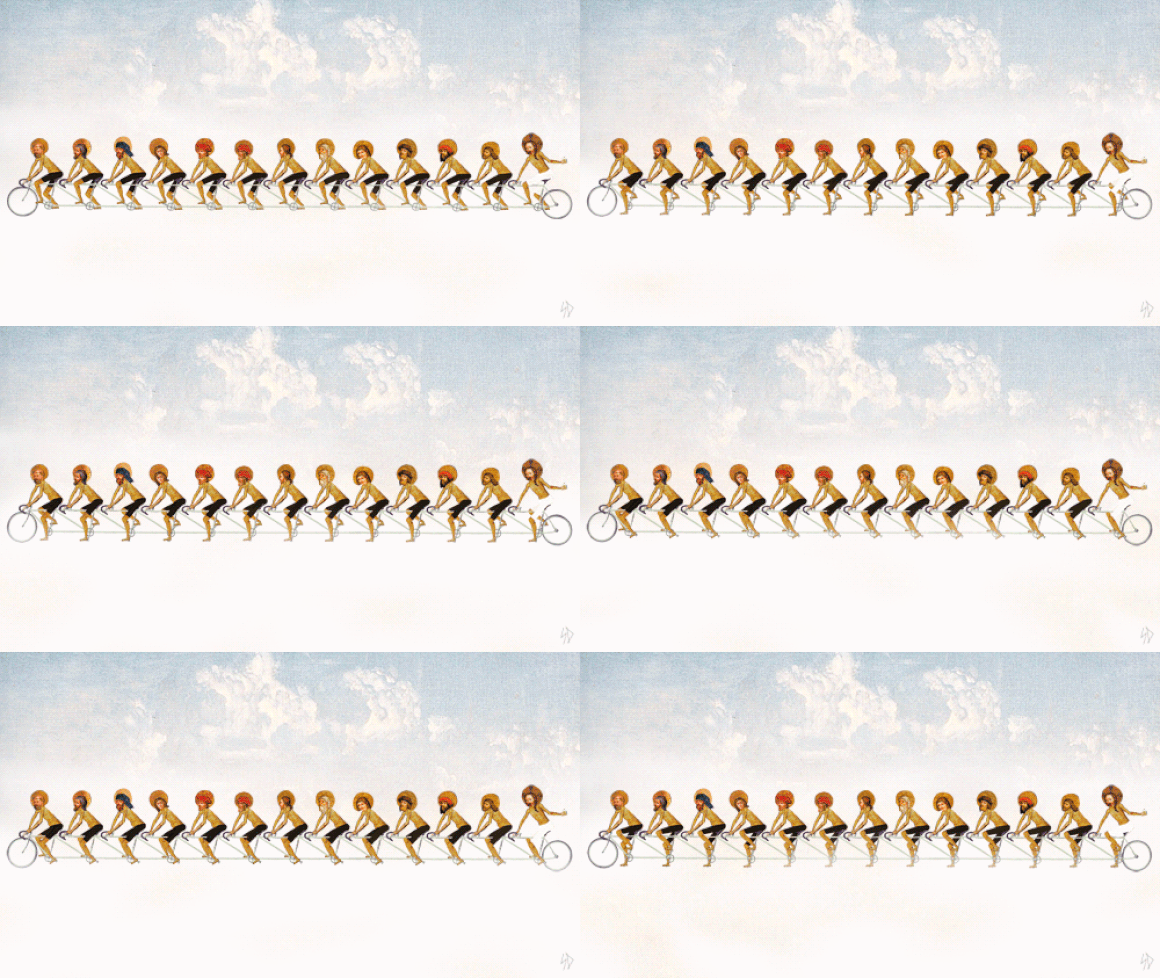
James Kerr, aka Scorpion Dagger, makes irreverent GIFs out of Renaissance art. He described his project in an interview this February:

Q: How does your practice relate to collage, or your other pre-GIF art practices?

A: Essentially, I’m using these Renaissance paintings as a palette to draw upon or cut open. So I’ll take a head from a Lucas Cranach the Elder painting, and hand from a Hans Memling painting and put those things together.

Mostly, I’m inspired by the idea of what happens to these types of paintings after a museum closes. I like the idea that the people in the paintings then get on the bus, go home, do the dishes, go to a restaurant. I like to think I’m creating a world for them outside of the museums where you would normally view these pieces of art. I like to think about what the life of these subjects might be away from the painting they are in.

Q: What is your process like? Many analog artists have a sketchbook. How do you collect and develop ideas?

A: Most of my ideas come from things that I see getting played out day to day in my life. The other day I was looking at the water cooler at the office where I work part-time, and I thought, What would it be like to have a water cooler in in the Vatican? Or in the paintings at the Vatican? So I made a GIF about that.

See more of his work here.

Quote For The Day

“When I look at [the Biblical book] Revelation now, it still seems frightening and impenetrable, and it still suggests a fearful, inexorable order that is unknowable by us, in which our earthly concerns matter very little. However, it no longer reads to me like a chronicle of arbitrarily inflicted cruelty. It reads like a terrible abstract of how we violate ourselves and others and thus bring down endless suffering on earth. When I read “And they blasphemed God of heaven because of their pain and their sores, and did not repent of their deeds,” I think of myself and dozens of other people I’ve known or know who blaspheme life itself by failing to have the courage to be honest and kind. And how we then rage around and lash out because we hurt. When I read “fornication,” I no longer read it as a description of sex outside marriage: I read it as sex done in a state of psychic disintegration, with no awareness of one’s self or one’s partner, let along any sense of honor or even real playfulness. I still don’t know what to make of the doctrine of the Nicolaitanes, among other things, but I’m now inclined to read it as a writer’s primitive attempt to give form to his moral urgency, to create a structure that could contain and give ballast to the most desperate human confusion. …

In the past, my compassion felt inadequate in the face of Revelation because my compassion was small–perhaps immature is a better word–and conditional. I could not accept what I read there because it did not fit my idea of how life should be, even though I could feel the truth of it in my psyche. Now I recognize, with pain, a genuine description of how hellish life can be, and how even God can’t help us because we won’t allow it. Paradoxically, I find that the more you accept the pain and fear inherent in human experience, the greater your compassion can become, until finally it is no longer merely your compassion but a small part of the greater love epitomized in the Bible as Jesus,” – Mary Gaitskill, from her essay “Revelation.”

(Hat tip: David Zahl)