The Plan To Make Community College Free, Ctd

This post is getting a lot of response from the in-tray:

Your skeptical readers perhaps have not read the full proposal from Obama:

Building High-Quality Community Colleges: Community colleges will be expected to offer programs that either (1) are academic programs that fully transfer to local public four-year colleges and universities, giving students a chance to earn half of the credit they need for a four-year degree, or (2) are occupational training programs with high graduation rates and that lead to degrees and certificates that are in demand among employers.

So the proposal appears to include the kind of “vocational and trade school” training your readers prefer. It limits participation to proven programs in high-demand fields, to improve the chances of employment. So when one of your readers writes, “The president ought to be focusing on expanding opportunity for those who either choose not to go to college or cannot afford to do so,” that’s exactly what this program is intended to do.

Another snipes:

You quoted a reader: “Less people should be going to college. I’ve been to college. I have my degree. Want to buy it for $100?” That’s too high a price for a degree from someone who writes “Less people” instead of “Fewer people.” Sorry! Couldn’t resist.

Another refers to that quoted reader as Judge Smails, seen in the above video. Several readers sound off more substantively:

I love Obama’s plan. He is working within the infrastructure that we have but making changes that will help millions. It’s exactly what he did with the ACA and immigration. It’s his MO. God bless him.

My local community colleges are a mix of transfer students and trade students. The transfer students are taking typical freshman and sophomore classes to prepare for transfer to a four-year college.  The trade students take some basic freshman classes (writing, math), but they are focused on exactly the type of job training that your reader thinks they should be getting. They are learning auto repair, engine repair, repair and maintenance of HVAC systems, building trades, horticulture, culinary arts, emergency medical technician, early childhood education, paramedic, medical laboratory technician, radiology tech, criminal justice/police skills, nurse assistant, RN nursing, etc. None of these kids are going to get rich doing this stuff, but they are learning skills that can provide them with a middle-class income.

Another adds, “My school (Orange Coast College) also has a helicopter mechanic training program; if I recall correctly, starting salaries for graduates are near $100k.” Another points out:

Many of these jobs were, not too long ago, learned on the job; many were apprenticeship programs, where a master taught apprentices and journeymen while they earned pay for their work. This, sadly, is becoming rare. There has been a shift of training from the employer to employees, and this is particularly true of what’s called the skilled trades.

So the presumption that much of this work is “unskilled” is elitist. If your furnace fails, as mine was, you will hope the person who comes to repair it is highly skilled and proficient at the job. If your car breaks down, you want a skilled mechanic. And if you go out to eat, you’ll probably want the restaurant managed by someone who comprehends how to safely handle food. You want x-ray techs who don’t bombard you with too much radiation.

Your plumber cannot be outsourced; she needs to come to your home or office to do her job. And she needs someplace to learn how to do that job if master plumbers aren’t shouldering the burden of training the next generation of plumbers. That’s where community colleges really matter; and where they offer a wealth of skills for young adults.

Another shifts the debate:

I have no problem with making community college free if we have the resources to spend on educational programs. For one thing, community colleges do provide a lot of the trade and vocational classes that your readers are interested in. My brother dropped out of a four-year liberal arts college and years later has started taking computer classes at a community college that are really beneficial for his job. And it’s much cheaper than traditional college, though it is still expensive for someone who doesn’t make that much to begin with. So making it free would definitely be beneficial for some people, like my brother.

But in a world where educational spending is not unlimited, I just cannot get behind the idea of spending more money on college degrees when we know that early education can make a much bigger difference in a community. I was so much more supportive of the idea of universal pre-K than this. Study after study has demonstrated that getting kids into preschools, even for just a few hours a week, makes serious long-term differences in people’s lives. If we are going to spend money on education, can we at least spend it on programs that we know will make a difference in a big way rather than on programs that might help a few people?

One more reader:

It’s been estimated that it would cost approximately $15-30 billion per year to make ALL public colleges completely free for everyone. Sure, it’s a lot of money, but for some perspective, we spent nearly a trillion dollars to remake a foreign country called Iraq. So for what we paid for that disastrous war (which we’re still fighting), we could have paid for public college for everyone for as many as 66 years!
Will The Paris Attacks Accelerate The Jewish Exodus?

Tributes And Reaction To Paris Terror Attacks After Gunmen Kill 17 People

Jamie Kirchick remembers “an evening last September when I was strolling through the Marais’ windy and narrow streets”:

I came across the Notre Dame de Nazareth synagogue, a grand, 19th century building constructed in the Moorish revival style that serves the city’s Sephardic Jews, those who come from North Africa. The rabbi happened to be walking out of the synagogue with his wife. After dispensing with the facts of my Jewish background and American citizenship, I promptly asked, “What’s the situation?” Our shared patrimony obviated any need for further elaboration; as a European Jew addressing an American one, he knew exactly at what I was aiming. “There is no future for Jews in France,” he said. If the Rabbi is right, and I fear he is, than it means that there is no future for Jews in Europe. For France is home to the continent’s largest Jewish community, numbered at over half a million. But it is declining rapidly.

Josh Marshall also worries about the future of Jews in France:

When these events [last week] began to unfold I immediately thought of this article I saw [last] Monday. Jewish Agency Chairman Natan Sharansky (the same 70s and 80s era Soviet refusnik, Anatoly Sharansky) said that in 2014 some 50,000 French Jews asked the Jewish Agency (the primary agency organizing and facilitating Jewish immigration to Israel) for information about immigrating to Israel.

It’s important to note that Jewish immigration into and emigration out of Israel is a highly politicized and emotive issue within Israel – it goes to the essence of the Zionist project. So these numbers should be seen through that prism. But there’s something very real happening. To expand on those numbers, in 2012 about 2000 French Jews left for Israel. In 2013 it was a bit over 3000. 2014 apparently hit over 6000.

Joshua Keating points to a string of anti-semitic attacks in recent years that have motivated that exodus:

Tensions reached a high point during last summer’s war in Gaza, when demonstrations turned violent with pro-Palestinian youths attacking Jewish businesses in a neighborhood known for its large Jewish population. Several synagogues were also firebombed. Demonstrators at some rallies chanted slogans like “death to the Jews” and “slaughter the Jews.” These incidents followed an attack in May on the Jewish Museum of Belgium in Brussels, where a French former ISIS fighter killed four people.

These attacks have added to the growing unease of a community still reeling from the 2012 shooting at a Jewish school in Toulouse, which killed three children and a teacher, as well as the grisly torture and murder of  a young Jewish man named Ilan Halimi in 2006. While these dramatic incidents have garnered the most international attention, smaller anti-Semitic crimes have become depressingly commonplace. On New Year’s Day of this year, for instance, a fire was started and a swastika drawn on the wall of a synagogue in a Paris suburb.

The Jewish Agency, which helps Jews make aliyah, was on the scene in Paris this week and seemed to be harnessing French Jews’ fear to advocate for more emigration:

In what now has become a strange coincidence, the Jewish Agency and the Ministry of Immigration Absorption held an Aliyah Fair in central Paris on Sunday that was scheduled before any of the attacks took place. The fair was designed to inform French Jews and returning citizens above the age of 50 on how to start the process of relocating their lives to Israel. The fair had increased its security to make sure families felt safe as they came to the fair to weigh the option of immigrating to Israel.

Chemi Shalev is disheartened to see Israeli leaders, especially on the country’s right wing, pushing “emigration to Israel as a Zionist antidote for the anti-Semitism and atmosphere of fear”:

[T]his instinctive reaction – perhaps Pavlovian is a better word – should give reason for pause and discomfort, even among the most ardent of Zionists. Because whether French Jews answer these calls by emigrating to Israel or whether they simply take the advice in principle and go somewhere else, in some ways this campaign is no more than blatant capitulation to terror. It gives its instigators a prize they could never have dreamed of: a frenzied flight of Jews, at best, or the complete elimination of Jewish presence in France, at worst. … Such a surrender, as Netanyahu regularly lectures the West, can only invigorate the Jihadists and spur them to adopt similar tactics in other European countries.

Likewise, Brent Sasley argues that “the calls by many on the political right for French Jews to return ‘home‘ to Israel indicates a lack of interest in recognizing that the conditions that led to the emergence of Zionism have changed” – i.e., that 2015 is not 1933, and that the challenges Jews in Europe face today do not compare to the existential threats of the past:

At its emergence, Zionism was perceived by its leaders and adherents as a movement of no or little choice. Anti-Semitic persecution required a safe haven. At the same time, the belief that the Jews could never be a normal people so long as they lived among host societies and didn’t have their own state meant that national redemption was a necessary process, not an optional one. An effective conversation about Zionism can only begin if participants recognize that things have changed over time. While the events in France reinforce for some the notion that they haven’t, this is a misunderstanding of world, Jewish, and Israeli history.

Aliza Luft detects a different historical parallel, between the French Jews of the past and French Muslims today:

French protestors in the 1930s blamed Jews for their supposed capitalistic tendencies, for stealing jobs, for forcing French civilians out of the economy. Today, Muslims are stereotyped in France as stealing jobs and welfare, living off state benefits, and bringing down the country’s economy. French citizens who consider Muslims not really French see them as threatening to their material goods; as scapegoats for the country’s current economic woes.

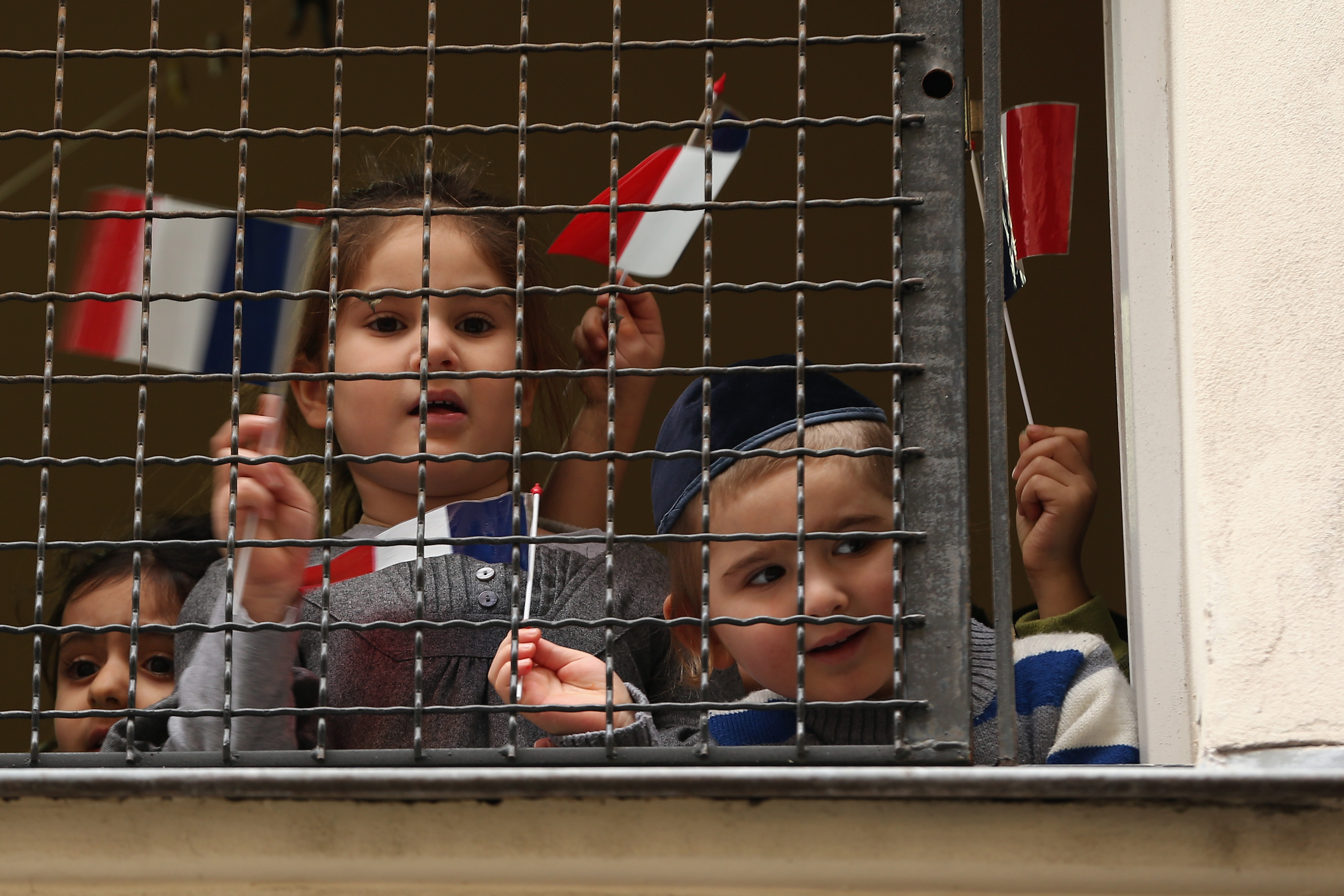
(Photo: Children wave French flags from a window as French Interior Minister Bernard Cazeneuve visits the Jewish school in the Jewish quarter of the Marais district of Paris on January 12, 2015. Mr. Cazeneuve visited the area to inspect the deployment of thousands of troops and police to bolster security at “sensitive” sites including Jewish schools. By Dan Kitwood/Getty Images.)

The Showdown Over Keystone, Ctd

A reader writes:

Bill McKibben’s comments that somehow carbon is staying in the ground if Keystone XL is not constructed is nonsensical. You see, there is this cool invention called “Trains” that have scores of large containers that hold bitumen and oil. Does he think the oil companies have never heard of them? That they would say “aw shucks I guess we’ll just stop producing”? How does he figure the oil is sold and delivered today?

The irony is that trains produce carbon emissions while pipelines do not. Trains are also more at risk to cause spills than a pipeline. Pipelines are the environmentally friendly choice to deliver oil or bitumen. People who oppose the pipelines are therefore either misinformed or are actually simply opposing oil production.

While there may be merits to argue for reduced production, the facts are that in the short to medium term, oil production is a requirement of our society, and as long as it is occurring, it will be delivered to the refineries one way or the other. Believing that stopping XL will benefit the environment is just sticking your head in the oil-sands.

Another reader made a similar case during a previous Dish debate on the subject. But Dave Roberts dismisses such complaints and accuses many commentators of “applying wonk logic to an activist problem“:

All along, at every stage, Very Serious People were absolutely sure that the pipeline was about to be approved. The economy was hurting, the Tea Party had everyone terrified, and the public was mostly pro-pipeline. The hippies just don’t win those kinds of fights. Obama would “trade” Keystone to show that he’s reasonable, that he can compromise, that he’s willing to move to the right to meet in the middle. That’s the script.

So if Keystone is blocked — and that’s still a big if — it will upend conventional wisdom. It will show that people can mobilize around climate with the numbers, intensity, and money necessary to pull the Democratic Party their way. It will show that there’s life in the climate movement.

Lizza wonders whether Obama will negotiate over Keystone:

From the White House’s perspective, the Keystone XL pipeline should be an ideal policy to give away in a trade: it’s a major issue that Republicans care a great deal about but one that Obama seems to view as a sideshow.

Before Keystone, there was little public appetite to debate the merits of fossil-fuel infrastructure. Obscure and opaque government agencies would stay within their lanes, largely approving projects so long as the requisite regulatory boxes got checked.

Even under the executive order that environmentalists have leveraged to cripple Keystone, another major Canadian heavy oil pipeline won Obama’s approval to cross the northern border in 2009. In 2014 that same pipeline’s operator had to resort to bureaucratic sleight of hand to push 75,000 extra barrels per day into the United States by building interconnections between existing projects—a literal crude switcheroo.

Recent Dish here on how plummeting oil prices are now changing the debate over the pipeline.

Terror Unites, Divides France

France responded to last week’s terrorist rampage with a massive manif in the streets of Paris yesterday, drawing the largest crowds of any demonstration in the country’s post-WWII history. But Robert Zaretsky doesn’t buy the show of unity, arguing that it masks divisions in French society that the terror attacks are ripping open even further:

[O]nlookers this afternoon in Paris saw not just leaders from across the globe joining the march, but nearly all the religious and political leaders in France. With one exception, though: Le Pen marched in the southern town of Beaucaire, a Front National fief. In a brief speech at the town’s city hall, she hailed about 1,000 supporters for “reminding the world of the values of liberty.” It was here, in le pays réel, or real France, and not in the international parade in Paris that such values are rooted.

In spite of Hollande’s declaration after the attacks that “Our best weapon is unity,” French politics—and the French people—appear as divided as ever. The lines are being drawn, and they will not be erased by any number of republican marches. This is where French society in the aftermath of these recent acts of terror is, in some ways, on shakier ground than American society was after the September 11 attacks.

A fair amount of hypocrisy was on at the Paris march as well; Daniel Wickham identifies nearly two dozen countries represented there that have their own ugly records of arresting, intimidating, assaulting, or murdering journalists, including some major offenders like Turkey, Russia, Egypt, and Saudi Arabia. True to form, the Charlie Hebdo staffers who attended the rally came away wishing they had called out these hypocrites:

They said their biggest regret was that they couldn’t have paraded caricatures from the past pages of Charlie Hebdo of the various heads of state who joined the rally– Benyamin Netanyahu, King Abdallah II of Jordan, of former French president Nicolas Sarkozy, of Russian Foreign Minister Sergueï Lavrov, of Turkish prime minister Ahmet Davutoglu, and of all the authoritarian heads of state they had lampooned over the years. (Many of the world leaders in the rally would have at the least jailed the Chralie Hebdo if they had been operating in those countries). Oh, well, said Luz, a cartoonist. You can’t think of everything.

But Tim Murphy attended the rally and was moved by its somber – not angry – tone:

[A]mid the sheer size of the crowds, I was struck, yet again, by how quiet people were overall, in contrast to the steroidal, rah-rah racket of an American rally. There were no drum circles and little chanting; occasionally “La Marseillaise,” the French national anthem, was sung, but certainly not by everyone; and though the French flag dotted the crowds, it wasn’t ubiquitous in the way that the American flag was post-9/11.

What was ubiquitous was the simple black-and-white “Je Suis Charlie” sign, which emerged today with all sorts of variations: “I am Charlie” plus “I am Jewish,” or “I am Muslim,” or “I am a Journalist,” or “I am a Secularist.” I saw no Islam-baiting signs unless you want to count those that bore some of the Charlie Hebdo images that courted so much controversy in the first place, including one of Mohammed gnashing his teeth over fundamentalists and another of a Muslim man and a male cartoonist making out that reads “Love is Stronger Than Hate.”

Bershidsky previews another wave of marches coming soon to a European city near you – and these won’t be about “unity” either:

Xenophobes elsewhere in Europe will also take this chance to assert themselves. Tonight, in Dresden, Germany, the anti-Islamic group Pegida intends to hold what will probably be its biggest rally yet. Since the Charlie Hebdo shootings, Pegida’s Faceook page has added about 20,000 supporters. German Justice minister Heiko Maas called on Pegida to cancel the gathering, denouncing the group as “hypocrites” who have protested against the “lying press” and are suddenly full of sympathy for its fallen representatives. The Pegida page’s only response has been, “What can one say???”

Marches like Pegida’s are more ideologically consistent than those held in Paris yesterday. They are also, of course, much smaller. But as the Charlie Hebdo massacre showed, it takes only two people to shed blood and frame the agenda as war.

Josh Rogin, meanwhile, wants to know why no major US officials were in attendance:

A senior administration official told me that the security requirements needed if Obama or Biden were to have attended the Paris rally could have interfered with the event itself, and the White House didn’t want the focus to be on the U.S. rather than on the French. The official noted that Attorney General Eric Holder and Homeland Security Deputy Secretary Alejandro Mayorkas were in Paris for related meetings, although neither attended the rally. But back in Washington, almost no senior administration officials participated in the much smaller rally and march that took place Sunday afternoon only blocks from the White House. Assistant Secretary of State for Europe Victoria Nuland was the only official representative.

Eugene Volokh shares that puzzlement:

The U.S. was represented by our Ambassador to France, normally a logical choice but rather an odd one, I think, when dozens of world leaders — including leaders of many of our main allies — were present. And this is especially so when the march is about protecting values that are so important to us as Americans, as well as to the French, the English, and others. … Am I missing something here? Is there some particularly good “smart diplomacy” reason why we would be absent when so many others were present?

How Much Humor Can America Handle?

God bless Tina Fey and Amy Poehler:

Poniewozik reviews the Golden Globe’s jokes through the lens of Charlie Hebdo. He pays particular attention to outrage over Margaret Cho’s impersonation of a North Korean general and Fey and Poehler’s skewering of Cosby:

For all the horror at the shootings and support for the right to expression, Americans get nervous about satire long before it reaches the scathing, vicious tone of Charlie Hebdo‘s cartoons. We’ve had numerous debates over whether a rape joke can ever be good and funny (though I’d say Fey and Poehler’s, aimed at a powerful person accused of assault, are Exhibit A of how one can be). And though Cho herself is Korean, playing a foreign character–and though she already played dictator Kim Jong Il on Fey’s 30 Rock–any lampooning of a heavily accented Asian character on this stage was likely to trip the outrage meter.

As with the Charlie Hebdo cartoons themselves, it was an example of a tension in American melting-pot culture, especially in left-leaning communities like Hollywood: classical liberalism (which emphasizes expression and personal and artistic liberties) bumps up against progressivism (which emphasizes identity politics and power dynamics).

So, nous sommes tous Charlie? Maybe. But more in theory than in practice.

#JeSuisJuif

Noah Rayman discusses how last week’s attack on the Hyper Cacher supermarket is affecting Jewish communities in France:

The assault on the Kosher supermarket shook the Jewish community in France and abroad. As dual hostage situations unfolded, police ordered the closure of all shops in the tourist-filled Jewish neighborhood in central Paris, far from the supermarket under siege in the city’s east, according to the Associated Press. And ahead of the Sabbath Friday evening, the iconic Grand Synagogue of Paris was closed, USA Today reported.

The Jewish community in France, numbering more than 400,000, had already been on guard after an uptick in anti-Semitic violence in recent years, including the shooting of four people at the Jewish Museum of Belgium in May 2014, allegedly by a French Muslim man. After the attack on Charlie Hebdo on Wednesday, Jewish institutions were on maximum alert, the Jewish Telegraphic Agency reported. Volunteers joined police deployed by the French authorities to secure schools and religious sites.

Elliot Abrams wonders why there isn’t more sympathy for the Jewish victims:

Terrorism against French Jews is not new. In 2012 a terrorist murdered three schoolchildren and a rabbi at a Jewish school in Toulouse. There was no million-citizen march.

And suppose that last week’s terror attack in Paris had not aimed at Charlie Hebdo, but “only” killed four Jews–or eight or twelve, for that matter. Does anyone believe a million French citizens would be marching in Paris, with scores of world leaders joining them?

One is reminded of the synagogue bombing on Rue Copernic in Paris in 1980, after which Prime Minister Raymond Barre publicly declared that “A bomb set for Jews killed four innocent Frenchmen.” That shocking lack of solidarity– that definition of Frenchmen to exclude the Jews – does not seem to have been cured, and the French today appear to feel more solidarity with the journalists who were killed than with the Jews who were killed.

But Jeffrey Goldberg observes that the current French leadership has been taking the issue of anti-semitism seriously:

[French Prime Minister Manuel] Valls, who on Saturday declared that France was now at war with radical Islam, has become a hero to his country’s besieged Jews for speaking bluntly about the threat of Islamist anti-Semitism, a subject often discussed in euphemistic terms by the country’s political and intellectual elite. His fight, as interior minister, to ban performances of the anti-Semitic comedian Dieudonne (the innovator of the inverted Nazi salute known as the quenelle) endeared him to the country’s Jewish leadership, and he is almost alone on the European left in calling anti-Zionism a form of anti-Semitism.

“There is a new anti-Semitism in France,” he told me. “We have the old anti-Semitism, and I’m obviously not downplaying it, that comes from the extreme right, but this new anti-Semitism comes from the difficult neighborhoods, from immigrants from the Middle East and North Africa, who have turned anger about Gaza into something very dangerous. Israel and Palestine are just a pretext. There is something far more profound taking place now.”

And Adam Taylor holds out the #JeSuisJuif solidarity campaign on Twitter as evidence that the world isn’t ignoring those victims, though anti-semitism remains a real problem in France:

#JeSuisJuif began to trend after news spread about hostages being taken at the grocery store, which is called Hyper Cacher, or Hyper Kosher, in Porte de Vincennes. The attack took place at the start of the Jewish Sabbath, when the store was busy, and there were fears that other Jewish businesses in the area could be targets. Later, French President Francois Hollande described the hostage taking as an “anti-Semitic attack”

The attack comes at a fraught time for France’s Jewish community. Many French Jews have perceived a rise in anti-Semitism in the country in recent years. Reports of violence against Jews skyrocketed at the start of 2014, and things became worse over summer as a conflict in Gaza prompted anti-Israel protests that blurred the line with anti-Semitism. One survey by the New York-based Anti-Defamation League estimated that 37 percent of French people openly held anti-Semitic views – the highest number in Europe.

“Take Your Medicine” Taken To The Extreme

A reader writes:

Essentially the question is whether a 17 year-old can commit suicide, but with the added complication that she doesn’t understand that’s what she’s doing. She is misinformed, to put it gently. I’ve had aggressive chemo for a different cancer. It sucks, sure. It’s strong medicine with strong side effects. But there are a lot of dangerous myths online that are simply not true. It doesn’t kill the rest of you. It isn’t more harmful than the disease itself (we’re talking cancer here). And we know from many, many years of experience and studies that more often than not it works. I can’t tell you how many posts I’ve seen on an Internet discussion board for my cancer from people who say that they chose to skip chemo, against their doctor’s recommendation, because they bought into these myths and now they have terminal, metastatic disease. And regrets.

We have to draw the line somewhere. We don’t let 12 year-olds make this kind of decision. It seems to me that 18 is a pretty good place to draw this line. And this girl has not demonstrated that she is particularly mature for her age.

I remember the series you had on suicide. I can’t remember the expert’s name, but one thing she said stayed with me: your future self will thank you for not committing suicide. There is no question in my mind that Cassandra’s future self will thank the judge for not allowing her to commit suicide.

Another reader also relates to the story from personal experience:

I am the parent of a cancer survivor, and I feel compelled to ask who is it who helped convince Cassandra she was being poisoned?

Her parents quite clearly.  My son was diagnosed with a rare, aggressive and very often fatal cancer when he was five years old. His treatment was as aggressive and toxic as was his disease and lasted more than three years. My wife and I spent those years – each and every day – agonizing over the question whether we were doing our level best to save him,  or torturing him to no avail and thus destroying whatever quality of life he might ever have. He had eight rounds of such high-dose and toxic chemo that one dose would have killed an adult because  mature organs would not be able to withstand the treatment.

Several surgeries, extensive radiation, and a host of experimental treatments on top of that exposed him to an array of side effects and collateral risks.  Many times we didn’t know if he would make it through the night. But we saw our duty to comfort and support him as best we could and not to quit until we were told there was no hope for him to survive.  We cried in private and smiled and joked whenever we were with him.  We felt we had to be strong for him, to explain that the medicine was killing the cancer, not hurting him, and reminding him that we loved him and wanted only for him to live a full and happy life. We NEVER suggested that avoiding the near term suffering was an option.

We held him close through the hard parts but tried to make him as happy as we could during the rest of it. We developed comedy routines about some of the worst aspects, and he soon was able to laugh about it all when he wasn’t too sick. We made it, and are eternally grateful to the most wonderful doctors and nurses on the planet and their commitment to trying to cure him. He is now 21 and healthy, happy and in love.

I have cried like a baby reading Cassandra’s story, as I have attended more funerals of children than anyone should have to, as has my son. I can assure you that all of the parents of those lost souls would give anything to trade places with Cassandra’s parents and have the hope of survival for their child, and that none of them would ever suggest to her – by either  commission or omission – that her treatment – as awful as it may seem – was worse than the disease.

Of course she doesn’t want to undergo the treatment. Her mother has told her or agreed with her that it is poison, and whom does a child trust more than her mother?  The discussion of legal rights and the boundaries between childhood and adulthood miss the real tragedy here. That a bit of parental courage and support and the situation would likely be much different; Cassandra would in my experience be viewing the treatment very differently despite its effects. But as it is, it seems a no-win situation for no reason other than fear.  It is absolutely shattering, but not because it is abrogating Cassandra’s rights.

How Will History Judge Obama?

US-POLITICS-OBAMA

Chait expects historians to be relatively kind:

In an April speech at the Lyndon Baines Johnson Presidential Library to praise the 36th president’s legacy, Obama turned to the theme of vindication in an explicit way. His choice of Johnson was a telling one. No American president left such a gap between the scale of his lasting accomplishments and the indignities he suffered in his own time. The Democrat who dismantled legal apartheid in the South and created Medicare and Medicaid was so loathed he did not even bother trying to run for reelection. At times in the speech, Obama linked Johnson’s travails to his own. The triumphs of history that seem clear and simple in retrospect, he noted, felt contemporaneously grueling and ugly. “From a distance, sometimes these commemorations seem inevitable, they seem easy,” Obama said. “All the pain and difficulty and struggle and doubt—all that is rubbed away.” You can sense his desperate wish to arrive at a vantage point where his accomplishments will be buffed of disappointment and take on the same heroic gloss.

One can imagine future histories that focus less on Obama’s dysfunctional relationship with Congress, and that measure accomplishment in more discerning proportion. But the lesson Johnson offers for Obama’s own eventual vindication is not quite so encouraging. LBJ’s political career was defined by his singular failure in Vietnam. The hatred this spawned blotted out his massive and more enduring achievements. The current film Selmainaccurately depicts Johnson as an opponent of the civil-rights struggle he had, in reality, thrown all his energy behind. Five decades on, Johnson still has not escaped the feelings he engendered—indeed, he still requires rehabilitation by figures like Obama.

Christopher Caldwell dissents:

Obama may wind up the most consequential of the three baby-boom presidents. He expanded certain Bush ­policies—Detroit bailouts, internet surveillance, drone strikes—and cleaned up after others. We will not know for years whether Obama’s big deficits risked a future depression to avoid a present one, or whether the respite he offered from “humanitarian invasions” made the country safer. Right now, both look like significant achievements. Yet there is a reason the president’s approval ratings have fallen, in much of the country, to Nixonian lows. Even his best-functioning policies have come at a steep price in damaged institutions, leaving the country less united, less democratic, and less free.

A poll of more than 50 historians provides another perspective:

Almost every respondent wrote that the fact of his being the first black president will loom large in the historical narrative — though they disagreed in interesting ways. Many predict that what will last is the symbolism of a nonwhite First Family; others, the antagonism Obama’s blackness provoked; still others, the way his racial self-consciousness constrained him. A few suggested that we will care a great deal less about his race generations from now — just as John F. Kennedy’s Catholicism hardly matters to current students of history. Across the board, Obamacare was recognized as a historic triumph (though one historian predicted that, with its market exchanges, it may in retrospect be seen as illiberal and mark the beginning of the privatization of public health care). A surprising number of respondents argued that his rescue of the economy will be judged more significant than is presently acknowledged, however lackluster the recovery has felt. There was more attention paid to China than isis (Obama’s foreign policy received the most divergent assessments), and considerable credit was given to the absence of a major war or terrorist attack, along with a more negative assessment of its price — the expansion of the security state, drones and all. The contributors tilted liberal — that’s academia, no surprise — but we made an effort to create at least a little balance with conservative historians. Their responses often echoed those from the far left: that a president elected on a promise to unite the country instead extended the power of his office in alarming, unprecedented ways.

(Photo: Nicholas Kamm/Getty)

Reasons To Keep Oil Prices High

Gas Tax

Michael Levi wants to raise the gas tax:

[W]hen oil prices fall, fuel efficient cars, homes in city-centers, and public transit investments all drop in value. This can lead to economic waste: underused automobiles, unrented homes, empty subways. A particularly glaring example came on Wednesday when President Obama visited a Ford plant that makes fuel-efficient vehicles: because of the drop in oil prices, that plant was closed, wasting both the factory and the skills of the workers that it would have employed.

In this world, a newly higher gasoline tax would actually avoid economic waste rather than creating it.

Ford and others that invested money on the expectation that oil prices would remain relatively high (and, if options prices on oil futures as recently as six months ago are any indication, that means most businesses) would see their investments hold more value. The same goes for drivers who, facing higher oil prices, already spent their money on ever-more-fuel-efficient cars. (They’d still pay more at the pump, but the resale value of their cars would rise.) One can go down the list of oil-sensitive consumers and find more examples like this.

Josh Mitchell provides some context:

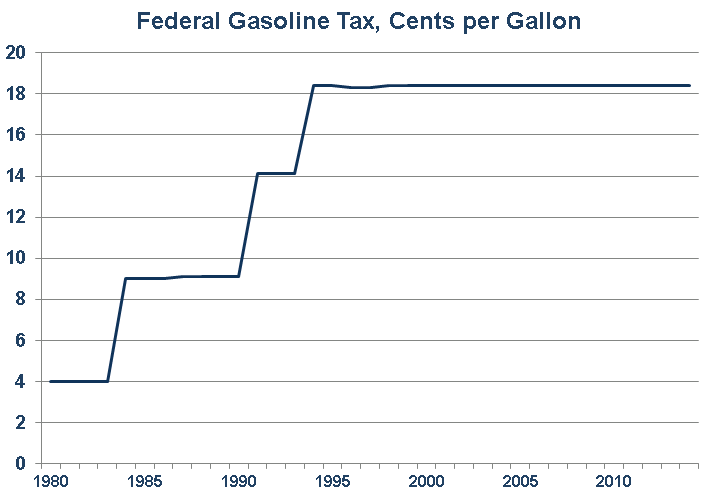
The federal levy—which amounted to about $23.5 billion in gasoline tax revenue in the 12 months through September 2013—has stood at 18.4 cents a gallon since the first year of the Clinton administration, despite multiple proposals over the years to raise it. Over the past decade, Congress has approved higher spending for highway construction but hasn’t raised the tax to pay for it, creating periodic funding crises.

Chris Edwards isn’t convinced:

Gas tax supporters say that it is time to raise the tax because it has not been raised in two decades. What they leave out of the story is that the gas tax rate more than quadrupled between 1982 and 1994 from 4 cents per gallon to 18.4 cents, as shown in the chart [above]. Thus, looking at the whole period since 1982, federal gas tax revenues have risen at a robust annual average rate of 6.1 percent (based on Tax Foundation data). So, again, we have a spending crisis, not a funding crisis.

But, just last week, Krauthammer once again supported raising the tax:

A tax is the best way to improve fuel efficiency. Today we do it through rigid regulations, the so-called CAFE standards imposed on carmakers. They are forced to manufacture acres of unsellable cars in order to meet an arbitrary, bureaucratic “fleet” gas-consumption average.

This is nuts. If you simply set a higher price point for gasoline, buyers will do the sorting on their own, choosing fuel efficiency just as they do when the world price is high. The beauty of the tax — as a substitute for a high world price — is that the incentive for fuel efficiency remains, but the extra money collected at the pump goes right back into the U.S. economy (and to the citizenry through the revenue-neutral FICA rebate) instead of being shipped overseas to Russia, Venezuela, Iran and other unsavories.