The End Of Snow Days, Ctd

4335538238_caf3a1e1b8_z

A reader writes:

This is a terrible idea.  I cannot remember a single snow day that did not come with at least the threat of a power outage, as snow laden trees took out the power lines leading to my semi-rural house.  And if your Internet comes via satellite, good luck getting reception when the snow is coming down.  Not to mention having a sister with whom I would have had to share my family's only computer; who would have gotten computer priority and gotten to be "present" at school?

Plus, I can't remember anything better in childhood than the games of tackle football made gentle by piles of snow limiting our running speed, and the sheer joy of tackling your neighbor into two feet of snow.  And my mom made some badass hot cocoa to warm us back up when we were all exhausted.

Another:

I actually found that one of the more profound results of Snow Days as a child was that I could expect, without fail, my father to raise me out of bed early to help shovel the front walk, driveway, and all the pathway to the door on the side of our garage.  And I could generally expect to have to re-shovel the sidewalk every hour or two, if the snow was coming down hard.

Granted, the intermittent and menial labor of shoveling was a welcome replacement for a day at school. But the larger point is that Snow Days, for my siblings and me, were not just a free day off.  It was actually one of my first big life lessons.  Since my parents still had to get to work, and our hands were free, the least we could do is spend some of our unexpected day off mitigating Mother Nature's effects on our homestead.  It instilled in me a sense of duty to my family.

I obviously didn't analyze it like that at the time.  Obviously the last thing I wanted to do on my Snow Day was shovel.  But many of the best lessons of our youth are taught to us in moments where we are completely oblivious to the lesson we're being taught.

So I agree with you.  Don't do away with Snow Days.  If not for the fond memories you cited, then for the opportunity for growth and learning that they presented to people like me.

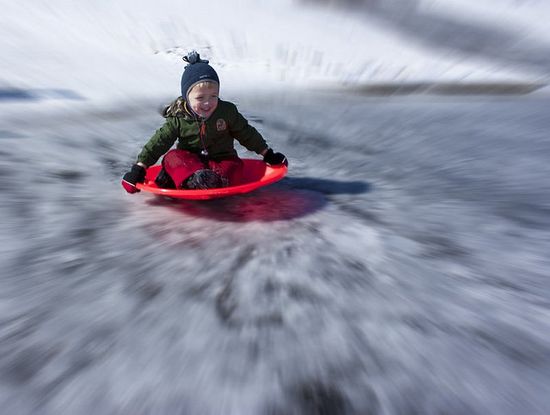
(Photo by Flickrite Sebastian Cartes)
“The Marketplace For Punditry”

Justin Wolfers capitalizes on partisan demand by predicting that "Democrats will retain control of the House and the Senate." His reasoning:

If I’m right?  Well you can bet that I’ll beat the drums loudly and tell everyone in sight that I called it.  I’ll blog it all week.  I’ll write an op-ed explaining my insights. I’ll go on to Jon Stewart’s show to explain the fine art of psephology.  Hopefully you’ll be calling me the Nouriel Roubini of political punditry.  I’ll go on to a new life of lucrative speaking engagements and big book advances, while I beat back my coterie of devoted followers.

And if I’m wrong?  We both know there won’t be any real consequences. 

I’ll be sure to sell some clever story.  You know, there was weather on election day (hot or cold, wet or dry — it all works!) and this messed with turnout.  Or perhaps, This Time Was Different, and my excellent forecast was knocked off course by our first black president, by rising cellphone penetration or a candidate who may not be a witch.  I’ll remind you how I nailed previous elections.  (Follow the links, you’ll see I’m doing it already!)  I’ll bluster and use long words like sociotropic, or perhaps heteroskedastic.  And I’ll remind you that my first name is Professor, and I went to a prestigious school.  More to the point, if I’m wrong, I’m sure we’ll all have forgotten by the time the 2012 election rolls around.  Shhhh… I won’t tell if you won’t.

(Hat tip: Sides)

Lather, Rinse, Repeat

Chait explains the GOP's "endless loop of failure and recrimination" on spending:

The loop begins with Republicans gaining power on the basis of promising to cut unspecified programs, or perhaps programs accounting for a tiny proportion of the federal budget. That is the stage of the cycle we are currently in. Then Republicans obtain power and have to confront the fact that most spending programs are popular, and so they must choose between destroying their own popularity by taking on programs like Medicare, or failing to materially cut spending. So they settle on tax cuts instead of spending cuts. Then eventually their supporters conclude that they have been betrayed by their leaders, and cast about for new leaders with the willpower to really cut spending this time.

As I've been saying over and over, there is a way around this. Republicans can make a bipartisan deal and obtain Democratic cover for cuts in popular spending programs. But the price of this deal is to impose shared sacrifice on the rich and violate the fundamental republican taboo against ever allowing revenue increases. Since the party cannot violate that taboo, it's back to the cycle of failure, recrimination, and self-delusion. Right now, conservatives are in the hopeful self-delusion phase. Look, these new leaders have learned their lesson! They sound serious!

When Warren Buffett Retires

Seeing that he has named a possible successor, Megan goes on to explain why his success is unlikely to be replicated:

The lure of value investing is that all you need is common sense, hard work, and the courage to resist your own greed, but in fact, Buffett's intelligence is really singular. Reading his thoughts on the bubble in 1999, you're struck not merely by his courage in naming the bubble, but his ability to crystallize such an incisive critique of the prevailing zeitgeist.  Moreover, the kinds of stock values that made Buffett rich are thin on the ground these days–the proliferation of screening tools, and other sorts of company information, means that few people are able to make money simply by identifying "hidden gems".  Buffett has survived through a combination of unique vision, good management, and the magical effect of the Buffett name on the investments he does choose to make.  It's going to be hard to impart that to a successor.

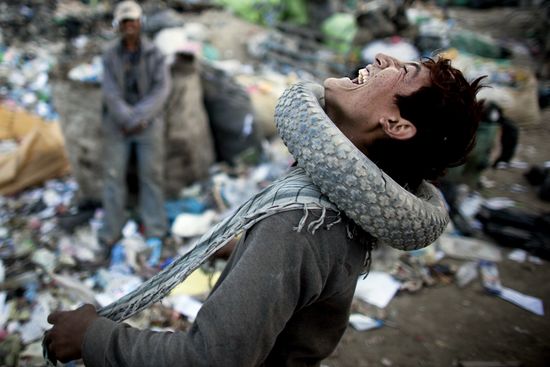
Face Of The Day

AfghanManMajidSaeediGettyImages

An Afghan man wears a tire around his neck while sorting through plastic and metal items near a rubbish dump on October 27, 2010 on the southern outskirts of Kabul, Afghanistan. According to the Global Anti-Incinerator Alliance (GAIA), about 15 million people throughout the developing world earn a living from collecting garbage. By Majid Saeedi/Getty Images.

A Step Closer To War

Marc Lynch fears that Obama is going to talk more about military options against Iran:

The greatest danger of introducing open war talk by the administration is that it would represent the next step in the "ratcheting" of which I've been warning for months and pave the way either to the 1990s Iraq scenario or to an actual war.   Once the military option is on the table, it never goes away.  The only way to signal "toughness" in future encounters will be to somehow escalate beyond military threats — i.e. to action, such as airstrikes or cruise missiles.    And those would, by the consensus of virtually every serious analyst, be a catastrophe.    If it isn't prepared to follow through on the threat — and it really, really shouldn't be — then it shouldn't make the threat.  That would just either undermine credibility, or else give a hook for hawks to demand that actions live up to rhetoric. Dangerous either way. 

Are There Too Many Lawyers?

Annie Lowrey sees an incongruity: 

Between 2007 and 2009, the number of LSAT takers climbed 20.5 percent. Law school applications increased in turn. … [But the] demand for lawyers has fallen off a cliff, both due to the short-term crisis of the recession and long-term changes to the industry, and is only starting to rebound. The lawyers that do have jobs are making less than they used to. At the same time, universities seeking revenue have tacked on law schools, minting more lawyers every year.

Mental Health Break

Landscapes: Volume One from dustin farrell on Vimeo.

A year's compilation of my time lapse work. All shot on the Canon 5D2 and processed in Adobe After Effects. The majority of the shots are in my beautiful home state of Arizona. Goblin Valley State Park and Natural Bridges National Monument in Utah also make an appearance.