A New Low, Ctd

A reader writes:

Although I understand the disgust at the Human Rights Campaign for this, I actually believe such a bracelet is helpful.

In general, colored bracelets (Livestrong, breast cancer awareness) merely convey a weak form of solidarity – like "liking" something on Facebook. But in this case, the bracelet would serve a function of few other bracelets: A means of signaling. Imagine a gay teen being bullied at school. Where should he/she turn for support? Students, teachers, or administrators (or even people in churches) wearing an anti-bullying bracelet signals to these teens that they have someone to talk to. As a means of signaling, the bracelet would be both subtle and effective. No other bracelet I know of performs this sort of function.

However, buying such bracelets from the HRC is too much to ask. School districts should just make their own and hand them out to teachers, staff, and administrators interested in reaching out to bullied teens.

In other HRC news, revenue was down 17 percent from last year.
Horserace Crack

Nate Silver's updated House prediction:

Republican chances of taking over the House are now up to 80 percent, according to the FiveThirtyEight forecast model; they had been 75 percent two days ago.

And the Senate:

Our latest forecast shows little change in Republican chances of taking over the Senate after the Nov. 2 election. They now have a 19 percent chance of doing so, according to our forecast model; their chances had been 18 percent in our previous update on Thursday.

Feeding Them Hope

David Rieff skewers the status quo on global aid:

Neither Geldof nor Bono has ever been willing to accept that, however well-intended, the premise of Live Aid was flawed from the start. Amid criticism of the ways in which the monies from Live Aid were being used by international relief agencies to fund programs connected with resettlement, Geldof told The Irish Times that “the organizations that are participating in the resettlement effort should not be criticized…. In my opinion, we’ve got to give aid without worrying about population transfers.”

The way in which both men have capitalized on their new status as global consciences to rescue their pop music careers has been grotesque, but their sincerity is beyond doubt. Yet their competence to hold the opinions that they peddle is another matter. What is so great about sincerity if it leads not to understanding but to mystification?

Lucky Charms

Piercarlo Valdesolo reports on a study suggesting that good luck charms actually do work. He then wrecks the effect for his readers:

The influence of the charm depends crucially on your belief in its inherent powers. Once you acknowledge that performance is a function of what goes on in your brain rather than a product of any mystical properties of the object itself, it becomes useless.

Following The Money

Williams

Felix Salmon points to a new trend in microfinance: the fact that we need to look at where microfinance money actually goes (not always to the one purchase, like a sewing machine, that we think it does). One study showed that:

[S]ome 46% of borrowers used a decent chunk of their business loan to pay down other debt and about 28% spent part of the money on a big household purchase—even though fewer than 4% of people in either category ever admitted this to their bank. …

As [microfinancer Carlos] Danel put it, microfinance is an industry that was born out of supply—one that came from people thinking about what organizations were capable of doing. Now, he said, the challenge is to figure out what poor people around the world actually need.

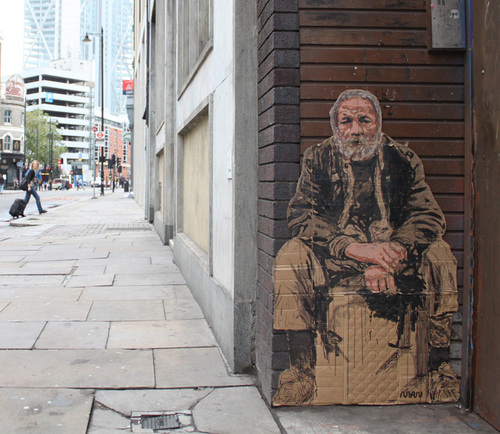
(Cardboard depiction of the homeless by Michael Aaron Williams via Wooster Collective)

“Time To Arrive”

David L. Ulin interviews Alain de Botton about his book A Week at the Airport and his residency at Heathrow:

The real problem with airports is that we tend to go there when we need to catch a plane — and because it’s so difficult to find the way to the gate, we tend not to look around at our surroundings. And yet airports definitely reward a second look — they are the imaginative centers of the modern world. It’s here you should go to find, in a concrete form, all the themes of modernity that one otherwise finds only in abstract forms in the media. Here you see globalization, environmental destruction, runaway consumerism, family breakdown: the modern sublime in action.