
The Rise Of Blogazines

Sullivan_10thbanner

Farhad Manjoo notes an overlap:

The design shifts—with blogs looking more like magazines, and magazines looking more like blogs—aren’t just superficial. These changes in presentation are collapsing all distinctions between “blog posts” and “articles.” Over the last few days I contacted various bloggers and editors at big sites around the Web to ask how they define each term. The answers I got were surprisingly diverse—while each of these organizations has its own rules for what it calls a “blog post” and an “article,” the rules aren’t at all consistent across newsrooms. What’s more, the lines are blurring—blog posts are looking more like articles, and articles are looking more like blog posts.

Further thoughts over at Chloe Veltman’s place.

I’ve thought of the Dish as a blogazine for quite a while now. The model we’ve groped our way toward combines the agility of a pond-skater with the ability to deep dive at any moment. And its reader-generated content makes it a product of a collective mind as well as an individual one, a bull-session as well as an individual’s thinking out loud. Who knew this evolution was possible even a year or two ago?

And I have to say, our new “read on” feature has helped us evolve this more quickly and intuitively than I thought it would.

See?

You get the choice to skim or dive in – at your leisure, and with minimal hassle. Then the links help you explore even more, if your nose takes you there. So the Dish becomes as much a mediator as an individual thinker, as much a collective mind as a single one, as much a biased broadcast as a communal debate. With videos, art, quotes, thoughts, provocations, jokes, and photography thrown in for good measure – some prompted by you, some by me, some by Patrick, Chris, Conor and Zoe. And all, in the end, channeled through what’s left of my fried frontal cortex. That’s much more than this blog was in, say, 2002.

But that’s the joy of this new medium. We still don’t know where it will go next. And we’re all  improvising like mad. What’s not to love?
Malkin Award Nominee

"Bill, I’m not a bigot. You know the kind of books I’ve written about the civil rights movement in this country. But when I get on the plane, I got to tell you, if I see people who are in Muslim garb and I think, you know, they are identifying themselves first and foremost as Muslims, I get worried. I get nervous," – Juan Williams.

No, Juan, what you just described is the working definition of bigotry.

What if someone said that they saw a black man walking down the street in classic thug get-up. Would a white person be a bigot of he assumed he was going to mug him? What percentage of traditionally garbed Muslims – I assume wearing a covered veil or some other indicator and being of darker skin – have committed acts of terror? And, of course, the 9/11 mass-murderers were in everyday attire, to blend in. So was the Christmas Day undie-bomber. The Fort Hood murderer was in US military uniform, for Pete's sake.

The literal defense of anti-Muslim bigotry on Fox is becoming endemic. It's disgusting.

“Do Something” Money

David Zetland ponders the core argument of The Crisis Caravan: What’s Wrong with Humanitarian Aid?:

The central thesis of this book … is that the people who deliver aid are addicted to horror stories and starving kids, and this addiction is fed by those who benefit from aid, whether they be local leaders, militias committing atrocities or even victims who don’t wear their prosthetic legs because they can get more attention with their stumps.

… Here’s the simple version: If people give you money because of A, then you don’t do anything to stop A. Even better, make A bigger so you get more money.

… What’s interesting in Polman’s book is the way that … warlords and crooked politicians are actively making poor people worse off, to raise their profile and increase the flow of “do something!” money funneled through the Angelina-Bono-Geldof-Sachs pipeline.

Sounds like civil rights groups in Washington as well. Give us equality – but keep giving us money to fight for equality as well. Funny how equality never quite happens, innit? And the groups keep going and going and going …

Obama’s Stealth Tax Cut

Michael Cooper revisited it yesterday in the NYT. Jonathan Bernstein assumes the thinking man position: 

[T]his story is a good example of why media bias is so difficult to measure. On the one hand, here’s the (liberal?) New York Times running a story unprompted by events, and just two weeks before Election Day, highlighting a policy which presumably would help Democrats if people knew about it. On the other hand, the fact that such a story could be written — the fact that most people think Obama has raised taxes when in fact the opposite is true — is strong evidence against the idea that Americans are influenced by a liberal media.

I think of this as a perfect example of how Obama put good policy before good politics. I notice, however, that he is not going to fall for that again on the debt. Here he is on serious entitlement cuts in the future:

[The debt is] going to require us making tough decisions about things that are important to us. 

And the big debate that we’re going to have to have as a country is what is important enough to us that we’re willing to pay for it — and then who pays for it? I think Social Security is important and we have to pay for it. I think Medicare is important and we have to pay for it. 

I think both programs can be more efficient, but I think those provide a core safety net to the American people. I think that our investments in education are absolutely critical to our long-term economic health. 

I think we have to have infrastructure that keeps up with the demands of the 21st century. We can’t have a China that has the best airports, the best railways, the best roads, and we are still relying on infrastructure that was built 200 years ago or 100 years ago or even 50 years ago when it comes to things like broadband lines.

 I’m going to have to make an argument that if we say we revere our veterans, then when our veterans come home, we’ve got to pay for treatment for post-traumatic stress disorder. We’ve got to pay for traumatic brain injury. And we’ve got to care for families who have lost a loved one. And all that stuff costs money.

And when you tally it all up, then it turns out that there’s no such thing as a free lunch.

Notice that this math means huge tax increases to keep Medicare and social security intact. I don't actually believe that's his agenda (or the Debt Commission's likely recommendation), but he's not going to concede spending cuts up front, because of the stimulus lesson. Back then, he conceded the tax cuts and no one noticed them, the GOP pocketed them and then described the stimulus as liberal waste. The GOP will have to fight for entitlement cuts next year – and own them – in a way they did not have to fight for tax cuts in the stimulus. Obama's positioning himself for 2011 already. And in a contest as to who comes off the most reasonable, I don't think the current GOP stands a chance.

Propaganda In Painting

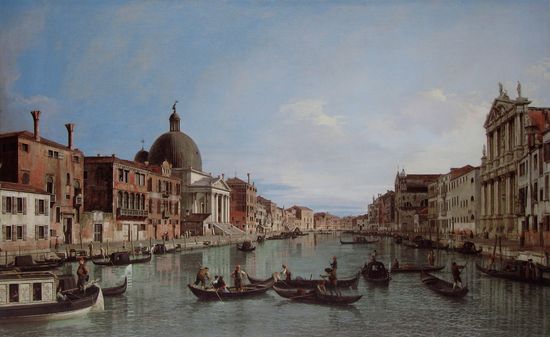
CanalettoVeniceUpperReaches

The perpetrator is Canaletto, who died in 1768:

The sun always shines in Venice; the sky is always blue. This is how visitors like to remember that most beautiful island city. Not coincidentally, that is how Canaletto most often painted the place. His clients, after all, were Grand Tourists, many of them back home in dark English country houses, worrying about farm rents. They longed for the gorgeous, licentious place their memories turned into paradise.

The fact is that in the 18th century and today, Venice would win the title of bronchitis capital of the world if such a contest existed.

One December when I lived there (I know, lucky me—and I felt that way too, when I wasn’t shivering and coughing), the sun came out exactly once. It was a feeble appearance, too, as if Sol exhausted himself in the struggle to get through the fog. In Canaletto’s time, of course, there were more worrying illnesses to worry about, such as syphilis, to name one. But never mind, as the English are inclined to say. Never mind the smell of drains and wilting heat in summer, the pickpockets and the cheating restaurateurs. Venice is heaven, or as close to it as urban life can get. That is the important thing. Some 60 examples of painted propaganda in support of this make up “Venice: Canaletto and his Rivals”, which just opened at London’s National Gallery. The works of Giovanni Antonio Canal (1697—1768), otherwise known as Canaletto, are rightfully the heart of the show.

(Image: Wikipedia Commons)

Dan Choi’s Vindication

He re-enlists while the ban remains unenforced during the injunction imposed by Judge Virginia Phillips:

(Hat tip: Joe.My.God.) More details on new gay enlistments in this window here. I remain very proud of my friend. And of his tenacity and clarity. Money quote from the NYT:

R. Clarke Cooper, the executive director of the Log Cabin Republicans, applauded the Pentagon decision as “a huge deal.” … Mr. Cooper, a member of the Army Reserve, said that he was taking part in training last week at Fort Huachuca in Arizona when the injunction was issued, and that he was surprised by the lack of visible opposition or outcry. He likened it to a “giant shoulder shrug of ‘so what?’ ” Most of the people he was with, he added, were younger members of the service, and “a few people actually thought repeal had already occurred.”

The Road Not Taken

Two honest right-leaning writers, libertarian Matt Welch and conservative Tim Carney, agree that had John McCain been elected in 2008, domestic policy largely look the way it does now, healthcare excepted, and that our foreign policy would likely be far worse. They're also concerned, as the Dish is,  that if Republicans retake the House, especially under current leadership, the K Street faction will coopt them, or else they'll take up social issues because the real fiscal choices are way too hard for them to win re-election on.

If more voices on the right were similarly skeptical of folks on their own side, there might be enough accountability to advance small government ends through a GOP controlled Congress. More power to them. Unfortunately, the most trusted voices on the right — people like Limbaugh, Hannity, Palin, Levin, and Beck — are either partisan hacks, ideologues who abandon small government principles whenever the word terrorism is uttered, or… well, who can say what Glenn Beck is?