Back To Chalabi?

Eli Lake covers US outreach to Iraqi political actors:

On Wednesday, Brett McGurk, the senior State Department official responsible for policy on Iraq, met in Baghdad at the home of Ahmed Chalabi, the former exile leader who was supported by neoconservatives inside the Bush administration before the Iraq war.

The meeting, first reported by The New York Times, was the first time McGurk had traveled to Chalabi’s Baghdad estate, according to Chalabi’s Washington adviser, Francis Brooke. “They discussed the current politics and Dr. Chalabi told him it would be very difficult for (Nouri al) Maliki to continue as prime minister,” Brooke told The Daily Beast.

Uh-oh. Then this:

Brooke would not say if Chalabi was eyeing the top job himself. But he did point out that the former exile leader—who is now a member of parliament and a senior member of the Shi’ite party affiliated with Iraq’s powerful Hakim family—supported the creation of a national reconciliation committee and the release of Sunni prisoners detained without charge. What’s more, Brooke added, Chalabi “is now open to reconsideration of the national de-Baathification law.”

That’s the law that purged members of Saddam Hussein’s Baathist party from Iraq’s government—the law that Chalabi helped write. Not surprising, the de-Baathification law is one piece of legislation that has infuriated Iraq’s Sunni minority, who say it has been used to isolate their leaders from important national positions.

But Beauchamp doubts booting Maliki would do much good:

[T]he core of the conflict is that Sunnis and Shias want the government to look dramatically different, and be run by different people. That is an astronomically difficult problem to solve on its own terms. The idea that the United States could pressure a solution to it — in the middle of a civil war — overestimates how much influence America has over Baghdad .

It’s not that Sunni-Shia divide is totally intractable. As [Marc] Lynch notes, there have been opportunities to make deals that would have significantly calmed sectarian tensions. Deals that Maliki rejected, of course. And perhaps the US could help broker negotiations at one point in the future.

But the idea that the US could solve the deeper problems fueling the insurgency by removing Maliki oversimplifies just how deep those problems go, and ignores the bigger and more difficult issues. Removing Maliki is a first step, but the broader causes of the chaos in Iraq run much deeper than his administration.

This all feels like some sick, recurring nightmare. Because, after all, trusting Chalabi the first time around worked out so well, didn’t it?


No Place To Sleep, By Design

b41fdad26

Robert Rosenberger calls attention to urban design choices meant to deter the homeless:

An example of a pervasive homeless deterrence technology is benches designed to discourage sleeping. These include benches with vertical slats between each seat, individual bucket seats, large armrests between seats, and wall railings which enable leaning but not sitting or lying, among many other designs. There are even benches made to be slightly uncomfortable in order to dissuade people from sitting too long.

Sadly, such designs are particularly common in subway, bus stops, and parks that present the homeless with the prospect of a safely public place to sleep.

When thinking about this landscape of homeless deterrence technologies like the benches and still-ubiquitous spikes, it is important to consider the role of laws against loitering. For many cities, loitering laws have the effect of enabling law enforcement to arrest the homeless simply for being around. Such regulations target things like sleeping in public, panhandling, or even outdoor charity food service. This further complicates the relation of the homeless to this public landscape. Why do you think the homeless so often choose bus stops in particular as a place to sleep? One reason is surely that it affords a kind of plausible deniability: I was just waiting for the bus.

The Inept Iraqi Military

Jassem Al Salami surveys the fruits of all that American aid and training:

The Iraqis’ aerial tactics are sloppy. Instead of orbiting a target area at a safe distance in order to gain full awareness before attacking, Iraqi pilots tend to fly straight in firing rockets and guns at close range. The absence of zooming optical gear might explain that reckless pattern. These tactics not only compromise the aircraft’s effect on the battlefield, they also expose Iraqi pilots to ISIS ambushes. The Iraqi army has already lost at least one helicopter west of Baghdad.

Iraqi armored units are no better than the air force and army aviation. ISIS rides mostly in “technical” armed pickups, whereas the Iraqi army possesses modern M-1A1 main battle tanks and BTR-4 armored fighting vehicles plus older T-72 and T-55 tanks and BMP fighting vehicles. ISIS cannot match their firepower. But almost no Iraqi armor has even appeared on the battlefields in Mosul, Tal Afar and Kirkuk—except in videos depicting ISIS fighters destroying abandoned vehicles. Perversely, the only tanks that we can confirm have taken part in the fighting are the six T-55s now belonging to ISIS.

Dividing the military with sectarian meddling, in Zaid al-Ali’s words, was just one of many ways in which Nouri al-Maliki has squandered his country’s hard-fought security gains over the past few years:

On the day Tikrit fell, Iraq suddenly changed: Violent government-backed militias were suddenly allowed to operate openly in Baghdad and Baquba, manning checkpoints and organizing security without any oversight. Senior Iranian military commanders landed in Baghdad to help organize the city’s defense. Finally, in an effort to rally his base against ISIS, Maliki called for volunteers to take up arms against the militants and extremists — ignoring the fact that the military’s problem was never a lack of manpower. It was the clearest admission of failure possible.

Maliki micromanaged the security forces for years, and in the end he didn’t even trust them, choosing instead to let foreign-backed militias and untrained volunteers defend the capital. Meanwhile, one week after Tikrit’s fall, Baghdad had done nothing to free it from ISIS, abandoning its citizens to their fate and allowing the militants to reinforce their positions free from interference.

This was no accident, Keating suggests:

I’ve written about this a bit in reference to Qaddafi’s rule in Libya, but authoritarian rulers—and Maliki is clearly at least headed in that direction—often prefer not to have a strong and professionally organized military. As Hosni Mubarak learned a few years ago, strong militaries can turn on you when the going gets tough. But such “coup-proofing” obviously comes at the expense of the military’s preparedness for outside threats. Maliki made it abundantly clear to U.S. officials that one of his primary concerns was the possibility of a military coup organized by Saddam Hussein’s former officers. The best protection against such a scenario is not a large, well-trained, multiethnic military but a small elite fighting force selected on the basis of loyalty.

Even so, Kirk Sowell expects the Iraqi army to beat ISIS in direct fighting:

In Tal Afar this week, ISIS was initially able to gain some ground there because it’s out in the west, harder to resupply. But after the government sent more units out, they were able to regain the initiative. ISIS has around 10,000 fighters, and the Iraqi army still has 200,000. ISIS doesn’t have an unlimited supply of personnel, so these direct fights – like in Tal Afar – just drain them.

Syria has a much greater impact on Iraq than Iraq has on Syria. Having this rear base in Raqqa has been great for ISIS – it’s what allowed them to organize and recruit and train their fighters. If you take parts of Anbar and Nineveh, in Iraq, and Deir Ezzor and Raqqa and parts of Hassakeh, in Syria, that’s the so-called Islamic state. But these aren’t areas they totally control, and once Baghdad sends high-quality [military] units up to Mosul, ISIS is not going to be able to hold its ground or form an administration or anything like that.

But Zack Beauchamp points out ISIS’s skill advantage over the Iraqi forces:

[Nathaniel] Rosenblatt and [Yasser] Abbas [of private research firm Caerus] say there’s been an influx of skilled Saddam-era military leaders and soldiers into ISIS’ ranks. “When you look at some of the reports about the leadership under [ISIS commander Abu Bakr] al-Baghdadi,” Rosenblatt said,  “those second-in-command guys have very strong ties to Saddam’s army.” Acquiring lots of weapons, money, and experience over the course of the Syrian war allowed them to translate that new training into real military effectiveness.

It’s hard to overstate how much of advantage this training and professionalism gives the Islamist group. “ISIS knows how to use smaller units” effectively against larger forces, says [researcher Phillip] Smyth. They’re “very efficient, and you have to deal with that.”

This matters greatly. An undisciplined force, one whose movements aren’t well coordinated or can’t deploy proper tactics for taking city blocks, can be beaten by a much smaller opponent that knows what it’s doing.

Engaging The T, Ctd

One of our G readers can relate:

I loved the email from your transgender reader, recounting the normalcy of her MTF life. I admire how she successfully navigates in her complicated hi-tech office world and rejects transgender movement cant. There were no weepy complaints about anti-trans “hate” – which exists, to be sure, but is often overblown. She’s essentially my trans-analog. As a gay man I experienced in the gay world what she’s experiencing as a trans person. I always wondered if there were people like her out there – so glad to hear there are.

When I came out 25 years ago, I thought I’d be meeting guys who were basically like my straight buddies, except for sexuality. I’d read Andrew Tobias’ book – I thought I knew how this coming out thing worked: lots of “regular guy” types, doing regular guy stuff, comfortable in their own skin with no interest in waging gender revolution.

Oh how wrong I was.

What I found was a community where most of the leaders, spokespeople, organizations, and figureheads were in full-scale retreat from gender, didn’t believe gender roles are biologically hard wired, and disliked even the slightest vestige of traditional masculinity. It took me a long time to adjust. I’d come out to a community that doesn’t really know what to make of people like me.

I sympathize with the DL gay athletes and celebs we read so much about. They are inevitably portrayed in the gay media as closet cases, cowering in fear, afraid to be true to themselves. It never occurs to the gay establishment that perhaps these guys are being true to themselves. Perhaps they don’t “come out” because they haven’t been offered anything worth coming out to. They see the gay community in 21st century America as a tedious bore, and at times a bit of a freak show.

Like your writer, I no longer truck with gay officialdom (I was an early member of my college gay rights group back in the day, and an original “ACTUP-er”). I have nothing to say to those folks that they are even remotely interested in hearing. I no longer describe myself, or even think of myself, as “gay”. The term is now about gender, not sexuality.

For men like me (not only comfortable, but raucously enthusiastic, about trad gender), it’s best to avoid Gayworld altogether. Like an agnostic in church, sooner or later it dawns on you to move along and find new friends. Let one of the true believers have the pew space.

I like the term “MSM” [Men who have Sex with Men], popular with DL African-American guys for years (although I realize black MSMs often have a touch of denial about sexual orientation, which seems to lead unsafe sex – not good). For “MSMs” like me, the Internet is perfect for finding like minded guys, and weeding out the rainbow-flaggers. I also believe the strictly apolitical bears represent a quiet rebuke to the gay left establishment. So I hang out with the bears whenever possible.

Gay groups that skew towards conservative interests are great places to meet normal gay guys. I go to Log Cabin meetings, even though I’m a moderate Democrat. I go to Dignity services, although I’m not a super devout Catholic. I hang out at gay country western bars, even though I don’t like country music. I’m not a great ballplayer, but I join the gay softball leagues. As a lawyer, I’ve found gay bar associations are a great place to socialize with like-minded guys, as long as the politicos aren’t in charge.  I’m even trying to break into a cop/firefighter/military gay group, even though I’ve never been any of those things. Strange yes, but extreme measures are called for once you’ve lost interest in rainbow flag world.

Of course, I have huge sympathy for my reader. I’ve long had issues with a super-gay world as portrayed by the pomo-left tendency. And I think many in the gay community don’t fully understand how their hostility to old-fashioned comfort in one’s own gender marginalizes many who deserve no such thing. As more gay men come out, this has changed somewhat. There are now far more places for men who have no gender issues and who enjoy more traditionally masculine pastimes to meet and congregate and socialize and find husbands and boyfriends and flings. From a plethora of sports bars to sports teams to online hookups, “non-scene” gays now have a foothold. But it’s a precarious one, and often subject to a certain amount of shunning or even ridicule.

In some ways, the emphasis on military service and marriage equality was designed to create an atmosphere in which more gender-conforming gay men could feel welcome, enfranchised, and equal in both the gay and straight worlds, and, of course, to reach a place where that division is not so clear-cut. But it can also mean a drifting away from the gay “community” in favor of a simpler and less defined way of life as a man who can fall in love with another man, or just fuck one. That’s in part what I mean by the end of gay culture. It may also be a birth of a new, and more inclusive, one.

Chart Of The Day

legality_of_lgbt_workplace_discrimination

On what other subject is the public so grotesquely misinformed? And what does it say about the acumen of the Human Rights Campaign that its Number One legislative priority for the last 25 years (with 76 percent national support!) remains as out of sight as ever? Just keep sending them your checks, guys. In another quarter century, you might get something back for them.

It’s OK To Call Her “Hillary”

I try not to, because it can come off as belittling a woman in politics, but maybe I shouldn’t care. Beinart grants absolution:

When was the last time you heard Nancy Pelosi, Sarah Palin, or Dianne Feinstein referred to primarily by her first name? When a man shares a last name with another famous pol, by contrast, he often gets the first name treatment. A certain ex-Florida governor is constantly referred to merely as “Jeb.” With his brother George W. Bush—who shared first and last names with his president-father—the press often accentuated his middle initial, as in “George W.,” “W” or even “Dubya.”

Kurdistan’s Moment? Ctd

kurdish-populations-map

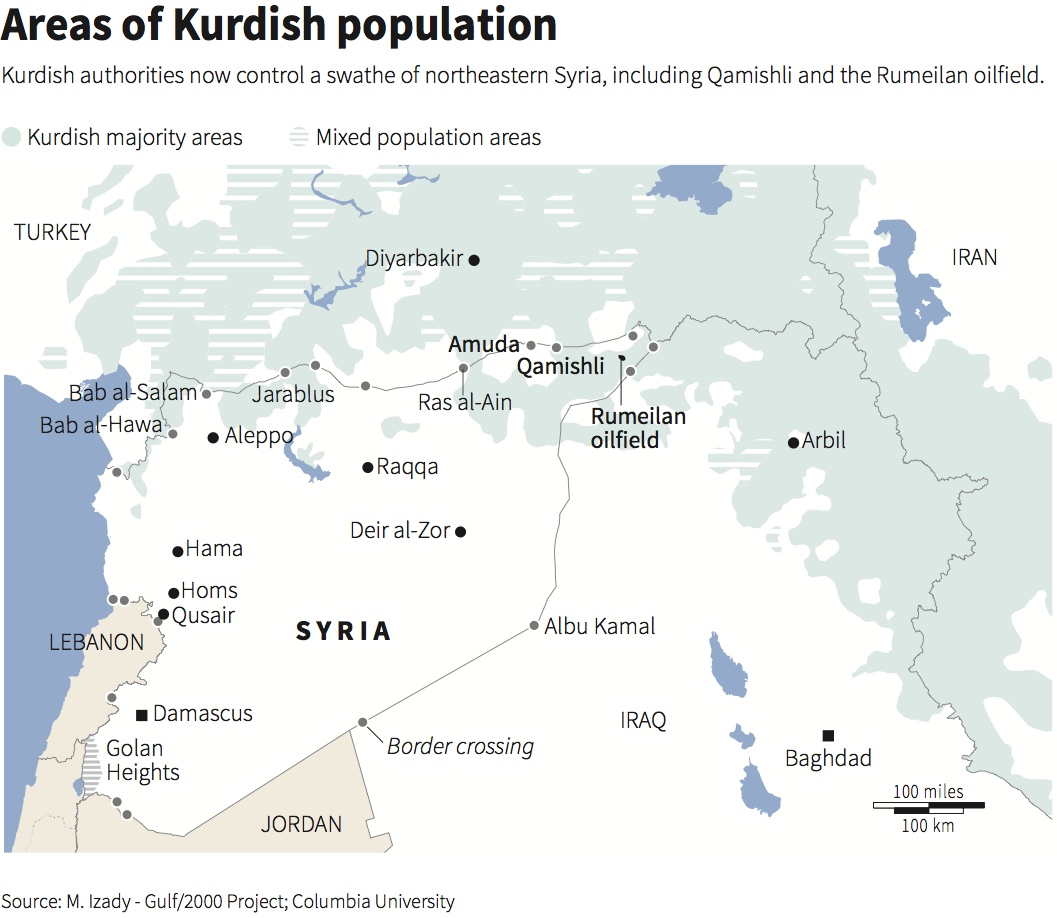
Iraqi Kurdish leaders are reportedly hinting that they’re on board with partitioning Iraq. That’s not surprising, as they’d get their own state out of such an arrangement:

Kurdistan Democratic Party figure Abdul Salam Berwari said in a phone interview with Al-Hayat, “The Kurdish political leadership sees since the 1990s that the only solution for the survival of a unified Iraq is to transform the structure of the state to reflect the population distribution of Iraqis. The basic components are the Sunnis, Shiites and Kurds, and the experience of the last 10 years supports what has always believed. … There is no solution except by establishing three regions for Iraq’s main components.” …

Pointing to the worsening differences between Erbil and Baghdad, Nechirvan [Barzani, prime minister of the Kurdistan Regional Government] told the BBC that Iraq can never return to the period before ISIS’s expansion and called on “Maliki to step down from office after the completion of the current phase,” [saying] “an independent Sunni region” is the “best solution to rule the country.”

Reporting on the Kurdish fight against ISIS in the north, Jaime Dettmer relays the peshmerga’s scorn for Maliki and his soldiers who abandoned their posts to the Jihadist advance:

Convoys of trucks carrying peshmerga, who flash thumbs-up signs when locals wave, have been scurrying along the highways of Iraqi Kurdistan strengthening positions in readiness to block jihadists and their Sunni militant allies from gaining any territory. But stopping jihadist infiltration will be no easy feat and the Kurds are relying on sympathizers among the Sunni tribes around Mosul and to the south of Kirkuk to alert them to ISIS movements.

The Kurds have no faith in the Iraqi military rallying and the confident note struck on Wednesday by beleaguered Iraqi Prime Minister Nouri al-Maliki only prompted peshmerga derision. In a televised address announcing that a fight-back had begun, he promised government forces would retake Mosul. But the Kurds don’t see al-Maliki as the man who can save Iraq: they blame his exclusionary Shiite politics for the disaster that has befallen the country. Like the Americans they want al-Maliki’s Shiite-dominated government to be replaced by one able to reach out to Sunni Muslims and start a process of reconciliation to undercut the jihadist exploitation of Sunni resentment.

Meanwhile, Marsha Cohen explores Israel’s longstanding, complicated relationship with the Kurds:

For decades, Israel has been a silent stakeholder in northern Iraq, training and arming its restive Kurds. Massimiliano Fiore, a fellow at the Department of War Studies at King’s College London, cites a CIA document found in the US Embassy in Tehran and subsequently published, which reportedly attested that the Kurds aided Israel’s military in the June 1967 (Six Day) War by launching a major offensive against the Iraqi Army. This kept Iraq from joining the other Arab armies in Israel, in return for which, “after the war, massive quantities of Soviet equipment captured from the Egyptians and Syrians were transferred to the Kurds.”

So what stake does Israel have in Kurdish fortunes today?

Less than a year ago, Lazar Berman of the Times of Israel, under the optimistic headline, “Is a Free Kurdistan, and a New Israeli Ally, Upon Us?” quoted Kurdish journalist Ayub Nuri who argued that Kurds were “deeply sympathetic to Israel and an independent Kurdistan will be beneficial to Israel.” Fast forward a year later to Neriah’s article titled, “The fall of Mosul could become the beginning of Kurdish quest for independence,” where he says nothing about the stakes for Israel. Would an increasingly independent Kurdistan continue to look to Israel as its patron?

Or will Kurdistan fully join an anti-ISIS Iraqi alliance, backed jointly, if discreetly, by Iran, with the approval of the US? Any scenario in which Iran is part of the solution, rather than the underlying problem, is a nightmare for Israel.

Previous Dish on the Kurds here, here, and here.

(Map via Jeremy Bender)

If You Liked The Old GOP Leaders, You’ll Love The New GOP Leaders

f073ace08

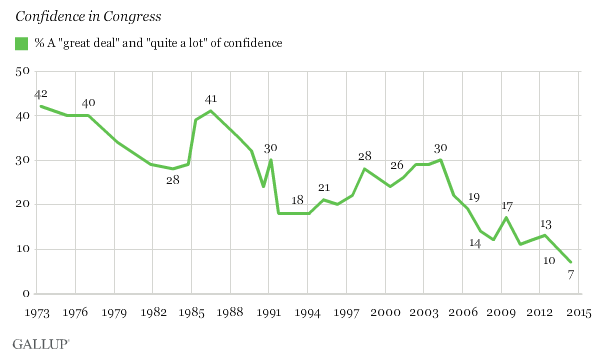
As the public’s view of Congress sinks to a near-incredible low in Gallup’s polling – not only the lowest on record, but also the lowest Gallup has recorded for any institution in the 41-year trend – House Republicans are staying the course. They just elected California Congressman Kevin McCarthy as the new majority leader yesterday, and Louisiana Congressman Steve Scalise to fill McCarthy’s former seat as whip. Ezra Klein doubts McCarthy will be much different from Eric Cantor:

They both want to cut taxes. They both voted for the Ryan budget. They both want to repeal Obamacare. And, for all the talk of Cantor’s defeat being about immigration reform, McCarthy has basically the same position on immigration reform: he’s abstractly for immigration reform, but he’s not going to bring any solution to the problem up for a vote. Which is probably as it should be. When the conservative columnist Ramesh Ponnuru dove deep into polls of tea party supporters, he was comforted by what he found. “Tea party advocates already believed the same things that regular Republicans did. They basically were regular Republicans, just, if you will, more so. The differences between the tea party and ‘establishment Republicans’ have largely concerned style and attitude rather than program and ideology.”

But Al Hunt expects immigration to be just as much a thorn in McCarthy’s side as it was for his predecessor:

McCarthy, who earlier served in the California Assembly, knows how the immigration issue has destroyed the Republican party in his home state ever since then-Governor Pete Wilson went on an anti-immigration campaign two decades ago. At every level of government in California, Democrats dominate consistently, running up big margins with the fast-growing Latino and Asian-American constituencies. But McCarthy also will lead a party in the House that has a strong nativist bloc, and may resist taking up a serious immigration effort in this Congress and perhaps the next one too.

More than a few political experts, including Boehner, believe this would be devastating for the party in national elections. McCarthy shares that view, but sensitive to his own party conference — he’ll have to be reelected to a leadership post after the November elections — he’ll be very cautious on the issue.

So does Dara Lind, who observes that McCarthy’s position on the issue is deeply unpopular:

In January, before House Republican leadership released its principles for immigration reform, McCarthy told local television station KBAK/KBFX: “In my personal belief, I think it’ll go with legal status that will allow you to work and pay taxes.” But extremely few people actually support “legal status” that doesn’t result in citizenship for the undocumented. Most Americans want unauthorized immigrants to become citizens, either immediately or eventually; most of the rest want them deported. … There’s no real middle ground.

Weigel calls both McCarthy and Scalise “safe as milk” come November, which he suspects was part of their appeal:

If you’re looking for a “conservative victory” here, look to Scalise. The fast-talking Southerner bested Rep. Peter Roskam, a deputy whip who’d been groomed for big things, and Rep. Marlin Stutzman, a sort-of Tea Party candidate who nonetheless gets farm subsidies back home in Indiana. He becomes, as some reporters quickly pointed out, the first Republican from a “red” state to take a leadership job since Barack Obama won the presidency.

But “red state” is a sort of useless term when you’re talking about congressmen. The victories of McCarthy and Scalise are good news for Republicans who want to avoid future Cantordammerung-style upsets. Why? Simple: There are three states where party primaries have been replaced by jungle primaries, followed by runoffs between the top two finishers. After John Boehner, the rest of the GOP’s leadership hails from these states.

Jonathan Bernstein cautions against reading too much into these choices:

House leadership is quite important. But it is also severely constrained by the conference’s stance on issues of public policy. On the margins, or perhaps a bit more, leadership has some ability to choose the bills it will schedule and those it will bury, and perhaps one leadership team is more able than another to get over the finish line to 218 votes. But it’s not as if the conference will automatically fall in line with whatever leadership wants. Leaders who misjudge what individual members want is the perfect recipe for coups.

So today’s elections are meaningful. Just don’t be too sure you know exactly what they mean.