A reader writes:
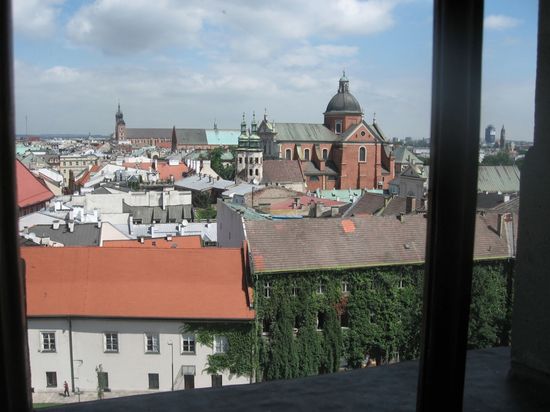
Alrighty, this is somewhere in Europe. Given the haphazard nature of the streets, this could be a medieval city, but the architecture is more modern. The red brick church with the stone neoclassical front indicates that it was probably built in the mid-1700s or later. The tower in the background on the left looks like this one in Delft, Netherlands, but the surrounding buildings don’t match up, and the city appears to be much larger than Delft. I’m going with Brussels, Belgium.
Another writes:
Constanta, Romania? Okay, here’s my logic: This city looks like Central or Eastern Europe, but there appears to be water in the background, and it strikes me as an inland body of water rather than, say, the Mediterranean. I thus looked for cities on the Black Sea, and images of Constanta appear to be similar. I’m sure that even if I’m right, someone else will come up with the exact address, but what the heck, I’ll give it a shot.
Another:
Y’know, this might actually be in Copenhagen. Wish I could find this scene via Google, though. The architecture matches, it’s very flat, there’s what looks like a big body of water in the background. The problem with the architecture is that it also matches so many other places. I saw towers and cathedrals exactly like that in Vilnius, Lithuania, which was my first guess, and searching for “copper domes” or cathedrals brought up some awfully similar places in Ireland. But, I’ve got to say something, and I can’t keep searching Denmark and Lithuania all night, so Copenhagen it is.
Another:
In the foreground is one of the beautiful courtyards at the historic Vilnius University (founded 1571) in Vilnius, Lithuania. The Old Town of Vilnius, where the university is located, is a beautiful, dense, well-preserved medieval city that has been designated a UNESCO World Heritage Center. The steep roofs are typical of the cold and snowy Baltic countries. Vilnius is very much a city of churches (some of them turned into tractor factories or “museums of atheism” during the Soviet period), several of which you can see in the background of the photograph.
Another:
Riga, Latvia? I spent three days there with my brother four years ago. We shot guns in a former Soviet military encampment, ate a palate-cleanser made from balsam and liquid nitrogen and drew so few sober breaths during my time in Latvia that I’m surprised my mouth didn’t catch fire every time I lit a cigarette.
Another:
I think it’s Riga, with a view of Riga Cathedral. I was there in the dead of winter 2008, tracking down genealogical information for my grandfather. My first ancestor to immigrate to the US was a Jewish woman who left from the port there as a young teenager in the mid-1850s. She worked in a garment factory in Boston, married a man twice her age, and was widowed young with four children. My grandfather met her in the early 1930s, and was always impressed with her fortitude.
Another:
This is most certainly Prague. I don’t feel like finding the exact address, as I will not win, and I have no story to complement my guess. I had the floor of the hotel in Tromsø and the address in Talinn without result. I just greatly appreciate the “game”. For kicks I will say Melnická, Malá Strana 13, 4th floor, though as my Swedish fiancee (who is far more thorough than myself) is experiencing California at the moment.
Another:
I love this contest; it’s a way to indulge my wanderlust. I also teach two sections of a Freshman Writing class. We’re using a travel motif this semester; the readings and assignments are travel related. Since the class meets M/W, it has been easy to incorporate VFYW as the concluding bit of every 1:20 min class, and it makes the last 5 minutes zip by. Mondays we look at what was posted the previous Saturday; my students air their opinions and vehemently argue their differences. I try to point out what seem to be distinctive features of the photograph. My guess is as good as any of theirs. On Wednesdays, we check to see how wrong we were.
In both my classes today, the consensus was that this was Northern European (the churches, the ivy, the red sloping roofs; the medieval architecture in the foreground with modern-looking steel and glass buildings in the background etc.). In my 1:30 class, Eric declared confidently that it was Munich. Some basic googling suggests that he may be right. Someone will of course write in with the precise coordinates , and claim that he/she got married in that very church and their first grandchild was christened there last summer. Still, if it is Munich, or some comparable German city, please give a shout out to Eric.
Not Munich, but hi Eric. Another:
If this isn’t a photo of Bazylika Mariacka (St Mary’s) in Gdansk, Poland, I’ll be embarrassed. I spent Christmas Eve there in 1992. The view is from the south, I believe. Using google maps satellite view, I am thinking it might have been taken from the history museum.
Another:
My sister and I used to call them ADCs – Another Damn Church (or Cathedral or Castle) – first labeled when we were 16 and 18 years old and running amuck with two months of free rail travel and instructions from Mom to “absorb the culture.” We obligingly visited hundreds of ADCs over the next three summers (we were living in Brussels at the time) but I can’t say that I ever picked up the fine details that would help me suss out this particular set of churches – are there touches of gothic or are they Romanesque?
In any case, I feel like we are in the north and east of the continent, amongst a mostly Catholic population (three big churches on one street), with a hint of the Germanic among the buildings. It’s flat, so I’m guessing Poland. Given the out-of-the-way places of late, I avoided looking at the big cities and a quick google maps scan of a few mid-sized cities lead me to Gorzow, which might be close – but no time to really investigate as I’m sticking with my pledge not to devote more the 15 minutes to this addiction per week …
Another:
My intuition said Czech Republic. It wasn’t Praha or Plzen. I image-searched the cities nearby and thought of Krakow. Then I had to leave. When I came back home, my sister had identified the church towers. I was happy we’d found the spot. But… with a place that well documented (better than Cabanaconde!), I’m afraid we’ll have to get the very window right. 2D geometry hints at the tower. 3D imagination gets me to the floor I marked in the picture.
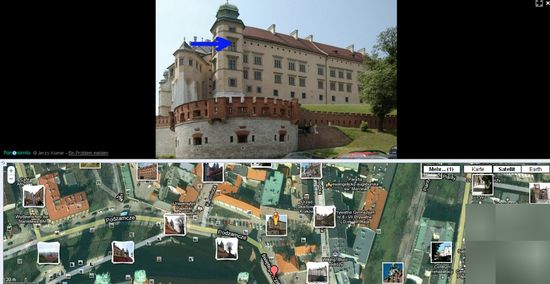
Should I win the book, I’ll share it with my sister!
Another:
It’s Krakow, Poland, 100% sure. It’s my mother’s hometown (she came to the U.S. in 1978, after marrying my father, a second-generation Polish American). First thing I noticed that triggered recognition was the color of the roofs, the same one I remember seeing there and no where else. From satellite images, you can tell the orange color is common. Next up, Mary’s Basilica, seen in the distance in the top left of the photo. It’s very famous for having two towers of different heights, and from the taller one, a trumpeter sounds the hour (interesting tidbit: the last note he plays is cut short to honor the death of the trumpeter who was shot by an arrow while playing as Mongol hordes were invading, I believe in 1241). So with that, you can also orient the view from the window (the church faces west, so the view must be coming from south of it).
It also must be on higher ground, suggesting to me Wawel Castle/Cathedral, home of dead kings, presidents, poets, other great Polish patriarchs, smok wawelski (the dragon who supposedly lived underneath it until tricked by a shepherd into eating a salted lamb which made him drink so much of the Vistula River that he popped), and most recently, comedians (Lech Kaczy?ski).
As for specific view, I think I’ve narrowed it down to within about 30 feet (or 10m), here. This is the VFYW contest I’ve been waiting for … a perfect excuse for staying in on Saturday night.
Another:
Beautiful photo! I’m addicted to this contest but haven’t been able to pin point the location, until today! The red roofs initially led me to Bavaria and all the beautiful cities in Germany. However I know many, many cities in Germany and across eastern Europe give off a “feel” like the one in the photo. So to narrow it down, I focused on the white church in the center. The fortressesque paired towers and copper spires look old and very unique. I did some searches for circular arches, paired towers, etc. and found it on the Romanesque Architecture Wikipedia page—the octagonal paired towers are that of the St. Andrew’s Church, in the Old Town district of Kraków, Poland! The larger baroque church behind it is the Church of Sts. Peter and Paul.
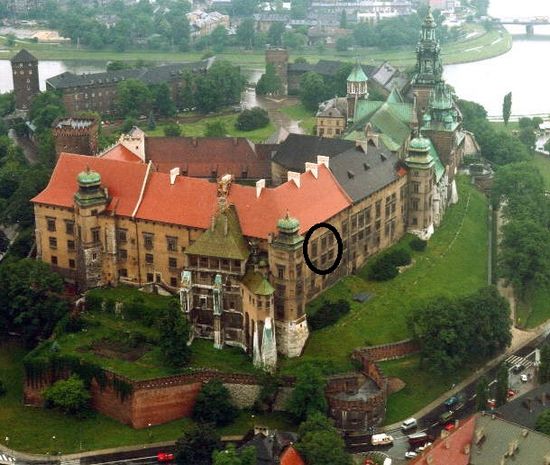
Based on where St. Andrew’s church appears in the photo (and the immense vineage on the building in the foreground) the photo appears to be snapped from the Wawel Royal Castle high up on Wawel hill. Attached is a photo of Wawel Royal Castle with a circle around the likely window. This makes me want to go to Poland (or, until I find a job, the G train to Greenpoint)!
Another:
The two churches in the center are St. Andrew’s (which dates from the 11th Century, thus not named for Andrew Sullivan) and the Church of Sts. Peter and Paul.
Another:
I think it’s the window in the attached image.

Now with this one you really had me going; I searched for 6 hours. I’ve been a Dish reader since 2002, but you’ve never me engaged like this. The moment I saw this picture it felt like home or very near home, but I didn’t know why (home is in Erlangen, Bavaria). So I tried to narrow it down.
It’s definitely European and it has this Habsburg look of many towns of the former Austrian empire. But I wasn’t sure. The first insight was the chimneys, there are too many of them, so it can’t be in southern Europe. It’s cold there sometimes; there’s snow and rain. I immediately thought that this was Prague but there are no similar churches or any view like this there. The next step was the colour of the roofs. There were a lot of metal roofs, in Germany or Austria metal roofs are rare. In France there are a lot of metal roofs but the town would look much more dense (I learned that from looking at hundreds of roof pictures). So at the end I settled for eastern Europe, somewhere in the former Austrian empire. I went to Google Maps, saw Krakow, Googled “Churches Krakow” and everything matched immediately.
Thank you for the fun. It’s the first riddle I solved with my 9-week-old daughter; she was sleeping on me while I googled chapels, churches and roofs of every Austrian town. If I win I’m going to visit the window with her. I wanted to go to Krakow anyway and now I have a memory to share.
There were so many wonderful entries for Krakow, but we have to pick one. So the winner of this week’s contest was the first of two previous correct guessers to submit a Krakow entry. He writes:
Ok, after getting cities right twice and not winning, I am going to be super specific, even though I imagine hordes have beaten me to this. The view is from the Wawel Royal Castle (or Zamek Królewski na Wawelu) overlooking where the streets Podzamcze and ?wi?tego Idziego intersect (roughly where the foliage covered building and the clay-colored roofed building adjoin). The window itself is in the smaller of the two towers near the bulge in the wall – let’s say the middle of the three windows shown in that tower in this photo.
If I can win this contest once, I think I can stop caring so much!
Congrats, and we will get a Blurb book out to you shortly. Below are some of the more memorable entries for Krakow. One reader writes:
What luck! I’ve never been compelled to try my hand at this contest, but I just recently returned from a trip to Prague, L’vov and Krakow on break (I’m currently studying abroad in Moscow). I was in Krakow not three days ago; in fact, when this VFYW was posted at noon eastern time, I was entering my 18th hour on a Ukrainian motorcoach to Prague. So, to my surprise and delight, the sight of the Peter and Paul Church immediately gave me flashbacks of seeing it from the belltower of the Wawel Cathedral. It looks very much like my picture of the cathedral, only closer, and it looks like the photographer is lucky enough to live in Krakow.
Another:
I absolutely love the city. I lived there in 1998 for a couple of months. Last summer, I faced the disappointment of returning and seeing how much sex tourism has taken off there. It was nowhere near becoming the bachelor-party capital of Europe when I lived there. I still think it would be a good place to settle, but I’d probably spend most of my time in the Planty park that surrounds the downtown area (jump out this window and walk a little bit to the left to get there). Thanks for the picture, it brought back some nice memories.
Another
Just a cool story from my own travels: As a white, Jewish 21-year-old New Yorker backpacking through Krakow in March 2002 by myself, among the incredibly friendly people of Krakow was a fellow New Yorker – a black Puerto Rican who had moved to Krakow to teach English after having seen his family torn apart by crime. We met in an internet café on what was to be my last evening in Krakow, but very quickly, I decided to extend my stay for an extra day. During those 24 hours, I got a tour of some of the parts of the city that were definitely not on my itinerary. I’ll never forget the fantastic little restaurant in an alley off the main square featuring live jazz and some of the best food and beer (love Zywiec) I’d ever had. I haven’t spoken to or heard from him since.
Another:
That’s my partner’s hometown! We play this game every week but never send in our guess. The view is from the northern wing of Wawel Castle. It’s probably from a window of one of the 2nd floor State Chambers, specifically the Sala Pod Ptakami (The Hall Under the Birds). This room is lined with painted gilded leather and birds dot the ceiling.
The middle of the picture features the twin white limestone towers of St Andrew’s Church on Grodzka Street, which is next to the larger, domed, red brick Lesser Basilica of St Peter and Paul. Further away you can see the Dominican Church; it has the partial gray-green patina copper roof that appears to blend with the roof of St. Mary’s Basilica at the Main Market Square. On the horizon to the far right you can see the “Szkieletor”, a 300 ft unfinished Soviet-era high rise office building dating from 1975. It’s now a gigantic billboard.
By the way, we live in Andrew’s native country (England) because we couldn’t legally be together in our homes in the US or Poland. We have an official Civil Partnership in California but it’s not recognized by either the US government or Poland. That document is accepted by the UK government (Conservatives, Labor, and Liberal Dems), who are all more than happy to let us live in peace and equality in London.
Another:
I spent a long weekend in Krakow in April 1997. I went to visit a friend who was living with his girlfriend in the old Jewish district of Kazimierz, which lies south of the area in this photograph. I believe the photo was taken from Wawel Castle.
Some happy memories: bar hopping in Kazimierz, listened to Klesmer music in the old ghetto, visiting the old Jewish cemetary, wandering the deserted, dark streets of old Jewish quarter in the early morning hours. My friend and I visited Oskar Schindler’s factory, which was not marked by anything except a plaque to 3 Australian crew of a bomber which crashed into the factory in 1944.
Krakow was a mix of Catholic and Jewish heritage, a history of scholarship combined with anti-Semitism, and a tough working class culture which was ascendant during Communist times and which was losing its power as Poland geared up for the new century. I found it to be a sad but hopeful place, on the cusp of something new.
 The Dish