Mechanical Proust

John Horton has started an automated crowd-written blog called Mechanical Proust.  Contributors answer basic questions taken from the Proust Questionnaire. They are paid by Amazon Mechanical Turk, an "online market where people perform simple tasks for pennies, like labeling photos, though more recently, social scientists are using it to do online experiments." Horton learned:

Most of the responses are unsurprising but they are occasionally poignant or insightful. People are proud of their children. They regret dropping out of school. They want to live in Paris. They fear dying and being alone. They like chicken dishes, etc.

(Hat tip: Samuel Arbesman)

Shell Art

105182686

Trent Gilliss admires the latest installation at the Tate Modern by Chinese artist Ai Weiwei:

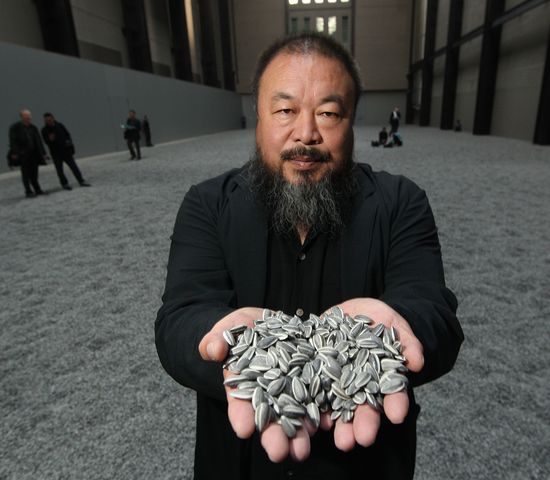
Chinese artist Ai Weiwei’s latest installation at the Tate Modern is an incredible feat: one hundred million hand-painted pieces of porcelain that resemble the shells of sunflower seeds. 

Sadly, they have stopped letting visitors walk across the sculpture due to dust.

(Photo: Peter Macdiarmid/Getty Images) 

The Karma Of The Tea Party

Here's a somewhat rose-tinted glasses view of the movement's core rationale. And I agree with it, for the most part: people need to be held responsible for the consequences of their own actions or we end up in collectivized hell. On the banks, my heart agrees, but my head doesn't. Alas, their total implosion would have brought down everyone else. Ditto the pragmatic attempt to save the auto industry, which, amazingly, has not been a disaster. And health insurance? We already have socialized medicine in America because of the guarantee of emergency room care. And of all things people should not be held responsible for, and where, as Hayek noted, some form of social insurance makes sense, is poor health, which can hit the most responsible member of society, and without insurance, bankrupt her.

So the general principle I agree with. I oppose dependency on government; I support and have long internalized the karma Jonathan Haidt describes. Hence my support for means-testing social security, raising deductibles for Medicare for those who can afford more, opposing nation-building, etc. But I don't see Obama as the prime mover of these things – just a pragmatic manager of them. (On foreign policy, I think he's more TP karmic than the neo-imperial neocons). And I do not trust the GOP to really do what's necessary to get us back to fiscal responsibility, and reactionary on social issues.

The Cameron Tories on the other hand? Never been prouder …
What Should They Be Called, Ctd

Adam Serwer fights back against my defense of the labels "illegal immigrant" and "homosexual":

The reason anti-gay rights advocates like to use "homosexual" is because it evokes being gay as a clinical condition — which makes it easier for people like Colorado Republican Senate candidate Ken Buck to compare being gay to alcoholism. For them it's a disease, it's a disorder, and so it must be referred to in scientific-sounding language. Communities reappropriating slurs against them is probably as old as the use of language as a tool for oppression, but that doesn't actually happen if the term is actually "neutral" as we use it in contemporary language, not as it is itself defined.

That's so gay. Would you say the same for "heterosexual"? That sounds just as clinical. Most of the time I use "gay". Maybe we can all agree that the only thing no one should ever write or say is "LGBT". It looks and sounds like a place in Bosnia.

What Will The Feds Do If California Legalizes Pot? Ctd

MarijuanaProhibitionGettyImages

Mark Kleimen unpacks Eric Holder's vow to enforce federal drug laws in California should the state legalize marijuana: 

[Holder's threat] means that the commercialization provisions of Prop. 19 – taxation and regulation via local option – are a dead letter. Presumably the Justice Department would ask for an injunction barring any California official from issuing a license – in effect, a license to commit a federal felony – under Prop. 19, and I expect that the courts would issue such an injunction. Even if no injunction issued, any grower or retailer who filed California tax or regulatory paperwork would be confessing to a federal felony. So there wouldn’t be open commercial growing or (non-medical) sale.

That doesn’t effect the home-growing provision of Prop. 19: anyone who owns or leases property could grow one 5?x5? plot per parcel. Since that activity will be legal under state law, state and local cops won’t be able to investigate, and there’s no way the feds have the resources to deal with 25-square-foot grows.

The big question left unresolved by Holder’s announcement is the behavior of state and local cops with respect to commercial growing and (non-medical) retailing. If no county or municipality can issue a license, that activity will remain illegal in California. If California law enforcement continues to enforce those laws vigorously, nothing much will change. If not, there’s no way to put enough Federal resources in the field to make up for the absence of state and local enforcement, and California will become the cannabis supplier to the rest of the country, and probably Canada.

Yglesias agrees with Kevin Drum that confrontation with the fed is one of Prop 19's greatest selling points:

At the end of the day there’s a real need to revisit the underlying premise that regulating the availability of a moderately unhealthy recreational substance is something that needs to be done at the federal level. Especially given that this is a country where, in practice, police authority is overwhelmingly exercised at the state and local level I think it would make a lot of sense to decentralize policymaking on this front. But Congress isn’t going to just take up the cause for no reason, only an atmosphere of crisis would prompt action.

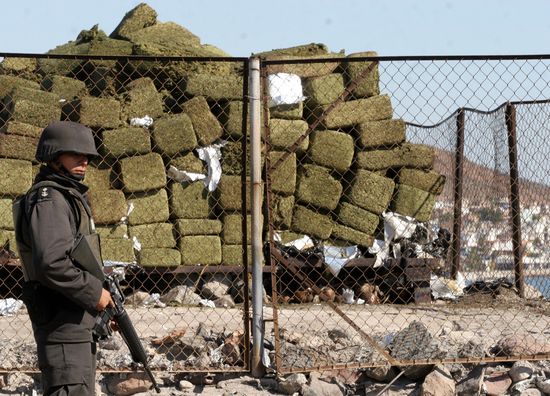
(Image: A member of the Mexican Army stands in front of four tons of marijuana prior to being incinerated 25 January 2007 at the naval base in Topolobambo, Sinaloa State. By STR/AFP/Getty Images)

The Fundamentalist Threat To Liberal Democracy

The Economist interviews Damon Linker about his new book. Read the whole thing, but here's a critical point I've been trying to make for a while now. Fundamentalism is a real threat to liberal society, and without a revival of moderate, humble faith, we are in real danger:

History shows us that traditionalist religion can be compatible with various forms of non-liberal government (theocracy, absolute monarchy). The same can be said for strident atheism and totalitarianism. Conversely, when religion is liberal—when it makes few supernatural claims, when it is doctrinally minimal, and when it serves mainly as a repository of moral wisdom—it can play a significant role in a liberal society. But the relationship between traditionalist religion and liberal politics is far more contentious …

A deeply devout Christian—someone who places his faith at the centre of his life—will tend to think of himself first and foremost as a member of the one true church working toward the establishment of the kingdom of God under Jesus Christ, if not in this life, then in the next. His ultimate loyalty will be to Christ, just as the ultimate loyalty of the most observant Jew will be to God and the Torah, while a Muslim’s will be to Allah and the Koran. Liberal citizenship at its peak, by contrast, requires devotion to the liberal institutions and democratically-enacted laws of the political community above all else. That’s why American presidents and other high officials swear an oath to uphold the Constitution and not natural or divine law of any kind.

Not Knowing – And Still Acting

Jim Manzi fisks a NYT article on uncertainty in economics. It starts out well and then veers into, well, let Jim explain:

The author writes that “A depression seemed possible two years ago, and thanks to the ideas of economists, that didn’t happen.” [Bold added] But, as per the first half of the article, how do we know that a depression didn’t happen because of the ideas of economists? We don’t.

It is extremely hard to maintain awareness of our own ignorance when trying to make real-world decisions. The article ends with a quote by currently-fashionable behavioral economist Dan Ariely:

"If you have a simple problem, you can offer a simple solution. But the economy is a hugely complex problem. So we either simplify the problem and offer a solution, or embrace the complexity and do nothing."

But there is an unconsidered alternative that permits us to constantly recognize our ignorance, yet not be paralyzed: The Open Society. This is the whole point (in my view) of the institutions of representative democracy, limited, law-bound government, and free markets.

We are back to Oakeshott, Hayek and Popper, aren't we?

The Palestinian Morass Intensifies

Karma Nabulsi writes a personal account of the fractured state of the Palestinian struggle:

The way Palestinians see things, the fragmentation of the body politic – externally engineered, and increasingly internally driven – has now been achieved. This summer, even the liberal Israeli press began to notice that the key people in Ramallah, the Palestinian Authority’s capital in the West Bank, no longer discuss strategies of liberation but rather the huge business deals that prey on the public imagination.

Every institution or overarching structure that once united Palestinians has now crumbled and been swept away. The gulf between Gaza and the West Bank, between Hamas and Fatah, between Palestinians inside Palestine and the millions of refugees outside it, between city and village, town and refugee camp, now seems unbridgeable. The elites are tiny and the numbers of the dispossessed and the disenfranchised increase every day. There is, at this moment, no single body able to claim legitimately to represent all Palestinians; no body able to set out a collective policy or national programme of liberation. There is no plan.