A Problem You Can’t Scrub Away

Illinois recently became the first state to ban microbeads  those little plastic bits of grit found in some personal hygiene products. Katherine Martinko explains the environmental rationale:

Microbeads give facial and body scrubs a grainy texture for exfoliation, but they are an ecological nightmare. Because they range in size from 0.0004 to 1.24 millimeters, they are too small to be filtered out by water treatment plants. They get flushed into waterways, ending up in lakes where they float, absorb toxins, and get eaten by marine animals because they resemble fish eggs. It takes a freshwater mussel 47 days to flush out ingested microbeads.

Martinko shows how the decision has repercussions far beyond the Land of Lincoln:

Illinois’s ban is important, but one more statewide ban is desperately needed, since that would create a “distribution nightmare” for companies and force them to come up with alternatives. The CBC quoted 5 Gyres associate director Stiv Wilson: “Effectively by winning two states, you win the entire North American region.” New York, Ohio, and California all have anti-microbead legislation in the works.

Meanwhile, researchers are working to develop eco-friendly alternatives to the plastic beads. Alexa Kurzius considers the prospects of polyhydroxyalkanoate (PHA), a “bioplastic” made with fermented bacteria:

[T]he majority of microplastics tend to float, which means they move readily from your shower drain, through wastewater treatment plants, and into waterways. “It’s like the saying from Finding Nemo,” explains [researcher Kirk] Havens. “All drains lead to the ocean.”

PHA, on the other hand, is denser than water, and thus sinks to the bottom. When it sinks, it’s buried with other sediment or consumed by salt or freshwater bacteria. This is an improvement over synthetic microplastics, which are more likely to be eaten by microorganisms that mistake the tiny pellets for food. But if bacteria consume PHA, they break the substance down into water, carbon dioxide, biomass, and naturally occurring small molecules after a few months. These substances are relatively harmless compared to longer-living man-made plastics like polyethylene.

Update from a reader:

Just wanted make a slight correction to the quote you provide from Martinko. Microbeads can be removed by water treatment plants. Coagulation/flocculation removes particles down to 0.01 microns and granulation media filtration removes particles down to 0.5 um. So, microbeads wouldn’t end up in your drinking water.

Wastewater treatment plants, however, do not have the same emphasis on particle removal so, yes, microbeads do end up in receiving water ways.

Plate Invaders

Hannah Newman takes stock of the burgeoning “invasivore” movement:

Norman’s Cay is currently the only American restaurant north of South Carolina serving 800px-Pterois_volitans_Manado-e_editlionfish, but that’s likely to change soon, thanks to a fast-spreading trend seeking to use our appetites as a way to control the vast numbers of plants and animals colonizing new habitats and destroying native species.

Yet as the second lionfish taco quickly disappeared from my plate, I couldn’t help but wonder: Can we really take down invasives with knives and forks? If more of us eat lionfish, wild boar tenderloinAsian carp fritters, or garlic mustard pesto, will it make a difference?

Experts are skeptical, pointing out that once a foreign species has entrenched itself in a new place – such as the Indo-Pacific lionfish that has now virtually taken over the waters of the Western Atlantic, Caribbean and Gulf of Mexico – eradication is almost impossible. Critics argue that encouraging consumption might have the unintended effect of spreading harmful species even more widely. But the invasivores are undeterred, noting that their campaign is not only selling books and changing restaurant menus; it’s also spreading awareness of a crippling environmental problem that is rapidly homogenizing the world’s ecosystems and costing over $130 billion a year in the United States alone.

(Photo: The red lionfish [Pterois volitans] is one of two species of lionfish to colonize the the east coast of North America and the Caribbean. It’s pictured above its native habitat in Indonesia. By Jens Petersen)

A Day Late And A Dollar Short

Mulling over the link between “time poverty” and economic want, Konnikova contends that “in the case of someone who isn’t otherwise poor, poverty of time is an unpleasant inconvenience. But for someone whose lack of time is just one of many pressing concerns, the effects compound quickly”:

We make a mistake when we look at poverty as simply a question of financial constraint. Take what happened with my request for an extension. It was granted, and the immediate time pressure was relieved. But even though I met the new deadline (barely), I’m still struggling to dig myself out from the rest of the work that accumulated in the meantime. New deadlines that are about to whoosh by, a growing list of ignored errands, a rent check and insurance payment that I just realized I haven’t mailed. And no sign of that promised light at the end of the tunnel.

My experience is the time equivalent of a high-interest loan cycle, except instead of money, I borrow time. But this kind of borrowing comes with an interest rate of its own: By focusing on one immediate deadline, I neglect not only future deadlines but the mundane tasks of daily life that would normally take up next to no time or mental energy. It’s the same type of problem poor people encounter every day, multiple times: The demands of the moment override the demands of the future, making that future harder to reach.

The Best Of The Dish Today

photo(1)

So here’s a reason to be cheerful: this fantastic vignette of American democracy alive and well in Mississippi. It’s a Coffee Klatch of octagenarians at Kroger’s in support of Chris McDaniel, and a Democrat walks by:

“How, with no seniority and a promise simply not to get along with anyone, will you accomplish any of the things you want to accomplish?” shouted John Davis, a 77-year-old retired teacher who was shopping at Kroger’s grocery when he noticed Mr. McDaniel about to begin a meet and greet session with about a dozen local retirees.

“What have they accomplished lately by putting us in debt?” shot back Mr. McDaniel, who outpolled Mr. Cochran in the June 3 primary but is facing in a June 24 run off because he did not break 50%.

Mr. Davis, with finger-wagging emphasis, retorted, “What have they accomplished? They have accomplished airports. They have accomplished roads. They have accomplished schools.’’

Shit is going down. The Democrat is really way too loud and won’t sit down, but it only gets a little bit tense:

“Dissent is a good thing in this country but you don’t do it in that manner,” said Mr. McDaniel. He found a way to turn the confrontation into a dig at Mr. Cochran, who has refused to meet his primary opponent in a debate and has been criticized by Mr. McDaniel for not talking more about issues. Mr. McDaniel said of Mr. Davis, “He said more about his positions than Thad Cochran has said in his entire campaign.”

One woman praised Mr. McDaniel for maintaining his composure but told him to be tougher if he gets elected to the Senate. “When you get to Washington, don’t be that nice,’’ said Geri, who asked that her last name not be used.

The video is awesome too. Or maybe I’m just sick of Sunni and Shia and seeing some ancient Southerners have it out at Kroger’s is a balm.

So, anyway, it was Neocon Hathos Day on the Dish and you can get your dose of Cheney here. Kristol here. NPod here. Their unnerving fondness for Hillary Clinton here.

I threw up my arms at the CIA’s latest hopes for a war in Iraq and Syria, while trying to make sense of the resilient resistance to the most important breakthrough in HIV prevention in two decades. Oh, and Boies and Olson are channeling Jo Becker. In some cases, it doesn’t get better, does it?

Plus: the challenges of standing for a month for fitness’ sake; and what taking a simple walk is like if you have autism. Major ’80s nostalgia here.

The most popular posts of the day were Obama Caught Another Terrorist And The Right Can’t Handle It, followed by Have the Cheneys Finally Jumped The Shark?

Many of today’s posts were updated with your emails – read them all here.  You can always leave your unfiltered comments at our Facebook page and @sullydish. 15 18 more readers became subscribers today. You can join them here – and get access to all the readons and Deep Dish – for a little as $1.99 month.

See you in the morning.

(Photo: the triped this evening)

Demystifying Death

Reviewing Victor Brombert’s Musings on Mortality, a collection of essays on how a number of literary figures approached death, Joseph Epstein recounts Montaigne’s advice for considering your eventual demise:

Putting death out of mind as best one can is a mistake, or so Montaigne thought. Wiser, he felt, to think constantly about death, not so much to confront it—how, in any case, would one do that?—but to get used to the idea of its ineluctability, and also of the suddenness with which it may visit. “How can we ever rid ourselves of thoughts of death,” he writes, “or stop imagining that death has us by the scruff of the neck at every moment.” Better to familiarize oneself with the idea. “Let us deprive death of its strangeness,” he wrote, “let us frequent it, let us get used to it; let us have nothing more often in mind than death.” Montaigne himself claims regularly to have been besieged by thoughts of death, “even in the most licentious period of my life.”

… All learning, he believed, was to make us ready for the end, to prepare us for death. “To Philosophize Is to Learn How to Die” is the title of his essay, and major statement, on the subject. He hoped that when death finally did appear, “it will bear no new warning for me. As far as we possibly can we must have our boots on, ready to go.”

Even Forgotten History Matters

Slogging his way through Norman Davies’ two-volume history of Poland, Dale Favier wonders if it’s really worth it, given how many of the book’s details he’ll forget. Why he answers in the affirmative:

When I was young and foolish, I thought I could learn all of history and have it all available in my head, or at least a lot of European history, or at least a lot of English history. Now I know that almost all this stuff will fall right back out of my head again. That doesn’t necessarily mean it’s not worth doing. There is another kind of knowledge building up, a synoptic sense of what people have done and will do, what sorts of organizations have succeeded, what sorts have failed, and some of the common notions of why. It’s all terribly vague and unsatisfactory, and the more you read the more you realize how variable and subjective the notions are, but as it accumulates I find that I’m far less likely to be fooled by the demagogues and politicians of the moment. I’m no better at predicting the future than anyone else, but I recognize the rashness of betting on my predictions better than most. History has a way of wriggling out of what people expect.

And there is a sense one gets for the fullness, depth, complexity of any one place and its people. It’s like looking at pond water under a microscope: suddenly you become aware of the incredible richness and diversity referred to — but also concealed — by a name like “water” or “Poland.” That, too, is worth knowing: and you gradually obtain the conviction that the parts of the world that have not yet been given thousand-page histories by an Oxford or Harvard don are every bit as diverse and complex. You may not have looked at them yet through the microscope; you don’t know what’s there; but you know that if you did, they would resolve into new worlds and new constellations of sub-worlds. That, I guess, is what you really gain by reading these fat narrative histories: a sense for just how large the human universe is.

A New Iraqi Refugee Crisis, Ctd

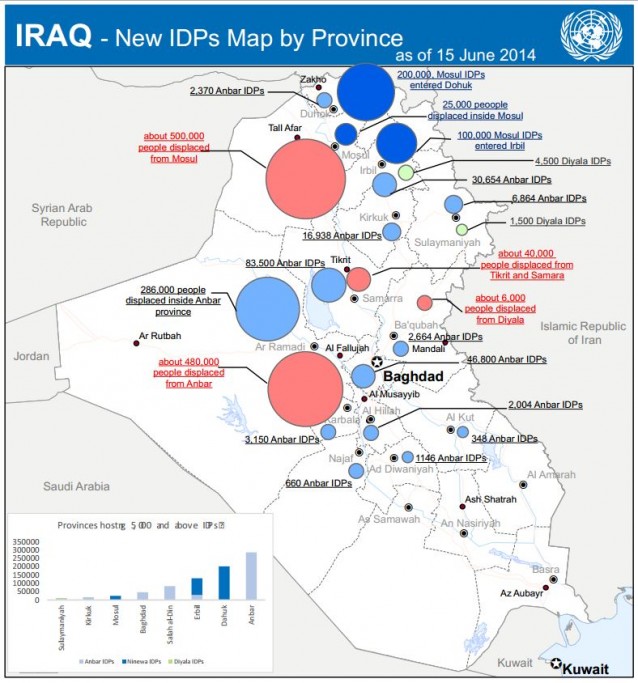
iraq-idps-province-638x683

Hayes Brown provides an update on the escalating emergency:

[T]he United Nations on Wednesday upgraded Iraq’s crisis to a level 3 humanitarian disaster — the most severe rating it has. “Now we’re focused on delivering water, food and essential items,” Colin MacInnes, deputy head of UNICEF in Iraq, told the Washington Post. “Iraq already has a level 3 polio disaster,” MacInnes continued, and as Syria across the border is also in the midst of a level 3 disaster, “that means we have currently three level 3 disasters that are affecting the country.”

“At the present moment, we have a very serious confrontation and we have meaningful levels of internal displacement. We are not yet witnessing a massive refugee outflow and I think it will depend on whether this crisis can be addressed effectively in the near future or whether it will be a protracted conflict,” said U.N. High Commissioner for Refugees Antonio Guterres at a press briefing on Tuesday.

Meanwhile, for neighboring countries like Jordan, refugees from the original Syrian conflict remain a huge burden:

Tensions between Syrians and Jordanians are still a worry. Eighty percent of Syrian refugees live in Jordan’s cities and towns, where, since they are banned from working, they take black market jobs for low wages. The government says this has pushed down pay for Jordanians too. “The potential seeds of conflict are really there,” says Musa Shteiwi, who heads the University of Jordan’s Centre for Strategic Studies. A poll he ran late last year found that 73% of respondents were against hosting more refugees—up from 64% in 2012.

Jordan is asking donors to give it the $1 billion it says it will spend on additional security over the next three years thanks to the refugee influx—about as much as it has asked for education and health services for the refugees. It may also like to see a larger proportion of Syrians in controlled areas such as Azraq. Plans are already underway for a third refugee camp. Current urban dwellers are unlikely to be moved, but newcomers will find it harder to leave the camps.

This Fight Is About More Than ISIS

Marc Lynch explores how Arab supporters of Syria’s rebels see the conflict in Iraq:

The popular Al Jazeera personality Faisal al-Qasim recently observed to his 1.5 million Twitter followers that the Syrian and Iraqi revolutions were examples of “dressing up a popular revolution in terrorist clothes, demonizing it and opening fire on it.” Former Kuwaiti member of parliament Walid al-Tabtabaie, for instance, supports the “Iraqi revolution” while warning that ISIS “has some good people but is penetrated by Iran” and that “the corrupt in Syria can’t be in the interest of Iraq… they will stab you in the back.”

ISIS is a real threat, without question, a savvy and experienced fighting organization with a clear ideology, significant financial resources and a proven ability to attract foreign fighters to its cause. But this Arab counter-narrative shouldn’t be ignored.

The sharp divide between an American debate that focuses exclusively on ISIS and an Arab debate that focuses on a broad Sunni rebellion starkly evokes the similarly skewed discourse in the first few years of the U.S. occupation of Iraq. From 2003 to 2006, U.S. officials and media often reduced the Iraqi insurgency to “al-Qaeda” and regime dead-enders, thus vastly exaggerating the importance of al-Qaeda in Iraq, delegitimating the political grievances of the Sunni community and missing opportunities to divide the insurgency. Heavy-handed, indiscriminate military responses informed by these views helped to fuel the insurgency.

Another major reason this matters:

These Arab narratives about what’s happening in Iraq shouldn’t be taken at face value, but listening carefully to them might help to avoid a counterproductive American foray back into Iraq. Inside Iraq, a broadly based Sunni insurgency, which commands the support of non-ISIS tribes and armed factions, would reinforce the case for why pushing Maliki for serious political accommodation before providing military aid is the right policy (Petraeus, for what it’s worth, agrees).

True, getting rid of him might not solve Iraq’s problems, but the crisis won’t be overcome without significant changes, which he seems highly unlikely to make (and nobody would trust his promises to do so after the crisis has passed). The point is not to appease ISIS, which could care less about such things, but to break the alliance between ISIS and some of its current Iraqi Sunni allies by giving them a reason to opt back into a political system in which they have largely lost faith. On their own, airstrikes and military support of Maliki without the prior delivery of real political change are likely to only push the various strands of the insurgency closer to ISIS. Political reform isn’t a luxury item that can be postponed until the real business of military action has been conducted – it is the key to once again dividing ISIS from those larger and more powerful Sunni forces.

Ali Kheder’s list of “the players actively fighting across Iraq today” further illustrates the folly of viewing the recent bloodshed as merely a fight between the Iraqi government and ISIS.

Does Israel “Pinkwash?” Ctd

ISRAEL-GAY-PRIDE-PARADE

Tyler Lopez is dismayed that Palestinian activists still accuse Israel of “pinkwashing” – i.e., using its mostly positive gay rights record to distract from its human rights abuses in the occupied territories – and are discouraging gay tourism to Israel during pride month:

Pinkwashing advocates are trapped in their own gender studies/international relations fantasyland. Legitimately concerned with human rights abuses in Israeli-occupied Palestinian territories, they have created an entire academic language in order to hype up a concept that draws an unrealistic correlation between their cause and the gay rights movement. Because of this, any LGBTQ person traveling to take part in a gay rights demonstration is a homonationalist, unwittingly part of the pinkwashing agenda. It’s no longer appropriate to label any city as “gay-friendly” or “homophobic,” because, according to pinkwashing activists, pro-gay legislation and LGBTQ visibility aren’t the appropriate barometers with which to measure social change. Gays, perhaps it’s time to book your tickets to Saudi Arabia. (Don’t worry about finding a hotel; if you’re openly gay, the Saudi government will be happy to provide accommodations.)

Of course, LGBTQ rights aren’t the only marker of social change or human rights. But suggesting that they’re separate from any other universal human right is dangerous. An accusation of pinkwashing presumes that gay human rights causes are less salient than Palestinian human rights causes, when in fact they’re all equal.

I rendered a similar verdict on “pinkwashing” way back in 2011. I see no reason to change my mind. It is perfectly possible to decry the brutal occupation and the relentless settlement building of the Israeli government in the West Bank while also celebrating Israel’s amazing commitment to gay freedom. In its region, Israel isn’t just an exception; it truly is a shining city on a hill. The tragedy of Israel is that so much of its democratic energy has been diverted into the oppression of another people. I favor engagement, not disengagement; argument, not sanctions.

(Photo: Russian tourists attend the annual gay pride parade in the Israeli coastal city of Tel Aviv on June 13, 2014. By Jack Guez/AFP/Getty Images.)