About That Iraqi Democracy: Forget About It

One might be forgiven for thinking that the catastrophic war in Iraq was designed to bring democracy and sovereignty to that nation after a brutal, foul dictatorship. That, after all, was what we were told from the get-go, along with the alleged threat of non-existent weapons of mass destruction. Many service-members died to bring that democracy about; almost 200,000 Iraqis died in the bloody transition. And they elected a prime minister; and re-elected him in fair elections. And yet now, courtesy of the CIA’s unofficial spokesman, David Ignatius, we hear that Maliki is nonetheless going to be deposed by the US:

President Obama sensibly appears to be leaning toward an alternative policy that would replace Maliki with a less sectarian and polarizing prime minister — and then begin using U.S. military power on behalf of this more broadly based government. The White House is already mulling a list of alternative prime ministers.

So the whole pretext of Iraqi democracy was a sham, and we now know this without a shadow of a doubt. The next leader of Iraq will be IRAQ-UNREST-VOLUNTEERSpicked in Washington, and not by the people of that country. And the right of an elected government to choose its own policies and direct its own governance – for good or ill – has been effectively rendered null and void. There’s never any welfare reform with imperial welfare. They are to be dependents for ever. And, of course, the CIA’s previous regime changes in the Middle East – Iran, anyone? – do not even merit a mention. Just because they have screwed it up every single time doesn’t mean they don’t have the absolute right to screw it up again. Because the residue of their own disasters can be used to justify yet more ones. Just ask Fred Hiatt.

As with most imperial projects – and what other word can be used to describe the embedded assumptions in Ignatius’s column? –  Washington will use local power-brokers to implement its designs. Ignatius is perfectly candid about the rawness of the imperialism involved:

The people who will pull the plug on Maliki are Kurdish leader Massoud Barzani and other Iraqi kingmakers. The United States should push them to signal unmistakably that Maliki is finished. And they must do so in coordination with Iran, which will effectively have a veto on the next Iraqi prime minister, whether we like it or not.

Notice the lack of any subjunctive. The Kurdish leader will do what he is told; the Sunni tribes must cooperate with Iran. This is the mindset of the CIA, a beyond-the-rule-of-law organization that has done more damage to this country’s interests and values than any other organ of state. The contempt of these imperialists (who brought torture into the American bloodstream) for the autonomy of any other country is a striking as their contempt for American values.

So Ignatius admits that this illegal intervention needs “political cover”from other interested parties in the region (all of whom have ulterior motives and almost all of whom have contributed to this burgeoning sectarian warfare). And the goal now is to intervene simultaneously in Syria’s civil war, to the tune of training up to 10,000 “Syrian moderates” (try not to laugh out loud or burst simultaneously into tears).

And the entire point of this exercise is to get another war up and running – and soon – in Syria and Iraq:

Targeting ISIS perhaps could begin with its safe havens and infiltration routes along the Syria-Iraq border, where there’s less chance of hitting Sunni tribesmen. “We know where their base camps and training camps are, which is where we can start — and it’s important to start,” says U.S. Central Command adviser Derek Harvey.

Yes, “it’s important to start”. Sure, we don’t know where any of this could lead – but the one thing we have learned this past decade and a half is to launch a war first and figure out those questions later. Intervening in two sectarian countries just adds to the challenge, I guess. It’s so good to know someone advising Central Command has absorbed the lessons of the past so well.

I’m distressed by the news out of DC and alarmed by Obama’s presser, but I haven’t given up on the president yet.

Ignatius is voicing the CIA’s agenda, as usual, not necessarily the president’s. In his presser today,

Mr. Obama insisted that the United States would not press for Mr. Maliki’s replacement by a new leader. “It’s not our job to choose Iraq’s leaders,” he said. But he added, “Right now, there’s too much suspicion, there’s too much mistrust.”

And yet 300 military “advisers” and the possibility of air-strikes is how wars start. And the president has been woefully supine when it comes to confronting the lawless incompetence of the CIA for the past six years; and once military strikes begin, we’re back to square one, trying to control a country we do not understand and cannot master, taking the bait of all sorts of interested parties, who will use us as they have used us in the past to promote their own agendas. The president also signaled he is leery of Ignatius’ utopian notion of 10,000 “Syrian moderates”:

He cited the difficulties in deciding whether to arm members of the opposition. “If you have former farmers or teachers or pharmacists who now are taking up opposition against a battle-hardened regime,” he said, “how quickly can you get them trained?”

And how do you know that after they’ve been trained and equipped, they won’t turn around on a dime like the Iraqi army just did? This is the Arab Middle East. There is no trust there. And there are no reliable allies.

In my view, this is not a conflict in which you can half-intervene. By some miracle, we extricated ourselves at great loss. And yet the breezy tone in Ignatius’s column and the decision by Obama to send Special Forces advisers to Iraq suggest something more ominous still. So let me reiterate something: in my view, the one thing Obama pledged never to do he must never do. For me, re-entering the Iraq war – which is what US-targeted airstrikes with Special Forces on the ground against ISIS would do – is a deal-breaker. In one move, it could obliterate Obama’s entire foreign policy legacy of deleveraging the empire and effectively treat the American people as irrelevant. It would also instantly make the United States a prime target for these religious fanatics.

So this is truly a test of the president’s mettle. Will he stand up for the American people and follow his own instincts or cave to the CIA and the hyperventilating Beltway? His presser today both reassured but also worried me. I worry because I have learned the hard way that the elites in Washington like to treat the world as a garden to tend, they have never seen a crisis they don’t think they can solve, and they love to imagine themselves in the vanguard of the good and the true, even if all their recent interventions have led to mass murder and lies. This goes for Democrats as well as Republicans. And when the imperial complex sees a new opportunity to enlarge its power and money and relevance, they tend to have their way. Because they always have their way, and until we elect someone with the spine to rescue us from this eternal, corrosive, imperial quicksand, they always will.


UPDATE: A couple of sentences in Ignatius’ piece have been changed. Details here.
Terror Winning War On Terror

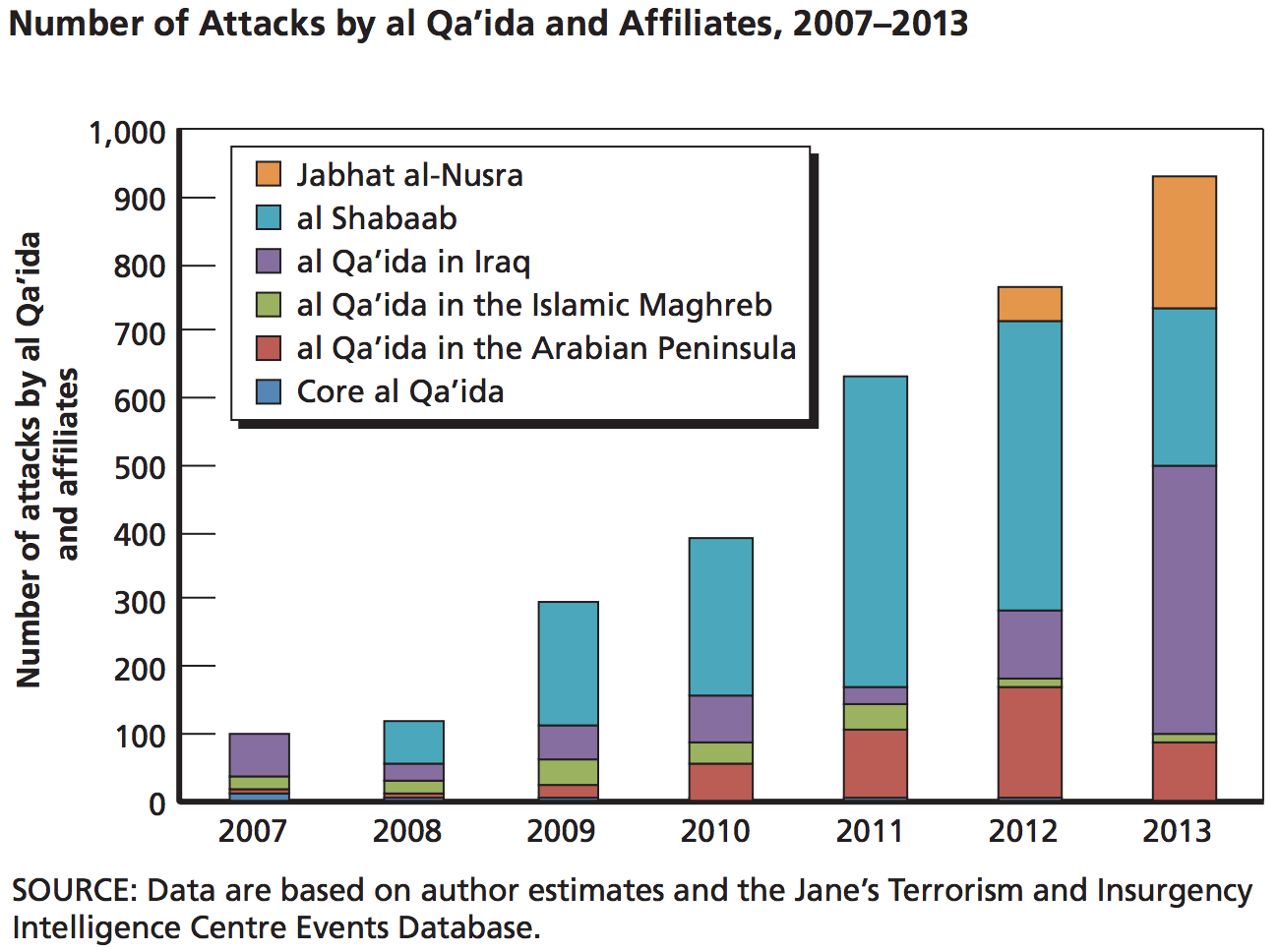
Terror Chart

Ian Bremmer captions the above chart from RAND (pdf):

Since 2007, the number of attacks by al Qaeda and its affiliates has risen nearly tenfold, with violence levels highest in Iraq, Yemen, Syria and Somalia. Unlike a decade ago, core al Qaeda has been involved in very few plots, but its branches have more than made up the difference. Between 2012 and 2013, both al Qaeda in Iraq and the Syria-Civil-War-born Jabhat al-Nusra quadrupled their attacks.

This war is real and metastasizing, as the Arab world continues on its rough road to what might be modernity. And I should reiterate one lesson I draw from this. Our previous tactics – invasion, occupation and torture – clearly failed. Drones have become a two-edged sword in terms of fomenting as much terror as they might destroy. We’re left with domestic security, which means to say the NSA. I worry almost as much as some others about the potential for abuse in this country’s vast intelligence and spying networks. But they exist for a reason; and they are primarily defensive. They exploit our core advantage over Islamist mass-murderers: our technological superiority. In this long war, which will wax and wane as the Arab and Muslim world grows and adapts, a better-monitored and better safe-guarded NSA is our friend and not our enemy.

Our Cold Civil War Intensifies, Ctd

In a shrewd and worried column, Clive Crook thinks Americans’ left/right social and geographic isolation has made productive ideological debate close to impossible and poisonous partisan discourse even worse. He cites a Stanford study that goes even further:

Using data from a variety of sources, we demonstrate that both Republicans and Democrats increasingly dislike, even loathe, their opponents.

We also find that partisan affect is inconsistently (and perhaps artifactually) founded in policy attitudes. The more plausible account lies in the nature of political campaigns; exposure to messages attacking the out-group reinforces partisans’ biased views of their opponents.

This makes a bunch of sense when you think about it. What is the primary form of communication to low-information voters? Political ads. What do they do? Intensify contempt for various candidates along stereotypical partisan lines. Rinse and repeat ad nauseam, and cut yourself off from anyone with a different viewpoint, and you have our gridlocked society. And all the Supreme Court seems to do is usher in yet more money to finance yet more of this poison; and all the media seems able to do is reach for ratings by exploiting these emotions.

“The Most Discriminatory Law In The Land”

That’s what Jamelle Bouie calls family cap laws, which prevent parents on welfare from receiving additional benefits when they have another child:

Of course, the policy was based on a myth, the idea of the sexually irresponsible “welfare queen.” In 1990, just 10 percent of households that received Aid to Families with Dependent Children—the precursor to today’s federal welfare program—had three or more children (most had two or fewer). Those figures were down from the 1960s, when 32.5 percent of such families had four or more children. In 2013, the Bureau for Labor Statistics noted that “average family size was the same, whether or not a family received assistance.” Public perception notwithstanding, there’s no difference in family size between those that collect welfare and that those that don’t.

So what are the results of these misguided policies?

There’s little evidence that family caps work as advertised. What is unquestionably true is that they make poor families poorer.

A 2006 report from the Urban Institute found that family caps increase the “deep poverty” rate of single mothers by 12.5 percent, and increase the deep poverty rate of children by 13.1 percent. It’s easy to see how this works. In Maryland, a state without family caps, the average benefit for a single-parent family of three is $574. If, while receiving that benefit, the parent had another child, it would rise to $695, a 17 percent increase. By contrast, in Virginia—where the benefit for a family of three is $389—it would stay the same (as opposed to growing to $451). And when you consider the generally low benefit levels of family cap states—in Georgia, the average monthly benefit for a three-person household is $280, in Mississippi it’s $170—what you have is a recipe for greater poverty.

Colorblind Affirmative Action

Affirmative Action

The Economist flags an Israeli study on it:

The researchers concluded that the programme works. It has increased the diversity of the student bodies at top universities by helping the poor without increasing the risk of admitting unqualified applicants. Students admitted through the programme “are not falling behind academically, even at the most selective majors,” the authors found.

Israel is a unique—and uniquely small—country with its own social complications, and there is no guarantee that a programme that works there would work in America. But the study offers some hope for those who seek to create more diverse student bodies and perhaps improve social mobility without explicitly privileging groups based on race.

Leonhardt, who provides the above chart, contends that traditional affirmative action is on the way out:

[H]ere’s the paradox for defenders of today’s affirmative action: Their best hope of salvaging some form of it is to make race secondary and class primary.

Justice Anthony Kennedy, the swing vote on the Supreme Court, has signaled some openness to letting institutions consider race, so long as race doesn’t dominate their decisions. And in today’s version of affirmative action, race dominates. The standard way that colleges judge any potential alternative is to ask whether it results in precisely the same amount of racial diversity, rather than acknowledging that other forms of diversity also matter.

An affirmative action based mostly on class, and using race in narrowly tailored ways, is one much more likely to win approval from Justice Kennedy when the issue inevitably returns to the court.

Richard D. Kahlenberg, editor of The Future of Affirmative Actionsupports a class-based system:

Shifting from racial considerations would substantially increase socioeconomic diversity. While those in the bottom socioeconomic half currently enjoy access to just 14 percent of seats at selective colleges, that would rise to 46 percent under socioeconomic affirmative action, 31 percent under a top-10-percent plan, and 53 percent under a program combining the two.

Achieving racial diversity by such alternative means is a matter of fairness and equity: While race matters in allocating opportunity, class is an even more significant barrier to success. Although the achievement gap by race used to be twice as large as the achievement gap by income, today the reverse is true.

The Neocons’ Last Stand?

Hillary Clinton Awarded The 2013 Lantos Human Rights Prize

Jacob Heilbrunn suspects so:

Whether the neocons’ audacious attempts to once more guide the debate over foreign policy will succeed is an open question. Kristol, for one, seems to think this is his moment, writing recently, “A war-weary public can be awakened and rallied. Indeed, events are right now doing the awakening. All that’s needed is the rallying.”

Wrong. This is classic neocon bombast, which is to act as though foreign policy is simply a matter of willpower. It isn’t. Foreign policy is not a cheerleading event. A host of other factors—the strength of the economy, our alliances, the growing power of China, climate change and other developments—mean that American cannot simply act with impunity abroad, as the neocons would have it. What’s more, the American people are not ready to rally: A recent Pew poll indicates that 54 percent of the public, a new high, believes that the United States should “mind its own business” internationally. Put simply, Obama is not flouting the will of the public. He is expressing it. It’s the neocons who are out of step with history.

John Nichols spotlights a recent PPP poll on Iraq:

In fact, if there is one thing that unites Americans, it is their skepticism about steering back into Iraq. Eighty-two percent of Democrats oppose sending US troops to Iraq, as do 86 percent of independents. Notably, 57 percent of Republicans are also opposed. Just 28 percent of Republicans favor the ground-troops option.

Overall, just 16 percent of Americans are inclined toward the sort of approach that might satisfy Cheney.

Their main source of hope at this point? Hillary Clinton. Millman notes how far to the neocon right Clinton is among Democrats, when it comes to intervention:

The one thing that distinguishes her from your typical Democrat is that she is substantially more hawkish, having taken the hawkish side in essentially every political debate from Bosnia and Kosovo through Afghanistan and Iraq and into the Obama-era debates over Libya, Syria and Ukraine. If she weren’t Hillary Clinton, that fact would not only make her a long shot; it would probably be disqualifying.

There’s a real risk that she’d drag us back into the Manichean struggle with Iran, cave to the Greater Israel lobby on settlements, and give bleeding heart liberal interventionists another crack at meddling in someone else’s country once again. Her entire career has been about insulating herself from attacks from the right by appeasing them. I see no reason why she would stop now. It’s in her bones.

The Price-Tag On Obamacare

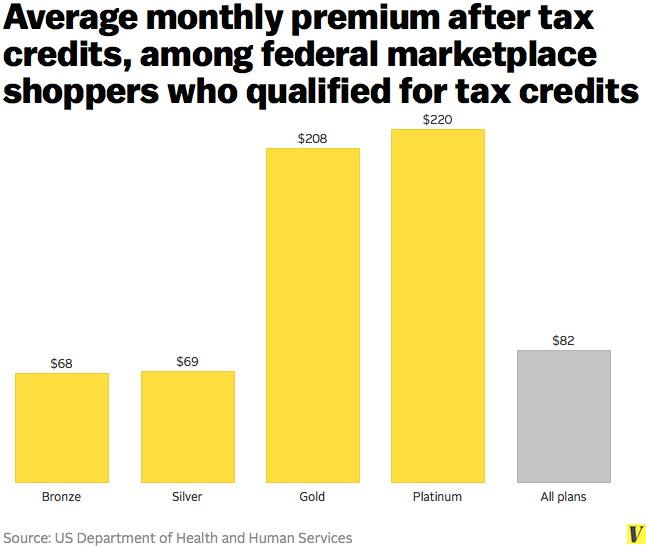
average_monthly_premium

Earlier this week, the HHS released a report (pdf) on Obamacare premiums. Yglesias, who posts the above chart, observes that the “average subsidy-eligible enrollee in the federal exchange gets a pretty cheap health plan.” But that fact worries Bob Laszewski:

The lowest income people––who pay the lowest premiums and out-of-pocket costs––are the ones who are obviously signing up. That explains why the average consumer subsidy is so high and the average net cost is so low.

As I have said on this blog before, the biggest consumer problem Obamacare has is that the plans––with their still high premiums even after the subsidy, big deductibles, and narrow networks––are not attractive to working class and middleclass families and individuals.

Simply, the Obamacare plans are unattractive to all but the poorest who get the biggest subsidies and the lowest deductibles.

Suderman points out that the “data released by the administration doesn’t account for premiums in the 14 states that ran their own exchanges this year” and that “those averages conceal an awful lot of variation.” He goes on to cite a Manhattan Institute study finding that health insurance has gotten significantly more expensive under Obamacare:

[T]he study by health policy fellow Yevgeniy Feyman found that, on average, premiums were up 49 percent under Obamacare. Again, that’s an average, and it masks some variation—in New York, which had unusually restrictive, badly designed health insurance market rules prior to Obamacare, premiums are actually down quite a bit—but it indicates that the overall trend for unsubsidized premiums is up.

The difference, then, is being made up by federal subsidies. According to the administration’s report, those subsidies are carrying 76 percent of the total cost of subsidized insurance plans selected in the federal exchange. The out-of-pocket average is $82. But the actual average premium price, without subsidies, is $346.

But the exact size of those premium increases is up for debate:

[A] new analysis from a conservative health-care economist suggests that Obamacare sticker shock wasn’t nearly as steep as other studies previously suggested. Consumers who bought their own coverage between 2010 and 2012 saw the average cost of their plan increase between 14 percent and 28 percent when they switched to new coverage under the Affordable Care Act, according to Mark Pauly, a professor of health-care management at the University of Pennsylvania’s Wharton School of Business.

Adrianna McIntyre digs into the details of that study. Why costs went up:

On balance, the authors suggest that the hike is attributable to insurers expecting an influx of sicker enrollees. Health reform makes insurance easier to obtain for sick people. The new insurance rules means that cost gets spread around across the sick and the healthy, so when enrollees get sicker overall, prices go up for everyone.

The other factor that might have driven up prices — the essential benefits package — doesn’t seem to have played a major role. This new paper finds that the generosity of the insurance benefits offered before Obamacare was roughly similar, on average, to the medium-level plans on today’s exchanges. And that suggests the change in who’s enrolling in insurance — not the richness of those insurance benefits — is driving the rise in prices.

Was Gitmo Even An Option For Abu Khattala?

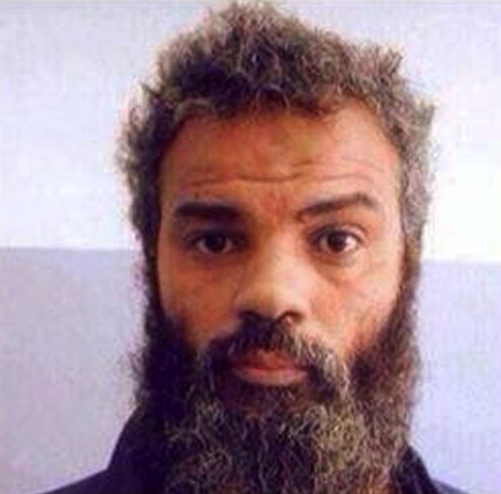
From a legal standpoint, Jack Goldsmith argues that the alleged Benghazi mastermind must be tried as a civilian, contra the FNC crowd’s insistence that he be sent to Guantánamo Bay:

Abu Khattala is an alien and not a privileged belligerent.  It might appear that he is an unprivileged belligerent because he has (or is alleged to have)abu-khattala “engaged in hostilities against the United States.”  However, the [Military Commissions Act] defines “hostilities” to mean “any conflict subject to the laws of war,” i.e., probably, an armed conflict.  While the Benghazi attacks were horrific, they might not – indeed, almost certainly don’t – rise to the level of a stand-alone armed conflict. …

There are other complications here, but my first take is that the critics of the Obama administration’s choice of civilian court to incapacitate Abu Khattala don’t have a legal leg to stand on.  If the United States wants to maintain custody over Abu Khattala, interrogate him as aggressively as possible, and incapacitate him for a long time, then a lawful interrogation on ship pursuant to the “public safety” exception before sending him to the United States for civilian trial appears to be the only legally available option.

Sam Kleiner reminds Butters and other detractors of civilian trials for terror suspects that these trials have been tremendously successful:

While Republicans like to portray federal courts as too weak to handle suspected terrorists, the reality is that they have a proven track record for securing convictions in these cases.

In case after case, skilled federal prosecutors have won convictions of suspected terrorists. Preet Bharara, the U.S. Attorney for the Southern District of New York, remarked after one conviction: “As we have seen in the Manhattan federal courthouse in trial after trialof Ahmed Ghailani, of Suleiman Abu Ghayth, and now of Abu Hamzathese trials have been difficult, but they have been fair and open and prompt.” Prosecutors have even been able to gather intelligence from suspects; in the trial of Abu Ghaith, a confidante of Osama Bin Laden, prosecutors produced a 22-page memorandum with all of the information that Ghaith shared both before, and after, he had an attorney.

Benjamin Wittes believes it made sense to send captives to Guantánamo in 2002, but not anymore:

The argument for Guantanamo—or some other detention facility—has to do with numbers. What happens when you capture, say, 10,000 people and know that most of them are foot soldiers but some of them are Abu Khattalas and some of them are mistakes—but you don’t know which are which? As John Bellinger has repeatedly pointed out, moreover, in the context of 2001 and 2002, the criminal law also did not yet cover the conduct of many people held at Guantanamo. So there was a substantive law problem in addition to a numbers problem.

Guantanamo, in other words, was a response to a specific set of circumstances—circumstances in which the criminal justice apparatus would simply have been overwhelmed by an influx of undeveloped cases. I believe it was a legitimate response, and I make no apologies for it. I also believe that at least some of the circumstances that gave rise to it could, and probably will, arise again. But that does not mean it is the answer to all problems. And it certainly is not the answer to the problem of an individual terrorist captured after a long period of investigation and against whom the evidence will support a strong criminal case. Dogmatically insisting on its use in such situations is as silly as rejecting it in principle.

The administration is actually “straddling the issue,” Mark Thompson writes, by questioning him on a Navy ship anchored in the Mediterranean:

The Administration has questioned at least two other terror suspects aboard ships for up to two months before dispatching them into the federal court system.

“The only reason for having him on a U.S. warship is to provide a nice quiet environment where the investigators can work their wiles on him,” says Eugene Fidell, a military-law lecturer at the Yale Law School and former president of the National Institute of Military Justice. “If the government wanted to have Khattala at the E. Barrett Prettyman courthouse [in Washington, D.C.] by four o’clock, he’d be there. The notion seems to have taken root that the government has, if not all the time in the world, as much time as it reasonably wants to see if can coax these people into making statements.”

The Fightin’ IP Attorneys?

Adam Raymond explains what has Washington sports fans riled up this morning:

Eight years after a group of Native Americans filed a lawsuit seeking to repeal the Washington Redskins trademark, the U.S. Patent and Trademark Office has done just that. The team’s name, the ruling says, is “disparaging to Native Americans” and trademarks that “disparage” or engender “contempt or disrepute” are prohibited by federal law.

The ruling doesn’t require the Redskins to change their name, but if it’s upheld after the inevitable appeals, the team may decide to do so anyway since its name will no longer be protected. If anything, the ruling should settle the debate over whether redskin is a slur or an honorific.

Jay Caspian King praises the decision:

As part of their appeal, the respondents argued that “Redskins,” as it referred to the football team, had been stripped of its associations with Native Americans – never mind the cartoon warrior on the team’s helmets and the headdresses worn by fans. Such disingenuous, purely linguistic claims have been used throughout history to justify all manner of terror; to argue that the name of the football team had shed its historical associations relies upon a terrible logic that says that, because a group of peoples has been, over centuries, killed, brutally dispossessed, and internally exiled – to the point that they are invisible to many of the residents of Washington, D.C. – their history should be trumped by the history of a football team.

Alyssa is also hoping for a name change:

I would not be surprised if [owner Dan] Snyder stands his ground anyway, after years of gleefully tweaking anyone who has issued a basic appeal to courtesy or financial common sense. But if he decides to change the name of his team, Snyder could seize an opportunity not just to reinforce his financial position, but to make a real gesture towards strengthening the franchise’s relationship with the city where it is located.

In contrast, Robert Tracinski is disturbed by the move:

Our system of government depends on the impartial administration of the laws by the executive. In this case, executive officials declared that a private company doesn’t deserve the protection of the law: if the ruling survives an appeal in the courts, the federal government will stop prosecuting violations of the team’s intellectual property rights, potentially costing it millions of dollars.

This ruling isn’t a slippery slope. It’s a slope we’ve already slid down: bureaucrats in Washington are now empowered to make subjective decrees about what is offensive and what will be tolerated, based on pressure from a small clique of Washington insiders. Anyone who runs afoul of these decrees, anyone branded as regressive and politically incorrect, is declared outside the protection of the federal government.

Kavitha Davidson considers the legal precedent:

Under trademark law, the [Patent and Trademark Office] reserves the right to reject an application if it “consists of or comprises immoral, deceptive, or scandalous matter; or matter which may disparage or falsely suggest a connection with persons, living or dead, institutions, beliefs, or national symbols, or bring them into contempt, or disrepute.” The office has exercised this clause many times, rejecting an application for “Khoran” liquor, since alcohol is considered sinful in the Islamic holy book. Basically any application involving the N-word is rejected, including Damon Wayans’s attempt to trademark his clothing line, “Nigga.” And a skiing equipment company was turned away from using the term “squaw.”

Joseph Stromberg looks ahead:

Today’s decision is an important victory for [plaintiff Amanda] Blackhorse and the plaintiffs, but it doesn’t guarantee that the team will actually lose the trademark registrations. For one, the team will almost certainly appeal the decision in federal court. … In the meantime, the team will keep full protection of its name and logo.

But Jordan Weissmann argues that losing the appeal wouldn’t hurt the team too much financially anyway:

[I]n the worst of all possible worlds for the NFL, a few companies might be able to start producing Washington apparel without any logos or player names. Irritating? Yes. Disastrous? Probably not.

Then there’s the question of who would actually want to go into that business. As of now, the companies that want to produce pro-football-branded merchandise have to negotiate with the NFL for a collective license that covers all of the teams. (That could change, however, depending on the outcome of a pending court case.) Any corporation that decided to go rogue and start selling unlicensed Washington gear would undoubtedly incite the NFL’s wrath. That might be fine for the odd guy with a stand selling T-shirts on the corner, but not, say, Nike.

For much more on this debate and mascot controversies in general, check out the Dish thread.