The View From Your Window Contest: Winner #19

Vfyw-contest-10-9

A reader writes:

Now you’re getting interesting. It feels like India, but not quite.  It almost looks as though there is a touch of East Africa in there.  What is the most common place a person who feels like they are in India, yet is not, tends to find themselves?  I’ll have to go with Ambanja, Madagascar.

Another writes:

It looks too ramshackle to be in North America, though I searched every Colorado mining town for inspiration.  And it doesn’t look Spanish enough to be in South America or in most of Mexico.  Then I thought of the Copper Canyon area of Chihuahua state in Mexico, and Google Images bear out the use of tin roofs in that region, so that’s what I’m going with!

Another:

Do corrugated steel roofs look the same everywhere? If they do, then I am way off, but everything about the rust and pattern and makes reminds me of sitting on the balcony of our favorite restaurant we fondly called the “cockroach” in Murree, Pakistan. I lived there for 14 years, but I don’t think this is in Murree because the mountains seem too close, but certainly feels like the Himalayas. It is a warm weather picture because of the potted plants, I am guessing it was taken during the fall or spring, because if it was the summer there would most likely be monsoon clouds. I googled for twenty minutes, but since I don’t have all night to spend on this one, I’ll leave it with a town where I spent a relaxing vacation: Naran, Pakistan, in the NWFP (North Western Frontier Province) recently changed to the unpronounceable, Khyber Pakhtunkhwa.

Another:

This location seems to be at a high elevation – not above tree line, obviously, but pretty darn high.  I think that’s a Chinese Parasol tree in the foreground.  And with the Asian-style bench, I’d say we’re somewhere in the eastern part of Asia.  The buildings aren’t quite right for China, and the mountains aren’t right for Taiwan or northern Vietnam, Laos or Burma.  The television/radio transmitter in the center of the picture indicates this is a larger city, as opposed to a smaller, less known town high in the mountains.  This may be a bit far too to the west, but I’m guessing Kathmandu, Nepal.

Another:

I used to live in Birtamod, in the far east of Nepal.  We would occasionally head to Kathmandu for R&R.  This certainly looks like the Thamel district to me.

Another:

Namche Bazaar, Nepal?  I spent five days there suffering gastroenteritis on way to Everest base camp.

Another:

I have no entertaining text.  Something about the mountains and the architecture makes me think of Bhutan, and Thimphu is probably the only city that’s big enough.  Go ahead and tell me it’s Chile or someplace.

Someplace. Another:

This is a tough one.  I generally am able to pick the correct continent, but this one … it really could be almost anywhere.

There is a substantial mountain range in the background that, at least during part of the year, is not snow capped.  The dwellings appear to be block construction with low pitched tin roofs.  Both of these clues lead me to believe it’s a warm climate.  It’s a densely populated area with a very limited amount of green space. The orange building appears to be either new construction, abandoned or simply an open air building.  The largest building is of no help at all.  A hospital?  An apartment building?  Who knows!

I scanned the world looking for some place remotely similar (Google Earth is fun!) – could it be Pakistan?  Vietnam?  Hong Kong?  India?   But I keep coming back to South America for some reason.  Thought it might be Rio, perhaps Santiago … but my final answer is Caracas, Venezuela.

Another:

Caracas? The roof tops look very similar to ones that I saw while saying in a seedy hotel there. I think the houseplant is a poinsettia. The radio towers are the same spreading the good news that Chavez spreads.

Another:

I grew up looking at pictures of my parents’ youthful hippy-trail travels through South America, and this photo immediately me of the Andes mountains.  I’m guessing Merida, Venezuela, because if that’s correct, I get to pass on the story of the friend who got banged up in jail for reminding members of the local constabulary (in perfect, although strongly Oxbridge-accented Spanish) that ‘Merida’ is an anagram for ‘mierda’ – spanish for shit.

Another:

The mountain range seems substantial, but that particularly arid mountain (without snow or foliage) seems to be characteristic of parts of the Andes, rather than, say, the Alps or anywhere in Africa.  The tin roofs and rest of the town also don’t seem to fit with any European towns.  The upper portions of the Andes seem to go directly from snow and ice capped to green, without these kinds of mountains in between.  This leaves me with Peru or Bolivia.  Peru, however, doesn’t seem to have a town or village that is close enough to these kinds of mountains. My guess is the immediate outskirts of Cochabama, Bolivia.

Another:

My hunch says the Andes.  The mountains look too dry for it to be Venezuela or Colombia, and those shanties suggest too much abject poverty for it to be Argentina or Chile.  That leaves Ecuador, Peru, or Bolivia.  I think I’m going to toss out Bolivia.  It’s a poor country, but much of the poverty is on the high altiplano, where there aren’t jagged mountains surrounding the cities.  I feel like this is somewhere in Peru.

I dunno, Ayacucho?  The city sits in a narrow valley, unlike some other highland cities.  Cuzco probably has too much tourism money flowing in to look this poor, and Ayacucho was the birthplace of the Sendero Luminoso terrorist group, so I imagine there was enough poverty to stir up Marxist revolutionary sentiment.  Yeah, I’m going with Ayacucho, Peru.

Another:

My guess is Huancavelica, Peru. Such majestic, mystical, and haunting mountains can only be in South America. I can hear the enchanting flutes of the indigenous people now, ancestors of the Incas.

How cultural:

This embed is invalid

Pandemic
Tags: SOUTH
PARK
more…


Another:

This is my first attempt at one of these as it usually seems rather futile to attempt to compete with your more well-traveled (or Google-persistant) readers. One place I have been, however, is Rio de Janero where I saw a lot of the favelas that are a such a(n) (in)famous part of that city. It was these favelas stretching up the hill-sides of Rio that immediately came to mind when I saw this photo.

But the mountains didn’t look quite right. This thought led me on a photographic tour of other mountainous metropolitan areas in South America. I started by heading just south to Sao Paulo and then Buenos Aires – neither of which had the geography I was looking for at all. So I headed west to the Andes and made my way through Santiago, Chile; La Paz, Bolivia, and finally came upon some pictures that looked pretty close in Lima, Peru. Unfortunately, I couldn’t get much more exact than that. So, my guess, for what it’s worth is Lima or one of its surrounding villages (Collique perhaps?).

I love reading the responses to this contest, right and wrong, and am a huge fan of the blog in general. Congratulations on 10 years.

Another:

Peru-huanuco-alud-pic The corrugated steel roofs and the bare walls made me think of South America. The mountains look like the city is located at the juncture of two valleys. Assuming it is evening, the sun comes from the West, so the houses would be East of the Tingo_maria_huanuco_peruriver. Huanaco is located like this.

An image search provided at least two pictures that fit: One showing just these antenna thingies. One has a mountain line in the background that could be the  one in the pic from a slightly different angle. What puzzles me still is that there must be a steep drop behind the houses, and I can’t find this on the maps. Who knows.

Another:

Very characteristic of Peruvian Andes.  I can’t find a comparable photo online, but I am going with La Rinconada, Peru, the highest permanent city in the world at a height of 5,100m.

We have a winner!  While La Rinconada isn’t the right answer, it is the closest to the actual location. From the reader who sent the photo:

Here’s a view from my hotel in Cabanaconde, Peru, just at the edge of the Colca Canyon, taken around 5.09pm on Aug 30th.  The canyon is absolutely stunning:  Twice as deep as the Grand Canyon, home of the Andean Condor (3-4m wingspan!) and untouched by the crowds of tourists that we had seen around Machu Picchu.  Absolutely amazing!

And in case you use it for the contest, the exact location is Room 15, Hotel Kuntur Wassi, Cabanaconde, Peru.  I was going to leave out the room number, but given how brilliant some of your readers have been in some of the contests, I wouldn’t be surprised if someone got it …

Not this round, but congrats to the La Rinconada reader – we’ll get a Blurb book out to you shortly.

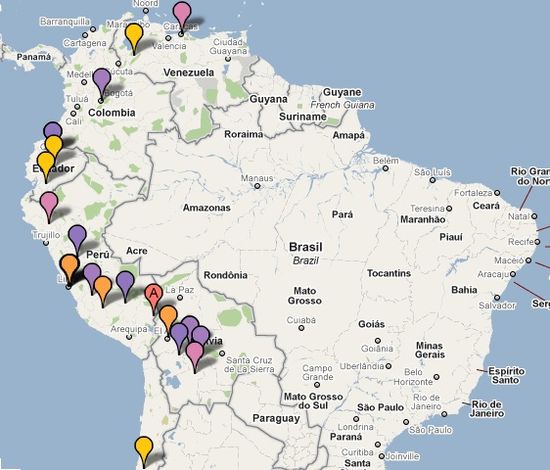
 

Screen shot 2010-10-12 at 12.48.50 PM

Screen shot 2010-10-12 at 12.52.16 PM

Know More Than Hope

Senior Advisor to the President Valerie Jarrett's speech at the HRC dinner co-opted the It Gets Better project's message. Dan Savage snaps:

You have the power to make it better. Right now. Suspend enforcement of DADT. Don't appeal the decision by a federal judge that declared DADT unconstitutional. Stop defending DOMA in court. Keep your promises. Make it better. And if you're not going to keep your promises or do what you can to make it better, White House, then you could at least have the simple human decency to shut the fuck up.

In related news, The IGBP has a new website.

Yglesias Award Nominee

"The same politician who once saw himself as a latter-day Winston Churchill — sent by God to save Western civilization — now gets rich off political hate speech. These days, Newt Gingrich’s modus operandi is to smear any public figure who fails to share his worldview. His insults are so overblown and outrageous that after the rhetorical dust settles, the reputation most damaged is his own. The former speaker seems oblivious to that fact. Or maybe he knows that in a political landscape driven by talk shows, their childish insults resonate in Washington as nowhere else. In a recent New York Magazine cover story called 'Cable Ugly', Gabriel Sherman noted that among most prime-time cable hosts, 'schoolyard rules rule,'" – Joe Scarborough.

Rambo Goes To Washington

Democrat Joe Manchin, running for Senate in West Virginia, ups the ante:

Weigel jeers:

[H]ow does [Republican opponent] John Raese answer this? Diving at a copy of the Affordable Care Act with a flamethrower in his hand and a knife in his teeth?

Dave Roberts gives more context:

Manchin's been a popular governor, but lately he's gotten caught up in the conservative backlash and fallen behind his Republican opponent, John Raese. That's why he's flailing to the right. Dem leadership says this is a must-win race to keep control of the Senate, so they're stumping for him, but as Nate Silver says, Manchin is refudiating virtually every policy position associated with Democrats, so it's not clear what exactly they win if he wins.

PPP has a new poll out finding Manchin with a narrow lead. 

Campaigns Matter, But Not Very Much

Harry Joe Enten gives a lesson:

"GOP Romps to Victory; Captures Majority in both House & Senate" is a possible November 3rd headline that is starting to look like a real possibility. In the case of the House, a majority looks more like a probably. The Democratic argument against such an outcome goes something like "our campaigns are just kicking into high gear, and we will bring the argument to the people." If the headline holds true, Republicans are likely to echo this platitude after Election Day "we ran good campaigns, people heard our arguments, and we won!" The truth is that both of these generic statements are mostly false. While some campaigns have made a difference (e.g. Dick Blumenthal's large military record exaggerations, and the emergence of Christine O'Donnell as the Republican nominee in Delaware), the overall nature of the upcoming Republican romp was determined long ago.

Shhhh. It's a tough enough job market for pundits and journalists anyway.

A Response To A Roast: A “Fifth Column” Apology

I don't know what to say about yesterday's many tributes except thank you. I'm peuce with chuffedness. I am also happy to be reminded of the infamous prime time butt-rub. One reader, however, makes a serious point I should address, about that infamous sentence in a piece I wrote a few days after 9/11. The piece was a vast one, but the sentence I wrote was both sloppy and disgraceful. I did address the issue at the time.

Here's the offending sentence:

"The middle part of the country–the great red zone that voted for Bush–is clearly ready for war. The decadent left in its enclaves on the coasts is not dead–and may well mount a fifth column."

Here's my first attempt at self-defense:

Note what I didn't say. I didn't say that the vast majority of Gore voters aren't patriots or that they don't support this war as much as anyone else. Later in the piece, I pay particular tribute to New Yorkers, mostly Gore voters, who have shown the world their humanity and courage this past week. The paragraph follwing that sentence continues:

"But by striking at the heart of New York City, the terrorists ensured that at least one deep segment of the country ill-disposed toward a new president is now the most passionate in his defense. Anyone who has ever tried to get one over on a New Yorker knows what I mean. The demons who started this have no idea about the kind of people they have taken on."

I'm sorry but it's completely clear I am not damning an entire section of the country because of the way they voted.

Elsewhere in the same piece I say,

"[Giuliani's] combination of chutzpah, practicality and deep, deep compassion is the essence of New York City. His troops – the firefighters and cops and medics and volunteers of the city – would make the Londoners of 1940 proud. If New York alone were a nation – and it has almost twice the population of Israel – then this war would already be well under way, and its outcome in no doubt."

So much for damning the blue zone. What I was clearly saying is that some decadent leftists in "enclaves" – not regions – on the coasts are indeed more concerned with what they see as the evil of American power than the evil of terrorism, that their first response was to blame America, and that their second response was to disavow any serious military action.

I really was thinking of far left academics. But even then, I quickly realized this was a step too far and apologized:

I have absolutely nothing against the countless patriots in the blue zone, as my tribute to New Yorkers and the rest of the essay shows. I was talking about a few intellectuals and their cohorts who clearly do feel ambivalence about America fighting and winning this war. But these broad categories of "blue" and "red zones" can be misleading and unhelpful. I won't use this shorthand again. Ditto the shorthand of "fifth column." I have no reason to believe that even those sharp critics of this war would actually aid and abet the enemy in any more tangible ways than they have done already. And that dissent is part of what we're fighting for.

By fifth column, I meant simply their ambivalence about the outcome of a war on which I believe the future of liberty hangs. Again, I retract nothing. But I am sorry that one sentence was not written more clearly to dispel any and all such doubts about its meaning. Writing 6,000 words under deadline in the heat of war can lead to occasional sentences whose meaning is open to misinterpretation.

Let me take one more chance nine years later to apologize again, and to say that, in retrospect, my vitriol for the academic left should not have veered into that territory, and I am ashamed I went there. But also to clarify some myths about it: I was not describing half the country (really, truly), and I was not describing opponents of the Iraq war (that was way in the future).

My better angel at the time wrote this piece, "This Is A Religious War." It represents my real thinking more accurately than that disgraceful, sloppy sentence, and I hope it helps balance out the offense.

A Child Psychiatrist’s Fears, Ctd

A reader writes:

Your reader clearly knows much more than I do about marijuana use as it relates to child psychology.  I'm not questioning those assertions. But this struck me as a little odd: "But let's not kid ourselves; more kids will have more access to weed, and this is a problem for which we need to prepare."  How is your reader so certain? 

Survey data reliably shows us that children today can more easily access illicit cannabis than either alcohol or tobacco.  California has seen no increase in teen use after the medical marijuana industry in that state exploded.  Usage numbers among Dutch teenagers are even lower than they are here.  There's simply no evidence that more liberal cannabis policies lead to higher use among kids.

Another writes:

Those who distribute marijuana are already violating the law and operate in a black Cannabis-clump1 market, where there is no incentive to follow any rules like age limits. However, legitimate establishments that sell alcohol have many incentives to follow the rules, including the possibility of losing their license to operate.

Of course we still have underage drinking (though I think that has more to do with America's schizophrenic attitudes towards alcohol and a legal drinking age so high as to be unenforceable), but there is no reason to believe that legalized marijuana will lead to an increase in access. Though it sounds counter-intuitive, legalization, if done correctly, would decrease the access children have to marijuana. While the arguments about individual liberty and decreasing violence are indeed compelling, it is this argument that I believe most likely to win the day over those skeptical of the idea.

Another:

Most of that child psychiatrist's fears are quite justified. I started smoking pot at 14 and wish I had waited.

The teenage brain truly is still developing and, just as important, life habits are settling into place. I was lucky that my motivation and energy doesn't seem to be sapped by weed, and life is now good, but it's still critically important that kids be educated about the genuine dangers of marijuana. (As opposed to the scare-tactics of our current D.A.R.E. regime.)

What the shrink is wrong about, however, is the idea that legalization will create greater access for kids. I started smoking pot at 14 because it was significantly easier to get than alcohol. Buying booze always involved either an illegal fake ID handed over to a stranger, or approaching a homeless person and negotiating with them. Neither of these were things I wanted to do at 14.

On the other hand, my friend's older brother sold pot and I had known the guy for years. And since what he was doing was illegal anyway, he didn't give a shit how old we were.  Kids can get pot. Period.

The point is that by giving someone an opportunity to start a legitimate business selling something, you make them a stakeholder in the process. Many bars and clubs really are conscientious about checking ID because they don't want to lose their license by getting caught serving underage kids. I can assure you that there are not many drug dealers who have a moral qualm about selling drugs to teens, especially marijuana. But licensing them to sell gives them a commercial incentive not to sell to kids.

If cannabis is legalized, will there be people who buy it for kids? Of course, just like I sometimes bought booze for my younger cousins when I turned 21. But at least when I was doing that, I felt a responsibility to take care of them, watch them, and not give them enough to really hurt themselves.

Another:

I think the child psychologist is quite wrong about legalization making access to weed easier for teens.  When I was in high school, 11 years ago in the backwoods of Missouri, it was much easier to get get marijuana than it was to get alcohol.  You had to find someone's older brother or older friend to get alcohol; getting ditch weed was just a matter of knowing the right classmate (and everyone knew who the right classmate was).  Drug dealers don't check ID. 

I don't imagine that it's gotten any harder to get weed in the past 11 years, especially in California. So legalization will probably make it harder for teens to get weed than it is today. It will be a different story for college kids, since they know a lot more 21 year olds who will buy it legally, but at least they won't have to deal with shady drug dealers to score a bit of weed.

Who’s Afraid Of Sharia Law?

In a post that runs through several of the ways that Pamella Gellar is an ignorant hate-monger, Jeffrey Goldberg does a particularly good job highlighting her most paranoid fear:

A Martian takeover of New Jersey is more likely than the imposition of a caliphate, or of Muslim law, on America, for any number of reasons, including: One percent of America's population is Muslim; within this one percent, a vanishingly small minority believes in the ideology of al-Qaeda, which propogates the idea of the restoration of the caliphate; a much greater percentage of American Muslims believes in interfaith dialogue (I know this from personal experience, having been invited to countless interfaith dialogue groups). Only a true paranoid could look at America as it is today and see the creeping takeover of Islamist caliphate ideology.

Amen. And no, I have not yet gotten around to addressing Jeffrey's latest pirouettes on the peace process or even his case for Israel launching World War Three, against the wishes of the US and eery other Western ally. But I will. And it won't be pretty. Civil, as befits a colleague I respect and a man I care about, but not pretty.