Maliki Must Go?

IRAQ-POLITICS-DEMO

Max Boot recommends “pressing the Iraqi government for serious political reforms that include embracing Sunni tribes, ending the persecution of Sunni leaders, curbing the prime minister’s authority and weeding out political hacks and sectarian actors from the security services.” To which one can only say: “Good luck with that!” As for the neocon-installed Maliki:

It is unlikely that he would agree to such reforms, so the United States needs to work behind the scenes to ensure that he doesn’t win a third term in office. His State of Law party was the top vote-getter in the April 30 elections, but it needs support from other factions to form a government. The U.S. should take advantage of ISIS’ attacks to press the other political parties to dump Maliki and find a more inclusive figure.

The Economist also speculates that Maliki may be on his way out:

Mr Maliki faces a stark choice. Either he must plunge his forces into a full-scale war of reconquest, at untold cost in lives. Or he must embrace the remaking of Iraq into a looser, genuinely federal state. But his days as Iraq’s leader may be numbered, as the Americans began hinting heavily that they would give extra military help only if he speedily departed.

But Maliki says he won’t quit to facilitate US airstrikes. And no leader in these circumstances is likely to resign. He’s not Sarah Palin. More to the point, deposing Maliki could be extremely dangerous:

There are likely to be months of wrangling before a new PM can be chosen. And maybe it will have to be a minority PM because the parliament is permanently hung. In the meantime, if al-Maliki is deposed, who will command the armed forces? So if you depose al-Maliki, you can’t be sure who will take his place. His successor may be even worse. As in Libya, the the government could also collapse.

One thing I’ve learned from having to study and watch this distant country for the past decade or so: whenever you think the worst has happened in Iraq, you’re wrong.

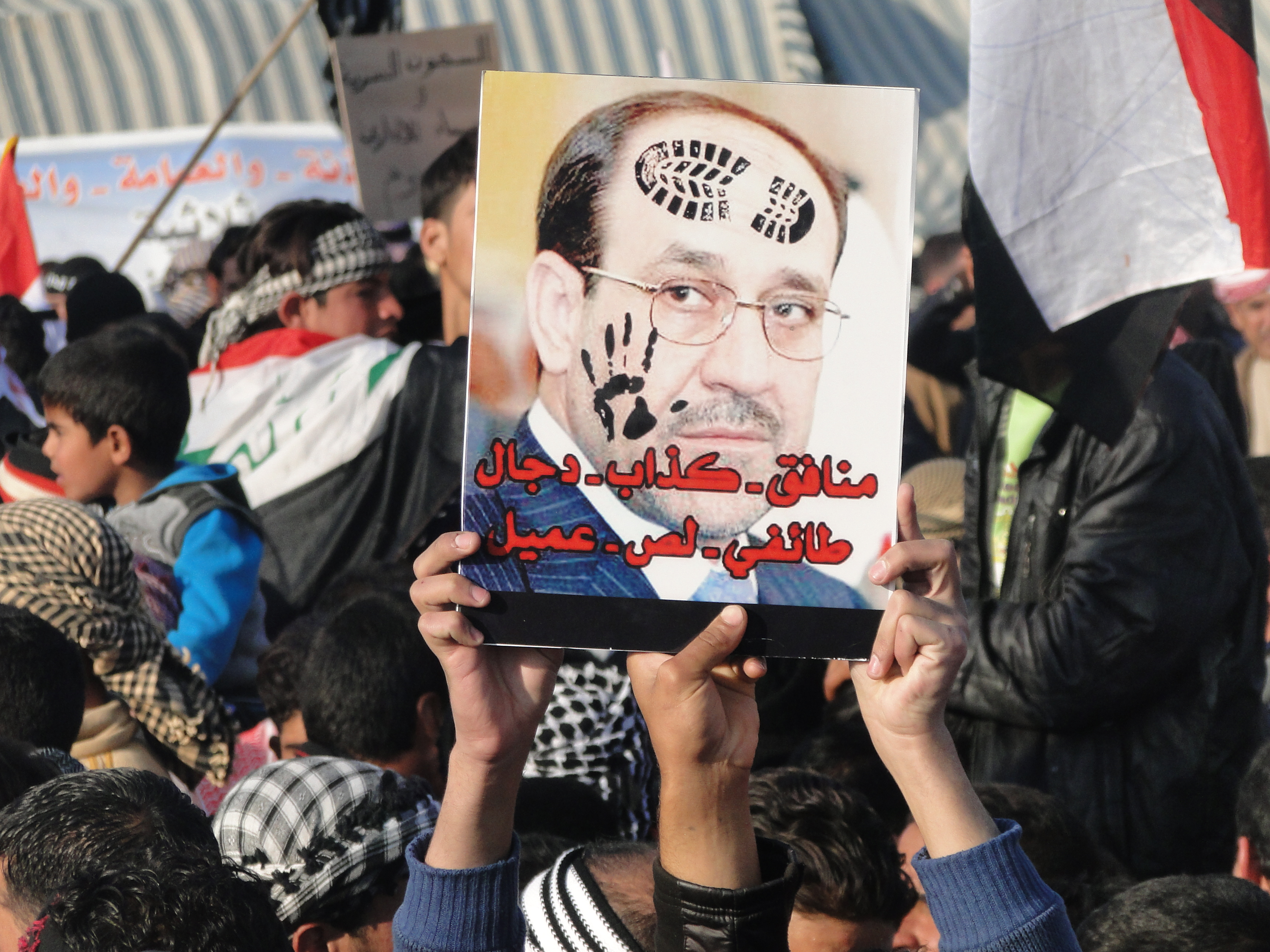
(Photo: Iraqi Sunni protestors hold up a portrait of Prime Minister Nuri al-Maliki with slogans reading in Arabic, “liar…sectarian, thief, collaborator” during a protest against him on the main highway to Syria and Jordan near Ramadi, Anbar’s provincial capital west of Baghdad, on January 4, 2012. By Azher Shallal/AFP/Getty Images)

Meanwhile, In Kabul

Afghan presidential candidate Abdullah Abdullah is alleging widespread fraud in last weekend’s runoff election against a former finance minister, Ashra Ghani:

Despite pleas from the United Nations, the United States, the European Union, and Ghani to give the [Independent Election Commission] time to conduct its count and review complaints, Abdullah is not accepting the second round election antics. In fact, it appears that he considers the IEC anything but ‘independent,’ and in many ways an instrument that remains loyal to the wishes and manipulations of Karzai.

If the vote’s credibility is shattered, Sune Engel Rasmussen warns that the ramifications could be very serious:

The consequences of an electoral failure go far beyond the immediate power struggle in Kabul. European and American officials have set a relatively clean election as a condition for the billions of dollars in aid on which the Afghan economy depends. And the ethnic tensions, as represented by the Abdullah and Ghani camps, could boil over.

Ghani, a former World Bank official educated in the U.S. who has served as finance minister and headed the security transition under Karzai, is Pashtun. To appeal to people in the North, he chose Abdul Rashid Dostum, a notorious Uzbek warlord, as his running mate. Abdullah, for his part, is of mixed Tajik and Pashtun ethnicity, and commands a lot of support from the Northincluding from Atta Muhammad Nur of the Balkh province, one of the most powerful governors in the country and a longtime rival of Dostum. Early Wednesday morning, Nur posted a Facebook photo of Mujahideen tanks rolling toward the frontline during the war against the Soviet Union in the 1980s. The accompanying text read, “To become president, Ashraf Ghani has to cross this border. Passing this border is impossible. A second generation of jihad is coming.”

Oy.

The Viennese Waltz With Iran Begins

Negotiators are meeting in Vienna this week to begin hammering out a final deal between Iran and the P5+1 on the Islamic Republic’s nuclear program, but the endeavor still faces a few major stumbling blocks:

Perhaps the biggest hurdle to overcome, six-power diplomats said, is Iran’s stance regarding its uranium-enrichment centrifuges, which one negotiator described as a “huge problem”. … “The Iranians have not yet shown a willingness to reduce their centrifuges to an acceptable number, making it difficult to envision a compromise at this point that we could all live with,” the negotiator told Reuters. Another Western official close to the talks confirmed the remarks as accurate.

A senior Iranian official seemed to confirm the assessment. “Our Supreme Leader (Ayatollah Ali Khamenei) has set a red line for the negotiators and that cannot change and should be respected,” he told Reuters. “Uranium enrichment should be continued and none of the nuclear sites will be closed.

On another key disagreement, however, Iran is backing down:

Abbas Araqchi, Iran’s deputy foreign minister, acknowledged amid a week of negotiations in Vienna that Tehran now accepts the principle that as part of the deal sanctions on its economy would be gradually eased as Iran gradually complies with limits on its nuclear activities.

Iran’s official line has been that it would require an immediate lifting of all of the sanctions at the time the deal is signed. The economic penalties have choked off its oil exports and limited its trade, and the Iranian government needs to have them lifted as soon as possible to help restore its teetering economy. “It’s a big deal,” said Cliff Kupchan, an Iran specialist at the Eurasia Group risk consulting firm. “Iran is recognizing that lifting sanctions will be tough and take time here. Araqchi’s statement lifts one barrier, a significant one, to a deal.”

David Sanger latest update (NYT) on negotiations:

The problem is that just as the Americans talk about reducing the number of centrifuges by roughly three-quarters, to just a few thousand operating machines, the Iranians propose expanding the numbers by tens of thousands. (There are 19,000 installed today, but only about half are running.)

At issue is a fundamental difference in points of view — Iran says it wants to produce all its own fuel for nuclear power plants — though it has only one major plant running, and the fuel for that comes from Russia. The West insists Iran should have only a token capacity, for research reactors.

“There’s no splitting the difference here,” said Robert J. Einhorn, who was on the American negotiating team until last year, and still advises the United States. “If the Iranians keep taking the view that they must have the capacity to fuel power reactors, they are not going to even get in the ballpark of the numbers the U.S. is talking about.”

Nader Uskowi scrutinizes the Iranian delegation’s upbeat attitude:

From what is reported of the talks so far, it seems that signing the JCPOA by 20 July deadline seems increasingly unlikely, and the six-month transition period under the current interim JPOA needs to be renewed.

Iranian Foreign Minister Javad Zarif still sounded optimistic, saying the final deal could be struck in July. But Mr. Zarif’s optimism could be because of his zeal to finalize the deal and to have the sanctions lifted as soon as possible. Iran was spending billions of dollars on the Syrian war, and now might be forced to spend billions of dollars more on the Iraqi conflict. The country needs to sell oil and use global banking system to finance the two wars. Considering that urgent need, Zarif might be saying something profound: The JCPOA will be signed, Iran will sign it, even if it has to give in on its demands, including the number of centrifuges.

But Ali Vaez worries that the negotiations will end up bogged down in “false dilemmas”:

The P5+1 is obsessed with the concept of “breakout time,” the time required to enrich enough uranium to weapons grade for one bomb. To lengthen it, the group is trying to define Iran’s “practical needs” for enriched uranium as minimally as possible. By contrast, Iran, having invested enormous resources and pride in its enrichment program, is trying to define those needs in maximal terms.

The negotiations will not get far debating over “needs,” which are ultimately a matter of interpretation. By the same token, breakout calculations are rough and purely theoretical guesstimates. They ignore time-consuming preparatory steps, inevitable technical glitches, the unpredictable weaponization process, the strategic and military illogic of breaking out with a single untested weapon, and the many convolutions of political decision making. Reducing a complex process to a one-dimensional race against time distorts reality, and overlooks competing interests and the natural tendency to avoid risk—including the nonnegligible risk of being caught.

Greg Thielmann and Robert Wright cover misconceptions about breakout time:

As a former U.S. official told the journalist Laura Rozen, “What everyone tends to forget is that, when U.S. government and academic experts speak on breakout timelines, they are usually describing a worst-case scenario … where Iran gets everything right the first time around, even if they are completing procedures they have never attempted before.”

Once a bomb is built, there’s testing to be done. States with nuclear weapons typically conduct multiple test explosions—particularly for the smaller, more efficient designs needed for missile warheads. Eight out of the nine countries that have nuclear weapons openly conducted tests before deployment—and the ninth, Israel, seems to have conducted a clandestine test off of South Africa. Preparing, conducting, and evaluating a test would take months—and would also mean that a new bomb had to be built, since the test would have eliminated the first one.

In short, even if “breakout time,” as conventionally defined, is only a few months, or even a few weeks, what you might call the “effective breakout time”—the time it takes to produce a deliverable weapon—is closer to a year, maybe longer.

Recent Dish on the Iran talks here, here, and here.
With Hindsight, Would You Still Invade Iraq?

That’s the question George Will asks the GOP’s presidential hopefuls:

Given the absence of Iraqi weapons of mass destruction, and given that we now know how little we know about “nation-building” and about the promotion of democracy in nations that need to be “built,” and given that Saddam Hussein’s horrific tyranny at least controlled Iraq’s sectarian furies, and given that Iraq under him was Iran’s adversary, and given that ten-year wars make Americans indiscriminately averse to military undertakings—given all this, if you could rewind history to March 2003, would you favor invading Iraq?

It appears that Norman Podhoretz would. He would, in fact, make the occupation as permanent as the Israeli one in the West Bank:

After explaining why and how the al-Qaeda affiliate ISIS has been able to capture city after city in Iraq and is now only about fifty miles from Baghdad, David Pryce-Jones flatly declares that “President George W. Bush is vindicated. The sole way Iraq could have continued was under a permanent American presence that gave and guaranteed state functions. President Obama’s withdrawal of American forces is already a historic error. They alone could have kept the peace. Arabs have a phrase to the effect that some mistake has opened the doors of Hell. President Obama has opened those doors.”

At what point did president George W Bush favor a permanent occupation of Iraq? He was the one who made 2011 the drop-dead date for withdrawal, after all. But it’s good to see the real agenda of the neocons explained: imperialism redux. It’s the only way to keep the forces of entropy under control, you see? If the Iraqis don’t want us? Fuck ’em. Their democracy is only as good as our imperial interests allow.

Breaking: Ted Olson Created The Conservative Case For Gay Marriage

That’s what the super-rich super-lawyer – who, unlike all the countless previous lawyers in the marriage equality movement, did not work pro bono – tells the world in his new book. Nathaniel Frank reviews it:

Olson and Boies seem to think they were the first to cast same-sex marriage as a conservative issue and to conduct bipartisan outreach, an idea that rightly made Andrew Sullivan apoplectic, given his pioneering 1989 New Republic cover story, “Here Comes the Groom: A (Conservative) Case for Gay Marriage.” Olson and Boies write that 20 years later, with their 2009 case, “we wanted to begin connecting with a constituency that hadn’t fully considered our side of the issue.” Yes, conservatives have a deplorable history on gay marriage and gay rights generally, but not because no one asked them to think differently until 2009.

One of the more unusual aspects of the marriage equality movement was the vital early and continuing role of gay conservatives in championing it. We were lampooned by the left for quite a while – even earning the term homocons in the 1990s. And when you read Olson’s virtually-normalarguments, you find that they contain nothing that I and Bruce Bawer, Jon Rauch, Dale Carpenter, John Corvino and many others hadn’t already pioneered as arguments and brought to conservative audiences and venues. In fact, large parts of Olson’s legal case are pretty damn close to plagiarism when you consider the content of the arguments.

Of course, we never caviled at this. The arguments we honed in the 1990s were designed to be used by others, to spread as memes. And there is nothing more rewarding in a civil rights movement than hearing others make arguments and even rhetoric that you helped pioneer. We were delighted to have Olson on our side. But when a straight man barges into the movement at the very last minute and actually claims he came up with these arguments all by himself and that there had been no conservative outreach before him, you can see why it smarts a little.

And, alas, the book echoes the themes of Becker’s: the marriage equality movement was born in 2009. It barely existed before then. It only had a political rather than a litigation strategy. It took two straight guys to whip it into shape and a straight woman to explain how they did it … and then the world changed overnight. None of this is true; and no one with any understanding of the movement would even think it, let alone put it in a book. But this Big Lie is central to Olson and Boies’ book. Money quote from Frank:

“Our effort,” they write, “and the efforts of the scores of people who helped and supported us have contributed, we hope, to the beginning of the end of this last major bastion of institutionalized discrimination in America.” They’re not talking about ending the marriage ban in California, but about ending marriage discrimination itself. Even when they credit others besides themselves with playing a role, it’s “the people who helped and supported us,” leaving little room for anyone outside their Prop 8 challenge.

More to the point, it’s absurd to suggest that the 2009 Prop 8 challenge was the “beginning” of anything related to the marriage equality effort. And this creation myth is not just a passing reference for the Olson/Boies team, which repeatedly suggests that they and their effort birthed the marriage equality battle in earnest. They recount a young gay lawyer on their legal team who, as he accompanied the plaintiffs to have their marriage application rejected, thought: “This is the first step toward marriage equality. It happened today. Right now.”

The proper response to this self-serving disinformation is outrage. But I can’t feel that any more. I’m just glad that victory has many authors. And sad that some are so graceless and pernicious and money-grubbing and vain.

Should We Just Tune Out The Neocons?

Kristol

Fallows is disgusted that Kagan, Kristol, and company are being allowed to participate the public conversation about Iraq today:

Am I sounding a little testy here? You bet. We all make mistakes. But we are talking about people in public life—writers, politicians, academics—who got the biggest strategic call in many decades completely wrongWrong as a matter of analysis, wrong as a matter of planning, wrong as a matter of execution, wrong in conceiving American interests in the broadest sense.

None of these people did that intentionally, and many of them have honestly reflected and learned. But we now live with (and many, many people have died because of) the consequences of their gross misjudgments a dozen years ago. In the circumstances, they might have the decency to shut the hell up on this particular topic for a while. They helped create the disaster Iraqis and others are now dealing with. They have earned the right not to be listened to.

I hold a somewhat different view, although I feel perhaps even more strongly than Fallows (with no legs to stand on, given my record). As long as these people forthrightly acknowledge they were terribly wrong in the past, they have every right to participate in the current debate. But when they either excise that past from history or even claim they succeeded, my head explodes. Beinart is pretty close to me on this:

Saying that Iraq hawks should have to squirm their way through debate number two [their past] before getting to debate number one is different than saying, as Paul Waldman recently did in The Washington Post, that “On Iraq, let’s ignore those who got it all wrong.” In fact, the two positions are antithetical.

You can either ignore the people who got Iraq wrong or you can ask them tough, searching questions about why they got it wrong. Doing the latter brings past debates to bear on present ones, and helps clarify what our disastrous 2003 intervention can teach us about intervention today. Doing the former offers no such opportunity at all.

Chait agrees, noting that those who would shush the neocons have also made mistakes:

Most Democrats in Congress opposed the Gulf War, warning of Saddam Hussein’s fearsome, World War I–style fortifications and citing 45,000 body bags as an indication of the likely U.S. death toll — predictions that turned out to be wildly incorrect. Why shouldn’t anti-Gulf war Democrats — that is, the vast majority of Democrats — have been excluded from subsequent foreign policy debates? If your answer is “because people died — Iraq,” then then you’re not arguing that pro-war arguments should be ignored because they’re analytically wrong, you’re arguing they should be ignored they’re inherently morally suspect, regardless of accuracy.

When you’re trying to set the terms for a debate, you have to do it in a fair way. … We shouldn’t disregard Dick Cheney’s arguments about Iraq because he’s Dick Cheney. We should disregard them because they’re stupid.

Stupid is too kind. They are the deranged views of a man with a mighty ax to grind and a sense of shame surgically removed. Larison makes an important point:

The Iraq war in particular was the greatest foreign policy blunder in a generation. Surely it must count against someone more to get a major policy decision horribly wrong than to be on the “wrong” side of a more debatable and relatively minor decision.

He follows up:

Chait is mostly wrong that “the ideological fault lines” aren’t the same. He can find some liberals that are pro-intervention now that were against the war, and he has identified a handful of hard-liners that were all for the war and now don’t want a new intervention (albeit for extremely hard-line reasons). Chait is an example of a previously pro-war liberal that now claims to be more skeptical about using force in Iraq. Nonetheless, overall the fault lines are depressingly familiar. Neoconservatives, liberal hawks, and more than a few “centrists” will loudly demand action while the rest of us marvel at how these people still have any influence in the wake of one policy failure after another.

Waldman weighs in:

Is there a bit of over-enthusiasm with which people like me are attacking the return of the Iraq War caucus? Maybe. Part of it comes from the fact that a decade ago, those of us who were right about the whole thing were practically called traitors because we doubted that Iraq would turn out to be a splendid little war. And part of it comes from the fact that the band of morons who sold and executed the worst foreign policy disaster in American history not only didn’t receive the opprobrium they deserved, they all did quite well for themselves.

Paul Wolfowitz became president of the World Bank. Paul Bremer, Tommy Franks, and George Tenet—a trio of incompetents to rival the Three Stooges—each got the Medal of Freedom in honor of their stellar performance. Bill Kristol was rewarded with the single most prestigious perch in the American media, a column in the New York Times. (The drivel he turned out was so appallingly weak that they axed him after a year.) The rest of the war cheerleaders in the media retained their honored positions in the nation’s newspapers and on our TV screens. The worst thing that happened to any of them was getting a cushy sinecure at a conservative think tank.

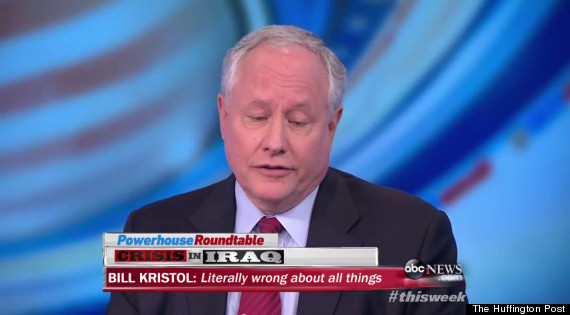
(Image from HuffPo’s “True Chyrons For Bush-Era Iraq War ‘Experts’“)

Well This Dude Isn’t Ready To Be The Non-Clinton

Brian Schweitzer is on a roll lately. On Dianne Feinstein’s criticism of the CIA:

She was the woman who was standing under the streetlight with her dress pulled all the way up over her knees, and now she says, ‘I’m a nun,’ when it comes to this spying! … I mean, maybe that’s the wrong metaphor—but she was all in!

And he has a genuinely new theory to explain the implosion of Eric Cantor:

Don’t hold this against me, but I’m going to blurt it out. How do I say this … men in the South, they are a little effeminate … They just have effeminate mannerisms. If you were just a regular person, you turned on the TV, and you saw Eric Cantor talking, I would say—and I’m fine with gay people, that’s all right—but my gaydar is 60-70 percent. But he’s not, I think, so I don’t know. Again, I couldn’t care less. I’m accepting.

Next!

(But let’s keep him in the primaries. I miss Gravel.)

Baghdad Begs For Bombs

iraq1

The Iraqi government has formally requested US air strikes on ISIS, but our top brass is hesitant to give Maliki what he wants. Karl Mueller asks whether attacking ISIS from the air would be effective:

The military success of any air power intervention in Iraq depends very much on the ground forces fighting against ISIS. Bombing could do a great deal to give Iraqi security forces the upper hand, and it might also provide an important psychological boost to their willingness to stand and fight, which has often been less than impressive. But if they were ultimately unable or unwilling to make effective use of that advantage, such an intervention would be a wasted effort. (Conversely, if the Iraqis can defeat ISIS without such help, there would be little reason to consider intervening.)

And of course, even if ISIS were defeated with the help of Western air power, whether the outcome would ultimately be a strategic success for the United States hinges on what comes next in Iraq. Air power is a potent instrument for changing the course of wars, but as experience in Libya shows, shaping what happens in the wake of the conflict means building influence on the ground and devoting sustained effort to the often difficult problems of postwar stabilization.

Carpenter doesn’t see the point of airstrikes to prop up a loser like Maliki:

U.S. airstrikes could deepen Iraq’s Sunni-Shia divide, they could alienate the Saudis and align us with Iran, they could convert thousands of non-combatant Iraqi Sunnis to violent jihadism against the United States, and perhaps worst of all, they not only could, but would tie us militarily to the region’s most incompetent leader–Nuri al-Maliki. All of which tends to swamp the “good.”

Nonetheless, airstrikes to bolster the Iraqi Army’s morale might indeed be a good thing–other considerations aside–but not as long as Maliki rules. That would be bad. In fact that would be dumb. And President Obama isn’t a dumb president.

But Morrissey is more sanguine:

This is probably an easy call for Obama to make. Air strikes are a lot more antiseptic than putting ground troops in harm’s way, and a lot more practical in terms of politics, logistics, and timing. It gives Obama a chance to take some action that will at least address the deep concerns from allies in the region about the lack of action and direction from Washington these days, too. Air strikes will also provide a positive impact on the situation and give Baghdad some room to maneuver politically and militarily. Plus, Congress is likely to rally around this limited intervention, which would provide Obama with political cover — if he’s smart enough to seek it. He didn’t in Libya and is still paying the political price for high-handing Congress and going it alone.

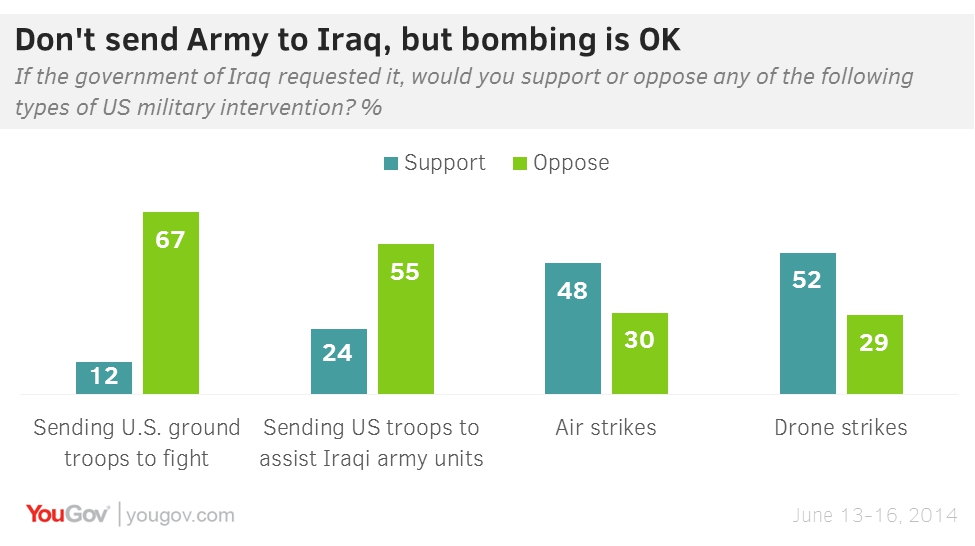
A new poll reveals that Americans don’t much care for bombing Iraq, but as the above chart shows, it’s a good deal more popular than boots on the ground. The public, however, doubts intervention will do any good:

Opposition to sending troops to Iraq may not be entirely due to weariness after nearly thirteen years of war, but also because of doubts over the ability of the US to actually have a positive impact. Only 19% say that US intervention would defeat the insurgents and restore the power of the Iraqi government, while 25% say that the insurgents would be defeated but the Iraqi government would still be ineffectual. 34% think that US intervention would do little to change anything.

Previous Dish on the possibility of US airstrikes on ISIS here and here.

Have The Cheneys Finally Jumped The Shark?

In a video introducing their new 501(c)4, Dick and Liz provide what will surely be SNL’s opening skit this Saturday:

Update from a reader:

I took a look at the Cheney video on YouTube to read some of the comments. And what did I see? Comments have been disabled. Some things never change.

Their astonishing op-ed – a classic in the annals of non-self-awareness – has even prompted Fox’s Megyn Kelly to balk and Byron York’s jaw to drop. Waldman identifies one of many huge holes in the warmongering op-ed from the father-daughter team:

[T]he Cheneys’ op ed is silent on what they would do differently in Iraq today. The op-ed contains nothing even approaching a specific suggestion for what, other than to say that defeating terrorists “will require a strategy — not a fantasy. It will require sustained difficult military, intelligence and diplomatic efforts — not empty misleading rhetoric. It will require rebuilding America’s military capacity — reversing the Obama policies that have weakened our armed forces and reduced our ability to influence events around the world.”

So to recap: we need a strategy, and though they won’t tell us what that strategy might be, it should involve military, intelligence, and diplomatic efforts, and rebuilding the military. Apart from the absurd claim that the armed forces have been “weakened” (we’re still spending over $600 billion a year on the military even with the war in Iraq behind us and Afghanistan winding down), the Cheneys are about as clear on what we should do now as they were on how invading Iraq was supposed to spread peace and democracy across the Middle East.

They know nothing but the fumes of their own ideology and self-regard. Ed Morrissey comments that the Cheneys “are likely whistling into the wind here”:

There hasn’t been much polling on Iraq, but the PPP poll taken over the weekend shows that the neocon policy is even less popular than Obama’s leadership at the moment. Even with the looming disaster facing Baghdad and by extension American policy, and even with the threat that ISIS represents to the region and eventually to the US directly, only 20% want American troops back in Iraq. The majority want a diplomatic “mobilization” to deal with ISIS, which as I wrote yesterday would look pretty strange, since ISIS is an unapologetic terrorist organization.

Jason Zengerle calls the op-ed an opening for Liz Cheney’s next political campaign:

While Obama is the ostensible target of the Cheneys’ op-ed and new group, their real opponent isn’t Obama but Rand Paul and the school of foreign-policy thinking that Paul represents inside the GOP. Liz finally has the proxy war she’s been waiting for.

Even before Liz abandoned her Senate race, people in Wyoming were speculating that she wouldn’t stay in the statethat, win or lose, her family would move back to the home in the Virginia suburbs that they never bothered to sell. But six months later Liz is still in Wyoming (just witness that gorgeous mountain backdrop on the video she recorded for the Alliance for a Strong America) and it seems likely she’ll make another run for office there at some point. If she does, today will have marked the start of that long campaign.

Maybe she could just get a job at NBC for $600,000 a year. I hear the children of shameless nepotists are doing quite well in this economy. Allahpundit also detects a preemptive strike against the young senator from Kentucky:

Really, why would you even need to attack O on foreign policy at this point? His numbers are already in the toilet; Chuck Todd read his political obituary on the air just this morning. He’s the lamest of lame ducks.

The guy whom hawks are worried about is Paul, who could do a lot of damage to the interventionist cause by succeeding with a more dovish foreign policy agenda in the GOP primary. Remember, too, that the Cheneys have a history with Paul: He eagerly endorsed Enzi after Liz announced her primary challenge and offered to campaign personally for him in Wyoming in the name of squashing a famous hawk with the Cheney name. The Cheneys are going to repay the kindness next year by attacking him as a dangerously irresponsible appeaser who’ll build on Obama’s legacy of failure. That’s where the new group comes in, I think. By rolling it out now against Obama, they’re going to build goodwill among righties. Then they’ll put that goodwill to use next year in hammering Paul.

But Tim Mak points out that Paul has been pretty cagey about where he actually stands on Iraq:

Paul has dropped hints here and there about his Iraq stance. He told the Des Moines Register this month that he didn’t oppose helping arm the Iraqi military and said he “would not rule out air strikes.” In a Senate Foreign Relations Committee hearing last week, he said he was “not very excited about” the prospect of sending military service members back into Iraq. But he stopped short of endorsing military intervention in Iraq or ruling it out, and his on-the-fence position hasn’t been clarified.

Boarding a senators-only elevator Tuesday morning with fellow Republican Sen. John McCain, a hawk well known for his foreign policy views, Paul joked that he should just tell reporters he believes “whatever McCain says.”

Paul is not turning out to be a profile in courage, is he?

Why Aren’t Gay Men On The Pill? Ctd

The New York Times has produced a “Room for Debate” colloquium on Truvada, the daily pill to prevent HIV infection. They lead with the Michael Weinstein, who writes this sentence:

PrEP has failed to protect the majority of men in every clinical trial (study).

He links to an Indian summary of drug trials from 2011. That ignores the data since then:

A key Truvada study found more than 90 percent effectiveness in preventing HIV infection even among those not fully compliant with the one-pill-a-day regimen. Another study showed that “parti­ci­pants could re­duce their risk of HIV by 76 pe­r­cent tak­ing two doses per week, 96 pe­r­cent by tak­ing four doses per week, and 99 pe­r­cent by tak­ing se­ven doses per week.”

That’s a huge majority in all the most recent studies. Then we have Larry Kramer writing the following:

Truvada is a form of chemotherapy, and we have not faced up to the possible side effects that might come.

truvadaChemotherapy? He sounds like someone’s hysterical grandma from a Roz Chast cartoon. It’s one pill a day whose side effects have been documented as minimal for the vast majority and easily monitored for anyone else. You get your bloodwork every three months. The drug has been used in combination for several years and has no resemblance even slightly to chemotherapy in any form. Of course, with any drug, including aspirin, there are side effects. But they pale in comparison to the side-effects of the full anti-HIV cocktail – which is the real life alternative to this simple pill a day.

So where are these people coming from?

If they were deadly serious about reducing HIV infections, why wouldn’t they want every possible means of prevention? Why, in fact, continue to favor an approach that has already demonstrably failed, rather than try a new one that might work? One clue comes from a sentence like this from Weinstein:

What we do know is that this generation didn’t live through the holocaust of the ’80s and ’90s.

As if that’s a bad thing! It doesn’t seem to occur to him that sex without terror is a good thing, in fact, an extraordinarily good thing for a fully realized life. Or that adjusting your behavior when the cost-benefit analysis decisively shifts is a perfectly rational thing to do. The same blindspot is in Larry’s sentence:

There is already a lot of complacency among gay men that makes the lucky uninfected neglect or reject condom use.

Complacency? It doesn’t seem to occur to Larry that it’s not complacency, but rationality at work here. Adjusting your behavior when the cost-benefit analysis decisively shifts is a perfectly rational thing to do. The only people being complacent with HIV are those “mainly” using condoms, hoping for the best when they lapse from time to time, and not taking Truvada. Why would Kramer not support someone attempting to make his own body as immune to HIV as possible – with a safety net as well as protective gear?

What we’re seeing perhaps is the understandable trauma of an older generation cramping the options of a younger one, in a different time, with different – and much less terrible – problems. The obvious drawback is the possibility that fewer condoms means more other STDs. But the check-ups required for continued use of Truvada can be a warning sign for that; and one study has found no probability of such unintended consequences. Maybe they’ll occur and we can adjust. But right now, we have a lethal weapon in the fight to the most lethal STD there is, and we’re unconscionably failing to use it.

The long-running Dish thread on the male pill is here. Update from a reader:

Thanks for continuing to cover Truvada. I’m a 54-year-old gay man, HIV-negative, lived in San Francisco in the early ’80s (and have lived to tell about it). I don’t have unprotected sex (truth be told, I don’t have much sex, period, but that’s another story). But at my last doctor’s visit, I went on Truvada. My doctor was unfamiliar with it (my gay doctor!), but he was happy to prescribe it. He said it seemed “a bit like overkill, but when the alternative is a life-and-death condition, is there such a thing as overkill?” My health insurance covers it, and so far no side effects that I can tell.

My reasons for going on Truvada are mostly emotional (what a spectre of fear relieved!) and political. As part of the political aspect, I’ve begun telling people that I am taking Truvada. The stigma attached to it needs to be removed, and having more people on the drug will enlarge the medical track record as well as, eventually, bringing the price down.

When I told two women friends about it, and the very high prevention rate some tests show, she said, “Why aren’t they putting it in the drinking water?” The other, in response to the idea that if gay men won’t even always wear a condom, how can they be expected to take a pill daily, pointed out that women on birth control seem to handle taking a pill every day.