Your morning moment of really, really gay.
Author: Andrew Sullivan
If Republicans Take Congress, Ctd
Bernstein runs though their options. One possibility:
[One] strategy would be to go on offense: to try to get their agenda passed by streamrolling Barack Obama and the Democrats. In other words, to imitate 1995. The problem with this one is that it would be spectacularly unsuccessful, and those who remember 1995 know it. Surely that includes John Boehner, who is almost certainly no fan of Newt Gingrich. Depending on the size of their majority, it's not even clear that Republicans could agree on a budget on the floor of the House. Even worse for them, if they can pass a Tea Party budget, it will almost certainly be stopped in Senate (best-case scenario 51 Republicans including Olympia Snowe and Susan Collins aren't going to try to shut down the Department of Education). And in the highly unlikely chance that they do get agreement on a budget that could make the conservative base happy, they'll never get enacting legislation through WH vetoes. The whole exercise would leave few if any substantive accomplishments, and plenty of ugly votes for the Democrats to sift through for the 2012 campaign. Even worse, a veto fight produced by this strategy would yield a government shutdown, which might thrill Tea Partiers but would likely help Obama and produce Boehner-destroying chaos inside the Republican conference.
Following The Chinese
Walter Russell Mead decodes the Castro brothers' recent actions:
Havana no longer fears that Miami will restore the ancien regime by armed invasion or by triggering an American attack on the island. But it does fear that as the Cuban economy gradually tracks back toward a capitalist model, Cuban American investors will simply buy the island back — investing in key industries and property. As far as I can see, the New Economic Policy now being formed in Havana is an attempt to prevent that from happening. On the one hand, island-based individuals and groups will have a chance to become rich and powerful as the economic controls are slowly lifted; on the other, the political authorities will still be able to control the ability of foreign firms and foreign investment to penetrate the island. Raul does not have his brother’s charisma and in any case the second Castro brother will likely follow Fidel into retirement in the not too distant future. Greater economic prosperity will be more important to the regime’s stability as the brothers fade from the scene.
Chart Of The Day
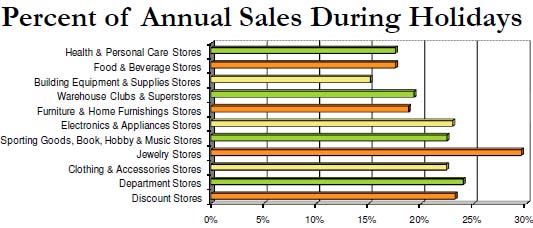
Catherine Rampell shows how much holiday sales matter:
As you can see, holiday sales make up a decent chunk of annual sales across the retail industry. In the jewelry subsector alone, 29.51 percent of annual sales come during the holiday season. In other words, a disappointing holiday season can affect 2011, too.
Breaking The Stereotype
Ackerman flags a study on the demographics of new Army recuits:
The National Priorities Project, a lefty research organization in Massachusetts, crunched the numbers for enlistment in fiscal 2009. Its findings show an Army that’s smarter and more upwardly mobile than it often gets credit for being. Yes, in order to meet the strain of recruiting during the Iraq and Afghanistan wars, the military as a whole lowered standards in the mid-2000s. But the National Priorities Project indicates that the Army, at least, may have turned a corner — and this is a group of people that knows it’s going to war.
The Enthusiasm Gap, Ctd
Ed Kilgore's spin:
There are two big takeaways that Democrats must understand from the enthusiasm gap data. The first is that it's a mistake to primarily assign turnout disparities to an insufficiently progressive agenda from the Obama administration. Maybe a different agenda would have been a good idea on policy grounds, or might have had a different impact on the congressional dynamics. But there's really little evidence that the discouragement we see among progressive elites is that widely shared among rank-and-file Democratic voters, whose relative likelihood to vote or not to vote is more easily explainable by structural factors.
Second, Republicans may be benefitting today from the hyper-excitement of its radicalized conservative base. But they will pay a price in the long run for the sort of agenda and rhetoric they are being driven to. That will become immediately evident in the 2012 cycle, when GOPers are forced to disclose their extremist hopes and dreams for the country, in the context of an electorate that is automatically less favorable.
The Dems And Prohibition, Ctd

Chris Weigant thinks that the Democrats will come around if Prop 19 boosts liberal turnout:
California's youth may surprise everyone and buck the general trend for any midterm election (where young voters mostly skip voting), and vote in droves precisely because a pet issue of theirs is on the ballot. This means it may behoove Democrats to put marijuana legalization initiatives on state ballots in order to drive up turnout in 2012, and beyond.
Democratic politicians, however, are going to be a lot more reluctant to join this bandwagon, but one assumes they'll certainly be thankful for the benefits of a bigger Democratic turnout. Both Jerry Brown and Barbara Boxer are officially against Proposition 19, but I bet in private they're thanking their lucky stars that it made the ballot this year.
"Yes on 19" spokesman Tom Angell, when contacted about this possibility, was optimistic about the prospect of Democrats having a change of heart politically, if Proposition 19 wins in November: "The pervasive political thought among Democrats is that supporting marijuana reform is politically dangerous — but eventually they'll realize that supporting such reform means that they won't be punished at the polls as a result, but that they may in fact be rewarded."
(Image: Sean Gallup/Getty Images)
The Making Of An American House
A bit from Bill Bryson's new book, At Home:
[T]he history of early America is really a history of coping with shortages of building materials. … During the first century of colonization, it was a rare house that lasted more than ten years…A hurricane in 1634 blew away – literally just lifted up and carried off – half the houses of Massachusetts. Barely had people rebuilt when a second storm of similar intensity blew in…Even decent building stone was not available in many areas. When George Washington wanted to pave his loggia at Mount Vernon with simple flagstones, he had to send to England for them.
Pot Grows Up, Ctd
A reader writes:
I'm not too sure where this reader's numbers came from. I can only guess that the legalish market in California has really driven down the prices of quality product. In less progressive areas of the country, an ounce can be had for about $40 for very low-grade product. For something higher-grade like indoor cultivated quality strains (like the warehouse in question would likely be producing), the price can be from $15 to $40 a gram. Twenty-eight grams to an ounce roughly adds up to $420-$1120.
This may not be the case in Oaksterdam, but anyone looking to rob that warehouse would likely be selling in a black market away from the scene of the robbery, where profit margins would be much higher. It just goes to show that facilitating a black market for this plant product only creates incentives for criminal activities. How many more markets can we afford to surrender to mobsters?
Another writes:
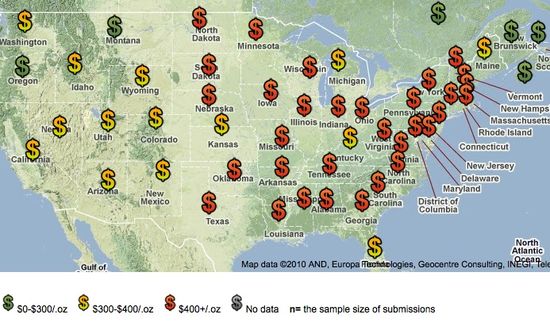
Pot retails for about $300 an ounce IN CALIFORNIA. West Coast pot (I'm from Eugene, Oregon – whaddup!) is famous throughout not just the US but the world. If I take an ounce of medical grade pot, put it in my trunk, and drive it to Texas or the East Coast, I could charge $500 or $600 for the ounce and sell it in hours. So, just pointing out that the economics of pot are a lot more complicated really than either of those first two readers indicated.
However, historically, an ounce of pot has tracked the price of an ounce of gold in some rough way. My friends and I had a running discussion of how crazy that fact was pretty much our entire pot-aware childhoods.
Another:
The dissenter who points out that wholesale pot goes for $200 an ounce while gold sells for $1300 might have a point – but it's fairly limited and fairly disingenuous when long-term pricing (as opposed to Fox News-driven exuberance) is included. Gold has only been at $1300 an ounce for a very short time. During the previous few decades, its price hung somewhere between $200 and $300 an ounce. As this chart shows (pdf), in 2004 it started going up to somewhere between $400 and $600, until exploding in price in recent months.
Another:
By the way, gold is measured in troy weight. From Wikipedia: “At 480 grains, the troy ounce is heavier than the avoirdupois ounce, which weighs 437.5 grains.”
Ah, the collective wisdom of Dish readers.
(Map taken from the crowdsourced site Price Of Weed.)
 The Dish