The Plan To Make Community College Free, Ctd

A reader isn’t a fan of this plan:

I sure wish people would stop using the word “free” regarding these kinds of plans. They aren’t free.  I’ll be paying for them.  You’ll be paying for them.

I think that more concentrated “trade school/technical” type of high schools are better than sending everyone to college.  My guess is that for most people the years spent on college would be better spent on preparing to have a trade. It is a cruel trick to play on the working classes to make them think that EVERYONE is going to profit by merely going to college, as if you can’t better yourself without it.  Only the Left will benefit from everyone going to college, since Leftist/Marxist indoctrination is rife amongst Academicians.

Less people should be going to college.  I’ve been to college.  I have my degree. Want to buy it for $100?  I’ll sell it to you. There is very little that college gave me that I couldn’t have obtained on my own, simply by continuing my life-long love of reading (I was reading by age of five, thanks to my mother’s own love of reading).

As a taxpayer, I don’t want to pay for the education of people when it won’t enhance their life.  I would rather pay for more trade schools and technical skills for people.  And by the way, you can get damn rich by being a carpenter or a plumber or an electrician.

More readers sound off:

I can’t help thinking that, regarding this plan from Obama, he’s getting the issue all wrong.

From my perspective, the problem with higher education in America is that too many people need it more than that too few people get it. As it is already, too many college students either don’t want or don’t need what, at its core, a college education actually (and should) offer: a chance to pursue knowledge for its own sake and engage with thought and ideas simply for the sake of doing so. Few people actually enjoy this or can benefit from it, and yet it is really this experience, not job training or acquisition of marketable skills, that college is meant to provide.

Conversely, colleges are comparatively ill-equipped to provide job skills training, since most faculty members’ primary goal is pursuit of new knowledge (research) rather than teaching. Vocational and trade schools, not colleges, are the proper forum to provide Americans who are looking to get ahead with the skills they need to improve their lives, and yet the president is doubling down on the absurd misuse of colleges and universities that is already so pervasive.

As a student at a prestigious (if I may say so myself) university, I can tell you that most students are not there to engage with ideas and acquire knowledge, but to “check the box” on their way to a lucrative career. Academia is simply not meant to be no-cost employee training for corporations, and it is to the detriment of everyone when it gets used this way. The president ought to be focusing on expanding opportunity for those who either choose not to go to college or cannot afford to do so.

Another skeptical reader:

I have given a lot of thought about this based on my own experience. In my smallish hometown back in the late ’90s, when NAFTA was picking off manufacturing right and left, several of the largest factories closed in a short period of time.  Lots of people took advantage of Trade Adjustment Assistance, which basically allows you to receive unemployment benefits for two years as long as you are in a degree program. The tuition wasn’t included (as I recall), but virtually everyone was eligible for full Pell Grants.

Two years later though, the jobs of the future had not arrived. You just had a glut of people with Associate Degrees competing for jobs that paid less than the ones they lost.  Now the president’s new plan would be aimed at young people who have the option of moving to where the better jobs are. So this is definitely not apples to apples. But it’s still going to be many more Associate Degrees, which will make Bachelor Degrees more sought-after.

And how are these folks who needed the free community college tuition going to pay for that? Student loans. Throw in wage stagnation and a larger share of people with these degrees, and round and round we go.

Don’t get me wrong. I’m all for more education. For cheaper education. I applaud this as a great start. But we need cheaper higher education and higher wages to really make a difference.

Update: Many readers here correct and counter the ones above.

Prison For Petraeus?

CIA Director David Petraeus, testifies b

It’s looking likely that the general will face felony charges for leaking classified information to his mistress. Trevor Timm reviews the relevant law:

By all accounts, Petraeus’s leak caused no damage to US national security. “So why is he being charged,” his powerful friends will surely ask. Well, that does not matter under the Espionage Act. Even if your leak caused no national security damage at all, you can still be charged, and you can’t argue otherwise as a defense at trial. If that sounds like it can’t be true, ask former State Department official Stephen Kim, who is now serving a prison sentence for leaking to Fox News reporter James Rosen. The judge in his case ruled that prosecutors did not have to prove his leak harmed national security in order to be found guilty.

Eli Lake notes how unusual this is:

Senior officials such as Petraeus, who serve at the highest levels of the national security state, are almost never punished as harshly as low- and midlevel analysts who are charged with leaking.

When former CIA director John Deutch was found to have classified documents on his unsecure home computer, he was stripped of his security clearance and charged with a misdemeanor. President Bill Clinton pardoned him. Sandy Berger, who was Clinton’s national security adviser, absconded with sensitive documents relating to al-Qaeda from the National Archives. In 2005, he was fined $10,000 and stripped of his security clearance for three years.

The fate for lower-level leakers is rarely so kind.

Martin Longman remarks that “one of the most dispiriting recent trends in Washington has been the way that high officials have skated despite the worst kind of malfeasance and incompetence”:

Holding anyone to the same standards we hold regular folks to would have to be considered a turn in the right direction. If you want to restore some faith in government, you have to demonstrate that we’re capable, at least occasionally, of acting like there is one set of rules that applies to everyone equally. Tossing Petraeus in prison would definitely send that message.

Having said that, I think his crime is significant but ultimately not that serious. His punishment should be commensurate with his offense.

Joyner joins the conversation:

My instinct is that people in the highest positions of public trust ought indeed to be prosecuted when they violate that trust. Putting the sainted David Petraeus on trial would send a powerful signal that no one is above the law and that we take safeguarding our secrets seriously. This wasn’t, after all, a situation where he skirted the law in misguided pursuit of the nation’s security; he did so for the most selfish reasons. To the extent that his long history of service to the nation counterbalances his transgressions here, it can be weighed at sentencing.

And Marcy Wheeler is sick of Washington elites defending one of their own:

McCain (and his sidekick Lindsey) are not the only ones rending their garments over the injustice of a top Obama official being investigated for leaking classified details to make himself look good. Jason Chaffetz keeps complaining about it. And Dianne Feinstein took to the Sunday shows to declare that Petraeus has suffered enough. Richard Burr apparently made false claims about how the Espionage Act has been wielded, of late, even against those whose leaks caused no harm.

Golly, you’d think all these legislators might figure out they have the authority, as legislators, to fix the overly broad application of the Espionage Act.

(Photo: by Karen Bleier/AFP/Getty Images)

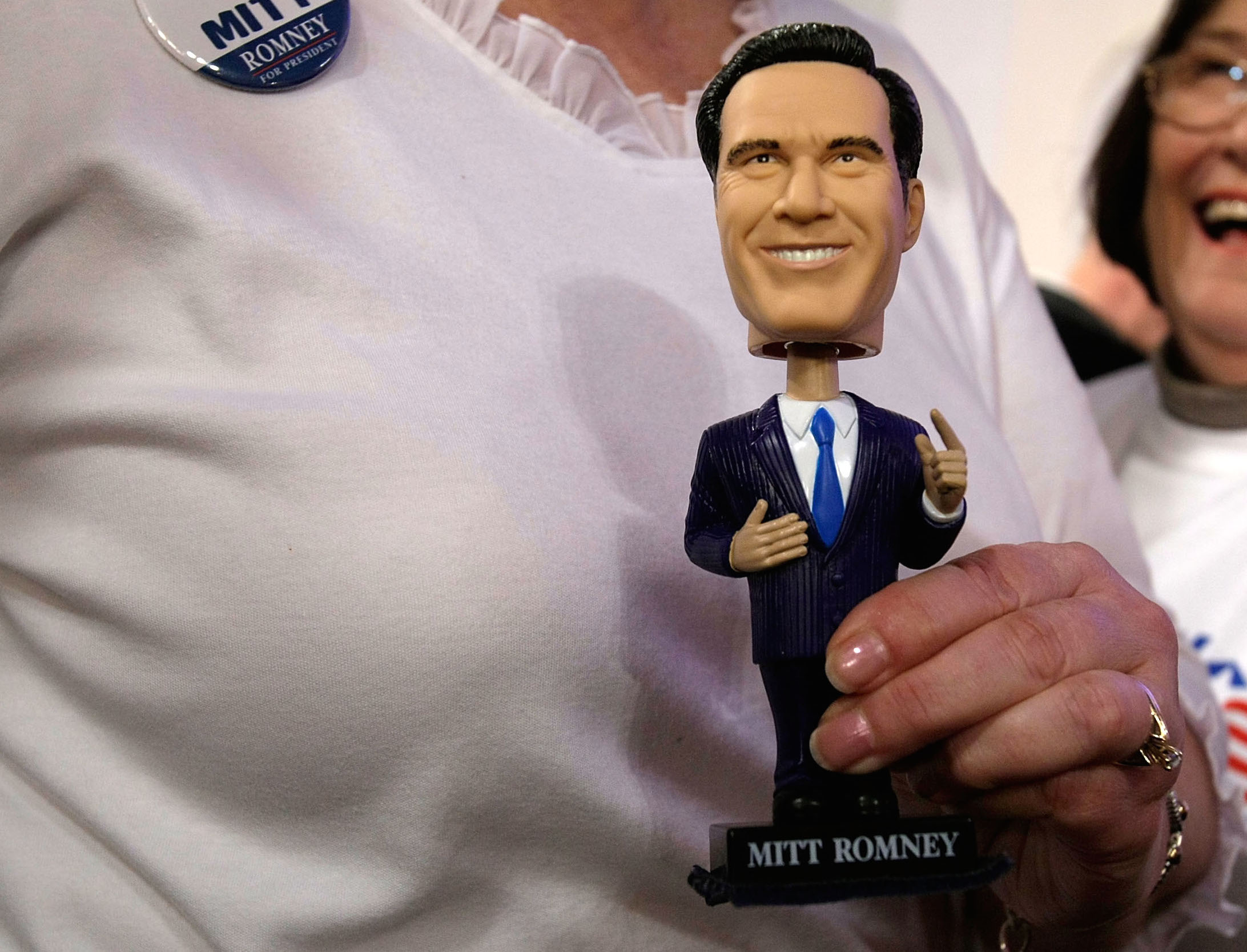
Romney 3.0

Mitt Romney Holds Florida Primary Night Event

Romney is apparently considering yet another run at the White House:

“Everybody in here can go tell your friends that I’m considering a run,” the former candidate told the gathering in midtown Manhattan, according to Politico. But insiders who spoke to BuzzFeed News about Romney’s evolution on the 2016 question said he only began to entertain the possibility recently, and that he still needs to weigh a number of factors — including Jeb Bush’s electability — before he decides to take the plunge.

Enten tries to understand Mitt’s logic:

In March, I wrote that this was the most split Republican presidential field in the modern era (since 1976). And that still holds today. Jeb Bush’s 23 percent support in a recent CNN survey was the highest for any non-Romney candidate over the past year. Most polls show every candidate (besides Romney) south of 20 percent.

But he keeps in mind that “general election losers that have run for their party’s nomination again have a terrible record.” Ben Jacobs cracks open the history books:

The last [general election loser] to even mount a campaign was George McGovern, the Democratic nominee in 1972, who mounted a quixotic comeback attempt in 1984. In fact, with the exception of Richard Nixon’s win in 1968, the only time a former major party nominee has since been elected to the presidency since the Civil War was when former President Grover Cleveland won his 1892 rematch for the White House against Benjamin Harrison.

Rather than signing on with Jeb in the next weeks or months, many of those money men and women will wait to see what Romney does before doing anything. So, Romney is really buying himself — and, whether intentionally or not, the rest of the potential field — some time. He’s taking the Bush pot off of boil and turning it down to simmer.

Lisa Lerer and Annie Linskey note that, while “Bush and Romney have always been cordial, they’ve never been close”

Some Romney advisers are still grumbling about Bush’s role in the 2012 campaign. Despite calls, e-mails, and private meetings with Romney before the hard-fought Florida primary, Bush endorsed Romney in March—nearly two months after the state’s contest and when the nomination was already within the former governor’s grasp. A few months later, in the midst of the general election, Bush criticized Romney’s approach to the immigration issue, saying at a Bloomberg View event that he needed to “change the tone.” “He got off message,” said Bush of Romney’s campaign in an interview last month with a Miami television station. “He got sucked into other people’s agenda.”

In private conversations, Romney has questioned Bush’s ability to beat Clinton, arguing that voters would recall her husband’s administration in a far more positive light than that of former President George W. Bush. He’s also warned that Bush, who spent his post-office years working on a range of business ventures, could be open to the same type of private equity attacks that Democrats successfully leveraged against Romney in the 2012 race.

Zeke Miller and Alex Altman aren’t sure how seriously to take Romney:

One Republican consultant suggests that posturing over a possible campaign was a way to signal that he wouldn’t cede automatically donors or staff to Bush. … This is why veteran operatives of the Romney campaigns consider the revived rumors of a 2016 campaign overblown. They have long scoffed at the notion he’d run again. They believe their former boss would be an excellent president. They say Romney agrees. At the same time, they don’t expect a campaign to materialize.

Jennifer Rubin hears much the same:

In my informal survey of about a 15 GOP insiders, some with other candidates and some unaffiliated, I did not find a single person convinced Romney was actually running. One person gave the back of the hand to the idea Romney was poised to enter the race: “I don’t think he is [serious]. I think his advisers are and they aren’t letting him kill the rumors.” Another remarked, “I think people who think Romney can still be president are living in a fantasy world. Great guy. Would have been super president. Should have won, but it’s over.” A third said, “It’s unclear if it is intended to start a ‘draft’ movement or if he wants to try and hold the field or if he wants to be in the wings in case the field implodes.” A fourth told me, “He has little to no natural constituency in the party.”

Larison rolls his eyes:

Given that success is very unlikely, and since it can only harm Romney’s reputation to embark on a third losing effort, it raises the question: what could Romney and his backers be thinking? Maybe his former staffers and advisers just want to get paid, but why would Romney want to go through the process all over again? There is every chance that he would be thoroughly humiliated along the way. That might be amusing to watch at first, but it would mostly just be sad.

Outside of a small band of loyalists, I can’t imagine who in the GOP would want to go through another failed presidential campaign.

(Photo by Alex Wong/Getty Images)

Busted With An Eggcorn, Ctd

Screen Shot 2015-01-08 at 10.49.30 AM

This is probably the last of the mega popular thread. A reader sends the above image:

Am I too late for eggcorns? One of Boston’s historic burying grounds is Copp’s Hill Burying Ground, named for the family of William Copp, who once owned the land. Several maps, including this one from 1776, label it “Corpse Hill” instead. Perfectly reasonable, especially considering locals’ relationship with the letter R.

An eggcorn fitting for the week:

Years ago, in winter, my Italian boyfriend called the “wind chill” factor the “windshield” factor, as he thought it meant how cold the temperature was going over a car’s windshield. He had been in Canada his whole life and nobody had corrected him (before me). He laughed.

Another:

What do you call it when you and your buddies go to the beach and build a big driftwood fire, cluster around it, and become even closer friends? This morning I saw the following on a gold prospecting forum I visit: “I have had many similar finds on beaches where people have at one time had a bond fire.”

A dozen more after the jump:

You guys are probably sick of these by now, but I’ll throw one in:

I remember calling my brother and getting my 4-year-old niece.  When I asked her if my brother was at home, she told me that he had gone to “his ami,” having clearly heard that her father was on his way to that city in Florida.

Another:

I’ve got a companion to the “Seattle” eggcorn! (“Who is Attle, and why are we going to see her?”) A young friend on her first airplane trip was paying close attention to all the pilot’s announcements in preparation for takeoff. At one point the pilot announced that they were just waiting for clearance and then would be taking off. The kid turned to her older companion and asked, “Who is Clarence, and why are we waiting for him?”

Another:

A neighbor once told me that the second of two related unwelcome events was “like addin’ salt to an injury.” (Insult to injury)

Another:

I worked with a marketing director of a Texas bank in the ’70s. When something went wrong he was afraid that he was likely to be the “escaped goat”.

Another:

OK, I’ll bite. In law school, one of my best friends, had two eggcorns that he used (until someone pointed out the error): “all intensive purposes” for “all intents and purposes;” and “the straightened arrow” for “the straight and narrow.”

Another:

After reading the latest update to this thread, I just received a letter from a fellow attorney in which he endorses a judicial candidate on the grounds that she is “imminently qualified” for the appointment.  Perhaps, by the time she takes the bench, she will be all the way there!

Another:

One of my partners in business sometimes tells me that he’s “flusterated” by one thing or another. The first few times I thought he might’ve misspoken. It wasn’t until recently that I realized he thought the word was flusterated instead of frustrated – and you know what, sometimes I get pretty flusterated too.

Another:

I grew up near Boston, and therefore I believed that Arthur was someone who wrote books.

Another:

I am a long-time reader and subscriber, but I this is the first time I am writing in. Reviewing all the eggcorns that have been shared, I thought your readers would enjoy this one. When I was about 10, I first encountered the hymn “All Hail the Power of Jesus’ Name.”  The opening line stated, quite dramatically, “All hail the power of Jesus’s name, let angels PROSTRATE fall.” By this time in my life I had heard of PROSTATE cancer and knew where it was located on the male body. For the life of me, I did not understand what was going on with those angels.

Another:

My aunt used to say that you had to heat water in a pot until it came to a roaring boil.

One more:

Teaching 8th grade English, I’ve circled more than a few eggcorns in red ink over the last 18 years. The one I see with astonishing frequency: some variation or other on “It’s important not to take things for granite.” I’ll cut them some slack; they are, after all, fourteen. Wy wife, however, is fair game for good-natured ribbing for telling our sons recently “Don’t lick a gift horse in the mouth”.

This Is Your Brain On Baby

UCL-neurology-maternal-vs-romantic-love

Adrienne LaFrance researches the neurological changes that women undergo when they become mothers. Yes, it’s like a drug:

“We see changes at both the hormonal and brain levels,” brain researcher Ruth Feldman told me in an email. “Maternal oxytocin levels—the system responsible for maternal-infant bonding across all mammalian species—dramatically increase during pregnancy and the postpartum [period] and the more mother is involved in childcare, the greater the increase in oxytocin.” Oxytocin also increases as women look at their babies, or hear their babies’ coos and cries, or snuggle with their babies. An increase in oxytocin during breastfeeding may help explain why researchers have found that breastfeeding mothers are more sensitive to the sound of their babies’ cries than non-breastfeeding mothers. … What scientists do know, Feldman says, is that becoming a parent looks—at least in the brain—a lot like falling in love.

Dads get doped up too, but in a different way:

Oxytocin does not seem to drive nurturing behavior in men the way it does in women, Feldman and other researchers found in a study last year. Instead, a man’s parental brain is supported by a socio-cognitive network that develops in the brain of both sexes later in life, whereas women appear to have evolved to have a “brain-hormone-behavior constellation” that’s automatically primed for mothering. Another way to look at it: the blueprint for mothering behavior exists in the brain even before a woman has children.

“Take Your Medicine” Taken To An Extreme, Ctd

That 17-year-old in Connecticut trying to refuse chemo lost her court battle on Thursday:

The state argued that the teen lacked competency extended to maturity and that they did not believe she understood the severity of her prognosis. Her mother and her mother’s lawyer said they expect to go back to trial court to more fully explore the mature minor argument.

Her words are pretty heartbreaking:

The day of the ruling, Cassandra published a personal essay in the Hartford Courant about her experience. In the article, she describes crying and hiding from the police in her closet, running away from home after two days of chemotherapy, and being strapped to a hospital bed to undergo treatment against her will. She also refutes any claims that her mother was neglectful during her illness. “This experience has been a continuous nightmare,” Cassandra wrote in her essay.

“I want the right to make my medical decisions. It’s disgusting that I’m fighting for a right that I and anyone in my situation should already have. This is my life and my body, not [the Department of Children and Families]’s and not the state’s. I am a human — I should be able to decide if I do or don’t want chemotherapy. Whether I live 17 years or 100 years should not be anyone’s choice but mine.”

The Courant also published an unpersuasive counterpoint from a local man who got the same kind of cancer at 19 and chose to undergo chemotherapy. Key word: chose. But as Brandy Zadrozny notes:

A guard is manning the door [of Cassandra’s hospital room], which is always kept ajar so she can be monitored. Contact with her mother and the outside world—beyond nurses and her temporary guardian appointed by the state’s Department of Children and Families—is limited.

In the words of her public defender, Joshua Michtom:

[17-year-olds] can consent to sex with someone who’s near an age to them. They can get contraception. They can get addiction treatment. They can donate blood. They can be tried as adults for certain crimes. So there’s recognition overall that maturity doesn’t happen overnight. You don’t go to sleep a 17-year-old knucklehead and wake up an 18-year-old sage.

A cancer doctor who goes by the blog name of Orac has “written time and time again about children with cancer who refuse chemotherapy in favor of quackery”:

The difference between Cassandra’s case and these other cases, interestingly, is that, from what I can tell, she refused chemotherapy before having received a single dose. Even odder, her mother backed up her decision. This is very unusual, in my experience, which, fortunately, is limited to small numbers.

But the doctor doesn’t quite know where to come down on this one:

Regular readers should also know that I’ve always said that competent adults should be able to choose whatever treatment they want or no treatment at all, even if it will result in their death. That’s why I’m very much torn about this case. The reason is simple. Cassandra is 17 and will be 18 in September. She is very close to being an adult legally. I have no problem—and never have had a problem—accepting that children are too immature to make such momentous decisions and that parents who refuse to treat children with cancer with appropriate therapy are guilty of medical neglect. Such certainty is easy for 10, 11, 12, 13, and even 14 year olds. Heck it’s easy for 15 and even 16 year olds. But as a child hits 17 and gets closer to being a legal adult, it becomes harder for me to be quite so certain.

“Overlook Their Annoying Talk”

Harris Zafar reminds us that, whether dealing with specific insults or with the freedom of speech more generally, Muhammad’s teachings fly in the face of what modern-day Islamists purport to believe:

Islam does not support people who violently censor free speech. Freedom of speech is guaranteed in the MuhammadQur’an both through direct instruction as well as recalling how Muhammad was insulted to his face and never retaliated. The Qur’an records that he was called crazy, a victim of deception, a liar, and a fraud. Through this all, the Prophet Muhammad never retaliated or called for these people to be attacked, seized, or executed. This is because the Qur’an says to “overlook their annoying talk” and to “bear patiently what they say.” It instructs us to avoid the company of those who continue their derogatory attacks against Islam. There simply is no room in Islam for responding to mockery or blasphemy with violence.

But perhaps most pointedly, the Qur’an tells believers not to be provoked by those who seem to attack Islam, stating very clearly “let not a people’s enmity incite you to act otherwise than with justice.” This is supported by the actions of the Prophet Muhammad himself. When he was once returning from an expedition, an antagonist used insulting words against him. Although a companion suggested that the culprit be killed, the Prophet Muhammad did not permit anyone to do so and, instead, instructed they leave him alone.

Readers on Friday underscored that incident and the same overall point – which can’t be reiterated enough. So where did the practice of not depicting Muhammad come from? Amanda Taub voxplains:

According to [scholar Reza] Aslan, the Koran does not explicitly prohibit depicting the Prophet Mohammed, and there have been images of Mohammed, his family, and other prophets throughout history. “The history of Islam teems with images of the Prophet Mohammed. You see this in the 7th, 8th, 9th, 10th, 11th, 12th, 13th, 14th, 15th, 16th, 17th, 18th, 19th, and 20th centuries.”

Still, the idea that depictions of Mohammed are disallowed didn’t come out of nowhere. Islam, Aslan explained, like Judaism, is an iconoclastic religion that does not permit God to be anthropomorphized — that is, portrayed as a human being — and prizes textual scripture instead.

Over time, Islamic scholars extended that tradition to cover Mohammed and the other major prophets as well, and discouraged artists from depicting them in images. That has created a strong cultural norm against images of Mohammed, even in the absence of a religious law against them.

Back in 2010, Omid Safi passed along the above image, “one of the classic images of the Prophet Muhammad’s Heavenly Ascension”:

In my recent biography of the Prophet, I have taken care to produce about 20 of the pietistic and sacred images produced by Muslim artists over the centuries. These are as far from the Danish cartoon images as one can get: they are works of devotion, illuminated by faith, and imbued with a deep sense of love. There are other options available to Muslims than either accepting the Danish Cartoonist caricatures of the Prophet or responding in pure anger and hatred. One such answer is a return to the rich pietistic Islamic tradition of depicting the Prophet who was sent, according to the Qur’an, as a mercy to all the Universe.

Quote For The Day II

“You ask yourself the question every time you open a newspaper or switch on the TV or walk the streets… You know the question. It reads: Just what the hell is going on around here?

The world looks worse every day. Is it worse, or does it just look it? The world gets older. The world has seen and done it all. Boy, is it beat. It’s suicidal…the world has done too many things too many times with too many people, done it this way, that way, with him, with him. The world has been to so many parties, been in so many fights, lost its keys, had its handbag stolen, drunk too much. It all adds up. A tab is presented. Our ironic destiny. Look at the modern infamies, the twentieth-century sins. Some are strange, some banal, but they all offend the eye, covered in their newborn vernix. Gratuitous or recreational crimes of violence, the ever-less-tacit totalitarianism of money (money—what is this shit anyway?), the pornographic proliferation, the nuclear collapse of the family (with the breeders all going critical, and now the children running too), the sappings and distortions of a mediated reality, the sexual abuse of the very old and the very young (of the weak, the weak): what is the hidden denominator here, and what could explain it all?

To paraphrase Bujak, as I understood him. We live in a shameful shadowland. Quietly, our idea of human life has changed, thinned out. We can’t help but think less of it now. The human race has declassed itself. It does not live anymore; it just survives, like an animal. We endure the suicide’s shame, the shame of the murderer, the shame of the victim. Death is all we have in common. And what does that do to life?” – Martin Amis, “Bujak and the Strong Force, or God’s Dice” in Einstein’s Monsters.

(Hat tip: John Benjamin)

Face Of The Day

dish_tentcity2

Christopher Occhicone photographed the residents of Tent City in Lakewood, New Jersey:

Tent City … has been home to up to 100 residents for the past 7 years. Local residents have been calling for the closure of the camp since it began. The town succeeded in forcing out most of the residents by August 2014. Some were offered one year of rent-free housing in neighboring towns. Others were given $3,000 in cash to agree to leave town. The remainder were unable to accept either offer because of outstanding arrest warrants.

The aim of my work was to provide an honest look at life inside the camp and thus better inform policy (being decided outside the camp). I wanted to make a document that can be used as a reference for people wanting to address the issue of homelessness.

The project was screened at Visa Pour L’image. See more of Occhicone’s work here.

“Let He Who Is Without Sin Cast The First Outraged Tweet”

800px-Guercino_-_Jesus_and_the_Samaritan_Woman_at_the_Well_-_WGA10946

Pascal Emmanuel-Gobry turns to an unlikely source as he implores us to avoid another year of online outrage – the French philosopher René Girard. He examines his work on scapegoating, which Gobry believes resonates with the way we interact online. The way to defuse our tendency toward scapegoating:

The only ancient text Girard could find that contained a denunciation, rather than an endorsement, of scapegoating, is the Bible. The Bible also has its narrative of founding murder. But while Rome’s myth states that Remus was guilty and needed to die, the Bible says that “Abel the Just” was innocent, and has its god character protect his murderer Cain from scapegoating vengeance.

The Bible also contains one of the most striking stories in all of human literature: the story of Jesus and the woman taken in adultery. The reason why the phrase “let he who is without sin cast the first stone” has resonated so deeply in every age and culture is precisely because it strikes at the core of the scapegoat mechanism. It really didn’t matter to anyone whether the woman actually committed adultery, and the lynch mob was just as guilty, or just as innocent, as her. Once the reality of the scapegoat mechanism was exposed, the men could only realize the futility of what they were about to do.

The only way to defeat the scapegoat mechanism is to expose it. … Let he who is without sin cast the first outraged tweet.

(Image of Guercino’s “Jesus and the Samaritan Woman at the Well,” 1641, via Wikimedia Commons)