America’s Trust Deficit

Trust America

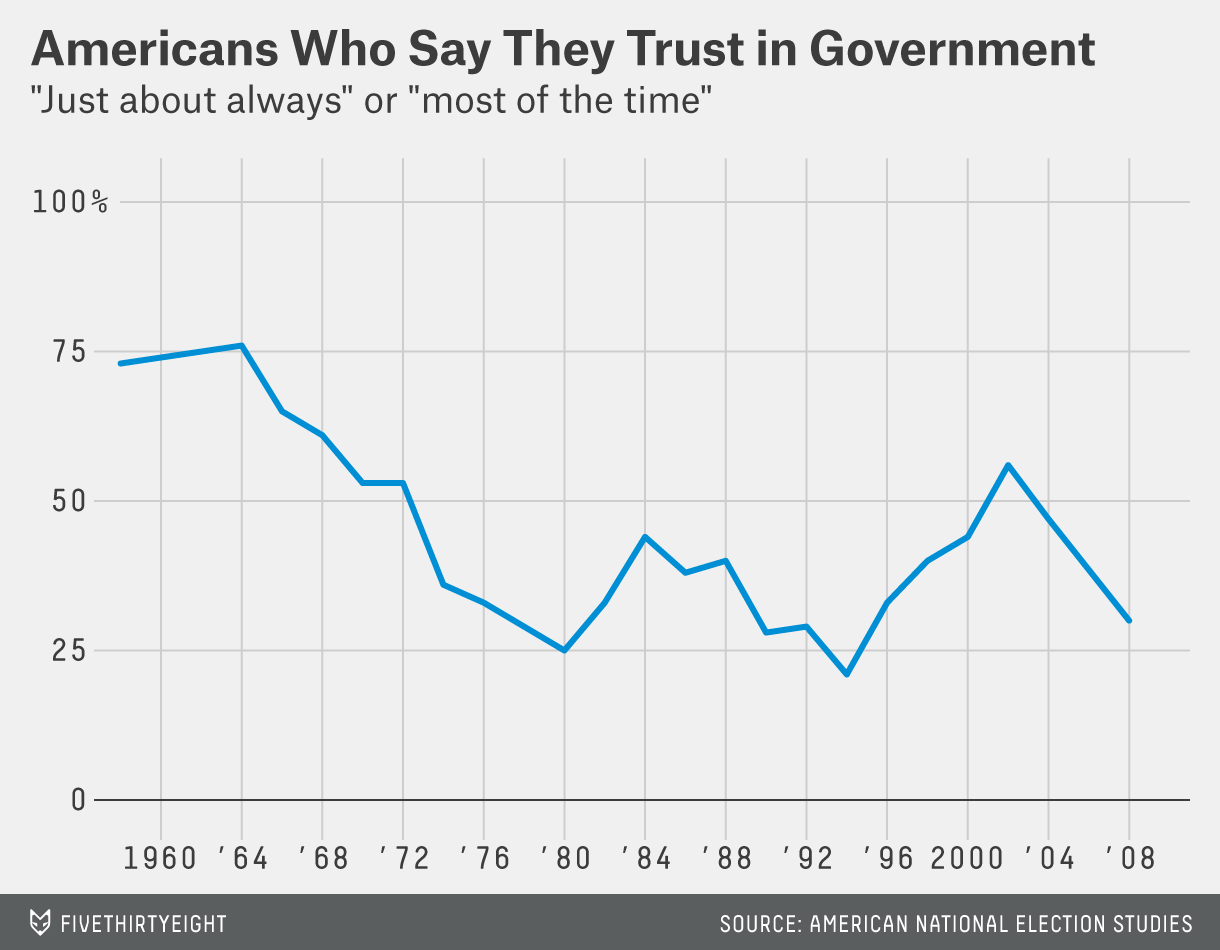
Dan Hopkins blames Obamacare’s low polling on it:

During a period of high trust like the early 1960s, Americans were confident that the government could accomplish what it set out to accomplish — and were willing to give it the benefit of the doubt. A War on Poverty? Sign us up, even if we were also trying to put the first person on the moon. And fighting a major war in southeast Asia. In 1966, Chief Justice Earl Warren said that President Lyndon Johnson had been “working hard on Vietnam and has been for a long time. … He will find some way out.” At the time trust was high, and much of the country agreed.

During a period of low trust, however, we might endorse a policy in theory but oppose it in practice because we doubt the government’s ability to make it happen.

He also argues that low trust can “become a self-fulfilling prophecy”:

In a low-trust environment, politicians who want to expand the government’s role face a conundrum. Even when the public is supportive of their policy goals, Americans might well doubt the government’s capacity to deliver on those goals. And that in turn might encourage the architects of public policy to hide the government’s role, leading to public policies that are at once highly complex and obscured from view. That’s not a great recipe for rebuilding trust in government. But it’s an apt description of Obamacare.

An Anthology Of Other People’s Mail, Ctd

Recently we featured the blog-turned-book, Letters of Note, an eclectic archive of correspondence from both the famous and unknown. Andrea Denhoed recently talked to Shaun Usher, the project’s mastermind, offering a glimpse of how it all works:

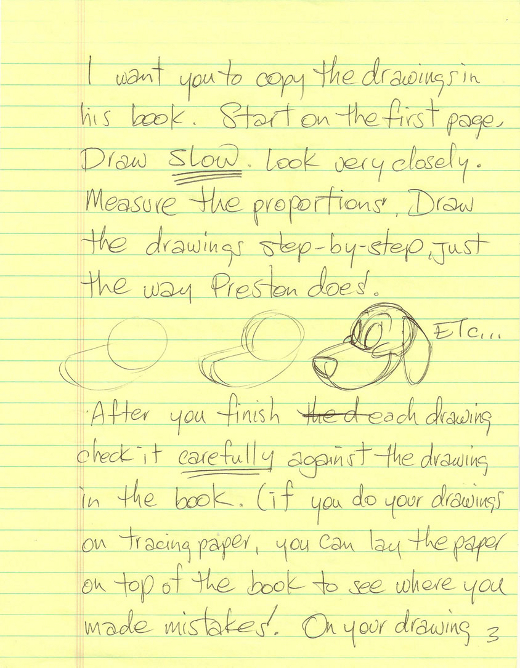
The success of “Letters of Note” is certainly a tribute to the charm of written correspondence, dish_renstimpyletter but it’s also evidence of the value of a supportive spouse—Usher’s wife, who was working as a manager for a cosmetics company, supported the family alone for most of two years before his work became profitable—and the indispensability of tireless trench work. These days, Usher receives a steady flow of submissions and has connections with a number of archivists. Starting out, however, there was much more digging involved. He says, “In those days … I’d get a list of famous people and I’d type into Google, I don’t know, ‘Stan Laurel letter’ and I’d literally just search about Google to see what I could find. And it worked to an extent.” His first letter to go viral was found this way, several pages into the search results. It’s an unusually kind and lengthy letter to a young fan from John Kricfalusi, the creator of the cartoon “Ren and Stimpy.” It included sketches, encouragement (“Alright Bastard, let’s get to work. Draw!”) and practical cartooning advice (“Learn how to draw hands.”)

The project’s popularity, however, has brought its own frustrations:

Usher estimates that he reads at least twenty unusable letters for each one that he ends up including. He says, “I’ve bought hundreds of books purely to find one letter I just had a hunch might be in there.” With his success, a new problem has cropped up: he also receives a huge number of unusable submissions. He’s been sent a few, he says, that are too scandalous to post. “It’s so frustrating,” he says. But “I’d get sued pretty quickly.” Far more often, he gets “very personal letters—from their grandma, or their grandpa … and it’s this very lovely letter. But I receive so many of them, and I’ve seen them so many times that they’re not …” He trails off, like he can’t quite bring himself to say that these precious family heirlooms can be boring. “I have to write some very tactful rejection letters.”

The idea behind the Letters of Note project—that correspondence holds a rare communicative and aesthetic power—also happens to be well calibrated for the Internet. It hits on a juncture of Pinterest-style object nostalgia, an appetite for emotive but bite-size reading, and a mild voyeurism. Usher points out the irony that “the very service that’s going to kill off letter writing” is responsible for bringing these missives before so many eyes.

(Image: Page from John Kricfalusi’s letter via Letters of Note)

Reading Above The Din

Although Tim Parks grants that today’s readers are willing to put in time for lengthy novels like Karl Ove Knausgaard’s multi-volume My Struggle or the Lord of the Rings trilogy, he finds that “the texture of these books seems radically different from the serious fiction of the nineteenth and early-twentieth centuries. There is a battering ram quality to the contemporary novel, an insistence and repetition that perhaps permits the reader to hang in despite the frequent interruptions to which most ordinary readers leave themselves open.” So what does this mean for fiction?

“In a good novel—it hardly needs to be said—every word matters.” Thus Jay Caspian Kang giving us the lit-crit, text-is-sacred orthodoxy in a recent New Yorker blog post. Honestly, I wonder whether this was ever really true; authors have often published then republished their work with all kinds of alterations but arguably without greatly changing a reader’s experience (one thinks of Thomas Hardy, Lawrence, Faulkner), while many readers (myself included), in the long process of reading a substantial novel, will simply not register this or that word, or again will reread certain sections when they’ve lost their thread after a forced break, altering the balance of one part to another, so that we all come away from a book with rather different ideas of what exactly it was we experienced during perhaps a hundred hours of reading.

But today Kang’s claim seems less and less likely to be true. I will go out on a limb with a prediction: the novel of elegant, highly distinct prose, of conceptual delicacy and syntactical complexity, will tend to divide itself up into shorter and shorter sections, offering more frequent pauses where we can take time out. The larger popular novel, or the novel of extensive narrative architecture, will be ever more laden with repetitive formulas, and coercive, declamatory rhetoric to make it easier and easier, after breaks, to pick up, not a thread, but a sturdy cable. No doubt there will be precious exceptions. Look out for them.

In response to Parks, Corey Robin confesses to taking long subway rides to no place in particular in order to find time to read:

I take nothing with me but my book and a pen. I take notes on the front and back pages of the book. If I run out of pages, I carry a little notebook with me. I never get off the train (except, occasionally, to meet my wife for lunch in Manhattan.) I have an ancient phone, so there’s no internet or desire to text, and I’m mostly underground, so there are no phone calls.

When I get back, I sometimes post about my little rides and what I’m reading on Facebook: Schumpeter in Queens, The Theory of Moral Sentiments in the Bronx, Hayek in Brooklyn. The more incongruous, the better, though sometimes I find some funny or interesting parallels between what I’m reading and where I’m riding and what I’m seeing.

But the joking on Facebook covers up my dirty little secret: I ride the rails to read because if I’m at home, and not writing, I’m on the internet. “It is not simply that one is interrupted,” as Park writes; “it is that one is actually inclined to interruption.”

Freddie recommends turning off “the part of your mind that cares about getting finished quickly”:

A project book is one that you want to take a long time with, often one that necessitates taking a long time with. And though so many of your instincts are going to militate against it, you should stretch out into that time. Get comfortable. Think of your project book as a long-term sublease, a place that you know you won’t live in forever but one that you also know has to come to feel like home. You want to take months, reading little chunks at a time. It might offend your bookworm nature, but I find it’s useful to make a regular appointment– for this hour, twice a week, I will read this book and ancillary materials about it. Think of it like appointment television, if that suits you. Learn to enjoy the feeling of not being in complete control over what you mentally consume all the time, a feeling that has become rarer and rarer.

Face Of The Day

Surabaya Mayor To Close Red-Light District

A Indonesian commercial female sex worker holds a broken pan during protest against the closing of the “Dolly” red-light district in Surabaya, Indonesia on June 18, 2014. Sex workers and others, such as taxi drivers and street vendors working in the district, oppose the plan out of concern for lost income. By Ulet Ifansasti/Getty Images)

Responding To Student Groans, Ctd

A reader writes:

I think that one aspect that is getting lost in all of this discussion of mounting student debt is that federal money is an enabler of growing college tuition.  When the government gives students extra money to spend on college, they will tend to compete the price of tuition up.  (Just how much the price increases depends on the relative elasticity of supply and demand.)  If, instead, the government paid universities a certain amount per student admitted, the universities would tend to compete the price of tuition down.

It’s counterintuitive that subsidizing the customer doesn’t ultimately help the customer. But then a lot of economics is counterintuitive.  Ironically, the best way the federal government could aid students would be to eliminate Pell Grants, tax write-offs and credits altogether and use that money to incentivize lower tuition rates on the supply side.

Why Doesn’t Turkey Fear ISIS?

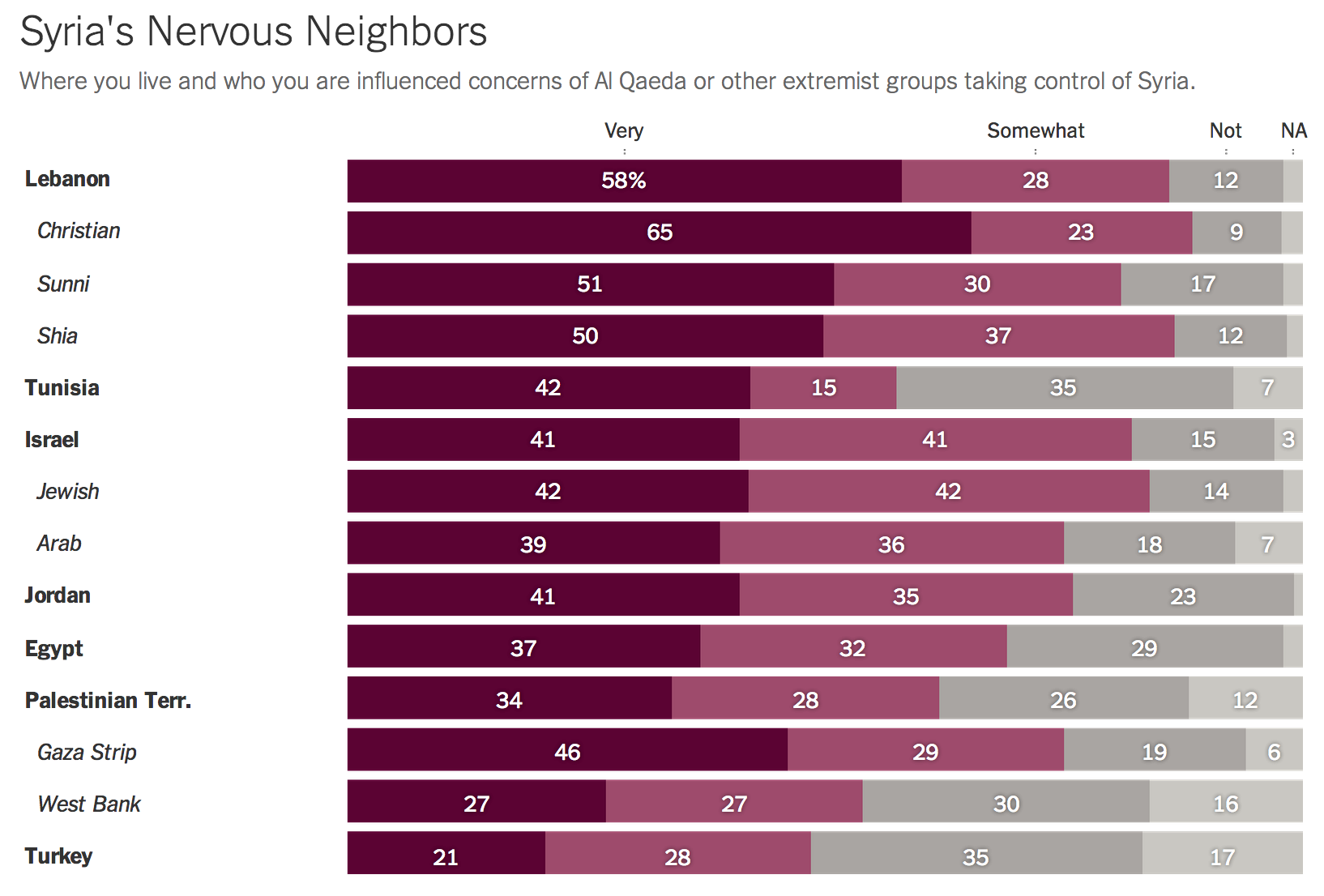
Turkey is less alarmed than its neighbors by Syria’s extremist groups:

Extremist Groups

Mustafa Akyol largely credits conspiracy theories for Turkey’s relative calm:

Many Turkish opinion leaders, especially those in the pro-government media, cannot accept ISIS, or its ilk, as extremist Islamist actors with genuinely held beliefs and self-defined goals. Rather they take it for granted that these terror groups are merely the pawns of a great game designed by none other than the Western powers.

For example, Abdulkadir Selvi, a senior journalist who has been quite vocal in the press and on television generally espousing a pro-government stance, wrote a piece last week titled “Who is ISIS working for?” This was his answer: “Al-Qaeda was a useful instrument for the US. To put it in an analogy, ISIS was born from al-Qaeda’s relationship with [the] CIA. The West gave its manners to al-Qaeda and now it designs our region through the hands of ISIS.” In short, al-Qaeda and its offshoot ISIS are both creations of the US Central Intelligence Agency and serve American interests.

Recent Dish on Turkey’s unsuccessful Syria policy here.

Quote For The Day

“Let me first address the first part of your remark about, ‘well, [Saddam] may have been unpleasant, but …’ This is a man who is guilty of the deaths of no less than one million Iraqis over a period of 35 years. So there is no ‘he may have been a brutal tyrant’ … there is no ‘but’ after that, there’s no comma after that phrase. It’s a period. Having said that, I can say that none of my aspirations for Iraq have come true. My worst fears, my greatest nightmares, have all been exceeded,” – Feisal Istrabadi, Indiana University Law School, who helped draft the post-Saddam constitution, and was Iraq’s deputy ambassador to the United Nations from 2004-2007.

The Battle Over Iraq’s Oil

Iraq’s largest refinery has come under attack:

The refinery accounts for more than a quarter of the country’s entire refining capacity, all of which goes toward domestic consumption – petrol, cooking oil and fuel for power stations. At the height of the insurgency from 2004 to late 2007, the Baiji refinery was under the control of Sunni militants who used to siphon off crude and petroleum products to finance their operations. Isis has used its control of oilfields in Syria to boost its coffers.

Any lengthy disruption at Baiji risks long lines at the petrol pump and electricity shortages, putting further pressure on the Shia-led government of the prime minister, Nouri al-Maliki.

Ari Phillips checks in on the Iraqi oil intended for export:

“Most of the oil fields in the region are around Basra between Iran and Kuwait, so they aren’t really under threat right now and I doubt they will be,” Peter Juul, a policy analyst specializing in the Middle East at American Progress, told ThinkProgress. “Unless somehow ISIS runs the table and takes over the entire country, which would lead to general chaos — but I don’t think that will happen.”

Rob Wile explains what a disruption of the southern oil fields would mean:

If the conflict migrates to the South, we could be looking at $160 a barrel, [Bank of America Merrill Lynch] says.

Our commodity research team believes that in the unlikely event ISIS invades the South and the entire 2.6 million b/d of southern oil production is lost, oil prices could face $40-50/bbl upside. Further immediate risks to production seem limited under the base case scenario where oil prices remain around $110/bbl. The bulk of Iraq’s oil fields are located in the Shia South, far from the conflict zones.

The Guardian assesses the situation:

Output from Iraq reached an all-time high of 3.5 barrels a day earlier this year and remains at a high level but output is hampered by a lack of export capacity made worse since a northern pipeline was blown up.

The key oilfields in Iraq have largely escaped the real impact of the fighting because they are located in the south of the country. But threats to oil workers of kidnapping, coupled with corruption and equipment shortages, have already hampered their development.

China is already considering its other energy options:

While Iraq has been growing in importance as a source for China’s energy needs, that’s likely to change if the crisis continues much longer. China may instead focus more on tapping oil in Russia, Iran, and Oman, according to Li Li, research and strategy director at ICIS C1 Energy, a Shanghai-based energy information consultancy, English-language China Daily reported.

Engaging The T, Ctd

photo (3)

A reader revives a recent thread with a fascinating personal story:

If you choose to use any of this, please scrub my name from it.  I am a transgendered woman who has, in fact, committed the unpardonable sin of transitioning and then, largely, being done with the whole thing.  The vast majority of people in my personal life have no idea, and almost no one in my professional life does. Now that’s because I pass very well, which is both a matter of luck and a matter of will. It was luck because I didn’t shoot up to an inconvenient height, nor were my hands or feet inconveniently large, but it was will because I tried to just be an ordinary woman of my generation (born in the late 1960s).

In the last decade or so, I have seen transgender activism take on the idea that gender is “constructed” and that the “medicalization” of being trans is a horrible thing.  It seems short-sighted in the extreme – at least for those of us who have a difference of opinion between our self-image and our secondary sexual characteristics.  I say that because just as Medicare and other providers are finally starting to cover SRS (sex reassignment surgery) and hormone treatments, the activists are trying to make the case that none of that is necessary.   It has taken activists two decades and more to get us to this place, and just as we are starting to see the light at the end of the tunnel, they are trying to not just pull the rope up, but burn it.

Why? Because some transgender people are not able to pass and/or some transgender people have a hard time finding work (whether because of passing issues or unwillingness to conform, even the least bit, with the kinds of behavior necessary to secure a well-paying job).

I agree, mostly, with your assessment that those of us who are minorities may be in the uncomfortable position of having to educate people and answer questions because we may be the first person someone outside our little social category may have had significant interaction with. It isn’t really fair, but better to learn it from someone within the group than to persist in ignorance or, worse yet, to learn it from someone hostile to the group.  I do part company with you on the issue of genitalia, however.  That is a really intrusive question and one that I think is reasonable for me to divulge to anyone I am dating, any medical professional, any mental health professional and to select friends. It isn’t for public consumption, however.

You wrote this:

The transgender desire not to be trans-gender but to be one gender physically and mentally is actually quite an affront to queer theorists for whom all gender and sex are social constructions. Many of these people want testosterone and estrogen and surgery to end their divided selves. And it doesn’t get more crudely biological and not-social than that. Which means that there are also divisions within the trans world between those who might be able to pass completely as another gender, after reassignment surgery, and those whose visual ambiguity or androgyny will remain.

Here is where I really have parted company with what has become of the trans-movement in the last decade or so.  When I transitioned in the early 1990s, the idea was to move through being transgendered and into just being a woman (or a man, for my FTM brothers). Now, it seems the point is to be neither a man nor a woman.  What’s more, well-adjusted and socially successful transgendered people like myself are a profound threat to the activist and academic portions of the movement because we violate the narrative.

As a black transgendered woman, the narrative is that I have found it difficult if not impossible to find work that pays me more than a pittance. What’s more, I am supposed to have spent some time as a prostitute. As a transgendered woman, the narrative is that I am socially shunned and ostracized and only other transgendered people or “allies” will have anything to do with me.

None of that has applied to me, and it has not applied to me in a very visible fashion.  I have not worked with someone who knew I was trans since the mid-nineties, when I told a boss that I was trans because I knew that I was going to need surgery and thus need to take some extended time off. Since my boss at the time was a lesbian, I thought it was a good risk.  To give you an idea of how well I pass, when I told her she was fine, but the next day a couple of my coworkers, who were also gay and whom I had told first to see how our boss would react, said I needed to clarify some things for her.  She actually had thought I was moving in the opposite direction (FTM instead of MTF) and was worried because, as she put it, “I just can’t see a femme like her as a boy”.  We all had a really good laugh about that.

This was while I was working at a large software company in the San Francisco Bay Area. Does that sound like rejection and ostracism? It doesn’t to me, and I didn’t experience it that way. It remains, to this day, one of my favorite memories from the time in my life where transitioning was still something I was doing and not something I had done.

One other thing you get right is that, in fact, from the point of view of the queer theorists and the activists who follow them, wanting hormones and surgery is a profoundly conservative impulse as defined by the theorists and activists.  Like marriage equality it does cede some realities that in a certain (politically) correct light be seen as conservative. In the latter case of marriage equality, it absolute cedes the conservative idea that marriage is a stabilizing force in the lives of individuals and communities. In the former case it concedes the “gender binary,” at least in as much as it doesn’t try to construe being transgendered as a third, fourth or twelfth gender and instead cedes that for the vast majority of people male and female more or less accurately.

One of the results of this has been that transwomen like myself have largely stepped back from the community and do not mentor people newly in transition.  It is not that I don’t want to; it’s that I don’t think I have anything to offer. Rather, it is that what I have to offer puts me at odds with a lot of the trans community – at least that portion of it involved in conceiving “theory”. I am very pragmatic in my approach to transition. Questions I think a trans person needs to ask and find answers to are:

1) Am I going to stay in a field that I started as my birth gender or am I going to find a new career?  (For me, I started young enough that I didn’t have a career, so I got into one because of the need for regular money in sums above and beyond sustenance levels and regular, reliable health insurance coverage)

1a) If the former, what do I do with my work history?

1b) If the latter, what kind of jobs can I find where I will make enough to actually be able to do this?

2) How am I going to broach this subject with my friends and family?

3) How do I do this?

These are no longer questions to ask, according to queer theorists.

I applaud your courage in taking on this topic.  You are going to be flamed for it as sure as there will be men in Speedos at Gay Pride parades in a couple of weekends.

Another reader circles back to the beginning of the thread:

Kevin Williamson’s essay may be over the top in its callousness, but I have to say, I read a lot of lefty sites/news outlets, and the focus on “the T question” sort of takes me aback. Why so much focus for what may be, as you note, as little as 0.1 of the population? Why is this the premier civil rights question of our lifetime, as trans folks might have it?

Worse than this is the impulse, which you address, among trans activists to essentially burn down the existing societal framework due to its inherent oppressiveness and replace it with something new – something that people like myself, a married suburban father who bears no ill will toward the transgendered community – will be required to accept.

For example, the use of the term “cisgendered.” We’re now supposed to use this at all times, you realize; I’m supposed to refer to myself as “cisgendered,” as a rhetorical means of leveling the playing field. The 99 percent or 99.9 percent must now adopt the rhetorical demands of the trans activists lest we reveal ourselves to be utterly hateful.

But you know what? I don’t use the term “cisgendered” and I will not use the term “cisgendered.” I think the term itself and the supposed logic behind it are ridiculous. Do your own thing; live your own life, and I will insist that however you choose to do so, you are accorded the same legal rights and privileges that every other American possesses. But when that’s not good enough – when my refusal to think of myself as “cisgendered” or use the term marks me as a bigot – I’m off the bus.

Update from a reader:

Your reader is claiming that an unknown group of straw trans-men and women are forcing him to use the term “cisgendered” to describe himself. To which I say, what planet do you live on??  “Cisgender” is an academic term adopted by some in the trans community to describe those who do, in fact, associate with the gender of their birth. Why your reader is so incensed that trans folks call him “cisgender” is beyond me. Why he thinks he’s now required to call himself that is a question for the ages. I have seen no movement, even among the most nutjob of activists, to force the term “cisgender” on the American citizenry.

Your reader, in short, is no bigot, but sounds like my parents did in 2006: “We support you, but why do you have to call it marriage?” (I’m thankful to report they were fully on the marriage bandwagon within five years after that.)

(Photo: The bedroom door of a Dish reader’s 15-year-old daughter)