Arrgh-onomics

Eric Barker excerpts a study on pirate economics from the Journal of Economic Behavior and Organization:

First, I examine the pirate flag, "Jolly Roger," which pirates used to signal their identity as unconstrained outlaws, enabling them to take prizes without costly conflict. Second, I consider how pirates combined heinous torture, public displays of "madness," and published advertisement of their fiendishness to establish a reputation that prevented costly captive behaviors. Pirates' infamous practices reduced their criminal enterprise's costs and increased its revenues, enhancing the profitability of life "on the account."

Face Of The Day

104591828

A young girl is pictured onboard a helicopter after she was evacuated from her flood affected area by the US military, near Kalam, in Swat Valley on October 1, 2010. The European Commission has decided to more than double its Pakistan flood aid to 150 million euros (205 million dollars), according to the European humanitarian aid commissioner Kristalina Georgieva. The EU's executive arm has already provided 70 million euros in aid and will now distribute another 80 million euros to its partner organisations. By Carl De Souza/AFP/Getty Images.

Chain Mail

Paul Collins traces the chain letter through its trickster history:

Like any truly great crooked scheme, it began in Chicago.

It was there in 1888 that one of the earliest known chain letters came from a Methodist academy for women missionaries. Up to its eyes in debt, that summer the Chicago Training School hit upon the notion of the "peripatetic contribution box"—a missive which, in one founder's words, suggested that "each one receiving the letter would send us a dime and make three copies of the letter asking three friends to do the same thing." …

[W]hat happened to Natalie Schenck, the teenager who nearly capsized her Long Island town with chain-letters for the Spanish-American War troops? The one who shook down a cascade of money, embarrassed a respected institution, and left government agencies tied up in knots?

Reader, need you even ask? She became a Wall Street banker.

Predicting The iPad In 1968

Sarah Kessler collected eleven sci-fi predictions and their real-life counterparts today. Money quote is Arthur C. Clarke's description of something akin to an ipad in 1968:

“When he tired of official reports and memoranda and minutes, he would plug in his foolscap-size newspad into the ship’s information circuit and scan the latest reports from Earth. One by one he would conjure up the world’s major electronic papers…Switching to the display unit’s short-term memory, he would hold the front page while he quickly searched the headlines and noted the items that interested him. Each had its own two-digit reference; when he punched that, the postage-stamp-size rectangle would expand until it neatly filled the screen and he could read it with comfort. When he had finished, he would flash back to the complete page and select a new subject for detailed examination…”

I gave in, by the way. I find it pretty useless for reading the web, and the lack of flash is simply bizarre. But the visual interactive apps are a joy, and I have to say I love iBooks. Somehow, for me, it beats the Kindle because it better represents the actual exerience of reading a real book – the fonts, the pages, the turning of them, even little design things like that bookmark. I know it's not so great in sunshine, but I've found myself wanting to read on it more than I ever did on the Kindle. And especially lying down on the couch or in bed, where, it appears, I am not alone.

Nowhere Land

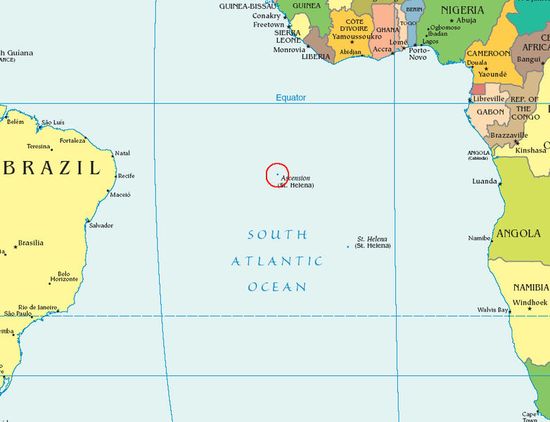
Ascension_Island_Location The Economist sent a correspondent to the off-the-beaten path Ascension Island for a series of reports:

The fact that there are no native people on Ascension Island does not mean there are no native traditions. There are lots. Two of them have their physical manifestation at a road junction called One Boat. It has become the custom that when sporty types depart from the island, they leave their trophies inside the bus-shelter-like boat that gives One Boat its name, perhaps on the basis that they mean more on Ascension than anywhere else.

A few hundred yards away sits the rather garish lizard rock. The tradition here, a more longstanding one, is that if you are leaving Ascension and keen not to come back, you have to paint the rock, unseen, at night. It is a live enough tradition that some of the paint looks pretty fresh.

That both these traditions focus on departure is not that surprising. Departure is a central fact of Ascension life.

“Trashy Is As Trashy Does”

Jillian Lauren found erotic inspiration, not in romance novels but in J.D. Salinger's Nine Stories:

I first read Nine Stories and felt the nakedness of being recognized in my loneliness. Desire wasn’t a narrative device with a neat payoff; rather, it was an ocean of longing that unfolded toward an ever-receding horizon. The book got inside me in a way that changed me irrevocably and, conversely, felt like it had been there all along. And that, I imagined, would be what having a lover would feel like.

Trashy novels encouraged me to employ sex as a strategy. But it was ultimately Salinger who made me want to fuck.

The Addicts: Intervention Required

Johann Hari wants to help them:

In the Western world today, there is a group of people who live in a haze of unreality, and are prone at any moment to break into paranoia, hallucinations, and screaming. If you try to get between them and their addiction, they will become angry and aggressive and lash out. They need our help. I am talking, of course, about the Drug Prohibitionists: the gaggle of politicians, bishops and journalists who still insist that the only way to deal with the very widespread drug use in our societies is for it to be criminalized, where it is untaxed, unregulated, controlled by armed criminal gangs, and horribly adulterated.

(Hat tip: Drug Warrant)

Gumming It

In part three of Sam Kean's interview with famed biologist E.O. Wilson, Wilson explained why he decided to write his first novel after all these years:

My favorite story along these lines has to do with this great evangelist of the 1920s. … I heard a record of him giving one these hellfire sermons of the kind that’s typical of Southern evangelicals. And here’s what he said, and here’s the accent—I can do it real well, having grown up with it. …

I’ma agains’ sin. I hayte sin sooo much, I’ma gonna fight it ‘til I cain’t move my airms no more.And when I cain’t move my airms no more, I’ma a gonna byte sin. And when all my teeth falls out, I’ma gonna gum it.

… I love that. That’s what I’m doing. I’m gumming it.