Who Are These ISIS Chappies, Anyway? Ctd

Keating pens a thorough explainer on ISIS leader Abu Bakr al-Baghdadi, tracking his rise from low-level militant to head of his own rogue proto-state:

Baghdadi fought in some capacity with Sunni militant groups after the U.S. invasion of Iraq but was arrested in 2005 and interred by U.S. forces at Camp Bucca, the main U.S. detention facility after the closing of Abu Ghraib. He wasn’t considered much of a threat and was released in 2009. The former commanding officer of Camp Bucca recently told the Daily Beast that when Baghdadi was released, he told his captors, “I’ll see you guys in New York.” (The guards at the prison were from a Long Island-based military police unit.) The commander, Col. Kenneth King, says Baghdadi “was a bad dude, but he wasn’t the worst of the worst” and is surprised he rose to such prominence.

It seems as if Baghdadi became far more hqdefaultinvolved with al-Qaida in Iraq while imprisoned than he had been before, to the point that he took over the group after the deaths of [Abu Ayyub] Masri and the other [Abu Omar] Baghdadi a year later. In 2011 he was designated as a global terrorist by the U.S. State Department with a $10 million bounty. Things really picked up in 2012, when, sensing an opportunity, Baghdadi dispatched some foot soldiers to join the fighting against Bashar al-Assad’s government in Syria. In 2013 he announced that the group was merging with Jabhat al-Nusra, the other al-Qaida affiliate in Syria, to form a new group called the Islamic State in Iraq and al-Sham.

That new group has turned out to be more formidable than anyone expected, in no small part due to its impeccable organization. Martin Chulov passes along what CIA and Iraqi analysts have learned from a massive trove of ISIS intelligence acquired on the eve of the group’s blitzkrieg on Mosul:

Laid bare were a series of staggering numbers that would be the pride of any major enterprise, let alone an organisation that was a startup three years ago.

The group’s leaders had been meticulously chosen. Many of those who reported to the top tier – all battle-hardened veterans of the insurgency against US forces nearly a decade ago – did not know the names of their colleagues. The strategic acumen of ISIS was impressive – so too its attention to detail. “They had itemised everything,” the source said. “Down to the smallest detail.”

Over the past year, foreign intelligence officials had learned that ISIS secured massive cashflows from the oilfields of eastern Syria, which it had commandeered in late 2012, and some of which it had sold back to the Syrian regime. It was also known to have reaped windfalls from smuggling all manner of raw materials pillaged from the crumbling state, as well as priceless antiquities from archaeological digs. But here before them in extraordinary detail were accounts that would have breezed past forensic accountants, giving a full reckoning of a war effort. It soon became clear that in less than three years, Isis had grown from a ragtag band of extremists to perhaps the most cash-rich and capable terror group in the world.

Yochi Dreazen outlines the “mafia tactics” ISIS is using to become financially independent of its benefactors in the Gulf:

The exact amount of money in ISIS’s possession is the subject of intense debate among Western intelligence officials. At the high end, some analysts estimate that the group may have access to at least $500 million in cash drawn from bank robberies, oil smuggling, and old-fashioned extortion and protection rackets. Other analysts believe the number is far lower, with one official putting it at between $100 million and $200 million. Those numbers are moving higher as the group conquers more cities on its seemingly inexorable drive toward Baghdad and is able to loot the local private and government banks. On Monday, ISIS fighters took the strategically important town of Tal Afar, adding to the territory under its direct control. …

ISIS’s success at funding its own operations is indicative of a broader trend. Extremist groups throughout much of the world, particularly Africa, are beginning to reduce their dependence on outside donors.
More background on ISIS here and here.

Why Is Paul Wolfowitz On Television?

A reminder (from David Corn) of the man’s fathomless ignorance about Iraq (as well as the blood of well over 100,000 on his hands). Here’s the intellectual’s assessment of the possibility of sectarian warfare once Iraq had been invaded:

There’s been none of the record in Iraq of ethnic militias fighting one another that produced so much bloodshed and permanent scars in Bosnia along with the requirement for large policing forces to separate those militias. And the horrors of Iraq are very different from the horrific ethnic cleansing of Kosovars by Serbs that took place in Kosovo and left scars that continue to require peacekeeping forces today in Kosovo. The slaughter in Iraq—and it’s been substantial—has unfortunately been the slaughter of people of all ethnic and religious groups by the regime. It is equal opportunity terror.

The tape is here. It’s reminiscent of Bill Kristol’s conviction that sectarianism was a fantasy:

We talk here about Shiites and Sunnis as if they’ve never lived together. Most Arab countries have Shiites and Sunnis, and a lot of them live perfectly well together.

I wish I could feel calm contempt for these people. But it is interwoven with rage.

Soccer: An Immigrant’s Game

Charles Kenny adds soccer to the list of reasons to support a more open immigration policy, pointing to the aftereffects of a 1995 European Court of Justice ruling that made it easier for players from outside the EU to play for European clubs:

Unsurprisingly, leagues that saw a higher influx of talented players improved: Clubs in the South Africa Child Football Teamsleague won more Europewide competitions. Meanwhile, talented players migrated to teams in strong leagues based in countries that were richer, closer to their home country, and shared colonial ties. That meant the better leagues, like the English Premier League or Spain’s Primera Division, extended their lead over other European leagues in countries such as Denmark and Romania. In this case, talented migration into Europe created greater productivity but also increased inequality. Everyone was better off, but it is true the best leagues benefited the most.

There was unvarnished good news for the countries that the talented migrants left behind. First, national teams in origin countries did better in international matchups the more their emigrants played in the top leagues in Europe. [Researcher Chrysovalantis] Vasiliakis estimates that the impact of greater global mobility of players lifted Uruguay, Paraguay, and Chile 25 places or more in the 2010 FIFA rankings of national teams.

But those effects only seem to extend so far. Mallé Fofana asks why West African countries don’t field World Cup-winning teams even though they produce lots of great players for European clubs:

Talent alone cannot win games. Talent must be molded and refined in a system that can nurture and sustain it.  European and South American football teams have perfected this system — a well-oiled and well-financed system of coaches, trainers, nutritionists, and sports psychologists that not only have helped to develop the system but also sustain it today.  This system offers part of the access that a country like Cameroon lacks, in soccer as in the rest of its economy.

The other part comes from the lucrative financial incentives for performance. When the potential for income is taken away, so is the incentive to perform.  This in turn impacts morale, motivation, and results, and once again the matter circles back to the issue of access.

Brandon Valeriano notices that the US national team is short on Latino players:

Club soccer dominates in the U.S., and this is an expensive and almost impossible barrier for Latinos due to the costs and suburban nature of the programs.  Moving up a level, participation in high school or college teams assumes the participant has the freedom to actually play sports after school, an option not many of us had as working became a priority once we were of legal age.  College soccer is an even tougher prospect, since the costs or barrier of an inadequate school system make this path a huge obstacle for the Latino population.  The pipeline of talent to the World Cup team is broken for Latinos, but it’s also broken in the higher education system and in the political system.  The lack of development of Latino players is a symptom of the deeper problems in American society.

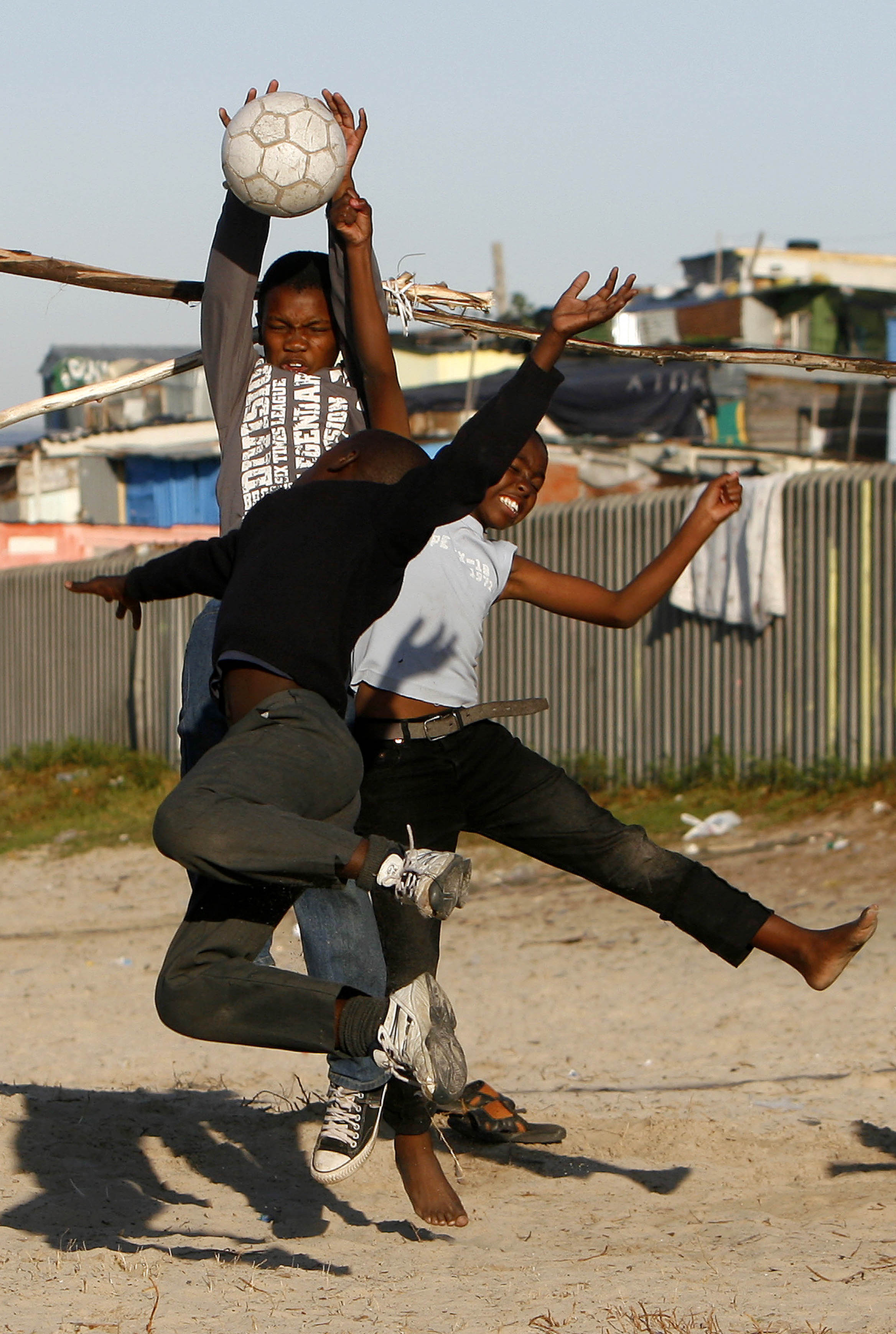
(Photo: Local children from the ‘Seven Stars’ Football Team practice and play football on their field next to the N2 Highway that runs past Gugulethu Township near Cape Town, Western Cape, South Africa on May 20, 2010. By Mark Wessels / Barcroft Media / Getty Images)

A Healthy Sign For Obamacare

Insurers

Last week, Dan Diamond spotlighted one:

Insurers sat out of the exchanges for different reasons in year one. Some were wary of the start-up risks. Others were openly taking a wait-and-see approach. Still more, it seems, didn’t want any part in the first year’s batch of customers, who were expected to be older and sicker.

And while the technical problems associated with the exchanges have been legion, plans that participated have reported predictably higher revenue, if unclear profits. One million more consumers signed up than expected…and while they weren’t as young and healthy as the insurance companies had hoped for, they were more customers.

Now, more plans want their chance to chase those dollars.

Kliff comments:

It’s not just new entrants into the exchanges that’s increasing competition.

In Washington, for example, there are two plans that only sold in small parts of the state that now want to sell everywhere. Both United Health Care and Moda, a local plan, are increasing the geographic area of where they plan to sell coverage.

The only state that hasn’t reported an increase in carriers for 2015 is Oregon. There, all 12 carriers who sold in 2014 plan to sell again in 2015, but no new insurers have proposed rates. It’s possible that this has to do with Oregon’s incredibly challenged Obamacare rollout — or it could reflect the fact that Oregon had one of the most competitive Obamacare markets to begin with.

More nationally though, the trend seems to be clear: More insurers are getting into the Obamacare game in year two.

Jason Millman adds:

The development is important for a few reasons. For one, recent research suggests that more competition in the exchanges could help temper premium increases. Other new analysis shows that exchange plans, on average, are cheaper than individual plans offered outside the insurance marketplaces. And given the narrow networks in exchange plans, more insurers could mean better access to providers.

In New Hampshire, the exchange’s only insurer last year had excluded 10 of 26 hospitals in the state from its network, meaning the exchange’s customers were limited in their choice of care providers. In 2015, though, New Hampshire will have five insurers selling individual and family health plans on the exchange, state officials announced [last] week. That also includes the expansion of two non-profit, co-op plans that received start-up funding from the Affordable Care Act.

India’s Rape Infrastructure?

crime-and-sanitation-of-homes-with-toilets-rate-of-rape-per-100-000-_chartbuilder

Neil Padukone connects the high incidence of rape in India to its urban design choices:

Most of New Delhi is built according to what urban planners sometimes call “single-use” design: sections of the city are devoted almost exclusively to one use (industrial, institutional, retail, or residential) and separated from each other by open space, roads or other barriers. … This is in contrast to “mixed-use” planning, which carefully integrates residential, retail, institutional, and cultural spaces into the same area—areas that are easily accessible by walking, bicycle, or mass transit.

There are many reasons planners favor mixed-use design, including smaller carbon footprints and increased access to economic opportunity. Easy and efficient access to work, leisure, home, and childcare makes juggling responsibilities much easier, particularly for women. But one of the most important benefits of mixed-use planning is what the urbanist Jane Jacobs famously called “eyes on the street.” If an area is used for multiple purposes, there will always be somebody—a homemaker, shopkeeper, pedestrian, peddler, or office worker—keeping a passive watch, inadvertently but effectively policing it 24 hours a day. Street vendors, for example, may be the most perennial pairs of eyes that monitor any streets, and even police have tapped this human resource.

Two girls who were gang-raped and murdered in Uttar Pradesh last week were attacked while going to relieve themselves in a field at night. Hayes Brown discusses how the absence of private toilets poses a serious safety problem for women in the poorest parts of the world:

Some critics have said that the focus on sanitation as an issue ignores the larger issue of rape and deterring men from assaulting women in the first place. As an article from First Point India explains, however, nobody is arguing that “the sole reason for sexual violence is the lack of a loo. It is an undeniable fact, however, that the absence of a safe toilet adds to the vulnerability of women. And there are numbers to show it.” The First Point article cites a BBC report in which “a senior police official in Bihar said some 400 women would have ‘escaped’ rape last year if they had toilets in their homes.”

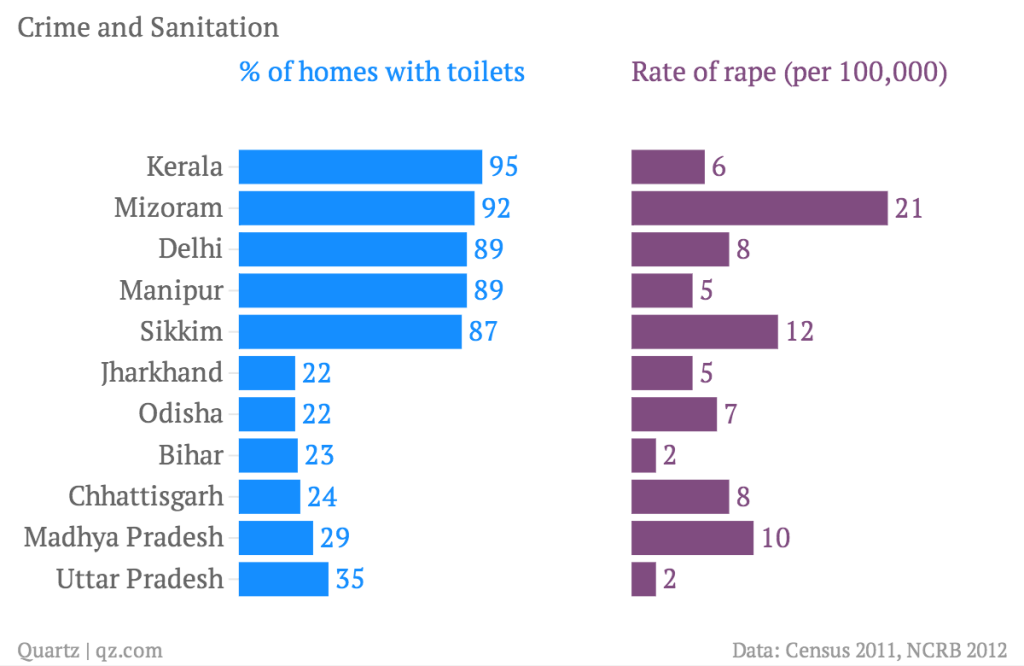
Diksha Madhok pushes back on that alleged link with the above chart:

[I]f a toilet shortage is fueling rape in India, then their presence should lead to lesser crimes against women. But data analyzed from the National Crime Records Bureau (NCRB) show that there is no inverse relation between rape and toilets. Quartz India compared the states with the highest and lowest toilet density against their rates of rape, defined as those reported per 100,000 women.

The state of Mizoram has one of the lowest number of households without toilets. Yet, the rape rate against women remains a stubborn 21, much higher than the national average of 4.26. Meanwhile, only 20% of households in Jharkhand have a toilet, but its rape rate is one-fourth of Mizoram’s.

Update from a reader:

As an Indian living in India, I strongly favour mixed-use urban spaces. That said, if this was the reason for rape, it would be a reason for all sorts of other crimes. But violent crime against men is relatively rare in India. As a man, I feel perfectly safe walking in quite seedy-looking neighbourhoods – far more than I would in New York or Paris. With women, two sorts of crime occur: (1) molestation (rape is merely the extreme end of a spectrum) and (2) “chain-snatching”, ie grabbing their gold chains and running. The solution to (2) is presumably not to wear gold chains, but social customs die hard. As for (1), I remain convinced that this is a societal problem exacerbated by inadequate policing by poorly-trained and often prejudiced personnel.

Back to mixed-use spaces: in 2006, the Chief Justice of the Indian Supreme Court, Y K Sabharwal, ordered the sealing of commercial establishments in many residential areas. Thousands of such establishments were sealed, many of which had been functioning for decades. It turned out that Sabharwal’s sons, both of whom were in the real estate business, stood to benefit immensely from this order. Journalists from the Mid-Day newspaper who reported this were held in contempt of court and jailed. A good overview of all this is here.

The bottom line is, India’s separate-use urban practices encourage not only criminal activity, but corruption. And when it’s the Supreme Court, there is little recourse for citizens.

Chart Of The Day

Reddit Fuck

Someone data-mapped every use of the word “fuck” on Reddit over an eight-hour period:

Appropriately titled The F Word, the visualization was created by user “codevinsky,” who mined all the fucking data on Monday and wrote the visualization [Tuesday], June 10. He broke it out into multiple categories, allowing you to toggle between instances when “fuck” was coupled to another word (All of the Fucks), and when “fuck” stood alone (Single Fucks). … All told, users said “fuck” or some variation thereof 25,203 times. Which doesn’t strike me as all that staggering. If anything, I’m surprised that figure isn’t actually much higher.

Interactive version of the above graphic here.

A World Cup Of Waste

It’s likely to follow in the soccer tournament’s wake:

The host country has been producing 30% more TV sets than last year, according to the Asociação Nacional de Fabricantes de Produtos Eletrônicos (National Association of Electronics Producers)—which means that, by the end of this year, Brazil will have between 18-20 million more TVs than when it started. By May, over half of them had been sold to giddy Brazilians in anticipation of seeing their team, the big favorites, win the sixth World Cup of its history in high definition.

The paixão pelo futebol, as they say in Brazil of their passion for soccer, might have unexpected effects. For every new TV set that comes into a Brazilian home, an old one usually goes out. A study by the World Bank pointed out that Brazil currently produces 14 lbs. of electronic waste per person every year, which makes it the leader in this type of garbage in Latin America. And it is rising: the government expects the amount will go up to 17.5 lbs per person by 2015. Television sets account for the largest type of e-waste in Brazil.

Meanwhile, the strain on Brazil’s power grid is requiring it to burn more fossil fuels:

According to Ildo Luís Sauer, director of the Institute for Energy and the Environment at the University of São Paulo, there’s “a chance” a blackout could occur in the country during the World Cup due to a “critical situation of excess demand” on the national electricity grid. “Usually, in Brazil, during World Cup hours — especially during evening games — you have a composition of huge demand because everyone is at home watching them,” he said.

But it is a risk that the sprawling country seems unwilling to take. Javier Diaz, a senior energy analyst at Bentek, said Brazil is attempting to preserve hydro inventory levels by importing and burning more liquefied natural gas, “especially with the [arrival of the] World Cup.” “Brazil’s monthly LNG imports broke new records in February and March, importing 95 percent and 76 percent more than in 2013,” he said in an email. In fact, the country is currently firing all of its thermal power plants — LNG, coal, diesel and fuel oil — said Sauer, who added that it’s “quite unusual.”

Finally, Thomas Brewster reports that Anonymous hackers are launching an all-out assault on FIFA, World Cup sponsors, and the Brazilian government:

Anonymous is irate at the Brazilian government for spending hundreds of millions on stadiums and infrastructure for the World Cup, rather than funnelling funds into the poorest parts of the country. It’s launching digital attacks to coincide with the street protests that erupted across the South American country this week, which have highlighted the abject poverty and governmental abuse of citizens in Brazilian cities and favelas.

A representative of the collective told Reuters they planned to launch attacks on other big-name sponsors, including Adidas, Budweiser, Coca-Cola and Sony, yet they seem to have had limited success with those large organisations so far. That’s likely because they’re used to DDoS attacks and have the resources to fend them off. DDoS threats can be dealt with by various techniques. One method is to use “scrubbing,” where massive influxes of data are split between data centres to ease the pain. Another is to use DDoS detection technology, which picks up on huge surges of traffic and allows the user to quickly block connections from offending IP addresses.

Previous Dish on Brazil’s World Cup woes here.

Female Execs Are Kicking Ass In Emerging Markets

Screen Shot 2014-06-13 at 12.28.20 PM

Maria Saab shares the perhaps-surprising news:

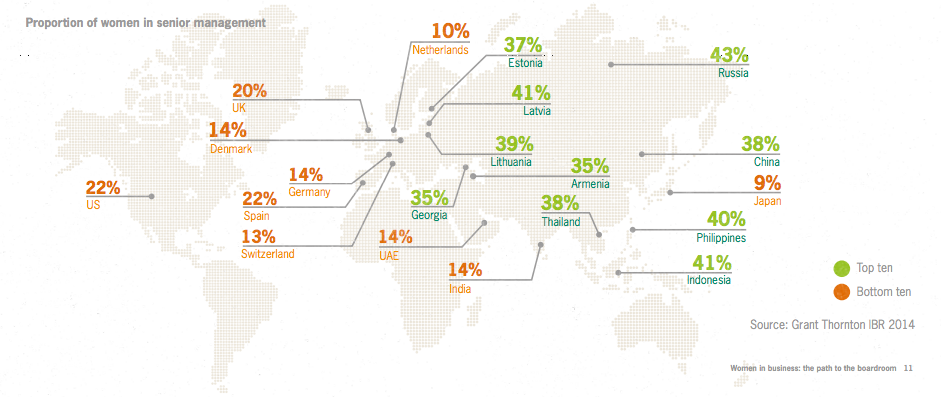
[W]here are women climbing the corporate ladder? In countries you would probably least expect. The highest proportions of women with senior roles are in the BRICS nations – Brazil, Russia, India, China, and South Africa. There, women comprise 30 percent of senior management positions, which is higher than the global average (24 percent).

What is more surprising is that none of these countries have enacted compulsory quotas or legislation addressing this issue. Russia has the highest proportion of women in senior management globally (43 percent) without this type of gender programming. The same applies for the neighboring Baltic States – Estonia, Latvia, Lithuania, Georgia, Poland, and Armenia – which boast 30 percent or more. Between 2012 and 2013, China doubled the number of senior management roles held by women from 25 per cent to 51 per cent.

(Map from Grant Thornton’s “Women in Business: From Classroom to Boardroom”)

Justice In A Bind

Dahlia Lithwick worries that retention elections for state supreme court justices are becoming more and more politicized, particularly with the help of outside money:

Knocking off a state supreme court justice is one of the cheapest political endeavors going. It costs a few measly million bucks to buy a judge’s robe, which is vastly cheaper than a Senate campaign. But when politicians target elected judges and justices with political claims using political tactics (big money and inaccurate accusations), judges are forced to either respond like politicians or judges. Opting to do the former destroys the notion of impartial justice. Opting for the latter ends judicial careers.

And now here we go again.

Three justices on the Tennessee Supreme Court are facing an election-year attack, not for any particular decision they have authored or even for any unpopular opinion they have espoused. No, in an ugly campaign in Tennessee that appears to be getting ever uglier, Senate Speaker Ron Ramsey, who is also the state’s lieutenant governor, is attempting to oust three state Supreme Court justices in their Aug. 7 retention elections, chiefly for the judicial outrage of having been appointed to the high court by a Democrat. Under Tennessee law, the governor appoints Supreme Court justices, and then they come up for retention elections every eight years thereafter. This is a pretty common set-up in states that elect their justices.

The Best Of The Dish Today

The United States Celebrates The World Cup in Brazil

It’s been a sobering day, with one paragraph I read – by Razib Khan – sticking in my mind:

“No matter what establishment voices assert, intervention in foreign lands in a ham-handed fashion to prop up our American values is bound to lead us down a path of tears. As Shadi Hamid states, the future of democracy in the Middle East is going to be illiberal. This may be inevitable. We don’t need to avert our eyes from it, and we need to acknowledge that so we were, so they will be. It took the Thirty Years war to finally purge the enthusiasm of sectarianism from the cultural DNA of Europeans (and even then, religious minorities were second class citizens for centuries). There will be no calm reasoning with Iraqis of any stripe because the march of history continues, and only sadness can convince all parties that moderation is necessary for the existence of modern nation-states. Intervention in some fashion may be inevitable in the world, but our goal should be to prevent hell, not to create heaven on earth. The former is possible, the latter is not.”

“Only sadness can convince.” An awful truth – but a deeply human one.

Today, we tried to cover every aspect of the confusing and dynamic civil war in Iraq. An alliance with Iran? The Battle for Baghdad – and how ISIS could regret it.  The welcome calm at the White House. Iran’s quagmire now? The Sunni quandary. The Kurdish exception. The impact on Syria. And, of course, the shamelessness of Bill Kristol.

Relief? A South Park superfan Book of Mormon supercut. And I answer readers on whether I can endorse (or even vote for this time) Hillary Clinton.

The most popular posts of the day was No Drama Obama On Iraq; followed by Responding To Student Groans, Ctd,

Many of today’s posts were updated with your emails – read them all here.  You can always leave your unfiltered comments at our Facebook page and @sullydish. 14 more readers became subscribers today. You can join them here – and get access to all the readons and Deep Dish – for a little as $1.99 month.

See you in the morning.

(Photo: Soccer fans cheer for team U.S.A. as they face Ghana during the World Cup in Brazil at Jack Demsey’s bar on June 16, 2014 in New York City. By Michael Loccisano/Getty Images.)