The War On The Right – And Obama

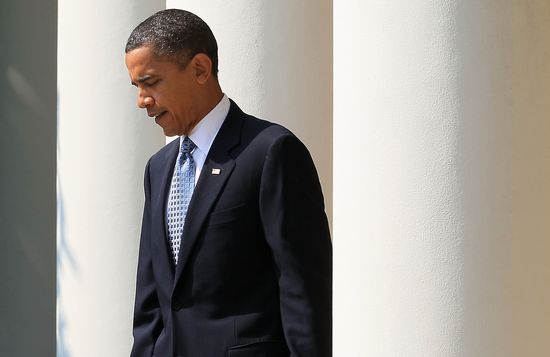
OBAMAPILLARSMarkWilson:Getty

My thesis that the core rationale for the Obama presidency was a post-boomer pragmatism has been assailed lately as unrealistic, and responsible for Obama's apparent woes. I can see how Maureen's critique does indeed make some psychological sense, can appreciate Sam Tanenhaus' reminder of the endurance of the cultural war and I under-estimated the sheer cultural panic and pent-up frustration on the right in the wake of the Obama landslide, with all its implications for America's future. (I did not, however, under-estimate the centrality of Sarah Palin to this environment.)

But isn't it increasingly obvious that Obama's refusal to take the far right bait, to position himself as a problem-solver open to sane Republican ideas, rather than as a tribune of the left, is looking wiser again? He has not focused on attacking the GOP until very recently with Boehner and had hung back from the cable news atmosphere. A whiff of Adlai Stevenson hangs about him for some Democrats. And yet, as the Dish has repeatedly argued, Obama's greatest skill is in letting his opponents destroy themselves and his greatest asset in these heated days of sound and fury is his calm and poise.

He is taking the responsibility of the presidency seriously, and people notice that. Hence his rather resilient polling numbers, given the broader public mood. I have made many criticisms but I remain of the view – very firmly of the view – that we remain extremely lucky to have him. And I think we will see his true mettle if the current GOP wins the House, which in many respects, I hope they will – if the GOP is to grow up, and take some responsibility for fixing the appalling mess they largely made at home and abroad.

Obama is a poultice, bringing these toxins to the surface. But his capacity to be more than that – to realize the possibilities I felt inherent in his candidacy back in 2007 – remains to be seen. What I hope is that he does not take the truly partisan advice and misunderstand the nature of his presidency and the reason he is still the indispensable figure at this point in American history.

(Photo: Mark Wilson/Getty.)

How Ambitious Is Mitt Romney?

We know he will say anything, do anything, take any position to advance his own agenda. He makes plastic look authentic. But it says something surely that he has sided with O'Donnell against Rove in this sudden outbreak of GOP civil war. He wants to win. He knows his only chance is to follow Palin, not challenge her. But she will eat him for breakfast.

The Unraveling Of Mark Levin

The beginning of serious discord on the right – as the tea party tiger they have ridden so cynically begins to bite the GOP in its behind – is not just happening in the primaries. In a recent wave of invective, Mark Levin is talking about his fellow conservatives like a latter day Michael Moore. Here's what he has to say about The Weekly Standard's John McCormick, who had the audacity to report information that reflected badly on a female candidate backed by Palin and the Tea Party:

"Have you obsessed over women before?  Have you ever been married?  Have you dated?  I hate to ask you personal questions, but they do seem to be your specialty."

Weigel pukes.

Then there are the staunch neocon bloggers at Powerline, where Levin again opts for ad hominem, saying they're dissemblers, arrogant, shallow and incoherent thinkers, and small-minded. When the blogger Patterico, a Los Angeles area prosecutor, dared to point out the manifold factual inaccuracies in Levin's attacks, the talk radio host couldn't persuasively respond on the merits, but he did call his critic a jackass. Days earlier, attacking Professor Stephen Bainbridge, Levin began,

"I'm sure he's accomplished at something beyond securing tenure and blogging.  But his rambling post doesn't seem all that impressive, does it?"

And on his radio show Tuesday he disparaged National Review and The Weekly Standard, complaining that they're elites who condescend to the Tea Party.

Is there pushback? Yes, and no. Here's John Hinderaker of Powerline in an otherwise cogent critique of Levin:

"Many of us go off on intemperate screeds from time to time, but is it too much to ask that such diatribes be directed against liberals, rather than against our fellow conservatives?"

He still hasn't figured it out. If more conservatives had challenged Levin back during his similarly intemperate, intellectually bankrupt attacks on Jim Manzi, David Frum, and so many others, he might not be upping the populist ante some more.

Instead they kept silent for a fellow movement conservative, or even defended him. And big surprise, he's persisting in intellectually bankrupt attacks that egregiously mislead his audience. There is some karmic justice in all this, isn't there?

The Unstoppable Sarah Palin, Ctd

PALINMALLNicholasKamm:Getty

In the wake of the O'Donnell win, Paul Mirengoff is now on the same page as me that "the nomination is Sarah Palin's to lose":

[W]here else is [the Tea Party] vote going to go? Romney instituted a program of mandatory health insurance in Massachusetts. Huckabee was not a small government governor. Gingrich was a Washington insider. Governors who actually served out their terms probably made some tough decisions that won't appeal to Tea Party purists.

[B]acked by the Tea Party movement, Palin can win between 30 and 40 percent of the vote in many of the early multi-candidate primaries and caucuses. This doesn't seem like a reach, given the vote count for Tea Party movement candidates this year. … Palin can ride a vote count of 30 to 40 percent in crowded early primaries to the front of the pack and then increase that count to 50 percent plus as the field narrow in the later primaries. John McCain's campaign in 2008 supports the view that a candidate can get out front by consistently winning 30 to 40 percent of the vote in the early, multi-candidate field. What might happen once the field narrows is anyone's guess. But unless Palin self-destructs along the way, I question whether anyone in the likely field is capable of defeating her head-to-head.

(Photo: Nicholas Kamm/Getty)

Getting Worse Before It Gets Better

Kevin Drum was rooting for an O'Donnell victory:

The die has been well and truly cast here for some time: the GOP is irrevocably committed to the undiluted Fox/Limbaugh/Drudge party line, and there's no going back. They're either going to stand or fall on that. So I say: let 'em do it. No excuses, no scapegoats. Finish up the Texification of the Republican Party and see how it goes. Only then is there any hope of a return to common sense.

Yglesias differs:

In the short-term, [the Castle loss will] be good news for progressive politics but as I said yesterday I don’t think that kind of narrowly partisan thinking gets you very far in the long run. Ultimately, the two-party system operates near equilibrium, and so the internal state of both parties counts. It’s better for progressives and better for the country for Republicans to field strong, reasonable candidates.

The War On Marty

Jack Shafer defends my old boss here. The sharpest point:

Say what you will about him, he has remained committed to ideas and intellectual life.

Two and three quarter cheers to that. When I was editor, I cannot imagine anyone else allowing me to air the kind of debates I did back then, against the teeth of many little orthodoxies, and throwing the dice on young talent like me or Kinsley or now Frank Foer. Time after time, when I went to bat for a magazine that would truly be open to debate, he backed me … until the five-year cyclical Wieseltier coup against whichever editor he had come to envy. (The exception to open debate and intellectual honesty was and is anything to do with Israel, a subject where the debate at The New Republic is profoundly intellectually rigged, a fact that successive editors have simply had to accept or not take the job at all.)

Take gay rights, where Marty owned a magazine that pioneered the military and marriage debate that transformed a civil rights movement; or race, where his insistence on airing the really tough issues helped shift the debate, in my view, for the better. TNR's brave pioneering of welfare reform made a huge difference.

Shafer argues that Marty's loathing of all things Arab and Muslim goes back a very long way. So why the fuss now? I suspect it is because the blog-post came at a moment of very ugly, populist anti-Muslim hatred, where it is a moral responsibility of decent people to stand up against the mob rather than to egg it on. Marty decided to join the mob, not restrain it. To his credit, Marty belatedly apologized. The oddness of his apology – its almost Freudian formulation – is simply a confession that he sometimes cannot help himself. The combination of a blog and Marty was always going to be an explosive mix.

Marty is a man of deep passion and such passion, especially on a subject like the Middle East, sometimes leads to irrationality. He is not immune to this, but neither am I at times. Who is? We are all human. And as someone who knows this human being extremely well, I'd like simply to say that in his deepest heart, I believe Marty is a good man who has done good things. He has a real conscience and a history of great kindness, compassion and generosity. I am not the only person whose life would never have spread its wings so soon without him – even as I have come to differ with him as times have changed. And I, for one, hope this latest spark of hate in a very dry tinder box will not distract from the true content of his character, and the endurance of his legacy of intellectual vigor.