Eamon Duffy has written a brief, helpful summation of Catholicism in the UK, on the eve of the Pope's visit:
Catholics were for centuries the hated other, against whom a single national identity might be forged for the disparate Protestant peoples of the archipelago: Confound their politics, Frustrate their knavish tricks, as the British national anthem has it (in a verse usually tactfully omitted nowadays).
That demonization was assisted in Victorian England by the flooding of the English, Scottish and Welsh Catholic communities by hordes of Irish immigrants. Catholicism now looked literally as well as notionally “foreign” – dirty, disease-ridden and disloyal, as well as religiously benighted. Time, social mobility and, not least, the atrophying of the Protestant convictions that once fueled anti-Catholicism, have changed all that. Catholics have colonized the establishment…
The English Catholic community has always encompassed a core of ancient families – the “Brideshead” phenomenon. It now includes a newer kind of elite, represented by a millionaire ex-prime minister, and the current director general of the BBC. During the last quarter of the 20th century, the cardinal archbishop of Westminster was an aristocratic ex-public school housemaster, whose brother-in-law was secretary to the cabinet, and whom the queen liked to call “my cardinal”.
Some personal reflections on this. My family was very much part of the Irish influx – immigrants into central London in the 1930s – not the Bridesheadians. My maternal grandmother, for example, was the seventh of thirteen children from Tralee in County Kerry, Ireland. As an immigrant, she worked as a cleaning lady for priests in inner London. Priests remained demi-gods for her entire life. The idea of questioning a scintilla of their pronouncements would have provoked a blur of tut-tut-tuts, with which she regularly interrupted the evening television news (she lived with us for years in her later life). As her children grew up and moved out to the suburbs and little exurbs outside of London (I was raised in a town which was the last on the railway line from the London commute), this distinction remained. But Sussex, my home county, also had a deep Catholic inheritance from the Middle Ages and the recusant aristocratic families combined with the upwardly mobile Irish-English flocks into an awkward but vibrant alliance in the post Vatican II era.
There were tensions. I was embarrassed by my grandmother's loud Irish brogue at mass, her almost primeval piety, the holy water in every room of her old house, the crossing of herself as frequent as her cups of tea, the constant familiar references to Our Lady, as if she were someone who might pop over at any time for a cuppa. But I also, even as a precocious bookish altar boy, came to revere her kind of faith, which was as deep as it was simple. Then there were the upper Catholic classes – a tiny Bridesheadian sliver, as Duffy notes – who were for ever distinguished in my mind by the pronunciation of the word "mass", a word one could hardly avoid. We Irish descendants said mass with a flat "a", much like Americans. The aristocrats said "maass". So there were two "others" – the English Anglicans and the upper-class Catholics. It was only when I studied at Oxford the brutal persecution of my faith in the sixteenth century and its subsequent relentless demonization that I came to see these old recusant Bridesheadians as outsiders as well, in their way, fellows, even, eventually, equals.
My Catholic elementary school set me and my siblings a little apart from the English mainstream – but I never felt oppressed or alienated by it. I was entranced by the church, by its aura of seriousness and beauty, its mystery and beckoning to bigger and deeper things than the shallow and failing materialism of 1970s England. At Oxford, I met the upper class Catholics as real people – the current editor of the Economist, John Micklethwait (an old friend and quite wonderful fellow) was a classic of the genre – and bonded with them. We'd all attend mass together – the Amplefordians and the grammar school oiks – in the bleak modern Newman rooms that for all their austerity, had a kind of beauty to them. It was all very Vatican II. (And in a nice irony, the rooms were also used for plays. In one, I played the gay English Communist spy, Guy Bennett, in the first amateur production of "Another Country." There was something quite thrilling about saying the line "I want to pour honey all over him and lick it off again," only a room or two away from the altar where I attended mass. But the gayness of the Catholic culture at Oxford then was overwhelming – almost as overwhelming, but far more mature and self-aware, than the current Vatican.)
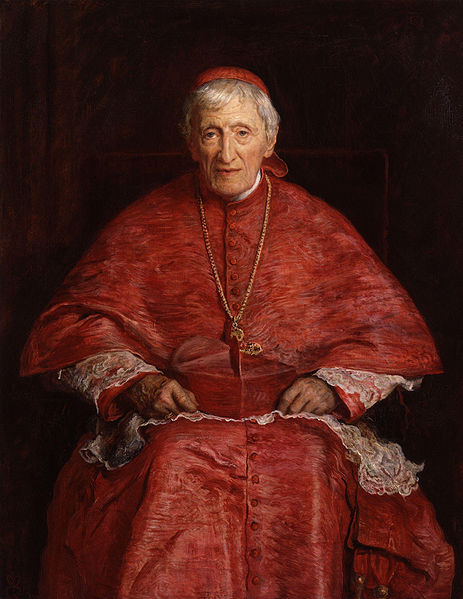
It seems so far away now. I recall the thrill of Pope John Paul II's visit to England, and the enormous historic resonance it had for me, just as I recall the easy anti-Catholic jibes of my Protestant high school. In time I came to reconcile my Englishness with my Catholicism – there was a tranch of Anglo-Saxon agnostics and atheists in my family and my father never practised the faith, so I was a hybrid to begin with. In this reconciliation, Cardinal Newman was very, very important to me as a student – as he was to so many English Catholics. Duffy is really good on him too:
In terms of the inner politics of contemporary Catholicism, Newman himself was a liberal, and his vision of a healthy church was in many respects the antithesis of Pope Benedict’s. Though punctiliously loyal to the papacy, Newman was a vocal opponent of the definition of papal infallibility in 1870, which he thought unnecessary and a burden to consciences. He denounced the “aggressive and insolent faction” of Ultramontanes who centralised Catholicism too much on Rome.
He deplored clericalism, worked to create an educated and active laity, and argued for greater freedom for theology within the church.
“Truth,” he wrote, “is wrought out by many minds, working together freely.” He detested, and himself suffered from, trigger-happy dogmatists who tried to pre-empt intellectual exploration by invoking pat formulae and ecclesiastical denunciations. Structures of authority gave the church strength, he conceded, but did not give it life: “We are not born of bones and muscle.” Truth was objective, but had to be sought out by the heart and conscience as well as by the head, and he took as his motto as a cardinal the phrase of St Francis de Sales, “Heart speaks to heart.”
And then, of course, I had to reconcile my sexual orientation with my faith. Neither was easy. Displacement – constant, gnawing displacement – was, I came to understand, simply a function of being me in my place and time. It was only later that I came to understand, with a mixture of astonishment and sudden obvious recognition, that Newman himself was almost certainly gay himself. As Wiki puts it:
In accordance with his expressed wishes, Newman was buried in the grave of his lifelong friend, Ambrose St. John. Previously, they had shared a house. The pall over the coffin bore his cardinal's motto Cor ad cor loquitur ("Heart speaks to heart"). Inseparable in death as in life, a joint memorial stone was erected for the two men; the inscription bore words Newman had chosen: Ex umbris et imaginibus in veritatem ("Out of shadows and phantasms into the truth")
That Benedict, whose complicity in child-rape is as profound as his anti-intellectual authoritarianism, will beatify this great saint is as painful as it is ironic. Johann Hari urges British Catholics in this vein to protest or boycott the state visit. For me, I would marginally prefer to attend a cocktail party with Roman Polanski than bow down to this pontiff as my grandmother would expect. I certainly would not attend any events associated with his visit. But I would not protest. The church is deeper than its current awful leader and its truth deeper than his neurotic fears and sublimated desires. Newman's slow emergence into sainthood is a great thing, and perhaps one day will lead to a deeper, better Catholicism in the land he loved and the culture he helped elevate.
I wish I could say this did not make me feel deep pain. I wish I could simply feel anger. I wish I could simply leave or stop believing, rather than hang in this well of hurt and alienation and lonely prayer. I long for reconciliation with so much that made me and so much that I love and so much that I believe in and so much that I fought for and defended with Irish tenacity against English condescension. But for this English and now American Catholic, it is currently beyond me to honor this man at this time with this record amid this immense hurt.
And so I will look away. And the pain of a reconciliation I can never experience will probably intensify. Until what Newman said may actually come true for me and for the church so many of us still love:
Ex umbris et imaginibus in veritatem

 The Dish