Abby Hoffman lives on: instead of "Steal This Book" you can now go straight to pirating the digital edition.
Author: Andrew Sullivan
A Poem For Saturday
Between the dark and the daylight,
When the night is beginning to lower,
Comes a pause in the day's occupations
That is known as the Children's Hour.I hear in the chamber above me
The patter of little feet,
The sound of a door that is opened,
And voices soft and sweet.From my study I see in the lamplight,
Descending the broad hall-stair,
Grave Alice, and laughing Allegra,
And Edith with golden hair.A whisper, and then a silence:
Yet I know by their merry eyes
They are plotting and planning together
To take me by surprise.A sudden rush from the stairway,
A sudden raid from the hall!
By three doors left unguarded
They enter my castle wall!They climb up into my turret
O'er the arms and back of my chair;
If I try to escape, they surround me;
They seem to be everywhere.They almost devour me with kisses,
Their arms about me entwine,
Till I think of the Bishop of Bingen
In his Mouse-Tower on the Rhine!Do you think, O blue-eyed banditti,
Because you have scaled the wall,
Such an old moustache as I am
Is not a match for you all?I have you fast in my fortress,
And will not let you depart,
But put you down into the dungeons
In the round-tower of my heart.And there will I keep you forever,
Yes, forever and a day,
Till the walls shall crumble to ruin,
And moulder in dust away!
– Henry Wadsworth Longfellow, "The Children's Hour" first published in the Atlantic in September 1860.
We're hoping to add more classic poetry from the Atlantic archives in the coming weeks and months. If you have a favorite, please let us know.
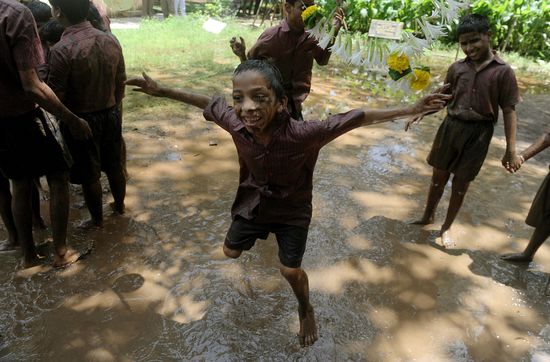
(Photo: A visually impaired child plays during a 'dahi-handi' (curd-pot) celebration at the Victoria School for the Blind in Mumbai on September 1, 2010, on the eve of 'Janmashtami' which marks the birth of Hindu God Lord Krishna. Scores of Hindu devotees of Lord Krishna take part in the dahi-handi celebrations during which a large earthenware pot is filled with milk, curds, butter, honey and fruits and is suspended from a height of between 20 to 40 feet. Sporting young men and boys come forward to claim this prize by constructing a human pyramid till the pyramid is tall enough to enable the topmost person to reach the pot and claim the contents after breaking it. Normally, currency notes are tied to the rope by which the pot is suspended and this prize money is distributed among those who participate in the pyramid building. By Punit Paranjpe/AFP/Getty Images)
Living With Terror
James Fallows quotes George Friedman's essay "The Nine Year War" as a brave assessment of where we've been and where we're going on this anniversary of 9/11:
Let me state a more radical thesis: The threat of terrorism cannot become the singular focus of the United States. Let me push it further: The United States cannot subordinate its grand strategy to simply fighting terrorism even if there will be occasional terrorist attacks on the United States. Three thousand people died in the 9/11 attack. That is a tragedy, but in a nation of over 300 million, 3,000 deaths cannot be permitted to define the totality of national strategy. Certainly, resources must be devoted to combating the threat and, to the extent possible, disrupting it. But it must also be recognized that terrorism cannot always be blocked, that terrorist attacks will occur and that the world's only global power cannot be captive to this single threat.
Fallows continues the discussion in a later post. I recommend Fareed's latest as well.
The View From Your Window Contest
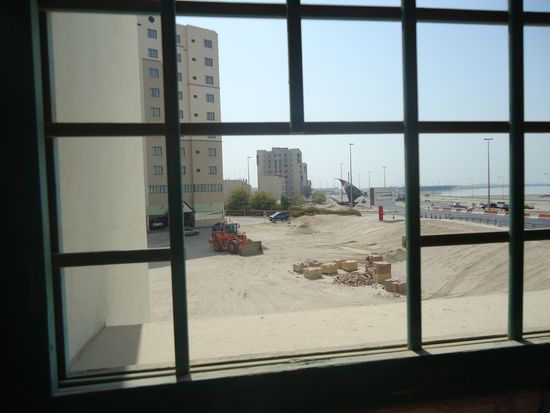
You have until noon on Tuesday to guess it. Country first, then city and/or state. If no one guesses the exact location, proximity counts. Be sure to email entries to VFYWcontest@theatlantic.com. Winner gets a free The View From Your Window book, courtesy of Blurb. Have at it.
Experimenting With Yourself
None of the examples hold a candle to the story of a certain Sir Henry Head dunking his penis in warm water, to test nerve damage and touch:
In the case of [Head], the tip happens to be devoid of heat-spots but is sensitive to cold and to pain. When… it was dipped into water at 40° C, no sensation of heat was produced, but [Head] experienced an unusually disagreeable sensation of pain… But, as soon as the water covered the corona without reaching the foreskin, both cold and pain disappeared, giving place to an exquisitely pleasant sensation of heat.
(Hat tip: Vaughan Bell)
“Shopping Is A Feeling”
Molly Young marvels at a Hollister store and its innovative, if unnerving, retail model:
Immersive retail is … a way to counter the allure of online shopping, which boils down to its convenience … IBM describes the goals of immersive retail the way a party planner might envision a successful bar mitzvah, aiming for a “memorable, interactive and emotional” experience full of “personalized dialogues.”
The paper explains that immersive retail “is more about involving the customer than it is about the merchandise.” It is about shirtless male employees miming one-armed pushups on a rack of distressed jeans, yelling, That’s what I’m talkin’ about! and Party at my house! on a script every ten minutes.
I could handle that. But I prefer it in a nightclub myself. The rest is Konsumterrorismus for me.
A Language Myth?
Pace Guy Deutscher, John McWhorter argues that as "cool as it would be if grammar were thought, the idea is a myth":
Deutcher’s favorite evidence is people who sense direction not as a matter of front and back but as north, south, east and west. In their languages you say not “in front of me” but “west of me” and so on — meaning that where if we were turned around after saying something was in front of us we’d say that it was now in back of us, speakers of these languages would still say that it was west of them.
Neat. But are these people’s languages making them sensitive to direction rather than position – or is it, as almost anyone would intuit, that the culture focuses on direction and thus the language does? Americans have a plethora of terms referring to psychology– complex, affect, syndrome, superego, compensation. Yet who would say that it’s the English language that makes us sensitive to these things? It sounds like something a Martian anthropologist might come up with, too eager for the exotic to perceive – or settle for — the more mundane truth.
Bird’s Eye View
Artists Thomas voor ‘t Hekke and Bas van Oerle’s latest project:
‘panoptICONS’ addresses the fact that you are constantly being watched by surveillance cameras in city centres. The surveillance camera seems to have become a real pest that feeds on our privacy. To represent this, camera birds – city birds with cameras instead of heads – were placed throughout the city centre of Utrecht where they feed on our presence.
YouTube Time Machine
Knowing Grief
Alissa Torres, wife of a 9/11 victim, speaks out:
What did I think about the decision to construct a "mosque" this close to ground zero? I thought it was a no-brainer. Of course it should be built there. I sometimes wonder if those people fighting so passionately against Park51 can fathom the diversity of those who died at ground zero. Do we think no Muslims died in the towers? My husband, Eddie Torres, killed on his second day of work at Cantor Fitzgerald while I was pregnant with our first child, was a dark-skinned Latino, often mistaken for Pakistani, who came here illegally from Colombia. How did "9/11 victim" become sloppy shorthand for "white Christian"? …
But here is what's been lost in this Park51 controversy: We are not experts, we are victims. We deserve to speak up, we need to speak up to acknowledge the pain and suffering, but we were never meant to be leaders in a national debate. Because the only thing we really know intimately is grief. The only thing we really know is what it feels like to lose a loved one in 9/11.
 The Dish