A Poem For Sunday

8331816773_f2ae45ac15_k

“The Stags” by Kathleen Jamie:

This is the multitude, the beasts
you wanted to show me, drawing me
upstream, all morning up through wind-
scoured heather to the hillcrest.
Below us, in the next glen, is the grave
calm brotherhood, descended
out of winter, out of hunger, kneeling
like the signatories of a covenant;
their weighty, antique-polished antlers
rising above the vegetation
like masts in a harbor, or city spires.
We lie close together, and though the wind
whips away our man-and-woman smell,
every stag-face seems to look toward us, toward,
but not to us: we’re held, and hold them,
in civil regard. I suspect you’d
hoped to impress me, to lift to my sight
our shared country, lead me deeper
into what you know, but loath
to cause fear you’re already moving
quietly away, sure I’ll go with you,
as I would now, anywhere.

(From The Overhaul © 2012 by Kathleen Jamie. Used by permission of Graywolf Press. Photo by Richard Fisher)

Poseur Alert

William Giraldi, the novelist, teaches at Boston University and was given paternity leave after his wife delivered their first child. He shares how those nine months of relative leisure transformed him into a near-alcoholic:

When Pascal suggested that humanity’s strife stems from our inability to sit quietly in a room by ourselves, he neglected to specify what happens when one rolls a few barrels of alcohol in for company. I cannot say precisely why my “workload reduction” coincided with my “drinking problem,” except suddenly I had so much time. Okay, the university made me sign a document that swore I’d be incurring more than 50 percent of parental duties. But let’s be honest: even in self-consciously progressive households, it’s a rare new father who does as much baby work as a new mother. …

There came, of course, the medieval hangovers that vanquished entire days. Sleep interrupted by migraines and dehydration that felt downright malarial. Iffy decisions involving the diaperless infant on an antique couch. Puffy face and puffier physique. Aches in the liver region, nights in the living room. A first-name basis with the Visigoth at the liquor store. A propensity to click “send” without reading what I’d written. Friends just itching for an intervention. I kept waiting for a knock on the door from the university officials who had so generously granted me a workload reduction. But they never came for me.

This isn’t his first time Giraldi has written about his hard-knock life. Back in October, he lamented the way his fiction was favorably compared to Pulitzer Prize-winning novelist Cormac McCarthy:

If most of the McCarthy comparisons have been favorable, all of them have been facile. This is testament to the McCarthy hegemony, to how wholly he dominates an entire sector of American fiction, and to how he has usurped our understanding of a certain literary pedigree. Write a novel with a specific poetical register adequate to the task of addressing nature and redemption, one which includes the sanguinary madness of men, and McCarthy is the artist languidly at hand for every reader itching to make a connection.

But McCarthy’s prominence is such that another novelist interested in the primitive flux and flex of violence, and in that crossroad where this world grinds against the other, would have to be outright masochistic to attempt to emulate him. Neither the novelist nor the novel could ever get away with it. Every page would carry its own proof of transgression, and thus its own guarantee of detection. ‪Let’s remember, too, Walker Percy’s perfect warning to writers who attempt to channel Faulkner: “There is nothing more feckless than imitating an eccentric.”‬

On “Species Guilt”

Robert Pogue Harrison ponders humanity’s relationship with animalkind:

We like to think of ourselves as the stewards or even saviors of nature, yet the fact of the matter is, for the animal world at large, the human race represents nothing less than a natural disaster. This applies to all creatures, from those we allow to roam “wild” in designated nature preserves to those we cram together on our chicken farms; from the dancing bears of Anatolia to the bald eagles of Alaska, with their collar monitors; from the laboratory animals we test our cosmetic products’ chemicals on to the sharks whose fins leave the oceans to swim around in our nuptial soups. All creatures are under our yoke; and all, including our beloved horses, dogs, cats, and canaries, are subject to human persecution in one way or another.

From a quantitative point of view our species guilt is more aggravated today than it ever was in the past, when Plutarch or Pythagoras cried out against animal murder and the consumption of animal flesh. As the French philosopher and biologist Jean Rostand put it, “Science has made us gods even before we are worthy of being men.” While the scale of animal death has increased exponentially, the main issue today is no longer death but the coercive reproduction and perpetuation of animal life under infernal conditions of organic exploitation. Industrialized farming today, in its manipulation of the biological processes of genesis, growth, and multiplication, forces animals like cows, calves, turkeys, pigs, ducks, and geese into artificial, barely endurable forms of existence. Far more demonic than the slaughters and animal sacrifices of the past, our relegation of these creatures to a standing reserve of consumable stock reduces their “lives” to a worldless, merely mechanical process of flesh production. In his Letter to the Romans, Saint Paul wrote of the malaise of the earth: “the whole creation has been groaning as in the pains of childbirth right up to the present time.” That creaturely groaning has gotten a lot louder of late, and if God indeed loves his creatures enough to open heaven to them, it is highly likely that, when our pets get there, they will find themselves on their own.

Why It’s Big Of You To Forgive The Little Things

Amy Westervelt talked to professor Frederic Luskin, who has spent ten years leading forgiveness classes at Stanford, about the importance of pardoning everyday transgressions:

‘Even the stuff that forgiveness was supposed to be good for – stuff like murders … it’s so rare,’ he told me. ‘More important is can you forgive your brother-in-law for being annoying? Can you forgive traffic? Those things happen every day. Big things? They happen once in a lifetime, maybe twice. It’s a waste of forgiveness. That’s my perspective. But forgiveness is really important for smoothing over the normal, interpersonal things that rub everyone the wrong way.’

Part of what makes the word – and practice – tough for people, in Luskin’s view, is that it requires a degree of selflessness. ‘For me to say, “Even though you were a shithead, it’s not my problem; it’s your problem, and I’m not going to stay mad at you, because that’s you, not me,” that’s a huge renunciation of self,’ he said. ‘And I don’t know whether it’s our [Western] culture or a human thing, but it’s hard.’

Plus it requires acknowledgement of our fundamental human vulnerability, without getting angry or bitter about it. ‘A lot of times people start with this idea that “I shouldn’t have been harmed”,’ Luskin said. ‘Why not? We live on a planet where harm happens all the time, where children are murdered and horrible things happen; to think that you should escape that is a mammoth overstatement of your own importance and a lack of sensitivity to everyone else on the planet.’

Rabbi Jesus

Jan_Wijnants_-_Parable_of_the_Good_Samaritan

In an interview about her new book, Short Stories by Jesus: The Enigmatic Parables of a Controversial Rabbi, Amy-Jill Levine emphasizes Jesus’ Jewish identity as a key to understanding what he taught:

Jesus is the first person in literature called “rabbi,” which at the time–the late first century–meant “teacher.” The term “rabbi,” today thoroughly associated with Judaism, signals for Jesus his own particular Jewish identity.

For Christians, Jesus should be more than a Jewish teacher. But he must be that Jewish teacher as well. If his teachings were not of import to the Church, the Gospels would have skipped right from the Nativity stories to the Passion–right from Advent to Lent. To see Jesus as a rabbi, a Jewish teacher, is to take seriously what he had to say: his parables, interpretation of the Scriptures of Israel, apocalyptic pronouncements, ethical guides–and all of these teachings can only be fully appreciated if we see how they fit into their own historical context.

She goes on to claim the parable of the Good Samaritan is perhaps the most misunderstood:

Today, we hear that the “Good Samaritan” is about accepting the marginalized. Samaritans were not “marginalized” by Jews; to the contrary, they were the enemy. This fact also shows why the modern tendency to identify with the Samaritan is, although affirming for the Christian today, not what a first-century Jewish audience would do.

Or, we hear that priest and Levite ignore the injured fellow because they were following Jewish law concerning ritual impurity. The parable has nothing to do with purity laws; to the contrary, burying a corpse is one of the highest commandments in Judaism, a point made in sources ranging from the Deuterocanonical Book of Tobit to the writings of the first-century historian Josephus to the Mishnah and Talmud. Unless we know what the terms “priest,” “Levite,” and “Samaritan” suggested to that original audience, we’ll not only miss the parable’s profundity, we’ll promote negative stereotype of Jewish practice and ethics.

Recent Dish on the Jewishness of Jesus here.

(“The Parable of the Good Samaritan” by Jan Wijnants, 1670, via Wikimedia Commons)

Intelligent Design 2.0?

800px-Schnorr_von_Carolsfeld_Bibel_in_Bildern_1860_001

That’s what Damon Linker calls Eric Metaxas’ claim (behind a WSJ paywall, alas) that science increasingly makes the case for God. His summary of Metaxas’ argument:

Metaxas’ argument is quite simple. As recently as a few decades ago, physicists presumed that life had most likely emerged and evolved spontaneously on planets throughout the galaxy and universe, producing a cosmos veritably teeming with intelligent beings. But in more recent years, scientists have become far more circumspect, noting the enormous number of factors that must be present — on specific planets, in particular star systems, and in the universe as a whole — for life to emerge and evolve. These factors — sometimes called “anthropic coincidences” — are so numerous and involve such stupefyingly improbable outcomes that they point toward the existence of a cosmic designer who established the precise conditions for the emergence and evolution of life on Earth. And perhaps only on Earth.

The problem with such arguments? Linker holds that all Metaxas has done is update natural theology, which stretches back to Plato and Aristotle, and “doesn’t demonstrate the existence of the God of the Bible”:

The biblical God actively creates the universe and each specific form of life, with human beings created in his own image. He is a jealous, and sometimes angry, God.

He regularly intervenes in human lives and history, even selecting the Jews to be his chosen people. He promises rewards and punishments (while often leaving the criterion of judgment mysterious). In two New Testament passages (Matthew 10:30; Luke 12:7), Jesus Christ claims that God cares about every hair on every single human head. The Christian theological tradition even goes so far as to propose that the creator of the universe became incarnate in human form, living and dying an excruciating death in a gratuitous act of love that makes possible the redemption of humanity.

What Metaxas is really showing in his column is a simplified form of natural theology, and not at all an example of theological reflection based on divine revelation. That isn’t a criticism. It’s a statement of fact — a fact that severely complicates any attempt to treat his scientifically based speculations as providing evidence for the God that most Americans profess to believe in.

The Roman Catholic philosophy Francis J. Beckwith likewise urges believers to resist the temptation to latch onto scientific evidence that seems – for the moment, at least – to support God’s existence:

God – as understood by the Catholic Church and by most other theistic traditions – is not a being in the universe, a superior agent whose existence we postulate in order to explain some natural phenomenon, but rather, Being Itself, that which all contingent reality depends for its existence.

In order to appreciate how this understanding differs from Metaxas’ Watchmaker God, suppose in a few years scientists tell us, after further research, new discoveries, and confirmed theories, that the arising of life in the universe is not that improbable after all. What then happens to Metaxas’ God? He is now superfluous, and Metaxas would have to concede that theists are once again irrational, as they apparently were when the (temporarily obsolete) God hypothesis was down for the count the last time science threw its best punch.

Given the arguments Metaxas summarizes in his essay, it is tempting for the theist to confidently tout such evidence. When faced with a cadre of globally accessible, and endlessly annoying, village atheists who posit the findings of science as defeaters to belief in God, there is nothing quite like the Schadenfreude of pointing out to the self-appointed guardians of reason that they have been hoisted upon their own petard. But you should not acquiesce to this temptation. For in doing so, you concede to the atheist his mistaken assumption that the rationality of belief in God depends on the absence of a scientific account of whatever phenomenon is in question.

Dreher nods, adding that “order in creation does not prove God, but it is a sign pointing to God”:

Even if God’s existence could be proved, it changes nothing; even the devil believes in God, but rejects Him. God desires to live in communion with us. Recognizing His existence with the intellect is only a start. He wants not our minds, but our hearts. In Kierkegaardian terms, God is a subjective truth — a truth that can only be known by appropriating it with the most passionate inwardness. We don’t know God like we know the Second Law of Thermodynamics; we know God like we know the love of our father.

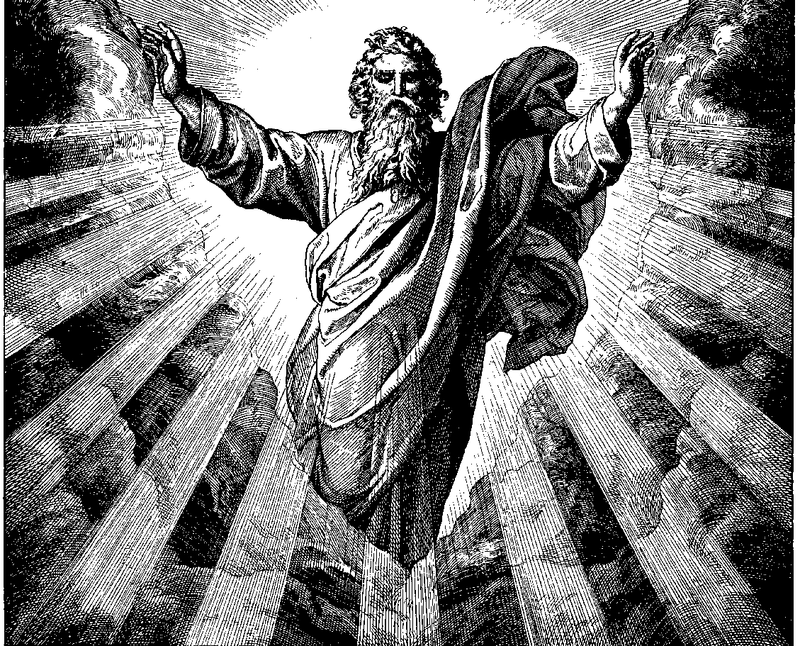
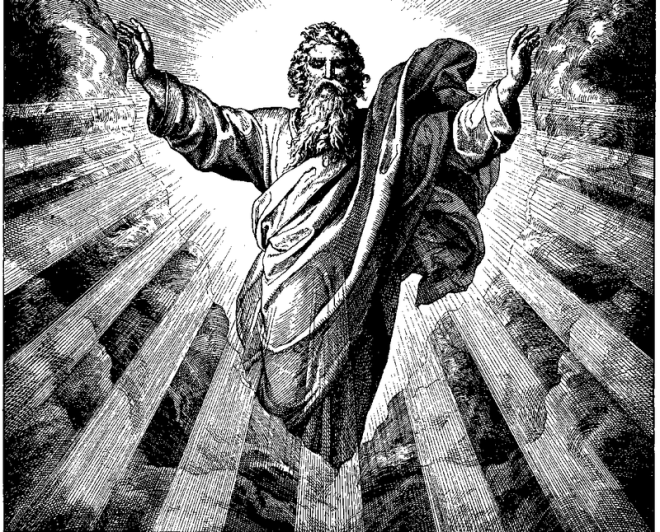
(Julius Schnorr’s sketch of God the Father, circa 1860, via Wikimedia Commons)

Taking A Stand On The Can, Ctd

god-stall

Some bathroom graffiti for Sunday:

On the inside of the door of a stall in the ladies’ room a Korean Presbyterian church in Philadelphia:

Psalm 139:1
Lord, you have searched me out and known me; you know my sitting down and my rising up.

Another:

One I first saw about a year ago; fun for a 56-year-old to learn new grafitti. In one handwriting: “John 3:16“. Below it in a different handwriting: “Bill, about 4:30“.

Another:

From a Canadian university in the mid-1980s: “Jesus Saves”.  Written underneath: “but Gretzky scores on the rebound!”

Many more below:

My favorite (and only) graffiti I remember from college is: “Jesus saves … Moses invests … Mongol hordes”.

Another:

When I was at the University of Iowa back in the ’90s I saw this gem:

Jesus lives!

Followed by:

In my penis!

Trumped by:

So it takes your penis three days to rise again?

Another:

During the 1970s, the preacher/faith healer/television evangelist Oral Roberts had a very successful ministry, but he was widely seen as a huckster by “mainline” Christians. Thus, a stall in a men’s room in Speer Library at Princeton Theological Seminary had the following graffiti: “Do you believe in Oral Roberts between consenting adults?”

Another shifts away from the porcelain god:

My favorite bathroom stall wisdom is this nugget seen in a stall in Peabody Hall, home of the University of Georgia philosophy department. It stated, quite simply: “I shit, therefore I am.”

More philosophy:

From a stall in Oxford:

“God is dead.” – Nietzsche

With the addition:

“Nietzsche is dead.” – God

Another reader:

Men’s room stall, UNC-Chapel Hill philosophy department: “Heisenberg may have been here.”

And another:

A reader wrote about the incongruity of writing to an erudite blogger about bathroom graffiti, but a few years ago I wondered into a bathroom at St. John’s College in Annapolis and had to take a picture of the graffiti that read “πολλὰ τὰ δεινὰ muthafucka” and honor the wisdom of whoever wrote them. As a classics PhD, I knew those words to be adapted from a chorus in Sophocles’ Antigone “There are many terrible things [but none worse than man]” (line 332). This citation shows the contexts where πολλὰ τὰ δεινὰ  usually shows up.

One more:

Found in a men’s room on the 4th floor of the Philosophy Building at UCLA (circa 1968):

To be is to do—Sartre
To do is to be—Hegel
Do be do be do—Sinatra

8-Bit Existentialism

Colin Marshall recommends the series 8-Bit Philosophy, which combines deep thinking with the aesthetics of early Nintendo:

If you’ve put in the hours playing both eight-bit video games and reading the relevant philosophical texts, you’ll surely find these videos’ Nintendonian aesthetics as impeccable as their encapsulations of Kierkegarrd, Sartre, and Camus’ positions are concise. You can find more from 8-Bit Philosophy on Youtube, including their vintage gamer-friendly renditions of Friedrich Nietzsche on time as a flat circle and what science has to do with truth.  They cover other areas of philosophy, too, but something about old video games themselves — with their endless cycles of death, regeneration, and not inherently meaningful challenges — leads my mind straight into existentialism every time.