Attending To Him

by Zoe Pollock

A South African pastor has drawn criticism for preaching AIDS awareness, getting tested in front of his congregation (along with 100 others from his township) and delivering a sermon "Jesus was HIV-positive." In an interview the pastor stands by his sermon:

In many parts of the Bible, God put himself in the position of the destitute, the sick, the marginalised. When we attend to those who are sick, we are attending to him. When we ignore people who are sick, we are ignoring him.

Rationality And Well-Being

by Zoe Pollock

The eternal fight over religion and rhetoric was reignited this week, fueled by the basic question: should atheists should be nicer? Quinn O'Neill at 3QD voted for moderation:

Let’s assume that the value of reason ultimately lies in its ability to improve well-being.  Reason and empiricism have brought us great scientific discoveries, lifesaving medicines, and technologies that make our lives longer and healthier.  It’s undeniable that rationality can improve well-being.

It might seem, given these benefits, that improving rationality would improve well-being.  But irrationality has its perks.  Delusions can provide comfort.  They can give us confidence, hope, or a sense of purpose.  Superstitions can improve athletic performance, and psychics and astrologers can help people deal with the discomfort of not knowing what the future holds.  The most rational objective, then, is not necessarily to have everyone be completely rational but rational to the extent that optimizes well-being.  

Phil Plait's lecture, "Don't Be A Dick" which Quinn references, is now online, wherein he writes he wasn't specifically reprimanding people like Richard Dawkins or PZ Myers:

It was aimed at everyone, everywhere, and also inward toward myself. I cannot accuse others of that which I have not at the very least searched for in myself. And I have indeed found it in myself, which was the final factor in my making the speech in the first place.

PZ Myers rebutted using his own heart trouble this week as an allegory about the importance of skepticism:

Denial is so tempting: the appeal of choosing ignorance to avoid hard consequences was something I felt strongly — it would have been so nice to go home and pretend there were no problems, and I probably would have been just fine, on the surface. But the heart disease would have continued to progress, and a problem deferred would have become a problem amplified.

That is the virtue of dickishness. It provides the social and psychological penalties that counter the draw of complacency. It's so easy to go with the flow, to pretend that a thousand issues, whether it's homeopathy or religion or transcendental meditation or an absence of critical thinking or a lack of concern about our health, are OK because they make people happy, and it's even easier to demonize the cranky Cassandras and make them the problem, because they make people uncomfortable.

But if bad ideas don't have immediate consequences to the placid mob, and if everyone is being Mr and Mrs Nice Folk and reassuring everyone that they're still good people no matter what foolishness they might believe in, where is the motivation to change? A skeptic who thinks their mission is to provide only positive messages and lead everyone along with affirmations and friendliness is going to be an ineffective skeptic.


Everything Is Illuminated

Untitled-ultraviolet-7

by Zoe Pollock

New York based Photographer Cara Phillips describes her latest project, Ultraviolet Beauties:

Many medi-spas and dermatologists take reflective ultraviolet photographs to show patients their ‘future’ skin. Even though there is no guarantee that this unseen damage will ever appear, beauty professionals and doctors still use these images to sell treatments to their clients and patients… The idea was to offer pedestrians a chance to see their possible future and reconsider the fear of flaws.


As Long As This Exists

by Zoe Pollock

Bonnie Alter has found a nice epitaph for the death of the long-sick chestnut tree outside Anne Frank's attic, which finally fell this week under heavy winds. From Anne's own diary in February of 1944:

Nearly every morning I go to the attic to blow the stuffy air out of my lungs. From my favorite spot on the floor I look up at the blue sky and the bare chestnut tree, on whose branches little raindrops shine, appearing like silver, and at the seagulls and other birds as they glide on the wind. As long as this exists, … and I may live to see it, this sunshine, the cloudless skies – while this lasts I cannot be unhappy.

Can Church Be Hip? Ctd

Hands in the air - in concert

by Chris Bodenner

A reader writes:

I've found the recent debate about spiritual music fascinating, but I have to take issue with a comment a reader recently made:

I could see these pieces in a "Christian coffeehouse."  But if the "hip" emergent church or the megachurches have begun using this sort of material for "worship," then they have departed even further than I realized from thousands of years of Judeo-Christian tradition for gathered celebration and supplication.  And in that case, the answer to your question would be, it may be hip, it may be Christian, but it's not church, because it's not worship, any more than listening to a reading of John Donne's or T.S. Eliot's lyrics – admirable Christian poetry – would be worship.

I often find that people who invoke thousands of years of Judeo-Christian teaching generally have no idea what they are talking about. This seems to me similar to the approach to history of NOM, who blithely assert that the institution of Judeo-Christian marriage has remained unchanged for thousands of years. It's only true if you adopt very loose standards about changes.

I can't speak to the Judeo part of the equation, but as a student of medieval history, I feel pretty confident in saying that our ideas about what constitutes worship have changed in some pretty significant ways over the past two thousand years.

I'm not entirely sure that I understand the objection to contemplation of John Donne as an act of worship. How, exactly, does it differ from the contemplation and reading of Psalms, which are again poems written by individuals contemplating the nature of the divine? For that matter, who says that worship must be communal? I don't disagree that it is often communal (the bit about "wherever two or more are gathered in my name" springs to mind), but there is a rich history of solitary worship in the Christian tradition. Many early saints, such as Cuthbert and Guthlac, were hermits, and while they would certainly pray with those who visited them, I can't imagine that many would dispute that their solitary rites constitute a form of worship. Early traditions in Ireland, England, Egypt, and many other places often placed a strong emphasis on monastic traditions that involved a withdrawal from the world, with community expressed through shared experiences of individual contemplation.

I'm also not sure what the reader's objection to these songs are. What makes one piece of music appropriate for "gathered celebration and supplication" and another not? Why are Donne's "Holy Sonnets" different from Psalms or modern hymns like "Amazing Grace" and "Be Thou My Vision", or even contemporary praise and worship songs? If everyone read Donne together, would it be worship?

The problem here seems to be that the reader is attributing qualities to the word worship which it simply does not have. The OED definition: "Reverence or veneration paid to a being or power regarded as supernatural or divine; the action or practice of displaying this by appropriate acts, rites, or ceremonies" seems pretty spot on to me. Over time the appropriate acts, rites, and ceremonies have changed quite a bit. We've seen this happen at an institutional level with the reforms of Vatican II.

(Photo by Martin Fisch)

Summer Skin

by Zoe Pollock

In another of Caroline Lazar reports from McSweeney's "Oh My Gawd: A Column About A Teenager Navigating Religion" we get her very contemporary and contemplative read on the end of the season:

We pack up trunks of summer skin and easy living in our attics to prepare for the chill of fall but the ream of summer scenes of the sun pinching our cheeks can stay in frames on the wall until next year. Until then, we can continue to search for summer in our worn bathing suits and straw hats—plucking leftover crumbs of sand out like specks of the season—in anticipation of all meeting again.

In Defense Of Casual Sex

by Zoe Pollock

Tracy Clark-Flory rejoiced after science finally confirmed her long held belief that hookup culture doesn't kill off all chances for love:

University of Iowa sociologist Anthony Paik's survey of 642 adults in Chicago initially found that "average relationship quality was higher for individuals who waited until things were serious to have sex compared to those who became sexually involved in 'hookups,' 'friends with benefits,' or casual dating relationships," according to a press release. But when he controlled for people who had zero interest in having a relationship, that difference disappeared. "Couples who became sexually involved as friends or acquaintances and were open to a serious relationship ended up just as happy as those who dated and waited."

For Stupid’s Sake

by Zoe Pollock

I don't entirely agree with this read on Judd Apatow's critical success, but it's an interesting take:

They strain to wring relevance out of Apatow’s pro-family message. (Who in America is against families and children?) They strain to argue for his place in a tradition. They use him as a cudgel against flawed filmmakers who are both smarter and more ambitious than he is. All the while they miss the simple moving force behind the gratuitous cameos, the accumulating in-jokes, the repeated casting of the director’s wife, children, and friends, and the constant carping about aging in Apatow’s films; they miss all the vanity. He is allowed this vanity because he delivers a message Americans crave to hear. As long as you behave yourself, take on a modicum of responsibility, and wear the yoke of commitment, it is entirely acceptable—even preferable and profitable—to be stupid.

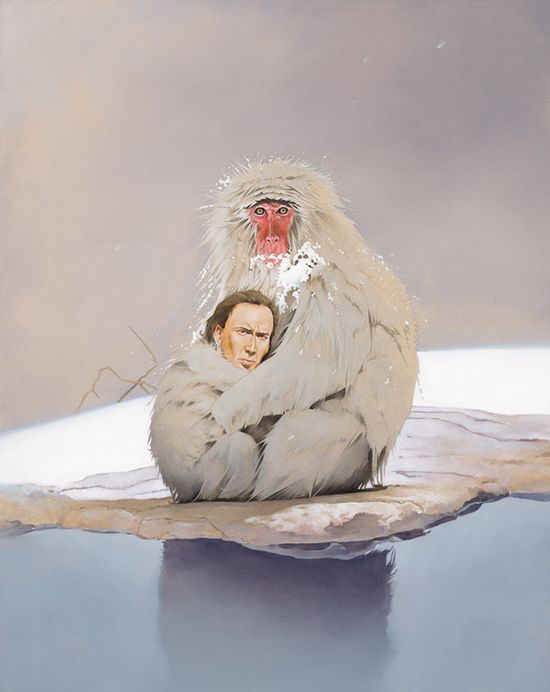
Nicholas Cage As Pop Art

Uncanny_valley

by Zoe Pollock

Alex Gurnham interviewed the artist Brandon Bird about his most recent foray into pop culture madness, starring Nicholas Cage:

I think that's really what pop art, or maybe even all art, is about. Presenting something people encounter every day in a way they had never considered. Whether that something is a sunflower, or a soup can, or Sam Waterston's awesome face.

(Hat Tip: Utne)

(Image: Uncanny Valley by Brandon Bird)