The California Scene

by Conor Friedersdorf

Since so many Dish readers write me from California, I thought I'd mention two very exciting journalistic efforts that are based in the Golden State, though of sufficient quality that outsiders will find them enjoyable too. One is the site California Is a Place. Its excellent videos blend the styles of photojournalism and art photography to produce some stunning pieces.

And then there is Slake, a new Los Angeles based quarterly that I described here. Its Web site recently launched. Cool photos here.

As long as we're talking Southern California, I should note that the swells have been big recently, and I took the opportunity to go down to The Wedge with my girlfriend to watch surfers and boogie boarders braver than me. Its difficult to do the place justice in words, except to say that most places one watches surfing for epic rides, whereas at The Wedge on a big day there can only be epic wipe-outs.

Here are some of them.

The Longer Libertarian Game

by Conor Friedersdorf

In his latest column at The Washington Examiner, Tim Carney argues that President Obama and his hostility to libertarianism are evidence that Brink Lindsey's project to encourage an alliance between liberals and libertarians failed.

The column is pegged to Mr. Lindsey's departure from the Cato Institute.

Mr. Carney writes:

Libertarian donors tend to be small-businessmen, and when they look at the nation's increasing debt, regulation and taxes, they begin to see Obama as the devil.

Obama's excesses are making free-marketeers more partisan. The same entrepreneurs who two years ago cursed Republican overspending and Bush bailouts are now asking one question: How can we drive Obama, Pelosi and Reid from power?

In such an environment, ambiguity about Obama – maybe he's not the devil – comes across as lukewarmness for liberty. This is a problem, because it means Republicans – no heroes on limiting government – could get a free pass from donors and activists.

Blissfully removed from Washington DC, I haven't any idea whether or not Mr. Carney is correct in his speculation about why Mr. Lindsey and Cato parted ways. But his column, and the libertarian donors he is channeling, make the same mistake (one he astutely recognizes in their case): operating on an inadequately short time horizon. I don't know if a liberaltarian alliance is ever going to be a reality, or if the project is doomed to fail, but it's folly to evaluate it based on two years of a single presidency. This is especially so when practically speaking, pursuit of the liberaltarian project is perfectly compatible with staunch opposition to President Obama and every aspect of his agenda.

Mr. Lindsey's project has never been about the 2010 midterms, or the 2012 presidential election, it's been about gradually reorienting America's ideological coalitions in a way that makes liberals more friendly to libertarian ideas, and libertarians less captive to the worst aspects of conservatism. Libertarian donors ought to fund efforts to oppose President Obama in the short term. They also ought to invest in intellectual projects with longer time horizons that only bear on particular electoral and legislative outcomes indirectly. If they can't distinguish between those projects, or if they actually display thinking as immature and counterproductive as "Obama is the devil" and "maybe he's not the devil" equals "lukewarmness for liberty," they're inadvertently sabotaging their own cause. Were I a wealthy man, I'd help fund Mr. Lindsey if only to avoid keeping all the libertarian eggs in the right's less than reliable ideological basket (the short time horizons apparently extend backward too).

The Worst Crisis In Recent Memory

Pakistan-Flood

by Patrick Appel

Jeb Koogler spotlights the floods of Pakistan:

Attention to the crisis has been heavily focused on the security angle. The dominant narrative regarding Western aid is that Pakistani extremist groups are gaining influence by controlling the aid distribution process, and that the West should thus increase its own aid distribution in order to counter these radicals. John Kerry, for example, visiting the region last week, mimicked this line of thinking: "Miles upon miles of destroyed homes, of people dislocated, people in camps in great heat, losing their possessions, growing frustrated, worried about the future. We need to address that, all of us rapidly, to avoid their impatience boiling over or people exploiting that impatience."

But note how this narrative obscures the humanitarian angle, and downplays the notion that governments have a responsibility to assist peoples beyond their borders. Our aid policy in the wake of this crisis should largely be constructed and justified based on a notion of shared humanity — not merely on a narrow assessment of American interests. That Pakistanis are suffering and desiring of international aid should be enough to warrant our attention, our dollars, and our support.

Via Joyner, who rounds up more analysis.

Property Wrongs

by Conor Friedersdorf

In Montgomery, Alabama, government officials are destroying the property of poor people:

Imagine you come home from work one day to a notice on your front door that you have 45 days to demolish your house, or the city will do it for you.  Oh, and you’re paying for it.

This is happening right now in Montgomery, Ala., and here is how it works: The city decides it doesn’t like your property for one reason or another, so it declares it a “public nuisance.”  It mails you a notice that you have 45 days to demolish your property, at your expense, or the city will do it for you (and, of course, bill you).

Your tab with the city will constitute a lien on your property, and if you don’t pay it within 30 days (or pay your installments on time; if you owe over $10,000, you can work out a deal to pay back the city for destroying your home over a period of time, with interest), the city can sell your now-vacant land to the highest bidder.

ABC News has more. And the Institute for Justice is helping with an upcoming protest.

Defending these demolitions is Todd Strange, Mayor of Montgomery, Alabama, and a Republican. The Conservative Christians of Alabama said prior to the last election that "conservatives see a vote for him as their only chance to save Montgomery from liberal Democrats." 

This would seem to be an example where libertarians, already on the scene doing excellent work, might ally themselves with a carefully chosen liberal challenger for mayor, given that the local conservative establishment is insufficiently enamored of property rights and limited government. If Strange doesn't face or beats back a primary challenge prior to the next election — some local conservatives are upset too — I don't see how any libertarian voter could fail to root for his ouster in the general election.

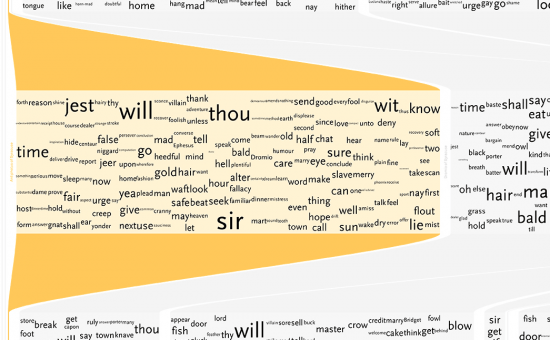
The Bard, Charted

Understanding-Shakespeare-visualization-550x340

by Zoe Pollock

Stephan Thiel at the University of Applied Sciences Potsdam has charted Shakespeare in various ways as part of his B.A. thesis:

The goal of this approach was to provide an overview of [each] play by showing its text through a collection of the most frequently used words for each character.

My favorite is how often "Oh" seems to occur in Romeo and Juliet. Oh, young love…

(Hat Tip: Flowing Data)

One Case for Localism

by Conor Friedersdorf

In California, local government is where our political failures begin.

Does anyone pay regular attention to their City Council or County Board of Supervisors? The people in Bell didn't, and were typical in that way. Those local bodies are used as stepping stones to the state legislature and beyond. But the folks who rise aren't doing so based on the considered judgment of citizens so much as their ability to curry favor with donors, spend on campaign advertising, and win elections via name recognition. 

It's a contest that's grown too sophisticated for amateurs.

Several factors militate against civic engagement. Ours is a large state with huge counties that contain sprawling municipalities. Our population is famously transient. A series of progressive reforms and populist ballot measures (especially Proposition 13) tended to strip control from local authorities, so that Sacramento grew in political importance. When the County Board of Supervisors sets property taxes, residents damn well show up at the meetings, whereas scrutiny is orders of magnitude less when the most contested subjects are settled regionally.

Nowadays so many critical matters of public policy are being decided by anonymous, faraway state officials, or even worse, their federal equivalents. In a way, life is less burdensome for people when they can safely ignore local civics, but the price in dysfunction and ceded influence is high. The thing about national or even state elections is that voters can only get their information from the mass media or professionally run campaigns. Though these are the best methods we've got, they are pretty terrible. Have you watched cable news lately?

Those of us who advocate federalism, and want states to give as much control as possible to locals, aren't just cranks who worry that tyranny is going to sweep the land if a marginally looser construction of constitutional law prevails. Our insight is that self-government works best when important matters inspire civic participation at a level where it can actually matter.

On Wednesday nights, a ten minute car ride is sufficient to arrive at city hall in time for the weekly meeting, where you can stand up at a podium, speak your mind directly to actual decision-makers, and respond if you still don't get your way by talking with people afterward — the ones who cheered when you spoke up, and might even be willing to back your own run at local elective office. These kinds of encounters inspire confidence that regular people can make a difference.

And we'd be far better off if our politicians started out as folks with particular passion for grassroots civic efforts, rather than coming from a power hungry class drawn by the prospect of a remunerative career in elective office.

Everything about national politics is awful. The candidates, the disingenuous talking heads, the artificially binary separation into Team Red and Team Blue, and especially the lack of weirdness, which is another way of saying that American communities and people are a quirky sort. Their diverse approaches to the pursuit of happiness are given short shrift if they're always forced to make consequential decisions in concurrence with everyone else.

Big Brother Is Listening

by Conor Friedersdorf

In Cato Unbound, Glenn Greenwald's essay on the surveillance state is now posted alongside comments by John Eastman, Julian Sanchez and Paul Rosenzweig. Mr. Greenwald has a response up here. It's a good debate, and another illustration of how the liberty versus tyranny framework isn't very useful for assessing liberal arguments.