by Conor Friedersdorf
James Joyner frames the back-and-forth between Michael Kinsley and Charles Krauthammer. Ron Paul and Christopher Hitchens are worth reading too.
by Conor Friedersdorf
James Joyner frames the back-and-forth between Michael Kinsley and Charles Krauthammer. Ron Paul and Christopher Hitchens are worth reading too.
by Chris Bodenner
A reader writes:
As a former Mormon of 40 years, I would like to think adherents of that faith would support the Mosque building in lower Manhattan. This may get you started on the "more varied opinions on this [topic] among Mormons at large" suggestion from one of your readers: For starters, their 11th Article of Faith, something every Mormon child is expected to commit to and repeat from memory, states, "We claim the privilege of worshiping Almighty God according to the dictates of our own conscience and allow all men the same privilege, let them worship how, where, or what they may."
Furthermore, the mosque issue is directly tackled in this post by the Mormon political blog, The Millennial Star (named after a Mormon magazine of the mid 1800s). The comments section if full of opinion both for and against the building of the mosque in its proposed location. One might fairly assume that many if not most commenters are faithful Mormons.
The Millennial Star's Brian Duffin moderates:
Sadly, not only were thousands of lives lost [on 9/11], but a religion was hijacked by the worst kind of extremists, extremists who do not represent the majority of Muslims who practice Islam. The broader question, I think, for Latter-Day Saints, is will we let our faith be hijacked by politics and sacrifice one of the most basic tenets of our faith and a right guaranteed in the American Constitution: the free exercise of religion? Or will we stand up for the rights of others and let them worship how, where, or what they may? We claim the privilege of worshiping Almighty God according to the dictates of our own conscience, but will we allow all people that same privilege?
by Chris Bodenner
A brilliant and NSFW spoof of those smug NYT Weekender ads:
(See also: "An Ode To The Daily Mail")
by Patrick Appel
A reader writes:
I can't comment on the accuracy of the rankings found in the Washington Monthly, but I would like to point out a major error in logic with respect to comparing college dropout rates with high school rates. As a former university administrator, I was one of those professionals entrusted with the task of compiling such data, and I'd like to offer a few points.
1- Within the university community, a transfer is considered a "dropout." If 10 of our students transfer to another university because they have decided to major in nursing or forest management, then they are listed as dropouts. We do not track them once they leave, so we have no way of knowing when or if they graduated from another institution.
2 – Unlike high school, a college education is not free. Yes, students do flunk out, but a large number of dropouts simply can't afford to stay. Many transfer to less expensive schools, and some come back a few years later, but this fact needs to be considered when discussing college graduation statistics.
3 – To date, college is still an "optional" experience for those who choose to go. As someone who worked closely with students (particularly freshmen), I can tell you that most freshmen have absolutely no idea why they are even in college, much less if they are in the "right one." I could spot future dropouts within 3 days of orientation. We tried to focus our energy on those who most needed it, but most can't be saved. Some need time to mature; some needed a different environment (larger, smaller, closer to home, etc), and some simply weren't cut out for college and never should have attended in the first place. Of course, with these students, I blame the adults in their lives (teachers, parents, society in general). Too much emphasis is placed on going to a 4-yr institution at the tender age of 18. It isn't necessary, and it isn't the right choice for a large number of students. We do all of them a disservice to pretend otherwise.
by Chris Bodenner
A defense of beards based on natural law:
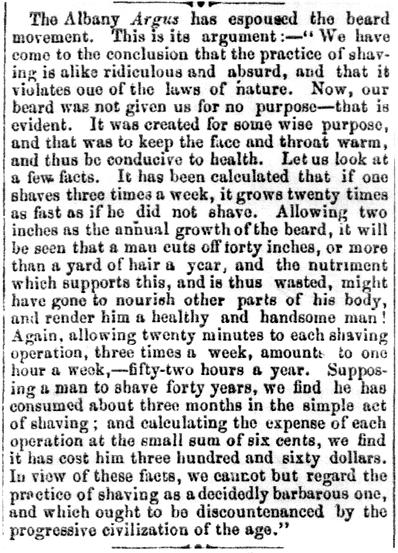
Published in the New Hampshire Sentinel on June 20, 1855, via David Malki (who interviews "the world's foremost beard expert" here).
by Conor Friedersdorf
Via James Fallows, an important reminder from Gary Hart about Iran and the possibility of American air strikes to stop it from getting nuclear weapons:
Bombing a sovereign nation is a de facto declaration of war. Our Constitution requires the Congress, not the President, to declare war. Simply because we have launched a number of wars without a Congressional declaration does not mean the Constitutional requirement has been suspended
How terrifying that we've gotten to the point where so many people write as if that requirement didn't even exist.
by Conor Friedersdorf
In an item yesterday, I argued that if you're trying to understand someone like Matt Yglesias, whether to effectively argue against his views or to engage him persuasively, the frames of "statism" and "liberty versus tyranny" are almost completely useless. Let's revisit why this is so. Mr. Yglesias favors deregulating various professional cartels, ending the legally proscribed monopoly on buses that some urban public transit agencies enjoy, reforming America's absurd system of agricultural subsidies, and making it easier for developers to build in accordance with the local demand for real estate, rather than government imposed zoning restrictions. (Odds are he subscribes to even more free-market friendly policies that the right embraces. That's just off the top of my head.)
Mr. Yglesias is neither a conservative nor a libertarian, as his approach to more consequential issues like health care policy demonstrates. On all sorts of policy questions, in fact, he favors a much larger federal role in American life than I do, putting us at odds all the time. Nor does he support the free market positions listed above because he has embraced the right's first principles on those issues: he is, after all, one of America's leading progressive bloggers.
Why does he favor some policies that conservatives like? And can we identify more of them for the sake of strategic alliances? We'll never know if, upon learning that he is a liberal, we automatically presume that he is a "statist," or even more absurdly, that he prefers tyranny to liberty. Those are unserious buzz words that sell books, not a realistic portrait of American liberals, a group that encompasses many people farther right than Mr. Yglesias.
In his response to yesterday's item, Mark Levin betrays his ongoing inability to understand any of this. He writes:
Idiot stalker.
This is so pathetic. So a liberal blogger favors regulation in some respect, and this proves to Friedersdork that my characterizing the general left-wing enterprise as statist is unhelpful – to Friedersdork. So, the fact that the liberal blogger isn't advancing big-government arguments ALL THE TIME demonstrates the inaccuracy of referring to his agenda as statist. This is the line that grabs your attention — "dismantling efforts to use the state to help the privileged has always been on the agenda." Really? So, before we get to this workers' paradise, we need this big state to sort things out. And, of course, at some point it will dissolve itself. Has anyone heard this stupidity before? And how will this occur. Marx does not tell us. His buddy Engels tried, but he failed miserably as well. This is not to say that those who post such things are Marxists. It is to say they are ignorant. Statism is the perfect word to describe them. Liberty and tyranny are the perfect words to explain them.
Let's be perfectly clear about why the "statist" frame is misleading:
The desired end of Matthew Yglesias isn't to grow the American state. On some issues, he sees a bigger state as a necessary means to an end he desires (like using subsidies to increase the percentage of Americans covered by some form of health insurance), and on other issues he favors taking power away from the state. It is useful to understand these distinctions, even if you think, as I do, that the federal government should be much smaller than Mr. Yglesias would have it.
Mr. Levin could mount a better defense of his pet term if his book merely argued that anyone who wants government to grow for any reason is a statist, but if you look at how he actually defines the term, ends are clearly implicated, and the notion that it describes the average American liberal becomes laughable. I'll cite page numbers from the hardcover text, where we learn that the statist “has an insatiable appetite for control… is constantly agitating for government action… speaks in the tongue of the demagogue… veils his pursuits in moral indignation…. and is never circumspect about his own shortcomings” (page 8). Qualities antithetical to the statist include “initiative, self-reliance, and independence” (page 9). “The Statist often justifies change as conferring new, abstract rights, which is nothing more than a Statist deception intended to empower the state and deny man his real rights” (page 14). “The Statist is dissatisfied with the condition of his own existence… he is angry, resentful, petulant, and jealous.” (page 15) “For the Statist, liberty is not a blessing but the enemy” (page 16). “The Statist urges Americans to view themselves through the lens of those who resent and even hate them… The Statist wants Americans to see themselves as backward” (page 18). “
The book goes on like that, with “The Statist” vexed by the Declaration of Independence in the chapter "On Faith and the Founding," falsely promising utopianism in the chapter "On the Constitution," and in the chapter "On Federalism," taking advantage of the 14th amendment as “a pathway to his precious Utopia where, in the end, all are enslaved in one form or another.” So again, returning to my original point, if you're trying to understand someone like Matt Yglesias, the frame of statism — as defined by Mark Levin — is almost completely useless. (Note: In another item on his Facebook page, Mr. Levin implies that he has persuasively rebutted my criticism, echoed in The Weekly Standard, that he argues against straw men in his book, but unless I am missing something, the issue is completely unaddressed in the various links he provides.)
by Chris Bodenner
A reader writes:
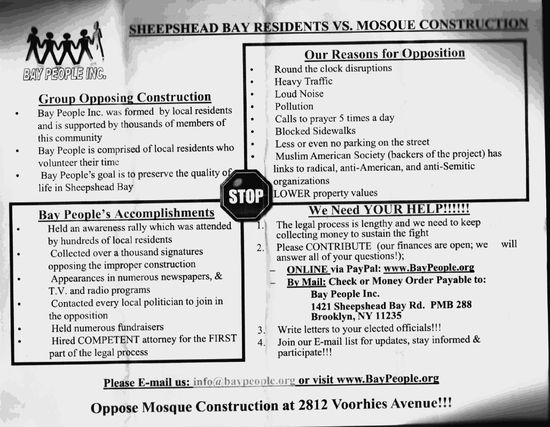
I just returned from visiting my 82 year old father who lives in the Sheepshead Bay section of Brooklyn. Within minutes of arriving, my father asked me what my thoughts were on the proposal to build a mosque "ground zero". This started a big argument, with my voicing support for the construction ("We're the good guys … what better symbol to show the world of our acceptance and tolerance of all people?") and my father expressing the standard Fox News drivel ("And where do you think they're getting the money for this project? They don't have this kind of money. It's coming from terrorist organizations!)
Several hours later, I left to find the attached flier on the windshield of my car. These fliers were placed on every car, and in every doorway, along the street. An organization calling itself "Bay People Inc." is seeking support to oppose construction of a mosque in Sheepshead Bay. The reasons include heavy traffic, loud noise, calls to prayer 5 times a day, less "or even no parking" on the street, and of course – due to the fact that it's backed by "Muslim American Society … links to radical, un-American, and even anti-Semitic
organizations".If this is what is happening on a grass-roots, neighborhood level in New York City, I fear that we are truly entering a dark phase of our history.
by Patrick Appel
Marc Lynch sizes up the Iran debate thus far:
I'd say that Goldberg's article has succeeded not in paving the way for military action but in focusing attention on the issue in such a way as to make an attack less likely.
by Patrick Appel
Yglesias is "a lot more open to the view that Barack Obama is secretly a Muslim than to the view that the spirits of dead people can return in certain situations." Douthat differs:
[W]hereas I would happily stake most of my net worth on the premise that Barack Obama is not, in fact, a secret Muslim, I wouldn’t risk much money at all on the proposition that ghosts do not exist. That’s not because I’m a huge believer in haunted houses: It’s just that I think I have an excellent handle on the likelihood (or unlikelihood, more properly) that Obama has been practicing taqiyya all his life, whereas the question of whether ghosts exist or not depends on too many unknown unknowns to fit with the scope of any effective odds-making project.
I get Ross's point, but I'm with Yglesias.
 The Dish