People As Pack Leaders, Ctd

by Chris Bodenner

A reader writes:

Pretty much everything that is wrong with Cesar Millan's training techniques – or at least how they are understood among his fans – is summed up in this selection from your reader:

Positive reinforcement (i.e., using clickers or treats) basically "tricks" the dog into doing something for a reward.  Using Cesar's techniques, however, your dogs will do what you ask, not for a treat, but out of respect for you, their leader.

First of all, as I'm sure you know, positive reinforcement does not "trick" a dog into doing something for a reward; it teaches a dog to associate rewards with good behavior, just as punishment teaches them to associate displeasure or pain with bad behavior (but doesn't necessarily teach them what good behavior is). With time, dogs shown positive reinforcement will need the reward to continue the good behavior. Furthermore, if you're feeding and caring for a dog (as well as setting boundaries), *of course* you're  obviously their leader – what Patricia O'Connell calls a benevolent dictator.  Cesar's "corrections" don't make him the leader worthy of respect; they make him a bully.

Watch this video, particularly just before the 3:00 mark. The dog does something Cesar doesn't like, Cesar kicks (er, "corrects" it), and things escalate. If he had gotten hurt, it would have been his fault as far as I'm concerned.

Another writes:

While I have been aware of the anger/jealousy directed at Cesar Millan by professional dog trainers, I am also aware that my personal experience with Cesar's ideas has helped me very much and has changed me for the better.

Previously, I experienced great fear in the presence dogs in spite of being raised with and around them all my youth.  Into my late adulthood I experienced even more fear and at the same time had more situations where dogs were annoying or aggressive with me.  It seemed the more I withdrew, the more determined dogs seemed to be to push their way into my experience.  Eventually, I was bitten.  Then I feared even more.

Accidentally, I stumbled upon Cesar's television shows and began watching.  His ideas that dogs are not little humans but pack animals who need to be treated in their own way made sense.  I realized I was not owning the space I was standing in, as Cesar would say.  Neither did I project myself as a leader in much of the rest of my life, let alone with dogs. 

But, it was his explanation that dogs learn to interact with the world in this order – first, smell; second, hearing; lastly, eyesight – that made all kinds of bells ring in my head.  From then on, I began consciously not making eye contact with any dog I met, even those I had already come to know and tolerate.  Now, any dog that comes my way, I look steadily at the owner or if the dog is alone, at ANYTHING else.  I avoid eye contact completely and calmly.  Since making and implementing that one idea, dogs have started to leave me completely alone!  It's as if I'm not in their world somehow, if we don't connect through sight.   

Now, I have also made an effort to own my space more than before, especially when around a dog but really, not making eye contact with dogs has completely reversed my experience with them and I feel empowered around them now, just by choosing to look elsewhere.  Simple.  Thank you, Cesar!
Initial Thoughts on America and Its Elites

by Conor Friedersdorf

Over the weekend, I spoke with two people whose take on the Park51 mosque and community center, quite apart from the merits of their respective positions, can only be described as aggrieved. One argued that the mosque should be moved farther from Ground Zero, the other that a location two blocks removed presents no problem. But their upset sprang from a deeper place: a conviction, expressed more emotionally than anything, that their insights aren’t shared or even respected by those in “the other America.”

Said the man, a wealthy fifty-something executive, “Seventy percent sees what is wrong with this, yet we’re called bigots! If the people in charge don’t change their cosmopolitan attitudes we’re going to lose this country.”

The woman, a top tier business school student in her late twenties, insisted that if demagogues manage to mess up even this, “I’m seriously moving abroad. Ever since 9/11 I just don’t know what’s wrong with people.”

These laments aren’t exactly surprising.

The right generally lashes out by asserting that its ideological opponents are out of touch elites, disconnected from traditional American values and common sense. More common on the left is for aggrieved participants in the national debate to bemoan what they regard as the perversion of values being perpetrated. Opponents are cast as pawns being manipulated into irrational or even bigoted positions by powerful interests who benefit from the world that results.

What I found interesting is that these two people, who’ll both enjoy far more wealth, influence and power than the average American in the course of their lives, both earnestly conceived of others being in charge. The executive saw cosmopolitan liberal elites as exercising control, so much so that he feared the loss of what makes America exceptional; whereas the liberal business school student understood herself to be part of the elite, given her educational credentials, but felt that people who share her values haven’t been running the country since 9/11, making her complicit in policies that she abhors. Is the United States home to a liberal elite that basically runs things except when its power is checked or overruled by the larger population? That’s the way a lot of people talk on the right and the left, but I think it’s a misleading frame. In reality, there are a lot of different elites in America, ideology is but one factor that distinguishes them from one another, and ordering them to reflect their relative power is literally an impossible task.

In terms of who does more to shape the country and its future, try ranking Leon Panetta, Oprah Winfrey, Bill Gates, an exceptional high school English teacher, David Foster Wallace, Barbara Streisand, Rick Warren, a successful small business man, Lynn Cheney, Haley Barbour, the mayor of Omaha, Nancy Pelosi, Kobe Bryant, Ezra Klein, Bill Keller, Sarah Palin, Chick Hearn, the scientist most responsible for Lipitor, Rush Limbaugh, a federal circuit court judge, the CEO of the biggest employer in Cleveland, a veteran police officer on the streets of Chicago, the Governor of Nevada, Rupert Murdoch, Malcolm Gladwell, Donald Bren and L. Ron Hubbard.

Were there an objectively correct ordering known only by God, what percentage of humans would arrive at it? And this is but an insignificant fraction of elites from a few different categories (it includes a lot of journalists, despite the fact that I think Americans generally attribute more power to individuals in my profession than we actually possess.)

The beliefs Americans form about the forces that shape this country matter. It’s unhealthy for a polity when an increasing number of people are alienated from a prevailing order they feel powerless to influence. Over the course of this week, I hope to delve deeper into this question of America and its elites. As always, e-mail on the subject is welcome.

Mormons On The Mosque

by Chris Bodenner

Stephen Prothero puts them on the spot:

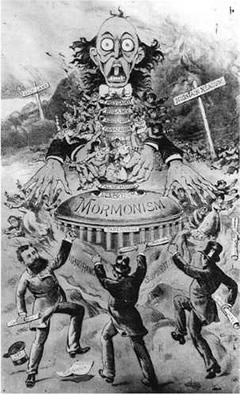
I thought that Romney, as a Mormon, might speak out passionately for the First Amendment. I Anti-MormonCartoonthought he might remember how the founder of his religion, Joseph Smith Jr., was murdered by an anti-Mormon mob. I thought he might recall how the U.S. government brought down much of  its coercive power against the Church of Jesus Christ of Latter-day Saints in the last decades of the nineteenth century.

Apparently not.  According to a statement released on August 10 by his spokesperson Eric Fehrnstrom, “Governor Romney opposes the construction of the mosque at Ground Zero. The wishes of the families of the deceased and the potential for extremists to use the mosque for global recruiting and propaganda compel rejection of this site."

More recently, Senate Majority Leader Harry Reid, also a Mormon, opened the floodgates for what will likely be a steady stream of Democratic equivocation on this important issue. "The First Amendment protects freedom of religion," Reid’s spokesman Jim Manley said in an August 16 statement. "Sen. Reid respects that but thinks that the mosque should be built some place else.”

One of the realities of robust religious liberty in the United States is that members of minority religions grow complacent over the years.

(Image: An anti-Mormon political cartoon from the late 19th century)

Why Statism Is the Wrong Frame

by Conor Friedersdorf

Matt Yglesias writes:

A colleague mentioned to me the other day that I’m “pretty conservative” on some state and local government issues, with reference to some recent posts on occupational licensing. Someone on twitter asked if I’m trying to score a date with a Cato staffer. I’m not. And I’m not. And I think that whole framing represents a bad way of understanding the whole situation.

I think it’s pretty clear that, as a historical matter of fact, the main thing “the state” has been used to do is to help the wealthy and powerful further enrich and entrench themselves. Think Pharaoh and his pyramids. Or more generally the fancy houses of European nobility, the plantations of Old South slave-owners, or Imelda Marcos’ shoes. The “left-wing” position is to be against this stuff—to be on the side of the people and against the forces of privilege. It’s true that some useful egalitarian activism over the past 150 years has consisted of trying to get the state to take affirmative steps to help people—social insurance, the welfare state, infrastructure, schools—but dismantling efforts to use the state to help the privileged has always been on the agenda. Don’t think to yourself “we need to regulate carbon emissions therefore regulation is good therefore regulation of barbers is good.” Think to yourself “we can’t let the privileged trample all over everyone, therefore we need to regulate carbon emissions and we need to break the dentists’ cartel.”

Awhile back, when I reviewed Liberty and Tyranny by Mark Levin, I argued that its fatal flaw was its author's insistence on the straw man that today's liberals are fundamentally driven by Statism, whereas actually what motivates most of them is a substantially different project. The passage above is a neat illustration of that point. If you're trying to actually understand someone like Matt Yglesias, whether to effectively argue against his views or to engage him persuasively, the frames of "statism" and "liberty versus tyranny" are almost completely useless. 

This isn't to say that progressives never support unjustified state intervention. That some do is implicit in the excerpted post. So is the fact that despite differences in first principles, a conservative, a libertarian and a progressive might very well come to agreement on certain matters, like the fact that dentists' cartels should be broken.

Being someone who understands progressives, Mr. Yglesias makes the case for deregulation in terms likely to appeal to his colleagues on the left. What would be nice is if more people on the right could be similarly persuasive. Of course, capitalizing on common ground or winning converts on individual issues requires an accurate understanding of what motivates people with different ideologies, so it isn't surprising that a Yglesias fan invoked Cato in that Tweet. It's a place where several staffers are daily deepening our understanding of where liberals and libertarians can work together. Should a loose left-right alliance succeed in reducing state power in the realm of professional licensing or asset forfeiture or sugar subsidies or surveillance, Mark Levin and his followers will still be insisting that Statism is what motivates the modern liberal. This error could be mitigated if the conservative movement subjected the work of its entertainers to greater intellectual rigor. To its credit, The Weekly Standard published a serious review of Liberty and Tyranny that grappled with its core flaw, whereas too many other outlets — usually serious ones included — failed to do so.

Legal But Unethical

by Conor Friedersdorf

This line from a New York Times editorial is being justly mocked:

Mr. DeLay, the Texas Republican who had been the House majority leader, crowed that he had been “found innocent.” But many of Mr. DeLay’s actions remain legal only because lawmakers have chosen not to criminalize them.

This reminds me to recommend this exceptional series published some years ago in The Washington Post. It explains the whole rise of modern lobbying in the nation's capital through the lens of a particularly compelling character. 

It's one of the most informative things I've ever read about how American government works.

After The Flood

by Patrick Appel

Kate Larkin worries that the Pakistani floods are damaging the country's irrigation system:

Without adequate irrigation, severe food shortages will become even more likely over the coming months. The Asian Development Bank, which is leading the first assessment of the flooding, says that 80,000 livestock have already perished and that 2 million hectares of crops are still underwater.

Do Moderate Muslims Exist?

by Conor Friedersdorf

Claire Berlinski has the answer:

That they do is a proposition so easily verifiable that I don't even have to leave my apartment to do it. I can just look out the window.

Elsewhere in the same post:

I've just walked down a street filled literally with thousands of Moslems of exactly the kind many people are seriously arguing do not exist. I saw them with my own eyes, as I have every day for the past five years. With so many other questions in the world, why waste time debating this? Book a ticket to Istanbul, spend an afternoon here, have a lovely time, drink some tea, meet friendly, tolerant, warm, welcoming Moslems (mostly), and see for yourself. They exist! They're my neighbors and my friends! Babür, is there anyone at our gym, for example, who would not describe himself as a Moslem? Would any member of our gym endorse terrorism, honor killing, forcing me to wear the hijab, or subjecting me to a dhimmi tax? The idea is so absurd it's beyond discussion — and yet we're discussing it.

This is a bit off topic, but since I'm covering for Andrew, I feel remiss in linking another post by Ms. Berlinski without mentioning that she is the author of a book on why Margaret Thatcher matters. I'd love to see the two of them discuss that one day.