Word Play In The War Zone

by Chris Bodenner

Retired Army Col. Andrew Berdy vents over at Tom Ricks' place:

Can you explain to me how, or why, the myth of "all combat troops out of Iraq" is allowed to be perpetuated by the press, much less our senior military leadership? Yes, the mission has changed. But units like my son's Stryker Brigade (not the one that just left!) are, and always will be, combat infantry units.

This is fiction pure and simple. I just don't get how the nation has swallowed this and why members of the media are not reporting facts the way they are rather than the political PR message the Administration wants portrayed. Does anyone not think that the likelihood of continued combat operations is a reality? When casualties are taken by these "non-combat forces" will those casualties be characterized as "non-combat" as well?

I'm reminded of an anecdote told by another retired Army colonel – my father. As a rifle platoon leader in Vietnam, sitting on his fire base in the spring of '72, he recalls reading in The Stars & Stripes a quote from Nixon boasting, "All combat divisions are out of Vietnam."  He laughed to himself, thinking, "You gotta be shittin' me!  I just saw combat."  While Nixon may have been technically correct – my dad was part of a brigade separated from the 1st Cavalry Division – the impression given that all combat troops were out of Vietnam was, well, laughable.  (In fact, there were about 70,000 Americans still there.)
Avatar Of Hope (And Industry)

Mongolia

by Zoe Pollock

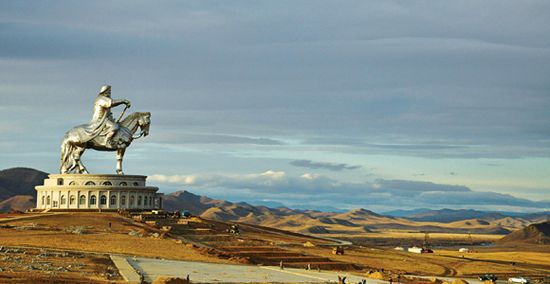
Bill Donahue has written a great dispatch in the current Atlantic on Mongolia's comeback efforts, beginning with a 131-foot stainless-steel statue of the infamous Mongol warlord:

Genghis Khan sits astride a stallion, grimacing as he clutches a gold-tinted stainless-steel whip. The statue’s pedestal is a columned, white-granite rotunda, and everything inside the rotunda is calibrated to impress and make money. There’s a collection of Bronze Age artifacts, a screening room wherein a stentorian video (with English subtitles) heaps praise on the Mongolian construction industry, and a luxurious conference room and restaurant, both empty when I visited. The landscaping is brutal: not a tree or bush in sight. The black iron fence surrounding the complex goes on for more than a mile. Cumulatively, the place shouted, “Watch out, folks— Mongolia is back on its horse!” But I detected an undertone of desperation too. A more plaintive voice seemed to whisper, “Believe in us, please. We’re trying very hard.”

Yglesias Award Nominee

by Chris Bodenner

"I am not ultra-ultra-conservative on every issue. I actually support gay marriage. I think the gay marriage thing would definitely surprise people. I mean, for some people, it will surprise them to the point that they won’t want to hear it. “No, that can’t be, I really want to have this sort of idea of her in my head,” so I sort of rain on their parade there," – Elizabeth Hasselbeck.  All the right people are pissed.

So Many Choices

by Patrick Appel

Jonah Lehrer takes on choice blindness:

we are completely ignorant of how fallible our perceptions are. In this study, for instance, the consumers were convinced that it was extremely easy to distinguish between these pairs of jam and tea. They insisted that they would always be able to tell grapefruit jam and cinnamon-apple jam apart. But they were wrong, just as I’m wrong to believe that I would be able to reliably pick out the difference between all these different coffee beans. We are all blind to our own choice blindness.

Not An Onion Headline

by Chris Bodenner

Sharron Angle Campaigned Against Black Football Jerseys On Religious Grounds: Color is 'Thoroughly Evil'  Money quote:

The black uniforms were then confiscated and held under "lock and key" by the administration, which refused to compensate the team for the money they had spent acquiring the jerseys.

They must not have had access to an Ecto Containment Unit.

Pseudovariety

Softdrinks

by Patrick Appel

Philip H. Howard provides a visual:

Three firms control 89% of US soft drink sales. This dominance is obscured from us by the appearance of numerous choices on retailer shelves. Steve Hannaford refers to this as "pseudovariety," or the illusion of diversity, concealing a lack of real choice. To visualize the extent of pseudovariety in this industry we developed a cluster diagram to represent the number of soft drink brands and varieties found in the refrigerator cases of 94 Michigan retailers, along with their ownership connections.

A much larger version of the graphic is here.

(Hat tip: Flowing Data)

Did The Stimulus Work? Ctd

by Patrick Appel

Chait counters Manzi:

Private forecasters unanimously believe that fiscal stimulus can temporarily boost growth. They give no credence whatsoever to the various right-wing alternative models in which foscal stimulus does not boost growth. Moreover, in 2001, when the objective case for fiscal stimulus was much weaker, there was no real debate about the efficacy of fiscal stimulus. The fact that Republicans are fiercely contesting the merits of fiscal stimulus now, while almost nobody was doing so when the case was much weaker in 2001, suggests that the right's skepticism is a political phenomenon.

Faces Of The Day

Ape-faces

by Chris Bodenner

Alexis Madrigal explores them:

Photographer James Mollison reveals the variability of our uncanny human cousins in a stunning series of close-up portraits of the Great Apes. The tight focus of his photographs forces us to look right into the eyes of gorillas, chimpanzees, bonobos, and orangutans of different ages and personalities.

More here, including an explanation of how the photographer got the apes to look so intently. (Click on the image to enlarge. Go here for several individual close-ups.)

Virtual Guest

by Zoe Pollock

Are live video feeds the wave of the future for weddings? Miriam Kotzin of the Smart Set watches happily from the sidelines:

I watched friends and relatives greet the jovial groom, who looked not one whit nervous, and now the wedding procession was starting. And then the procession was over, and the ceremony began. The groom was beaming, the bride radiant.

Each close-up of the bride and groom as well as the soundtrack’s fading out during the address mimicked the shifting attention I would have experienced had I been sitting in the garden with the other guests. 

The effect of watching the wedding on the computer was much closer to the experience of actually being present than watching a typical wedding video, which is a formulaic highlighted treatment of a ritual.

The Age Of Paine

by Zoe Pollock

Commonweal's Cathleen Kaveny tracks early American snark. Here's John Adams' comment on the title of Thomas Paine’s The Age of Reason:

I am willing you should call this the Age of Frivolity, as you do, and would not object if you had named it the Age of Folly, Vice, Frenzy, Brutality, Daemons, Bonaparte, Tom Paine, or the Age of the Burning Brand from the Bottomless Pit, or anything but the Age of Reason. I know not whether any man in the world has had more influence on its inhabitants or affairs or the last thirty years than Tom Paine. There can no severer satyr on the age. For such a mongrel between pig and puppy, begotten by a wild boar on a bitch wolf, never before in any age of the world was suffered by the poltroonery of mankind, to run through such a career of mischief. Call it then the Age of Paine.