The Value Of Truth

by Zoe Pollock

Bill Vallicella takes a closer look at the philosophy of Hitch:

What would Hitch lose by believing?  Of course, he can't bring himself to believe, it is not a Jamesian live option, but suppose he could.  Would he lose 'the truth'?  But nobody knows what the truth is about death and the hereafter.  People only think they do. Well, suppose 'the truth' is that we are nothing but complex physical systems slated for annihilation.  Why would knowing this 'truth' be a value?  Even if one is facing reality by believing that death is the utter end of the self, what is the good of facing reality in a situation in which one is but a material system? 

If materialism is true, then I think Nietzsche is right: truth is not a value; life-enhancing illusions are to be preferred.  If truth is out of all relation to human flourishing, why should we value it?
Age Of Engagement

by Zoe Pollock

The Big Think hosts an interview with professor Matthew Nisbet, asking if atheists or believers are better bloggers:

In part the new atheist movement is almost a social movement within the larger scientific community.  Many of the people that are attracted to new atheist movement identify with science or are scientists themselves and certainly scientists have been online for a long time.  In fact, many of the most prominent bloggers, new atheist bloggers, they came about… they came up and they kind of honed their skills in internet discussion groups, mostly around the debates about evolution. So they have that natural consistency and that natural… the pre-existing experience with using online organizing and reaching people online that maybe some of the religious organizations do not.  The advantage that the religious organizations have though is they have real world communities.  They have networks of interaction through mega-churches, through traditional churches and one of the things that I’ll be blogging and writing about and taking a look at, at the Age of Engagement is how are traditional religious organizations and movements now using the online world to foster the communities, to build their communities or is the online world actually taking away some of their followers and distracting people who otherwise might commit to that particular religious faith or even attend church on a weekly basis.

Intelligent Smattering

by Zoe Pollock

In honor of British literary critic Frank Kermode who died this week, a classic quote from 2006:

One of the great benefits of seriously reading English is you're forced to read a lot of other things. You may not have a very deep acquaintance with Hegel but you need to know something about Hegel. Or Hobbes, or Aristotle, or Roland Barthes. We're all smatterers in a way, I suppose. But a certain amount of civilisation depends on intelligent smattering.

Can Church Be Hip?

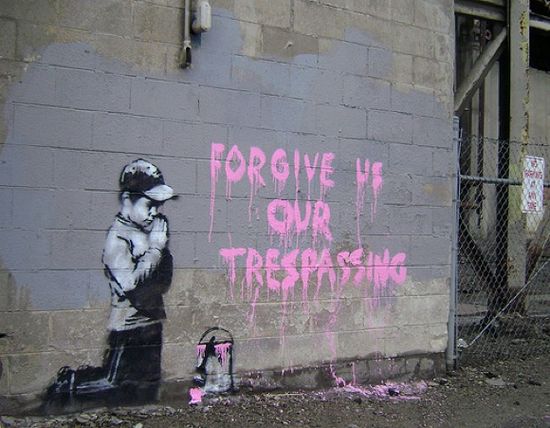
ForgiveUsOurTresspassingBanksy1

by Chris Bodenner

Nicole Greenfield reviews Hipster Christianity:

For [author Brett] McCracken, there are two types of hip churches, two types of hipster Christians: the natural and the marketed, the authentic and the wannabe. Both Resurrection and its leader fall squarely into the former categories. And after presenting a brief history of the evolution of cool and proffering definitions of key terms—the hipster, for example, is defined in a remarkably vague way as “fashionable, young, independent-minded contrarian”—McCracken explores both sides, glorifying the likes of [pastor Vito] Aiuto and Resurrection and criticizing the wannabes, somewhat playfully, for trying too hard, for “bending over backward to meet the culture where it’s at,” for being too high-tech, too shocking, too “rebellious.”

But in part three of Hipster Christianity, McCracken, a self-described “hipster Christian,” adopts a different tone altogether, a tone decidedly more Christian than hipster, lashing out at culture, at “the outside,” at cool itself, for thrusting Christianity into “an identity crisis unrivaled in the history of the faith.” Christianity and cool are at odds, he argues, irreconcilable forces that, when engaged with each other, breed narcissism, incite recklessness, and encourage deviation from faith.

In my experience, especially living in Brooklyn, hipsters can be just as conformist and fundamentalist as Christians. Illustrative guide here. And of course this.

(Photo: Guerrilla graffiti artist Banksy makes his mark in Salt Lake City.)

Your Brain on Sleep

by Zoe Pollock

The Oxford University Press blog continues to delve into sleep and the unconscious with Dr. Rosalind Cartwright who says:

The unconscious only comes up into the surface during our waking hours if we daydream and let our mind wander freely. In sleep the unconscious selects new experiences to save in memory, particularly new experiences that have an emotional charge. If you worked hard to learn something new you will remember it better after a period of sleep than if you stay awake before you need to remember that new learning.

Cartwright also explains how to coax your brain into getting rid of a recurring nightmare:

1) Identify why the nightmare was so strong that it woke them,
2) Name the opposite feeling,
3) Create an opposite image to represent that good emotion,
4) Practice that new image several times a day until it is easy to experience it at will. This image rehearsal is very successful with nightmares once the person feels “in charge”.

Her advice almost perfectly matches the advice my mother gave me growing up (to imagine scary leprechauns from under the bed tickling me, rather than attacking me). Though either image is still fairly horrifying, it did get rid of the nightmare.

A Poem For Sunday

Grass_ptown

By Zoe Pollock

Another from the wondrous Atlantic Archives, here's "I Am" by John Clare:

I am—yet what I am none cares or knows;
My friends forsake me like a memory lost:—
I am the self-consumer of my woes;—
They rise and vanish in oblivion's host,
Like shadows in love's frenzied stifled throes
And yet I am, and live—like vapours tost

Into the nothingness of scorn and noise,—
Into the living sea of waking dreams,
Where there is neither sense of life or joys,
But the vast shipwreck of my life's esteems;
And e'en the dearest, that I love the best,
Are strange—nay, rather stranger than the rest.

I long for scenes, where man hath never trod
A place where woman never smil'd or wept;
There to abide with my creator, God;
And sleep as I in childhood sweetly slept,
Untroubling and untroubled where I lie;
The grass below—above the vaulted sky.

Background on Clare and audio of poets, professors and the Atlantic's own poetry editor David Barber reading Clare's work can be found here.

The End Is Nigh

by Zoe Pollock

Scientific American devotes its entire next special issue to "the end." They explain some of our eternal fascination with it:

The desire to treat terrible events as the harbinger of the end of civilization itself … has roots in another human trait: vanity.

We all believe we live in an exceptional time, perhaps even a critical moment in the history of the species. Technology appears to have given us power over the atom, our genomes, the planet—with potentially dire consequences. This attitude may stem from nothing more than our desire to place ourselves at the center of the universe. “It’s part of the fundamental limited perspective of our species to believe that this moment is the critical one and critical in every way—for good, for bad, for the final end of humanity,” says Nicholas Christenfeld, a psychologist at the University of California, San Diego. Imagining the end of the world is nigh makes us feel special.

Buried in Regulations

by Conor Friedersdorf

The Institute for Justice is an organization I mentioned in my post about pragmatic libertarianism. In their video above, they highlight a defense effort they're mounting on behalf of a group of monks. They make coffins to support their cloistered lifestyle. Unfortunately, Louisiana law says that only licensed funeral directors can sell coffins, because we all know how much consumer suffering is associated with wooden boxes inside of which your corpse decays. (Perhaps the funeral directors' lobby can call Bernie of "Weekend At…" fame to testify on their behalf.)

The Associated Press has more here.