by Chris Bodenner
A meme mashup hits the Billboard charts:

(Hat tip: TDW)
by Conor Friedersdorf
In response to my defense of talk radio listeners, and my respectful exchange with one of his fans, Mark Levin has posted the following on Facebook:
We are under constant scrutiny by bloggers, like Friedersdork, who run nothing, are responsible for nothing, and contribute nothing to the advancement of liberty. If you google his name, you will see what a menace he has become, who he likes, and who he dislikes. He is obsessed with me, this site, and will now try to make nice with some of the posters here.
Take a good look at his "work" if you care. I have no idea why he listens to my radio show, contacts people on this site, and generally spends his days looking for any post with my name on it. But I find him truly pathetic. He fits the definition of a stalker, and he is now contacting some of you folks directly. Just be careful. He's very strange.
I actually tried to explain why I listen to Mr. Levin's radio show here:
It is nevertheless important to engage prominent talk radio show hosts by setting down their words on blogs, because otherwise their most indefensible nonsense just drifts off into the air unchallenged, a convenience that allows them to grow lazy in their call-screener-maintained cocoon while retaining more respect than is deserved from their ideologically friendly colleagues outside of it.
That was written back during the Shirley Sherrod controversy, when the talk radio host told his audience that he looked at the whole video of the USDA staffer's speech — as opposed to the two minute excerpt posted by Andrew Breitbart — and that it hurt her case rather than helping it. To be fair, Mr. Levin is absolutely right when he claims that I am very strange, as evidenced by this short film I made encouraging people to use the word panama as a noun.
by Chris Bodenner
Senate candidate Roy Blunt's campaign ad:
To his credit, Blunt removed it:
Blunt told the reporter he didn’t know about the ad, and it disappeared from the campaign’s website moments later. A spokesman subsequently told the reporter that ad was removed because it “didn’t reflect the right tone.” The ad has re-appeared, but now shows pictures of Carnahan with President Obama instead of graphic Ground Zero damage. (HT: Fired Up! Missouri)
But I suspect this ad is just the tip of the iceberg for November, particularly when it comes to candidates lower on the political food chain (Exhibit A).
by Patrick Appel
Laura Freschi asks why so few are paying attention to the Pakistani floods:
The difference in initial death toll reports may be one obvious explanation. The early figures for Haiti were 200,000 lives taken, compared to the 1,600 people reported to have died so far in Pakistan. But less than ten percent of the variation in amount of TV news coverage given to foreign natural disasters can be explained by severity, according to one academic study.
The same study found that one third of the variation in how much TV attention a disaster gets is explained by how popular the affected country is with US tourists. Sadly for the flood victims, Pakistan is nowhere on the list of top destinations for US travelers in Asia and the outlook’s not great: the World Economic Forum ranked Pakistan 113 out of 133 countries in its latest Travel and Tourism Competitiveness Report.
Freschi suggests places to donate.
by Chris Bodenner
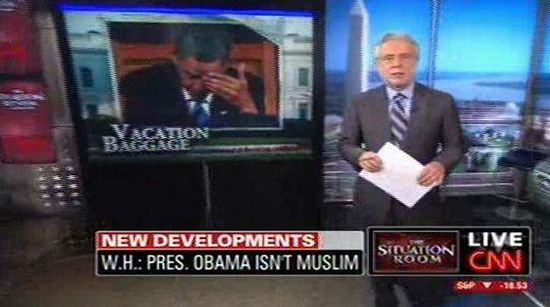
Allahpundit says all that needs to be said about new polling on the perception of Obama's religion:
It’s all very lame and obnoxious, especially given the testimony from pastors that Obama takes his Christian faith seriously, but much like the Birther thing, there’s virtually nothing you can say to convince someone who’s sure that O is what he thinks he is. I recommend re-reading Karl’s post from earlier this month on the phenomenon of polling Birthers, as it holds plenty of applicable wisdom in this case too. Essentially, when polling people who dislike candidate X, the specifics of the questions are almost irrelevant. As long as they’re negatively inclined — e.g., “Is Obama a werewolf?” — you’ll get a certain core percentage willing to say yes.
South Park put it more succinctly.
(Cable news fail via Pareene)
by Patrick Appel
Kathryn Schulz interviews Innocence Project co-founder Peter Neufeld:
About 30 or 40 years ago, the Supreme Court acknowledged that eyewitness identification is problematic and can lead to wrongful convictions. The trouble is, it instructed lower courts to determine the validity of eyewitness testimony based on a lot of factors that are irrelevant, like the certainty of the witness. But the certainty you express [in court] a year and half later has nothing to do with how certain you felt two days after the event when you picked the photograph out of the array or picked the guy out of the lineup. You become more certain over time; that's just the way the mind works. With the passage of time, your story becomes your reality. You get wedded to your own version.
And the police participate in this. They show the victim the same picture again and again to prepare her for the trial. So at a certain point you're no longer remembering the event; you're just remembering this picture that you keep seeing.
by Patrick Appel
James Downie has created a timeline.
by Patrick Appel
This is depressing but not surprising:
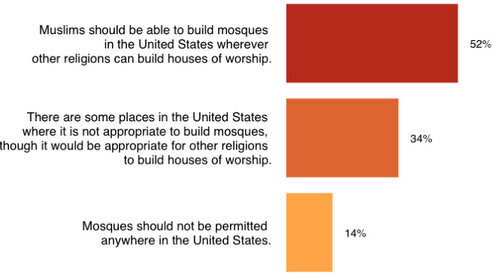
Serwer chimes in:
I'm going to reiterate what I said earlier about same-sex marriage, which is that prejudice does not cease being prejudice because it is widely held. Among both parties, prejudice against Muslims is widely held, and instead of tamping down this kind of sentiment, Republican leaders are exploiting it for political gain, and many Democrats are following along.
by Conor Friedersdorf
Reihan is thinking about less skilled workers:
One wonders if the deterioration of the labor market position of less-skilled workers might lead to a more "Confucian" arrangement in the United States, in which shared cultural practices are used to mitigate sharper economic inequality. The increasing cultural heterogeneity of U.S. society suggests otherwise.
Another possibility is that skilled workers will continue to consume more in-person services, thus creating an incentive to invest in the noncognitive skills of the future labor force. In a postmodern economy, most "needs" are invented. An abundance of relatively low-cost labor will presumably lead to the consumption of more labor-intensive services, just as the influx of less-skilled Mexican workers has kept the agricultural sector in the arid Southwest afloat. The problem, of course, is that the market wage for this kind of work might prove unacceptably low, as Greenspun suggests, thus creating pressure for expensive forms of redistribution.
by Chris Bodenner
Readers keep pointing to this story of a marijuana raid. Money quote:
Royal Canadian Mounted Police sergeant Fred Mansvield, said: ‘They (the bears) were tame, they just sat around watching.
 The Dish