A Plague On Both Their Houses

Tumblr_l79n181VEl1qzpwi0o1_500

by Chris Bodenner

Beinart despairs over national politics:

[T]he mosque fiasco hasn’t only exposed the pretensions of the GOP. It’s exposed the pretensions of the Democrats as well. In important ways, it has revealed that the Obama administration, too, is a false dawn. After all, what did Obama promise liberals when he ran against Hillary Clinton? He promised that if he won, Democrats would no longer consult polls to decide what they believed. That’s what made Obama’s 2002 Iraq War speech so significant: when Washington Democrats were ducking for cover, taking positions that they manifestly did not believe, he did what he thought was right.

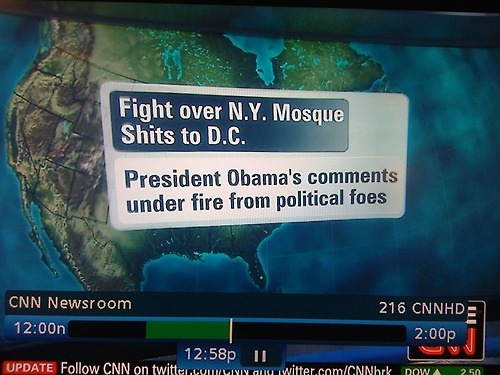
Regarding the screenshot above, Neetzan Zimmerman notes, "You misspelled 'on.'"

Did The Stimulus Work?

by Patrick Appel

Manzi thinks it's unknowable:

First, we should treat anybody who states definitively that the result of stimulus policy X will be economic outcome Y with extreme skepticism. And weaseling about the magnitude of the predicted impact such that all outcomes within the purported range of uncertainty still magically lead to the same policy conclusion doesn’t count; we should recognize that we don’t even know at the most basic level whether stimulus works or not. Second, “boldness” in the face of ignorance should not be seen in heroic terms. It is a desperate move taken only when other options are exhausted, and with our eyes open to the fact that we are taking a wild risk.

Actual science can allow us to act on counterintuitive predictions with confidence–who would think intuitively that it’s a smart idea to get into a heavy metal tube and then go 30,000 feet up into the air? But we don’t have this kind of knowledge about a stimulus policy. We are walking into a casino and putting $800 billion dollars down on a single bet in a game where we don’t even know the rules. In general, in the face of this kind of uncertainty, we ought to seek policy interventions that are as narrowly targeted as is consistent with addressing the problem; tested prior to implementation to whatever extent possible; hedged on multiple dimensions; and designed to be as reversible as is practicable.

What I am trying to describe here is not a policy per se, but an attitude of epistemic humility.

Yglesias Award Nominee

by Chris Bodenner

"[S]he does make one reasonable point—when anyone (liberals or conservatives) creates a feminist litmus test, it cuts off the possibility of real, fruitful discussion. … I think liberals must cede this round in the debate to the sassy Ms. Palin. The Emily's List video wasn't gathering liberals around an electrifying idea—it was attempting to co-opt Palin's very effective rallying cry. As Hanna said yesterday, Palin gets to be the cool one in this situation, the one the other ladies are sweating. The List, and liberals in general, would be better served creating a stunning, galvanizing idea of our own. Also, that burn about Piper and Trig is pretty good," – Jessica Grose, XX Factor.

I had to look away watching that ad. I feel the best approach to Palin is simply giving her the chance to self-immolate (there is no shortage of opportunities). Trying to engage her on her own terms and imitating her schoolyard taunts just make her critics look like, well, children.

(Video via C4P)

The GOP Yawns At Domestic Policy

by Patrick Appel

Robert Stacy McCain doesn't think that Republicans care about elections. Frum differs:

I think conservatives do pay attention to elections. What is neglected is governance. How much do we discuss what went wrong with the US economy in the Bush years? If tax cuts are essential to pulling the economy out of recession, why didn’t Bush-enacted tax cuts prevent the US economy from tumbling into recession in the first place? Why did incomes stagnate between 2000 and 2007? Why did health cost inflation suddenly accelerate after 2001? What went wrong in the energy markets? How can we do better next time?

Interest in these questions varies from slight to negligible. Even our leading think tanks prefer culture war to policy analysis.

Frum is half-right. In my experience, liberal think tanks and intellectuals dominate most domestic issues while conservative think tanks and intellectuals dominate foreign policy. This was made clear during the health care debate; there were certainly conservative pundits arguing against "Obamacare" but conservative health care experts were seriously outgunned. The opposite is also true: liberal foreign policy experts were undoubtedly outnumbered during the lead-up to the Iraq war.

Democrats have traditionally held an advantage on domestic issues while Republicans have traditionally held an advantage on foreign policy. The intelligentsia of both parties reflect this divide.

Combat Operations Have Ended, Again

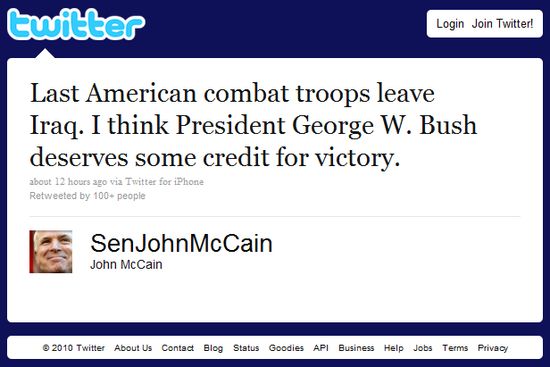
Mccaintweet

by Patrick Appel

Bernstein asks why liberals don't trust Obama on Iraq:

Case in point is the news that the last of the "combat troops" have left Iraq.  Now, those reluctant to celebrate this development certainly have strong grounds for doing so, with 50K troops remaining, plus private security forces and civilians, so more American casualties are certain (although the pace seems to have slowed again in the last couple months).  And I can certainly understand a reluctance to celebrate a retreat, even if it's orderly and good policy (as Obama's supporters presumably believe). …

[But it] does strike me that few liberals, at least few liberals who are speaking up right now, really appear to trust that Obama on Iraq.  I'm not sure why — is it because of Obama's policy in Afghanistan?  The disappointment of 2007, when a Democratic victory in 2006 failed to produce rapid results?  The residue of Obama's defeat on Gitmo?  His other policies on secrecy and rule-of-law issues?  Something inherent in liberals when it comes to trusting even liberal pols?  I don't know, and perhaps I'm reading things that aren't there, but I just don't see much trust there.  Support, yes, when he does something  they like, and perhaps even general support.  But trust?  Not really. 

Opponents of the war, myself included, tend to trust very few – if any – politicians when it comes to the Iraq war. The reasons Jonathan Bernstein lists are part of it, but this distrust has less to do with Obama and more to do with politicians, both Republican and Democrat, consistently bending the truth on Iraq. McCain's latest declaration of victory is as good an example as any of exaggerated success. The Onion has more along these lines. It's extremely difficult to unwind a war once we've established the sort of footprint we had in Iraq. In that context, the draw down thus far has been more than impressive, but in a war marked by rhetorical victories ("Major combat operations in Iraq have ended", etc) it's hard to summon much enthusiasm for the declaration that the last "combat troops" have left, especially when 50,000 soldiers remain on the ground. Here's Captain Hyphen:

Those advisers are likely to continue to patrol the streets with Iraqi units in the embedded Military Transition Teams (MiTTs – at least that was the term when I was last there), and the United States isn’t going to commit 4,500 SOF solely for the training mission. There will still be counter-terrorism operations in coordination with the Iraqis that could also result in American casualties.

As Eli Lake notes, there were more than 144,000 troops in Iraq when Obama entered office. Cutting that number to 50,000 is a tremendous success. But that accomplishment doesn't redeem the Iraq War – no matter how much Sen. McCain would like to think so.

“Hawkers Of 9/11 Porn” Ctd

by Chris Bodenner

A reader writes:

I was a student in NY art school at the time of 9/11, and shared the same disgust over the WTCcard-2p3(rast) copy strange commercialization of the WTC site in the aftermath of the tragedy and based a senior project around those feelings. It was the best way for me to express the complicated feelings I had. I made my own postcards of the vendors at the WTC site and then sell them to the general public amongst all of the other vendors down there, in the same manner in which they sold them, so that the only difference between me and them would be the product. (I donated all of the money gained to the Red Cross.) I got a lot of double-takes at the time, and actually sold a few to people who agreed with the awkwardness of selling something so obviously offensive.