Chart Of The Day

Taxcuts

by Patrick Appel

Howard Gleckman reads a new paper (pdf) by Adam Looney on the Bush tax cuts:

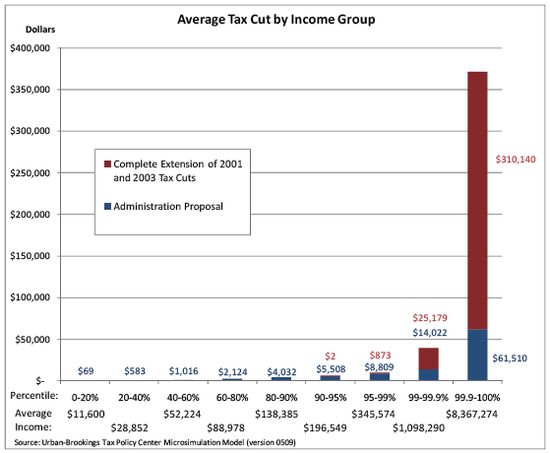
Keep in mind that Obama’s plan to extend the 2001 and 2003 tax cuts for nearly all–as opposed to all—would still add trillions to the deficit over the next decade. When Adam says the Obama plan would make a “small down payment toward fiscal responsibility” he means it would make the deficit less bad—relative to current law—than extending the tax cuts for everyone, including the highest earners. Still, in today’s political environment, adding $3 trillion to the deficit over the next decade is better than adding $3.7 trillion.

My view (which Adam does not necessarily share) is that given budget realities, Obama is wrong to propose extending the Bush tax cuts indefinitely for as many people as he does. I'd lower the threshold even further–perhaps to $150,000–and continue the tax cuts for only a year or two. But in any event, do we really want to extend them for a handful of the very highest earners as well?

The Paradox of Power

by Zoe Pollock

Jonah Lehrer gives us both the good news and the bad news. We put people in power who we genuinely like. It's only then that the situation changes:

The very traits that helped leaders accumulate control in the first place all but disappear once they rise to power. Instead of being polite, honest and outgoing, they become impulsive, reckless and rude. In some cases, these new habits can help a leader be more decisive and single-minded, or more likely to make choices that will be profitable regardless of their popularity. One recent study found that overconfident CEOs were more likely to pursue innovation and take their companies in new technological directions. Unchecked, however, these instincts can lead to a big fall.

Jesse Walker adds a grain of salt:

The scholars cited in the piece are most persuasive when they observe actual social hierarchies in action. They are least persuasive when they draw sweeping conclusions from dubious experiments. The article's most ridiculous moment comes when it describes a study whose subjects were asked "to either describe an experience in which they had lots of power or a time when they felt utterly powerless. Then the psychologists asked the subjects to draw the letter E on their foreheads. Those primed with feelings of power were much more likely to draw the letter backwards, at least when seen by another person. [Adam] Galinsky argues that this effect is triggered by the myopia of power, which makes it much harder to imagine the world from the perspective of someone else." That seems about as believable as palmistry.

Waiting Out The News Cycle, Ctd

by Patrick Appel

Steinglass responds to Ezra:

The effect of this [Park 51] nonsense, ultimately, is to discourage people from trying to educate Americans about Arabic language and civilisation, or from setting up interfaith dialogues between Islam and other American religions. Those ought to be near the top of anyone's list of worthy, non-controversial projects.It's not just Islam-related projects that get hurt. USAID offices abroad shy away from organisations that work with prostitutes or drug addicts; some part of their programme might turn out to offer birth-control advice or clean needles, and the next thing you know some congressman accuses you of encouraging prostitution or drug addiction and you're out of a job.

Quote For The Day

by Chris Bodenner

“It may not make me popular with some people, but I think probably the President was right about this. I do believe that people of all religions have a right to build edifices or structures, places of religious worship or study where the community allows them to do it under zoning laws and that sort of thing. And that we don’t want to turn an act of hate against us by extremists into an act of intolerance for people of religious faith. And I don’t think it should be a political issue. It shouldn’t be a Republican or Democrat issue either. I believe Governor Christie from New Jersey said it as well, that this should not be in that political partisan marketplace," – Ted Olson, whose wife died in the Pentagon on September 11, 2001.

From The Annals Of Chutzpah

Drlaura1
Drlaura2

by Chris Bodenner

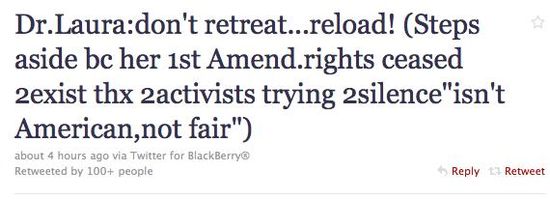
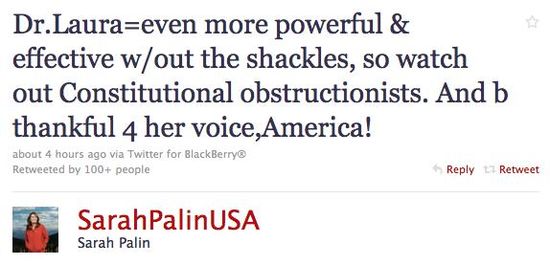
This comes from a person who for the past month has led the campaign to pressure and shame the Cordoba people into leaving their lower Manhattan location, which just yesterday she called a "stab in the heart" to the 9/11 families. To her credit, Palin has not suggested – like lower forms of politician – that the government should actually intervene to block the construction of the Cordoba center. Nevertheless, in her warped view, the spirit of the First Amendment is not meant for a minority religion trying to practice its faith on private property, but rather the feelings of a wealthy radio host who made some controversial comments on air. And for the record:

[Schlessinger] insists, however, that the decision to leave radio was her choice and not forced upon her by her syndicator. "Were you gonna have a new contract?" King asked. "Yeah," Dr. Laura responded. "We've added five stations this week and added sponsors. This is not an issue of I'm losing anything."

So she wasn't even under corporate or financial pressure, let alone "shackles" that made her "1st Amend.rights ceased 2exist." And now we learn that she had been planning to leave radio for the past year anyway.

On second thought, "chutzpah" might be inappropriate for this post, since it implies Palin is conscious of her temerity; she must have no idea what she's saying one moment to the next. Half of what she says is some cognitive version of "Keep your socialist hands off my Medicare!" Like the last time she was on "Fox News Sunday," railing against the budget crisis:

[Mama Grizzlies] have common sense. They know that we have to extend the Bush tax cuts, they have to repeal the budget-busting bills like Obamacare

On the other hand, there is consistency between Palin's defense of Schlessinger and her understanding of the First Amendment, which she spelled out in this timeless quote from 2008:

If [the media] convince enough voters that that is negative campaigning, for me to call Barack Obama out on his associations, then I don't know what the future of our country would be in terms of First Amendment rights and our ability to ask questions without fear of attacks by the mainstream media.

(Correction: I said Dr. Laura was Christian; she's Jewish.)
The Daily Wrap

Today on the Dish, on the Mosque front, Conor weighed in on assimilation and intolerance, Balko tracked the success of Muslims in America, Will Wilkinson disagreed about the intentions of the GOP, and Imam Rauf engaged with the other side. We grappled with Holocaust analogies, disparaged hawkers of 9/11 porn, remembered the Dubai Ports controversy, and Peter Feaver begged us all to focus on the floods in Pakistan.

Pat Tillman's story kept an R rating because of his last words, China developed a "Spider Man complex," and Yglesias debated amateur barbers. Patrick rallied with a reader over the dissent of the day; Conor countered the cult of the presidency, and we got your read on middle class privileges. Conor defended talk radio listeners here and here and Sugrue, in for TNC, reinvigorated the race and education thread. Your Yglesias award nominee here, Malkin award nominees here and here, quote for the day here, VFYW here, MHB here,and FOTD here.

Pirates ate turtles, commuting killed (kinda), North Korea twittered, and librarians were tenured.  We argued about burger prices across the country, health care jobs were growing, and even Ann Coulter and Glenn Beck were punished for getting too close to marriage equality, while the economic equalities of divorce remained crystal clear. 

We featured the last batch of first kisses, and this reader put Cesar Millan in the doghouse.

— Z.P.

Housing > iPods

by Patrick Appel

A reader writes:

Your reader states:

"An Ipod in San Francisco costs the exactly the same as it does in Idaho. This is true for cars, big macs, and a whole range of products that are marketed nationally."

He/she is mistaken on two counts. First of all, housing takes up the a huge portion of a family's income (>30%), so changes to that expenditure have a much more dramatic affect on living standards than does the price of an iPod. Other large portions of a family income are spent on food (>10%), gas (>5%), utilities (7%), insurance and other items. These vary dramatically between regions. We live in San Francisco. A pound of bananas is 79 cents, the same pound of bananas is 48 cents at the store near my in-law's house in Utah. Gas is over 3 dollars a gallon in SF, it's 2.40 here. Etc. Secondly, he's wrong about the cost of cars and other items costing the same between regions. A big mac is more expensive in SF than in Provo, UT. We buy our furniture, cars and other big ticket items in Utah and drive them back to SF because the stores are cheap enough here that it makes it worth the expense. But I'll grant the reader the cost of an iPod is the same in both places.

Another reader contests even the iPod:

Yes, prices of consumer electronics are fairly standardized throughout the country, but health care? Groceries? Clothing? Insurance? Utilities? Taxes? Fast food meals in any big city are noticeably more expensive than they are in the suburbs. This is not to mention the fact that that iPod is going to be more expensive in New York than in Tallahassee due to sales tax.

An final reader:

My wife and I make, combined, just over 100K per year. We have two small children in day care. We live in the suburbs of Chicago. To say we have the same purchasing power for luxury items as a similar couple living in rural TN is kind of crazy. To live within a reasonable commute to our jobs, a small three bedroom house would cost us well over 300K dollars. How much does that leave us for actual purchasing? Not much. Now, we realize that these are choices we make, and we love the variety and choice our location gives us for anything from culture and museums to sports. But, if you'll allow me a bit of all-caps, to the reader that said the above, HOUSING IS A MUCH LARGER PART OF THE NATIONAL ECONOMY THAN IPODS.

Face Of The Day

JosueBolaneJoeRaedleGetty

Josue Bolane washes outside the tent he is living in after being displaced by the January 12th earthquake on August 16, 2010 in Port-au-Prince, Haiti. As the country prepares for a presidential election, on November 28, some 1.5 million people are still living in tent camps and less than 4 percent of the rubble created by collapsed buildings has been cleared since the powerfull earthquake that killed some 200,000 people. By Joe Raedle/Getty Images.