Conservative Elites and the Park51 Debate

by Conor Friedersdorf

In his latest column at The Washington Examiner, Gene Healy argues that outrage over the Burlington Coat Factory mosque and community center is a red-herring. "You see, cutting government is hard, and often unpopular," he writes. "Faced with difficult choices, the alleged party of small government always retreats to the lazy politics of Kulturkampf… The establishment Right wants to play the Tea Party movement for suckers. It remains to be seen whether they'll play along."

I asserted a similar position here at The Daily Dish.

Will Wilkinson disagrees with us.

This idiotic foofaraw could be a distraction only if the GOP rank-and-file actually cared more about the size of government than the cultural politics of American identity. But they don’t. It’s not even close. American conservatism is a movement consumed by protecting and asserting a certain fabricated conception of the traditional American way of life against imaginary enemies. Support for small government is no more than a bullet point on the Right’s “What We Believe” cheat sheet, mouthed at opportune moments. I approve of what Gene’s trying to do here rhetorically, but the fact is that complaining about Muslims and keeping holy the memory of 9/11 and Ground Zero — the legitimizing altar of aggressive American imperialism —  is a direct manifestation of contemporary conservatism’s essence.

This overstates the degree to which opposition to the mosque among the general public is a conservative phenomenon. The polling I've seen, and Harry Reid's recent anti-mosque statement, suggest it's far more widespread.

Mr. Wilkinson may be right that the GOP establishment is "nervously along for the ride," but even so, this issue entered the culture wars largely because of elites in conservative journalism who framed it as provocatively as possible, often making factually inaccurate assertions and speculating darkly about the Cordoba Initiative's motives. Go watch this despicable anti-mosque ad. It's easy to imagine how members of the public who've learned about the controversy through it, Sarah Palin's Twitter feed, the Fox News Channel and Andy McCarthy columns would be misled about certain facts, and while I am under no illusion that rank-and-file Republicans would embrace the project if their elites behaved more responsibly (or merely more accurately), I can certainly imagine the issue being a minor one, and mosque opponents feeling less threatened, aggrieved, and inclined toward hyperbolic bombast. 

A Health Care Nation?

by Patrick Appel

Building off analysis by Richard Florida, Derek Thompson notes:

Look at the next ten years. The Bureau of Labor Statistics and the White House both expect health care jobs to grow nearly twice as fast as any other category. Six of the top eight jobs with the fastest projected growth are in the health care or medical science industries. Three of the top five jobs with the largest projected growth are in health care.

Quote For The Day

S0zal

by Chris Bodenner

“She’s got GUTS and is putting up with more crap than she deserves because the libs don’t know what to do with her and the support she has," – Sarah Palin, endorsing Sharron Angle.

(Photo: Angle fleeing her own press conference without taking a single question from reporters. Devastating local news segment here after she did it again the following day.)

Urging Assimilation Sans Bigotry

by Conor Friedersdorf

One objection I have to Ross Douthat's recent work on assimilation is the way his division of America into two camps creates a false choice for those of us trying to grapple with the best way forward in a multi-ethnic nation of immigrants.

Let's revisit the conceit as he articulates it in his column:

There’s an America where it doesn’t matter what language you speak, what god you worship, or how deep your New World roots run. An America where allegiance to the Constitution trumps ethnic differences, language barriers and religious divides. An America where the newest arrival to our shores is no less American than the ever-so-great granddaughter of the Pilgrims. But there’s another America as well, one that understands itself as a distinctive culture, rather than just a set of political propositions. This America speaks English, not Spanish or Chinese or Arabic. It looks back to a particular religious heritage: Protestantism originally, and then a Judeo-Christian consensus that accommodated Jews and Catholics as well. It draws its social norms from the mores of the Anglo-Saxon diaspora — and it expects new arrivals to assimilate themselves to these norms, and quickly…

The first America tends to make the finer-sounding speeches, and the second America often strikes cruder, more xenophobic notes. The first America welcomed the poor, the tired, the huddled masses; the second America demanded that they change their names and drop their native languages, and often threw up hurdles to stop them coming altogether. The first America celebrated religious liberty; the second America persecuted Mormons and discriminated against Catholics. But both understandings of this country have real wisdom to offer, and both have been necessary to the American experiment’s success.

The implication here, perhaps unintended, is that Americans should tolerate crude xenophobia from their fellow citizens, however ugly it may sound, because it is a necessary driver of the assimilation that helps the American project to succeed. But this misunderstands the nature of the wisdom that is supposedly missed by the first America, and known to the second: that some minimum of cultural cohesion is a necessary part of every society. If you believe that to be true, as I do (along with most but not all members of blue America) surely it is possible to encourage it without trampling on the rights or dignity of newcomers, or modifying their behavior through nativist intimidation.

It is telling that many millions of Americans manage to participate in this project, and they don't seem to fit inside the column's frame. In Embattled Dreams, Kevin Starr's book about World War II era California, one striking scene takes us inside the Japanese internment camps, where the American born adolescents of Japanese immigrants are re-forming the Boy Scout troops they belonged to prior to being rounded up and relocated. In prior years, the work of cultural assimilation had been done by people like a troop leader who welcomed his son's Japanese American friend into the fold, the Japan born parents who felt comfortable enough with their son's acculturation to let him participate, and the troop camping trip where parents of various backgrounds socialized. 

In the pre-WWII years, Southern California's gardens were largely tended by Japanese immigrants, whose Buddhist inspired landscapes helped to reshape this region's sensibilities. The Japanese were successful farmers and fishermen too. Being young laborers, they were also mostly men, but unlike the Chinese workers whose labor Californians had exploited in earlier years, the Japanese immigrants sought marriage in much greater numbers, and intermarriage with white women was a natural result. In February 1905, the California legislature held hearings exploring this "problem." One white farmer, capturing the atmosphere, told legislators that his neighbor had a white wife and a new infant. "What is that baby?" he said. "It isn't white. It isn't Japanese. I'll tell you what it is. It is the beginning of the biggest problem that ever faced the American people."

In other aspects of life that farmer probably contributed to his country, but there is no wisdom in the ugly sentiment he expressed in that hearing, and his incorrect understanding of America's distinctive culture was opposed in this instance to intermarriage, the surest vehicle of assimilation in the history of this country. It was morally and practically expedient to refute views like the one held by that man. Precisely because enough people forcefully did so over the years — challenging the wisdom of the second America — we got racial progress (it's impossible to watch "Guess Who's Coming to Dinner" without marveling at how far we've come on that issue in a short time).

It is important to note that the scout leader I conjured above, the one who welcomed the Japanese American boy into his troop, might himself have objected to the intermarriage of whites and Japanese. This is something Mr. Douthat captures better in a blog post followup to his column. "It would be nice, obviously, if you could draw a bright line between benighted exclusionists and enlightened assimilationists in American history," he writes. "But the record doesn’t really support that kind of line-drawing. The two tendencies can be separated, and sometimes were. But they just as often coexisted in the same movements and institutions — and in the same human hearts."

How do I recommend we approach these issues?

Take language. I submit that all immigrants to the United States should learn English. It is the language of our presidential debates, our Supreme Court decisions, and our jury trials, the language of our school principals and a common language that newcomers from Vietnam, Nigeria and Peru can use to interact with one another. The public school system should make English fluency its highest priority, poor immigrants and those granted asylum should get government assistance learning English, and it ought to be looked down on to live in this country for many years without making an attempt to learn the language, and especially to pass it on to your kids.

At the same time, I appreciate how difficult it is to learn a new language, and how comforting it can be to speak in one's native language. That's why I am neither bothered nor hostile if I hear a family of Algerian immigrants speaking French at the restaurant table next to me, or when I walk through New York City's Chinatown and admire the characters in its signage, or when I get the chance to practice my Spanish while doing interviews in San Francisco. Nor do I particularly mind if there's an old Polish woman in Greenpoint who tried to learn English twenty years ago when she came here at age 40, but just found it too difficult to manage.

Perhaps I don't have this issue exactly right. But arguments for the necessity of some cultural assimilation can be made and won sans bigotry or xenophobia. As such, I believe that ugly sentiments can be forcefully denounced without losing any wisdom in the process, and that unattainable though that public discourse may be, it should still be our goal.

As for an example of how tolerance advances the cultural assimilation of Muslim Americans

“I’m Pat Fucking Tillman”

by Chris Bodenner

An appeal to the MPAA by the makers of The Tillman Story to get the film's R rating changed to PG-13 was rejected. Why? Too many F-bombs:

“It comes as a very big disappointment,” said [producer John] Battsek. “We set out three years ago to make a very truthful film working in tandem with the family. This is almost another mini-blow to the family. It’s like they are being censored for their honesty in the film because the fact is Tillman used the F-word."

In fact, the words "I'm Pat Fucking Tillman" were his last – words he kept yelling as he was mowed down by friendly fire. Mark Warren narrates another pivotal scene with the word "fuck" in it. Sheila Broflovski said it best:

Remember what the MPAA says: Horrific, deplorable violence is okay, as long as people don't say any naughty words!

What Pirates Ate

by Conor Friedersdorf

This is a story about how some sailors fed themselves in the early 18th Century while trying to plunder Spanish colonies and their supply ships:

Tortoise, and to a lesser extent turtle, were ideal foods for seafarers. Giant tortoises are found only in the Galapagos and, at that time, a few remote islands in the Indian Ocean. Galapagos tortoises possess the remarkable adaptive ability to survive for months without food or water, their bodies going into a state of almost suspended animation during the periodic droughts that afflict the islands. Sailors would corral tortoises on deck for a few days while they cleared their bowels, and then stack them on their backs below deck like so many barrels of food, slaughtering them as needed for months thereafter. Turtles fared less well. If taken from the beaches before laying their eggs, they would last only a matter of weeks before dying.

The excerpt is taken from The Unnatural History of the Sea by Callum Roberts, which I'd include if I could assign the current Congress any five books to read. Its main subject, the alarming depletion of the world's fish and marine mammals, is among the most pressing environmental concerns of the next several decades, and he manages to impress that upon the reader in a work replete with beautiful turns of phrase and fascinating vignettes.

Dissent Of The Day

by Patrick Appel

A reader writes:

You write:

It's amazing to watch staunch secularists and the far right read from the same playbook. Islam is not a nation. And Harris dismisses religious moderates far too quickly, with too broad a brush …  Harris implies that the people building Park 51 are the wrong sort of Muslims without bothering to prove that charge.

Well, its only partly true that Harris holds a similar position as the far right. Unlike the far right, he doesn't actually want the government to step in and stop the construction Cordoba House. He does, however, see Islam as a civilizational challenger. As Harris says in the piece:

Nor can we ignore the fact that many who oppose the construction of this mosque embody all that is terrifyingly askew in conservative America—“birthers,” those sincerely awaiting the Rapture, opportunistic Republican politicians, and utter lunatics who yearn to see Sarah Palin become the next president of the United States (note that Palin herself probably falls into several of these categories). These people are wrong about almost everything under the sun. The problem, however, is that they are not quite wrong about Islam. [emphasis added]

I believe that Harris' main point is that, even though we should treat all Muslims as individuals, the Muslim world, by and large, does not see Muslims that way. Even here in the United States, 47% of American Muslims identify as Muslim first (according to , Pew Research Center's 2007 paper Muslim Americans: Middle Class and Mostly Mainstream [pdf]) and American second; Muslim-Americans. While this may seem like a trivial statistic, bear in mind that these numbers are much higher in Europe and the Middle East. What's more, like Christendom of old, Islam holds forth a territorial view of the world, dividing the earth into the House of Islam and the House of War.

All this should give us pause when we read statements like "Islam is not a nation." OK, so it's not a nation. But it's not exactly a matter of private belief, either. The way Islam poses itself today is not as a set of private spiritual and ethical beliefs (even if many Muslims practice it that way). Islam contains within it a set of explicitly political ideas that are the core organizing principal of several large countries and states. Countries with enormous amounts of oil wealth, political and cultural influence, and in the case of Pakistan, thermonuclear weaponry. Islam has a lot to say about how a state should be run, who should be in charge, what the moral and social order of a society should look like. The Old Testament has some of these things, but Judaism and Christianity have mostly come to ignore these ideas. How many Christians think that its a good thing to kill in defense of Christendom? Does the Hutaree militia control any states, or pose as a major political party in any Christian countries? Sam Harris, along with many, many Muslims, sees Islam as a global and globalizing political ideology. And he is right.

Sorry to burst this reader's "Clash of Civilizations" bubble, but identifying as "Muslim first" doesn't mean a whole lot. Here's Pew again:

Primary identification with religious affiliation is not unique to Muslims. Religious identity is almost equally as high among American Christians, 42% of whom say they think of themselves first as Christian. About half (48%) of Christians in the U.S. identify first as Americans, while 7% volunteer that they identify both with their nationality and their religion.

It's true that Islam plays a different role in world politics than Christianity, and Harris and Coyne – to their credit – do concede that Park 51 has every legal right to build a community center. But compare this line from Newt Gringrich:

Nazis don't have the right to put up a sign next to the holocaust museum in Washington

To this line from Coyne:

It’s no better an idea than would be building an American cultural center near Ground Zero in Hiroshima.

Or these lines from Harris:

Should a 15-story mosque and Islamic cultural center be built two blocks from the site of the worst jihadist atrocity in living memory? Put this way, the question nearly answers itself.

All three of these statements make Islam – a faith with over a billion adherents – into a monolith. See Reihan for more in this vein. America has among the most moderate Muslim population of any nation. Grouping them with the likes of al Qaeda is disgusting. P.Z. Myers quotes this post by Jeffrey Rowland to illustrate how Muslims are being singled out:

There's been a lot of pointless bickering lately about a Mosque being built near where Nine Eleven happened. Exactly what is a "safe distance" to put a Mosque away from a place so that it doesn't have some imaginary effect on it? I'd prefer a ban on ALL religious buildings being built within 1,000 miles of a place where ANY MEMBER of ANY SPECIFIC religious organization did some harm unto society.

This is needlessly inflammatory, and I by no means endorse Rowland's proposed ban, but this passage drives the double-standard home.

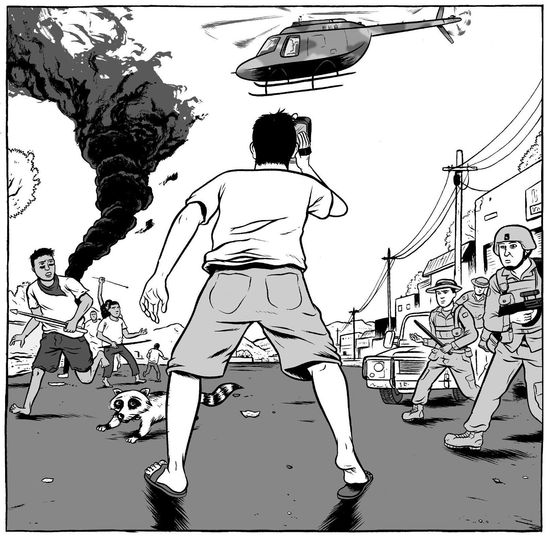
War Comics

Warisboring
by Patrick Appel

Noah Shachtman interviews David Axe about his exploits and his and Matt Bor's latest graphic novel, War Is Boring:

Danger Room: Okay. Of all the fucked-up places you’ve been, what’s the most fucked-up of all? Why?

David Axe: Chad, by far. Even in Somalia, I felt like there was a fairly clear division between “danger” and “safety.” When I was with my fixers, I felt safe. In Chad, I never felt safe. In that country, violence visited me everywhere: in the capital, when corrupt cops hijacked my car; in a Catholic mission in Sudanese border country, when heavily-armed child soldiers hopped the fence and tried to break into my photographer’s and my rooms as a gunfight erupted all around us. Now, as it turns out, my sense of safety in Somalia was an illusion. Just a few months after I left Mogadishu, the guards my then-girlfriend Daria and I had worked with — and had felt safe with — sold a couple of Western freelance reporters into the captivity of an Islamic group. The reporters — Amanda Lindhout and Nigel Brennan — were held for months, tortured, abused. My fixer in Mogadishu narrowly escaped coming to a bad end in that episode. Realizing he could no longer trust the guards and others around him, he went into hiding.