How Is Everyone Middle-Class? Ctd

by Patrick Appel

A reader writes:

My brothers and I grew up in a very nice suburb, but my family was at the very bottom of the yearly household income for the area and we knew it. Middle class is relative to your surroundings and the expectations of your peers. We were called the poor kids at our well funded public school.

We were never hungry, had a decent roof over our heads in a safe neighborhood  and went to college. Knowing now what the family income was during my childhood, we were solidly middle class in the 1960's surrounded by very, very rich families. But there is a part of me who still thinks of himself as the poor kid, while my coworkers who where not as fortunate think my family is rich. 

Once family income passes $250,000.00 a year, the parents are professionals who are in at least some business contact with the very rich. It is the proximity of the very rich makes you feel poorer or just middle class, despite the much higher than average income. The isolation from the rest of the real world and the unattainable riches of others, makes for a messed up view of your own success and income.

Another reader:

Incomes in various geographic areas vary more widely than ever. Living in central NY, finger lakes region (lets just say Elmira NY to name an exact location), probably costs 1/2 to 1/3 as much per year than does living and working in or around NY City, for example. One big aspect of this is what our easy money housing policy has done to the comparative rate of housing costs in such markets. So someone who makes $200,000 in Elmira is probably not middle class, but someone who is trying to own a house and send their kids to a decent school in NY City may arguably be living that way (even though their prospects are higher), even if you don't want to consider them such.

Living in expensive areas is a sign of wealth; it doesn't make a family middle-class. As of 2008 the median household income in New York County was $68,402. Even in relative terms, $200,000 isn't middle-class in NYC. A final reader:

I'll acknowledge a difference between a cerebral awareness of a fact vs an internal feeling for it, but someone who's privileged should actively recognize it, even if they're not a Bill Gates or Diddy…or even your neighborhood's highest-earning accountant. 

Agreed.
Sullivan Bait

Enhanced-buzz-32034-1281995165-0

by Chris Bodenner

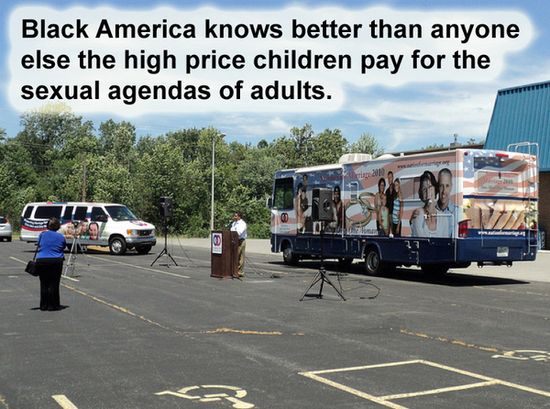
Matt Stopera compiles and illustrates the "10 Dumbest Maggie Gallagher Quotes." The one above reminds me of the following passage from Andrew's second long response to Ross last week:

[I]t seems to me from the logic of social conservatism that those most in danger of the social chaos social conservatives fear are those who would benefit most from being subjected to the cultural power of this institution. We know the consequences of marital breakdown for the black and urban poor: immiseration, poverty and dysfunction. We also know the consequences of a society that allows gay men sexual freedom, while denying them any social institutions to channel their love and desire: 300,000 young corpses. But the social conservative who insists that the family is vital for the black underclass somehow believes it is just as vital to deny it to gay men. In fact, social conservatives are intent on preventing this integrating institution from helping, guiding and ennobling a group most vulnerable to the consequences of emotional and sexual chaos.

Assessing Imam Rauf

by Conor Friedersdorf

Over at Ricochet, Claire Berlinski has been asking tough questions about the Cordoba Initiative, engaging that organization via social media, and expressing dismay at certain remarks made by Imam Rauf even as she opposes the approach taken by Sarah Palin, Abe Foxman, and Newt Gingrich. In other words, she's one of the people whose take on this differs from my own, but whose work on the subject nevertheless seems to me a valuable contribution.

In her latest, I want to highlight an excellent point:

I am all for pointing out good reasons to be offended by Imam Rauf's political opinions, but one argument that keeps coming up is actually not compelling at all. Feisal has been roundly criticized for saying the the September 11 attacks were a "reaction against the U.S. government politically, where we [the U.S.] espouse principles of democracy and human rights, and [yet] where we ally ourselves with oppressive regimes in many of these countries.” Feisal has said many stupid things, but these words can hardly be numbered among them by any enthusiast of the Bush Doctrine, given that they're indistinguishable from the standard neoconservative critique of American foreign policy prior to September 11. This point is explained approvingly by none other than William Kristol.

Elsewhere in the same post, she writes, "Those smiling photos of the good Imam at a Hizb ut-Tahrir conference at the very least suggest that the man is naive to the point of lunacy about what that organization represents and the likelihood of spreading moderation among its members through any form of outreach short of a Hellfire missile."

Obviously I cannot know the motivations of Imam Rauf, nor am I familiar with Hizb ut-Tahir, and I certainly don't think that the leader of the Cordoba Initiative is beyond scrutiny or criticism. But I will say that were I a moderate Muslim working to oppose violent jihad, I'd go wherever I was invited in an attempt to win converts. And it seems to me that folks engaged in similar projects often do reach out to some shady characters for better or worse.

Bill Clinton earnestly sought peace between Israel and Palestine. And he worked closely with Yasser Arafat. Naively? A lot of people think so. What would people say if Imam Rauf had sat down with the same man? It would be cited as proof that he isn't really a moderate Muslim who abhors terrorism, because Muslims in the media spotlight are in some ways held to a much higher standard, and distrusted far more readily. Again, I don't know the man's heart, but I don't envy the task he asserts is his life's work, and absent persuasive evidence that his public remarks, professed aims and admirable cooperation with the American government are all a charade, I see no reason to withhold from him the benefit of the doubt.

When Intuition Met Reason

by Patrick Appel

Suderman shares how he came to support marriage equality:

Is there any more damning moment for an advocate than when he admits that he not only does not know how to justify his own position, but that he believes it is so obvious, so utterly self-evident that it does not need justification at all? For the diehards, intuition is not just enough, it is everything.

But for the majority of the public, that will likely not suffice — not forever, anyway. It didn’t for me.

How Hallowed?

by Chris Bodenner

A reader writes:

If the World Trade Center site is such a sacred place, then why are we allowing a for-profit office complex to be erected on it?  Did we move the USS Arizona because it took up valuable dock space?  (Maybe someone will open a coffee shop on the first floor called Hallowed Grounds.) Also, I assume the new complex will have toilets and that they will be used. Talk about disrespectful.

Here is the most thorough accounting I've seen of all the strip clubs, sex shops, bars, liquor stores, and other less-than-sacred establishments within three blocks of Ground Zero. Daryl Lang snapped a bunch of commercialized scenes around the site and concludes:

The people who live and work here are not obsessed with 9/11. The blocks around Ground Zero are like every other hard-working neighborhood in New York, where Muslims are just another thread of the city fabric.

Past And Present, Ctd

Color1

by Chris Bodenner

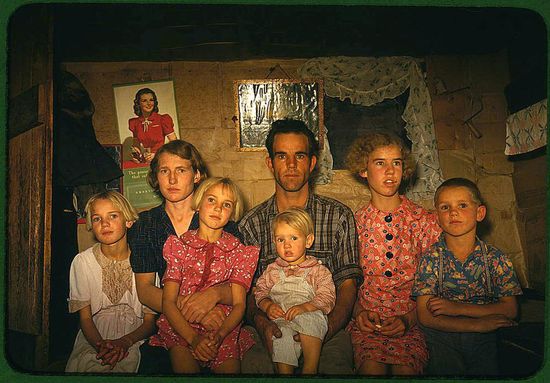
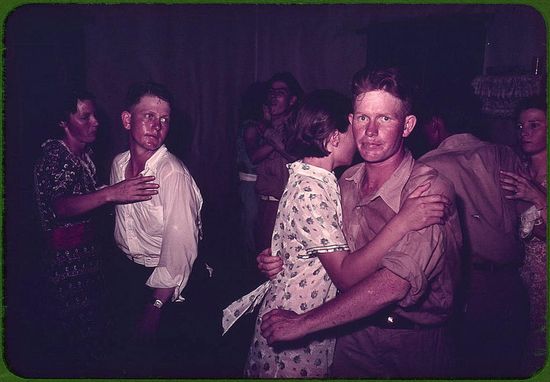
An incredible collection of color photos recently featured in the Denver Post:

These images, by photographers of the Farm Security Administration/Office of War Information, are some of the only color photographs taken of the effects of the Depression on America’s rural and small town populations.

Caption for the one above:

Jack Whinery, homesteader, and his family. Pie Town, New Mexico, October 1940.

Another Dish fave after the jump:

Color2

Who is he pining for?

(Hat tip: Zach Klein)

Who Do You Trust?

by Patrick Appel

Bernstein asks liberals:

Are there specific pols, interest group leaders, activists, pundits, or whoever who, if they support a candidate or a nominee or a bill, you would basically assume that she or it was acceptably liberal?

He poses the same question for conservatives. I don't trust any politicians; pols are incentivized to lie or gloss over hard truths. There are a number of writers who I trust to write with intellectual honestly, but I put more trust in systems than I do in people. This reader reply is spot on:

I think about this process in the way my uncle once recommended that I think about movie reviews: the key is to read the same reviewer over and over (regardless of whether you consistently agree with their perspective or not). In this way, you begin to establish a third (or fourth or fifth) point of reference in relation to to the objects under consideration (movies, pols, or policies) and yourself.

Running Towards America, Ctd

by Chris Bodenner

Matt Duss tackles Ross' column:

Whatever positive function nativism and bigotry, institutionalized and otherwise, may have performed in encouraging greater, faster assimilation is far outweighed by the harassment and discrimination endured by new immigrants as a result. This attempt at even-handedness also leads Douthat to underappreciate the extent to which, just as newly arriving Catholic, Jewish, Italian, German, and Chinese immigrants became more American upon arriving here, America itself became more Catholic, Jewish, Italian, German, and Chinese as a result of their arrival.

This, also, is part of what I think makes America unique: “Assimilation” has never been a one-way street. New arrivals to America have adopted American ways as their own, but they’ve also changed the way that we define and understand what it is to be American. Resistance to this is, I think, a big part of what underlies much of the opposition to the Cordoba House: Many Americans are uncomfortable with the fact — and it is a fact — that America will become, is becoming, more Islamic.

Duss also makes an excellent closing point – appropriated here as a response to Harry Reid's cowardly opposition to Cordoba.

The Daily Wrap

Today on the Dish, Andrew was away, so we got to assess the fray. On the mosque, Halperin urged Republicans to avoid hubris; Reid crumpled; and Douthat, Bouie and Bernstein butted heads. Conor hit upon an apt analogy by imagining a Catholic prayer group scenario instead. There's a history of the entire controversy here; and Reihan on Ross and his own Muslim parents here.

Debbie Riddle pulled a Palin on Anderson Cooper; Palin pulled a Palin on Levi's custody agreement; and Levi talked to Kimmel.  Conor got excited over a Salon profile of the could-be-perfect 2012 Republican candidate who no Tea Partier has ever heard of, and Palin came in 4th in an early Iowa poll. Goldblog was asked to clarify "going nuclear;" Conor invited examples of when analysts have been wrong about their predictions before and Mexico's narco-censorship was on the rise.

Patrick responded to Bazelon on Prop 8; he picked at an America where even the rich claim to be middle class, and he pushed against Kleiman's 'grow your own' cannabis policy. Obama was grouped under the same TARP as Bush, and readers responsed to race, poverty, gangs and education in America here, here, here, and here.

Chris catalogued the current cultural imperialism of Facebook on the web, via French rap; and song lyric riddles went the way of Google maps. Creepy ad watch here, MHB mash-up here, FOTD here, and VFYW here. Hewitt award here, Moore award here, and Yglesias award here.

Conor was curious about your first kiss, goaded Obama on his global war on terror, and had his mind blown by this piece of long form journalism. 

— Z.P.