The Ninth Circuit Court of Appeals just stayed Judge Walker's ruling. Brian Devine reacts:
First, and drastically most importantly, the Court granted the stay. Consequently the thousands of couples who were waiting for the day of equality will have to wait at least a few more months until December.
Second, the Court wants this case to be resolved quickly. Appellants’ opening brief is due in just a month and the hearing will happen on December 6th. This is lightning quick for a Federal Court of Appeals, and it’s a very good sign. The Court understands that this case is important, and it doesn’t want it to linger.
Third, the Court specifically orders the Prop 8 proponents to show why this case should not be dismissed for lack of standing. Here’s a discussion of the standing issue. This is very good news for us. It shows that the Court has serious doubts about whether the Appellants have standing. Even better, the Court is expressing an opinion that its inclination is that the case should be dismissed. That being said, the panel that issued this Order (the motions panel) is not the same panel that will hear that case on the merits. The merits panel will be selected shortly before December 6th and we don’t know the three judges who will be on the merits panel. But this is a very good sign that the appeal could be dismissed on the ground of standing alone.
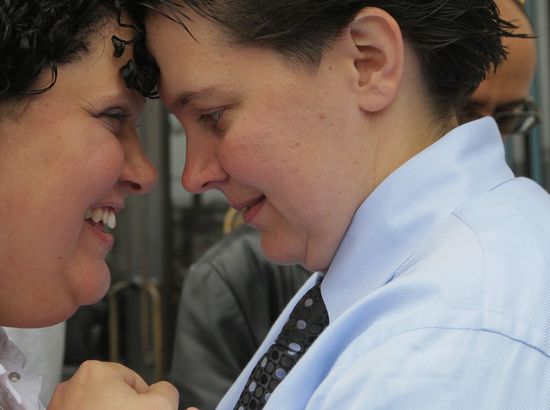
(Photo: Same-sex couple Kristen Orbin and Teresa Rowe embrace on August 12 in San Francisco as they wait to hear a decision on whether same-sex marriages will be allowed to resume in California. By Justin Sullivan/Getty Images.)
Sam Harris, whom I often enjoy, has an exceedingly wrong-headed article on the Cordoba project. He sees no legal reason to oppose the "ground zero mosque" but nevertheless feels it is a bad idea:
The claim that the events of September 11, 2001, had “nothing to do with Islam” is an abject and destabilizing lie. This murder of 3,000 innocents was viewed as a victory for the One True Faith by millions of Muslims throughout the world (even, idiotically, by those who think it was perpetrated by the Mossad). And the erection of a mosque upon the ashes of this atrocity will also be viewed by many millions of Muslims as a victory—and as a sign that the liberal values of the West are synonymous with decadence and cowardice. This may not be reason enough for the supporters of this mosque to reconsider their project. And perhaps they shouldn’t. Perhaps there is some form of Islam that could issue from this site that would be better, all things considered, than simply not building another mosque in the first place. But this leads me to a somewhat paradoxical conclusion: American Muslims should be absolutely free to build a mosque two blocks from ground zero; but the ones who should do it probably wouldn’t want to.
Do I oppose the center’s construction? No. Do I think that building it on that site is a good idea? No. It’s no better an idea than would be building an American cultural center near Ground Zero in Hiroshima. It was Islam, after all, that propelled those planes into the World Trade Center nine years ago.
It's amazing to watch staunch secularists and the far right read from the same playbook. Islam is not a nation. And Harris dismisses religious moderates far too quickly, with too broad a brush, a point Andrew made in detail during their debate. Harris implies that the people building Park 51 are the wrong sort of Muslims without bothering to prove that charge. The specter of 9/11 is enough. For someone who claims a special relationship to reason, Harris is leaning awfully heavily on emotion and strawmen. Hitchens, as Andrew noted last week, was more measured:
We need not automatically assume the good faith of those who have borrowed this noble name for a project in lower Manhattan. One would want assurances, also, about the transparency of its funding and the content of its educational programs. But the way to respond to such overtures is by critical scrutiny and engagement, not cheap appeals to parochialism, victimology, and unreason.
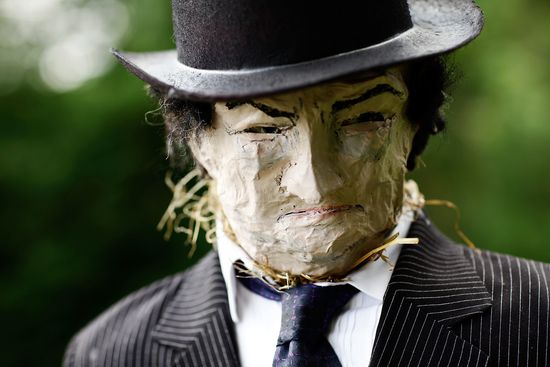
A scarecrow is dressed as a banker during the annual Scarecrow Festival on August 14, 2010 in Kettlewell, United Kingdom. Every year since 1994, hundreds of scarecrows have been created by the villagers and hidden on a trail around the village. By Matthew Lloyd/Getty Images.
But darn, that book is big and awkward. Also, it has a lot of words per page, and per line — understandable, given the novel’s length, but not ideal for readability. And then I started thinking that I might want to blog about it, and in that case, being able to access underlined passages online for quick & easy copying & pasting would be a large plus. . . .
So I bought the Kindle version. All the above problems solved . . . but . . . I found that I was missing the visual cues that codexes offer. I don't often miss them, or not all that much anyway, but in this case I miss them. Wallace goes off on these long riffs, but on the Kindle it’s hard to tell how long they are; whereas when holding the codex I could flip ahead to see how long I should be prepared to keep my concentration before I can expect a break. Also, I found that I don't wholly trust the Kindle the way I trust printed books: for instance, in a relatively early episode featuring a conversation between two men on a hilltop overlooking Tucson, Arizona, there’s a sudden cut to a description of vast herds of enormous feral hamsters in an environmentally ravaged region of the northeastern U.S. / southeastern Canada, and I thought, Wait . . . did someone make a mistake here? Is this actually a footnote misplaced? Did an episode heading get left out? I have seen enough mistakes in Kindle editions that I couldn't, and actually stopped reading until I could compare the codex — in the fidelity and accuracy of which I, like most people, have nearly absolute trust.
As yet, I haven't read a book length volume on a screen.
I do regularly use the Instapaper ap on my iPhone to read long magazine features. When I read Infinite Jest, a book I enjoyed as only a former high school tennis player could, the combination of its bulk and the need to flip back and forth between endnotes and text drove me crazy. I'm not sure how footnotes are navigated when reading on a Kindle (perhaps Professor Jacobs would update his post to tell us?) but I'm sure it could be handled in a way I'd prefer.
That clip of Michelle Rhee is definitely inspiring. Her students' success is, without a doubt, a credit to the time she invested as a teacher. That said, being straight out of school herself, my guess is that she was unmarried at the time or had yet to have her own children. What happens when the teacher has a family of her own? Must a teacher be expected to dedicate so much time when she has to care for her own family (as well as help them with their own homework)?
Another writes:
I must admit I didn't know who Michelle Rhee was until this evening. When I watched the video, my first instinct was that she must be lying. What she claims she did as a teacher sounded improbable (90% of the children went from 13% to 90%? It just doesn't sound plausible). I googled around and found a well-researched post from two years ago at Daily Kos about Rhee's claims, and it doesn't look good.
I do agree with her on one thing. Spending time more time with students before and after school makes a huge difference. I have held after-school tutoring in the past and it has helped many of my students improve. But her explanation of how 90% of her students came before and after school, and on Saturdays, for two years, seems a bit embellished.
Clay Risen wrote an excellent profile of Rhee for The Atlantic ("The Lightning Rod," November 2008). The piece is also, in part, a profile of Marion Barry, who serves as a foil for Rhee (and her closest ally, Mayor Fenty). The two intersect in this passage:
In one particularly testy exchange at an all-day meeting in April, Marion Barry, now the representative for the city’s poorest ward, lectured Rhee on the political realities of her job. “Whether or not you and the mayor want to take it out of the political arena, you cannot, because education all over America has political implications,” he told her. “Parents are also voters.”
Rhee would have none of it.
“I think part of the problem of how the district has been run in the past is that decisions have been made for political reasons, and based on what was going to placate and satisfy adults instead of what was in the best interests of children.”
“Let me be succinct, because my time is running out,” Barry retorted. “Talk to other people on this, because I think you’re absolutely wrong … I know you want to do it the right way, but I think that’s causing us more problems than we need to have.”
The comment was a warning, but it was also a reflection of the very political nature of education in the American inner city, and particularly in Washington.
The commenter you quoted showed the usual misrepresentation about DC school expenses. The District does not spend huge amounts more on instruction for its regular students. You cannot simply take the total school system expenditures and divide them by the number of students.
For one thing, DC has traditionally lacked the ability to provide appropriate instruction for many identified special-ed students, so they send them out to private placements, often at costs of $30,000. Second, DC was spending a lot of many on half-vacant buildings. One good thing Rhee did – and I am NOT a Rhee fan – was to close down underutilized buildings and consolidate. Third, DC spends a lot of money on security, more per student than most other districts. Fourth, DC had way too many central office staffers, many of whom got their jobs during the Barry era and who managed to stay there without contributing anything to the education of children. Again, to her credit, Rhee got rid of a lot of the dead weight (though the way she went about it was unnecessarily antagonistic).
Thus, when controlling for these other factors, DC costs are not way out of line as people like to argue.
The intra-Atlantic debate over Jeffery Goldberg's cover story is here. Elsewhere, Ezra Klein's criticizes:
The Israeli government is currently willing to do dangerous things when they involve firepower — like attacking Iran or bombing Gaza — but not hard things when they involve fighting domestic battles to restart to the peace process and reverse the settlements. That's a world in which their central problem keeps getting worse, and there is no hope of it getting better. I'd be a lot more likely to support "dangerous things Israel thinks to be necessary" if Israel seemed more interested in doing the hard things everyone knows to be necessary.
Reihan says Ross' column "captures my feelings almost perfectly." He offers a unique – and very American – perspective:
I wouldn’t say I’m a very religiously observant person, but the observant Muslims I know best are my parents. Both of my parents have lived in New York city for over thirty years. Both of them worked in the World Trade Center in the 1980s, when I was a kid. Some of my fondest memories of growing up involve visiting them at work, and watching the 4th of July fireworks display from my dad’s office window. They were born in a country (Bangladesh) where Islamist terrorists have killed a large number of people in bomb attacks and acid attacks, and they lived through a savage and mostly forgotten war in which over 1 million Bengali Muslims were tortured and killed in part because they were accused of being “polytheists,” etc. That is, armed cadres of proto-Islamists were killing Muslims who had a different way of seeing the world and practicing their religion.
So that’s part of where I’m coming from: the idea that Islam is one thing or that all Muslims are the same strikes me as highly unlikely.
A new word has been written into the lexicon of Mexico's drug war: narco-censorship.
It's when reporters and editors, out of fear or caution, are forced to write what the traffickers want them to write, or to simply refrain from publishing the whole truth in a country where members of the press have been intimidated, kidnapped and killed.
That big shootout the other day near a Reynosa shopping mall? Convoys of gunmen whizzed through the streets and fired on each other for hours, paralyzing the city. But you won't read about it here in this border city.
Here's why:
An estimated 30 reporters have been killed or have disappeared since President Felipe Calderon launched a military-led offensive against powerful drug cartels in December 2006, making Mexico one of the deadliest countries for journalists in the world.
But a ferocious increase in violence, including the July 26 kidnapping of four reporters, has pushed the profession into a crisis never before seen, drawn renewed international attention and spurred fresh activism on the part of Mexican newsmen and women.
The United Nations sent its first such mission to Mexico last week to examine dangers to freedom of expression. On Aug. 7, in an unprecedented display of unity from a normally fractious, competitive bunch, hundreds of Mexican reporters demonstrated throughout the country to demand an end to the killings of their colleagues, and more secure working conditions. Few killings are ever investigated, and the climate of impunity leads to more bloodshed, says an upcoming report from the New York-based Committee to Protect Journalists.
I'm always surprised that the prospect of a failed state on America's southern border doesn't get more attention. The rise of narco-gangs powerful enough to paralyze the country is terrifying, and there is no reason that their intimidation tactics, including kidnapping, torture, and gruesome murders can't spread to our side of the border.
There is a case to be made for putting a lot more of our foreign policy resources into this hemisphere, and dedicating a lot less treasure and attention to matters overseas. I'd also like to see changes in drug policy so that our failed yet ongoing efforts at prohibition stop empowering paramilitary drug armies from growing ever more powerful.
 The Dish