Bush Who?

by Patrick Appel

Nearly half of Americans incorrectly believe that Obama signed TARP. Weigel muses:

I just think it's fascinating that TARP has been the entry point for Republicans bashing Obama's social democratic economic agenda. It's one of the reasons I disagree with liberals who say the tea party is rooted in racism. Now, there's a case to make that some opposition to big spending, welfare programs is rooted in fear of money being redistributed to non-whites. But every big initiative of the Obama era has been slammed with that new pejorative word "bailout." It conjures images of wealthy Wall Street executives and wealthy bankers, not images of ACORN volunteers.

“Depressing Because It Is So Persuasive” Ctd

Michelle-obama-02-af

by Chris Bodenner

A reader writes:

While I understand your readers' arguments that socioeconomic factors are the major contributors to a seemingly perpetual black underclass, I am not persuaded. I have to agree the problem is cultural. My parents grew up in a time when racial discrimination was rampant and opportunities for poor blacks were scarce. They were both born in the rural South. My grandparents were farmers and had not graduated high school. Not only were there no examples of highly-educated or affluent blacks in their communities, there were no examples on television, and certainly not in the oval office. There was no family expectation that they go to college, only that they work hard, not lie, cheat or steal, and grow up to become decent human beings.

Both took the initiative to go to black universities to better themselves. There were no available scholarships. They worked their way through school and my maternal grandmother got a job outside the home for the first time in her life, standing on her feet all day peeling shrimp so she could send my mother her earnings for living expenses. My parents tell me that when they were in college, black men outnumbered black women. They tell me that it was considered shameful to be unkempt, that they all worked together to keep their grades up and keep their eyes on the prize – graduation and professional success. Both my parents went on to get graduate degrees.

Given the pervasive, accepted, and even legal discrimination faced by previous generations of black Americans, there is no excuse for our current failure to succeed.

Another crucial point: if the black community's success or failure is out of our own hands, how depressing and discouraging is that? If that's what our young people believe, it's no wonder they don't have a vision for their own futures or a belief in the opportunities this country provides. On the other hand, if our success is simply a matter of changing our own internal cultural norms and mindset, the profound disparities between white and black America can be ameliorated in a generation.

At some point in the last twenty years, black America took a wrong turn and it's up to us to save ourselves. And now after Obama's election there truly is no excuse. He should serve as a constant, highly visible example to black kids of what is possible in America.

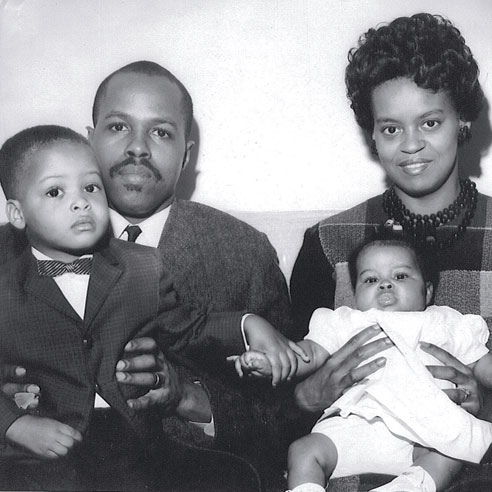
(Photo from a Reader's Digest profile: "Craig, Fraser, Marian, and Michelle Robinson around 1965. "Craig and I had excellent role models, " says Michelle [Obama]. "My parents didn't go to college, but they were smart, commonsense people who believed in hard work.")

Hello Again

by Conor Friedersdorf

A great pleasure of The Daily Dish is interacting with as thoughtful and diverse an audience as I've found in the blogosphere. You've my belated gratitude for the advice offered prior to a road trip I took across The South, when I drew liberally on suggestions shared in this space to guide my travels. Those e-mails also prompted many of you to remark on how enjoyable it is to ponder the thoughts and life experiences of fellow Dish readers.

In that spirit, I'd like to begin the week by offering another prompt: Tell us the story of your first kiss. 

It's a query that springs from a dozen curiosities. Are the stories from older readers going to differ substantially from younger readers, or is this sort of thing timeless? Do men and women remember the experience differently? Did anyone wind up married to their first kiss? What's the culture surrounding first kisses in other countries? What's the funniest story in this community of readers? How well do people remember their first kiss?

Give context.  Reflect on larger meanings. Take liberties with the question, and explore angles I didn't mention. I'll share a number of reader responses over the next several days. Email conor.friedersdorf@gmail.com with "first kiss" in the subject line. (Always feel free to use that email address for any correspondence directed to me. Twitter addicts can also reach me via the handle @conor64).

Finally, if you're new here, I'm a California based writer, a newly minted senior editor here at The Daily Dish, erstwhile blogger for The Atlantic's special reports on cities and ideas, a columnist at The Daily Beast and Forbes, and proprietor of WhatAmericaLooksLike.com — it's a Web site inspired by that trip around the South where I solicit submissions that show what the USA looks like outside the few places we see in the mass media. I'm also at work on other freelance projects and a biography of Milton Shedd, a co-founder of Sea World, World War II hero, and marine conservationist. My political beliefs are mostly grounded in conservative and libertarian philosophy, though I am allied to neither a political party nor an ideological movement. 

I'm eager for your thoughts, your concurrences, and especially your dissents.

Home News

Escape

I'm going off-grid for my annual bloggatical. Aaron has forbidden me to blog or write in this period, and for good reason, so, with apologies to my colleague and friend, Jeffrey Goldberg, and his challenging and chilling piece, I won't respond until I return. Maybe that will also allow me to respond to it with less immediacy and more perspective. The debate about it is, however, already in full swing and the Dish will be covering that in detail in my absence.

Meanwhile, for the first time in ten years, the blogazine will need no guest-bloggers. We finally have a team who can carry the Dish on their own for three weeks. Executive editors Patrick Appel and Chris Bodenner will be running the show, with blog posts from them and senior editor Conor Friedersdorf and associate editor Zoe Pollock. And, of course, you. See you after Labor Day, when we will have a full team to take the Dish forward into its second decade.

Have a lovely end of summer.

(Photo by Nicholas Hendrickx)

The Pope Is Not Gay

I find it hard to carve a single passage from Colm Toibin’s quite astounding essay in the London Review of Books on the Catholic church and the homosexuality question. It’s beautifully crafted and honest and true and inescapably Catholic. It covers a lot of ground that this blog has covered, but its description of the crisis of moral authority in the hierarchy is particularly nuanced and fine. What Toibin conveys is the special love many homosexuals have had – for two millennia – for this institution and its mission; and the choice the hierarchy has had for several decades to move forward in hope with these Catholics or to move back in fear against them.

So far, tragically, fear has won. But Toibin also sees the potential for a reborn Christianity in the papacy of John Paul II – wrecked by the white-knuckled reactionary politics that grew under him and now defines the Vatican. Here is what I too found so mesmerizing about Wojtila – as Toibin describes an event in John Paul II’s native Poland in the spring of his papacy:

Twice Wojtyla spent long periods with his hands over his face. The crowd below watched him, fascinated. All the lights were on him. It was hugely dramatic and unexpected, the pope unplugged, as it were. He was offering an example of what the spiritual life would look like; his message was mysterious and charismatic. If you did not know anything about the religion he represented, you would say that it was one of the most beautiful ever imagined, wonderfully speculative and exotic, good- humoured and sweet but also exquisite and exalted. While he lost nothing of his strength and power, the glory of his office, Wojtyla seemed at times almost sad about his own elevated position, suggesting that his real life was the one he spent alone in prayer and contemplation, the one we had seen when he sat without moving, his face covered. He was offering this rich private life of his to the crowd as the life they could have if they followed him.

The choice between this kind of affirmation of spirituality and love and a politics of control and fear was what the church faced under John Paul II, as modernity pressed. Toibin puts it this way:

The first way the Church could go emphasizes the spiritual and the mysterious element in Christianity; the second emphasizes the Church’s interest in control.

The church under Wojtila and Ratzinger took both paths, but the one, alas, has slowly eclipsed the other – until the sex abuse scandal tipped the scales to a near total collapse of moral authority in so many places, Ireland most spectacularly. The pursuit of control is really a GANSWEIN2:Getty fear of scrutiny and transparency which, when added to the unspeakable crimes of the past, ineluctably led to the current meltdown in the West. The homosexual question is not in any way marginal to this; in fact, you could see it as a central challenge for a church caught between truth and power. The path is littered with might-have-beens. The hope I once saw in the 1975 document on gays and then the reactionary bitterness of the 1986 retreat and Ratzinger’s subsequent campaign against gay people and all gay priests, regardless of their conduct,  encapsulates what has happened to the Catholic community in these years of crisis. (I cover all this ground in Virtually Normal.) And this collapse of authority rightly means that this Pope himself is no longer immune to the kind of scrutiny once deemed unimaginable.
The church, having been revealed to have concealed raw evil, now has little option but to allow the light in, or face sheer disbelief.

It seems pretty obvious to me – as it does to Angelo Quattrochi, whose book is reviewed by Toibin – that the current Pope is a gay man (just as it was blindingly clear that John Paul II was straight). I am not claiming that Benedict is someone who has explored his sexuality, or has violated his own strictures on the matter. There is absolutely no evidence of that, or of hypocrisy of any sort. But that does not mean that he isn’t gay. In fact, Ratzinger’s command that gay priests should actively lie about their orientation makes any public statement about this on its face lacking in credibility. But when you look at the Pope’s mental architecture (I’ve read a great deal of his writing over the last two decades) you do see that strong internal repression does make sense of his life and beliefs. At times, it seems to me, his gayness is almost wince-inducing. The prissy fastidiousness, the effeminate voice, the fixation on liturgy and ritual, and the over-the-top clothing accessories are one thing. But what resonates with me the most is a theology that seems crafted from solitary introspection into a perfect, abstract unity of belief. It is so perfect it reflects a life of withdrawal from the world of human relationship, rather than an interaction with it. Of course, this kind of work is not inherently homosexual; but I have known so many repressed gay men who can only live without severe pain in the world if they create a perfect abstraction of what it is, and what their role is in it. Toibin brilliantly explains this syndrome, why the church of old was so often such a siren call for gay men who could not handle their own nature. In Benedict, one sees a near-apotheosis of this type, what Quattrocchi describes as “simply the most repressed, imploded gay in the world.”

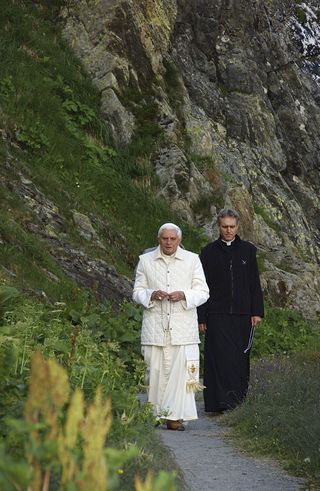
Toibin notes Ratzinger’s extremely close relationship with Georg Ganswein, his personal secretary, referred to by some priests I know as Gay.org:

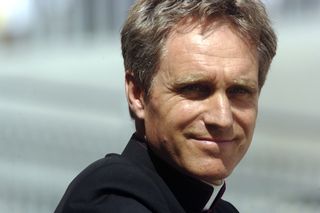
Gänswein is remarkably handsome, a cross between George Clooney and Hugh Grant, but, in a way, more beautiful than either. In a radio interview Gänswein described a day in his life and the life of Ratzinger, now that he is pope:

The pope’s day begins with the seven o’clock Mass, then he says prayers with his breviary, followed by a period of silent contemplation before our Lord. Then we have breakfast together, and so I begin the day’s work by going through the correspondence. Then I exchange ideas with the Holy Father, then I accompany him to the ‘Second Loggia’ for the private midday audiences. Then we have lunch together; after the meal we go for a little walk before taking a nap. In the afternoon I again take care of the correspondence. I take the most important stuff which needs his signature to the Holy Father.

When asked if he felt nervous in the presence of the Holy Father, Gänswein replied that he sometimes did and added: ‘But it is also true that the fact of meeting each other and being together on a daily basis creates a sense of “familiarity”, which makes you feel less nervous. But obviously I know who the Holy Father is and so I know how to behave appropriately. There are always some situations, however, when the heart beats a little stronger than usual.’

Toibin dismisses the notion that any of this proves anything contrary to Benedict’s or Ganswein’s vows of celibacy, and he’s absolutely right to. And yet the psychological profile that Quattrocchi paints is a powerful one:

About ten years before he became pope, when age was beginning to take its toll and was maybe sharpening the secret internal rage, Ratzy [Ratzinger] met Don Giorgio [Gänswein]. And it was a spark of life amid the doctrinal darkness … So we can at least imagine how a pure soul becomes inflamed when it meets its soulmate, when a nearly 70-year-old prefect of the Congregation for the Doctrine of the Faith meets a brilliant 40-year-old priest from his native Bavaria who shares the same outlook on the world … When we see the photos, which we publish in this book, of Georg putting Ratzy’s little hat on for him, handing him his stole, watching his back, looking after him, accompanying him and helping him as he walks, we cannot help being moved.

I would like to return to the world where this kind of speculation was disgraceful, unnecessary and blasphemous. But when this Pope has already enabled the rape of children, has covered up the crimes of many priests, when he has responded by blaming gay men for the moral failings of his own church, when he has publicly demanded that gay Catholics remain in the closet, i.e. lie about themselves as a sacred duty … then such deference becomes much more difficult. Toibin again:

The problem is that, after all that has been revealed, many of us who were brought up in the Church now know that we once listened to sermons about how to conduct our lives from men GANSWEIN3FrancoOriglia:Getty who were child molesters. And that senior members of the Church hierarchy protected these men, believing that the reputation of the Church was more important than the safety of children, and that Church law was superior to civil law. When they were found out, their sorrow was not fully credible. Thus, when we think of the Catholic Church, we think of secrecy, half-hearted apology, studied concealment.
This makes it difficult for Ratzinger, who is probably the most intelligent and articulate pope for many generations, to be heard properly when he speaks about matters of faith and morals. He wishes to make it clear, from a position that is starkly coherent, that moral values are not relative values, but absolute ones, that we must follow God’s will, and that the Catholic Church is in a unique position to tell us in some detail what this entails. However, rather than listening to this message or bowing our heads as he offers us his blessing, because of what has happened, because of a new suspicion which even the most reverent feel about the clergy, we will find ourselves examining Ratzinger’s clothes and his accessories, his gestures, and checking behind him for a glimpse of the gorgeous Georg with whom he spends so much of his day.

(Photos: 1. In a picture made available on July 20, 2006, by the Vatican newspaper L’Osservatore Romano, Pope Benedict XVI walks with his personal segretary Georg Ganswein, July 18, 2006 in Martigny, Switzerland. By the Vatican Pool/ Getty. 2. The Pope’s personal secretary Georg Ganswein smiles as he arrives in Saint Peter’s Square for the weekly general audience at Saint Peter’s Square, May 17, 2006 in Vatican City, Italy. By Franco Origlia/Getty.)

The Other Sex Abuse Conspiracy, Ctd

A reader writes:

Unfortunately, in the mid 90s, I spent just over four years (52 months) in prison. During my incarceration I spent time at San Quentin, Susanville, DVI, Solano, Tehachapi, and Jamestown. I did at least six months in each institution and also had the pleasure of spending weeks inside the SHU (Secured Housing Unit) at five of the institutions.

While popular culture is fascinated, dare I say oddly obsessed, with prison sex – it's usually the first question I get from men – I can confidently say that sex abuse in prison is definitely overhyped. While there were instances of sex abuse in some of the prisons I visited, they were few and far between.

I would point to a few main reasons for the decline of sexual abuse. First, prison culture has evolved from the olden days when only hardened criminals were sent to prison, to the present day when petty criminals are routinely incarcerated. Second, the introduction and expansion of conjugal visits has also provided incentive to stay out of trouble and a sexual outlet.

Third, AIDS. Most inmates are terrified to contract HIV.  For inmates who are not scared of the virus, there is typically a plentiful selection of homosexuals who are usually more than willing to accommodate the needs of inmates. I would hazard to guess that the homosexual community experiences sexual abuse on a much greater scale.

I firmly believe that the sex abuse in prison is not a significant enough problem to warrant any action from the federal government. There are many more serious problems in correctional facilities that warrant congressional action.

Voices In The Void

A stirring piece produced by Claire L. Evans for the World Science Festival:

This video montage is a meditation on [the Voyager Golden Record], our loneliness, and the herculean, courageous task of SETI. The now-distant voices — all of whom make statements of earnest peace, curiosity, and goodwill, our best human attributes — are paired with images of the night sky from their countries of origin. It seems they are shouting out into the void; indeed, the people on the Golden Record (and perhaps our entire civilization) will be long gone by the time the Voyager probes pass within range of another star system.

“Depressing Because It Is So Persuasive” Ctd

A reader writes:

Your reader commented:

The school systems in black neighborhoods are underfunded and undeniably worse on average than those in white neighborhoods.  The quality of the school, its teachers and leadership has a direct influence on graduation rates.

As an inner city teacher, I am sick and tired of being the nation’s scapegoat for all of the problems in the inner city. There are cultural and socio-economic patterns that have been set in motion by racism that have taken on a life of their own in the inner city. As the teacher there, I inherit these patterns and have to somehow deal with them. For example, when my students enter our school in 9th grade, they come in with low reading and writing scores, on average 3 to 4 years behind. The parents are apathetic, and do not seem overly concerned about this. On report-card pickup night, the teachers in my school see on average about 10-20 parents from the 150 students on their roster. During the school year I cannot get in touch with many of the parents by phone because they are many times disconnected. They move and change their phone numbers so often, so it is very difficult to keep in contact. I also have many homeless students. Studies show that parent involvement is key to student success, and as you can see, this is a challenge for the inner city teacher.

My students are also entering full-blown puberty and exploring their sexuality. Getting pregnant and having a child in high school is perfectly acceptable in the black and Hispanic inner city community. I see it all around me on a regular basis and it seems like an epidemic. Most of my students are themselves children of teenage mothers, and when they have their own baby, their mothers are home raising them while they come to school. If they don’t have someone helping them, they drop out. They are putting themselves on track for a life of poverty, and as their teacher, I am powerless to reverse this trend.

Violence among students is another daily occurrence and is such a serious safety issue that the police have their own office set up in the school I work at.

It isn’t only gang members. Violence is the only way my students seem to be able to resolve conflicts with each other, because in the inner city culture, you can never EVER let someone “dis” you publicly. If a student ignores it, they are viewed as weak. It’s a matter of survival to fight back.  I have witnessed pregnant teenage girls in fist-fights with each other on more than one occasion.  I have students getting shot on the street on a regular basis. This is all very “normal” to my students. As their teacher, I try to teach them alternative ways of dealing with conflict, but here again I am powerless to reverse this cultural pattern.

I am tired of being a public punching bag by the media for all that is wrong in the inner city.  The problem is that too many people who know nothing have strong opinions about inner city education.  I live it everyday, and I am sorry but much of the problem is coming from within the inner city community itself. That doesn’t mean we "blame” people and ignore the problem. It does mean that everyone – be it the government, the middle-class taxpayer, or the inner city community – must ALL take responsibility and make some changes. It is not and cannot be in the hands of the schools and teachers alone.

DC Schools Chancellor Michelle Rhee takes a different tack.

The Support Of The Grapevine

Jeffrey Polet mounts a defense of gossip:

Imagine, for example, that a close mutual acquaintance seems to be drinking too much, which causes increased levels of concern among that person’s intimates. It would not only be natural but also right for those persons to discuss it. Are we perceiving this correctly? What kind of problem is this person facing, and how significant a problem is it? How ought we address it? That it becomes a matter of mutual concern is due to the fact that we are thickly embedded in social relations which sustain us, and upon which we are dependent. That we do not confront directly or immediately is due to, on the one hand, the normal human capacity for self-deception.

On the other hand, we might not want to confront someone unless we are confident we have assessed the situation correctly. Gossip, then, is a kind of risk-management strategy within tightly knit communities by which we figure out how to navigate complicated relationships.