No, We Don’t Need To Go Back Into Iraq

Dexter Filkins assigns three reasons for the continuing disintegration of a country destroyed by the US invasion and occupation. The first two are the sectarian implosion in Syria and the sectarian authoritarianism of Nouri al-Maliki. But he then blames the Obama administration for not fighting harder to keep a minimal force in Iraq over Maliki’s and the American people’s wishes as the occupation came to a merciful close in 2011. IRAQ-UNRESTSomehow, that residual force would have restrained Maliki in his Shiite excesses, as the US did from 2006 onward, in the middle of a swirling civil war. The old guard in Washington will jump at this conclusion – with the neocon right and neocon left (what else do we call the liberals who never see a conflict in which the US should not be involved for the betterment of humankind?) rallying behind a new interventionism or, worse, a Captain Hindsight desire to pummel Obama again, while offering no real alternative.

It’s always a tempting idea that if we had stayed a little longer, all would have been well. It’s worth recalling the neocon desire to stay in Iraq for decades if necessary, in order to somehow forcibly impose a democratic structure on a sectarian, authoritarian and pathological non-state. But this is based on the fundamental illusion that the surge achieved anything of substance in altering sectarian divisions or Islamist extremism and thereby we ever had a success to sustain. We didn’t. We were able to temporarily pacify – by bribes and military maneuvering – a civil war that had always simmered below the Iraqi surface and had flared brutally even as we had 100,000 troops in the country. The idea that a few hundred could have prevented Iraq’s return to its historic sectarian entropy strikes me as absurd. It is not crazy for a Maliki ally to air this idea to Filkins in order to exonerate Maliki in the ensuing blood bath. What’s crazy is to take it at face value.

Yes, we broke Iraq in 2003. But another eight years of occupation, and billions in expense, fulfilled what obligation we had to the place. Does its disintegration mean more peril for the US?

We cannot know. But right now, it is a classic battleground for the ancient Shia-Sunni religious war still raging in the Middle East – with Iran and Saudi Arabia deep in the conflict. We have and must have no dog in that fight. And if we were to intervene again, we would only increase the likelihood of our being a target for some of the extremists now thriving there – on both sides. Mercifully, they hate each other more than they hate us – unless we give them yet another reason to turn their attention to the West.

The interventionists, remember, wanted us backing the Sunnis in Syria and now want us to back the Shia and Kurds in Iraq to prevent a newly fanatical Sunni insurgency. It makes you dizzy after a while. After a while, we’d just be taking turns backing one side or another, all the while painting a giant target on our own back.  But the hegemonic impulse to take every problem in the world as our own remains strong – especially among elites who love the idea of throwing their weight around in a world they have demonstrated they do not understand and cannot control.

I fear that the sane, smart decision to tell Maliki that we are not coming over the horizon to save him may not hold against the interventionists within the administration or against the Washington elite’s desire to keep running the world as they used to. If Obama succumbs, as he did in the disastrous Libya intervention, then much that he has achieved in de-leveraging the US from its neo-imperial burden would be at risk.

This is their religious war, and not ours. Neither an American soldier nor an American cent should be spent to alter its trajectory.
The World Cup Has Already Changed Brazil

As the World Cup kicks off in Brazil, Douglas Foster considers how the protest movement that emerged in the year leading up to the games has influenced the country’s politics:

[T]he mass anti-government protests that erupted in Brazil last year have stung the nation’s leaders and stunned FIFA officials. The World Cup is getting underway at a time when the country’s long economic boom has given way to a skid, fueling demonstrations against government corruption and shoddy public services. Protest organizers have managed to shift the country’s political discourse, while demanding that the $11 billion-plus budgeted for the games be spent instead on the nation’s highly stressed schools, infrastructure, and health-care systems. In a country where a majority of the populace now opposes the government’s decision to host the competition, a chant has emerged among demonstrators: “There will be no World Cup!” There will be, of course, but Brazilian politics may emerge from it transformed.

Luke O’Brien blames FIFA for much of the World Cup-related repression that Brazilians have come to resent:

FIFA is essentially its own nation-state, one untethered to any particular jurisdiction but powerful enough to impose its governing architecture on actual countries. In South Africa, FIFA demanded that the parliament pass legislation to ensure that nettlesome things like labor regulations didn’t interfere with business. In Brazil, FIFA made the host country ignore its own law prohibiting alcohol sales in stadiums (to prevent rowdies from getting too sauced) so World Cup sponsor Budweiser can push its suds.

Stadium exclusion zones, another tactic from the South Africa playbook, surround the venues. Inside them, only FIFA-approved products can be sold. Dissent is smothered by Big Macs and Adidas apparel. Free speech, also restricted, could be met with something more menacing, especially given the way World Cup protestors in Brazil have been treated so far, which is with rubber bullets and tear gas. When I went down to the famous Maracanã stadium in Rio a week before the first game, I found dozens of body-armor-wearing, black-clad special police waiting to pound the dirt out of any favela punk who dared take a run at the outer perimeter.

Travis Waldron laments that the World Cup “has become so ruinous that it borders on ruining itself”:

The thing is, it doesn’t have to be this way. None of the problems the World Cup has created, made worse, or highlighted in Brazil are necessary to hosting this tournament. None of the problems it has or will create in Russia, Qatar, or future hosts are either. We don’t need 12 shiny new stadiums that only remind us how hard we’re not working to improve the not-so-shiny schools and hospitals and favelas around it. We don’t have to perpetuate corruption, to abuse workers, to relocate families, to hand out special tax breaks, to pretend that these events drive massive economic growth when they don’t.

Drop a ball between two national teams in an adequately safe stadium and let them play, and the part of the World Cup that is fun will still exist.

Part of what has driven the protests is the amount of money Brasilia has spent on the Cup. But Diego von Vacano and Thiago Silva run the numbers and find that it wasn’t really that much, at least when compared to what the government puts into its social welfare programs:

Total investments in the 2014 FIFA World Cup  by the Brazilian government amounts to $11.2 billion. According to official data, these investments were provided by federal, state and municipal governments, as well as private entities. Also, according to public official information, the Brazilian federal government spent $1.76 billion specifically on the construction of stadiums. Now let’s look at social program expenditures in the same period. Between 2010 (the year that the investments on the World Cup and for the construction of stadia began) and the beginning of 2014, the Brazilian federal government invested $363 billion in health and education (the two social sectors that receive the greatest amount of investment by the government).

So, comparing expenditures on the World Cup and investments by the federal government on health and education, we can see that the former represents only 3 percent of the total of the latter two expenditures (the total of all forms social spending is $385.4 billion). Protestors claim that the government is spending too much on stadiums while neglecting health and education. Perhaps, but stadiums are only about 0.5 percent of the total amount invested in these two social sectors in the past four years.

Jon Lee Anderson decries the international criticism of Brazil that has come along with the games as opportunistic and unfair:

It is excruciating to watch this full-glare inquisition. It feels unseemly. Brazil is a big, uneven, still-developing country that, paradoxically, most of us love from afar and romanticize unequivocally most of the time (aaah, Ipanema, Rio, Ronaldinho, Gisele Bündchen, samba!, and so forth). …

This is not Putin’s Russia, where a megalomaniac gangster who has hijacked a state has spent fifty billion dollars for the purposes of self-aggrandizement. This is Brazil, the country everyone celebrated when it won the right to host this World Cup, and the next Olympics, too. This is the Brazil of the great beloved Pelé, and he was there, ecstatically hugging Lula, the bearded, wily left-winger who was President when Brazil was announced as the 2016 site. There were no serious questions, as there have been since Qatar was awarded the 2022 World Cup, about whether Brazil had bought its bid with bribes to sports officials. Brazil and fútbol are synonymous. When Brazil won, it seemed right to everyone, and it still should.

Previous Dish on Brazil’s World Cup preparations and protests here, here, here, here, here, and here.

Read Your Age!

Ruth Graham is embarrassed by adults who read YA fiction:

That will sound harsh to these characters’ legions of ardent fans. But even the myriad defenders of YA fiction admit that the enjoyment of reading this stuff has to do with escapism, instant gratification, and nostalgia. … There’s of course no shame in writing about teenagers; think Shakespeare or the Brontë sisters or Megan Abbott. But crucially, YA books present the teenage perspective in a fundamentally uncritical way. It’s not simply that YA readers are asked to immerse themselves in a character’s emotional life – that’s the trick of so much great fiction – but that they are asked to abandon the mature insights into that perspective that they (supposedly) have acquired as adults. When chapter after chapter in Eleanor & Park ends with some version of “He’d never get enough of her,” the reader seems to be expected to swoon. But how can a grown-up, even one happy to be reminded of the shivers of first love, not also roll her eyes?

Dianna Anderson protests:

It’s easy to be cynical about pat endings and the tying up of loose ends if you’re looking at a tiny sample of literature that exhibits those characteristics. But in the years I’ve been studying YA, I’ve learned that the only uniting feature of the genre is the age of the protagonists. There exists futuristic science fiction, dystopian fantasy, romance, stories of death and complexity to rival the heroes of the adult literary world. As it turns out, young adult literature is just as varied as adult genres. Writing it off entirely is like writing off all of popular music because you didn’t like that one Miley Cyrus song.

Hillary Kelly explains why she rereads a YA classic “year after year”:

I suppose nostalgia is a part of it – each time I turn past the title page of A Tree Grows in Brooklyn I reimagine myself on the floor beneath the window of my childhood bedroom. But it’s also because to reread Francie’s story is to reread the story of my literary life. It’s a chance to be more kind and generous to my younger self, to remind myself of how deeply the decisions of my childhood have ingrained themselves on my soon-to-be-30 brain. It’s a chance to remember that the complexities of adulthood are just variations on those from childhood.

Julie Beck has a more expansive take on why adults enjoy the genre:

I won’t deny that some of the appeal may lie in reading and remembering what it’s like to be that age, but I don’t think that’s the whole story. I don’t read these books to recapture a lost youth. I read them because the stories are good and meaningful to me now. And what, exactly, makes them good and meaningful? One of the great values of literature is its ability to convey experiences different from our own, to let us see inside the heads of characters from different time periods, different countries, different races, classes, and, yes, ages. Every time a grownup reads a YA book, they widen their perspective in important ways.

I don’t mean to delegitimize young adult books’ primary audience by suggesting their only value is to provide adults with a window into teens’ lives, or that the stories are only good if grownups can like them. What I do mean to say is that things made for teenagers are not inherently less worthy of our time, attention, and critical consideration, simply because they’re for and about teens.

Catherine Addington adds another perspective:

One obvious and undersung answer is that adults writing for children bring a cleaner perspective to their work. Sex and violence are present in their full human complexity, with fleeting emotional intensity, rather than in a numbing barrage of obscenity. The familiar social structures of young life, from school to summer camp to family life, provide a familiar backdrop for archetypal stories like first love and first loss. They allow adults to enjoy timeless themes with all of adult literary fiction’s seriousness, but little to none of its cynicism or vulgarity. They remove the obligation of maturity, while revealing the importance of life experience. In short, young-adult fiction does not condescend to its readers. It should be no surprise that it sells.

Responding To Student Groans, Ctd

McArdle argues against Obama’s proposed student-loan policy changes:

It’s not that the horror stories about people with low earnings and huge debts are imaginary – I have not only read those stories, but have also been one of them. However, that group is relatively small. And in order to give them an extra break on their payments, the president and Elizabeth Warren are proposing that we should also give a whole lot of money to folks who don’t really need it. That’s bad public policy; moreover, it’s not particularly progressive public policy.

That said, I do think we should do something to help people who are genuinely stuck with debt that they will never realistically be able to pay. We should end the exemption of student loans from bankruptcy so that anyone who is overwhelmed by debt can go to court and get a genuinely fresh start. The special treatment of student loans is an outrageous bit of self-dealing by the government, which appears to be fine with debt slavery as long as Uncle Sam gets to be the master. It should stop.

Drum counters:

[U]nlike McArdle, I’m persuaded by the aggregate numbers that we have a genuine problem here. We don’t have a problem with college grads buying ever more expensive cars, which is why no one wants to provide auto loan relief. We do have a problem with the cost of college skyrocketing.

The resultingly high aggregate student loan debt is having a noticeable adverse macroeconomic impact (family formation, buying a house, etc.) at a time when we can ill afford it, which makes the case for a temporary refinancing program fairly compelling. More generally, it’s also the case that no society is well served by making income a barrier to higher education. More and more, however, that’s what we’re doing.

Robby Soave’s view:

When federal lawmakers forgives debts – in part or in whole – they reward students who borrowed recklessly. They also incentivize universities to raise tuition prices. College administrators know that they can get away with demanding more money, because students will take out more loans, confident that the government will bail them out if they run into trouble – and the government will stick the taxpayers with the bill if the students aren’t able to pay.

Jordan Weissmann considers a Republican idea we noted yesterday:

Since 1983, Tom Petri, a low-key House GOP congressman from Wisconsin, has advocated an idea that education wonks sometimes call “universal income-based repayment.” It would completely scrap the convoluted system that former students currently rely on to repay their loans. Instead, college debt would work like just tax withholding. A borrower would simply pay a set percentage of her monthly earnings to the government, deducted straight from her paycheck.

Countries including Britain, Australia, and New Zealand already take a similar approach. And, as many educationexperts have agreed, bringing it stateside would likely cure some of the worst symptoms of America’s student loan binge. It would ensure that every single borrower’s payments stayed manageable and virtually eliminate the risk of delinquencies and defaults. Think of it as the financial equivalent of putting up gutter rails in a bowling alley – it’s a foolproof plan to stop borrowers from veering into trouble.

Meanwhile, Adam Ozimek argues that the real problem with higher ed is a lack of transparency about outcomes:

One potential concern is that transparency on outcomes might incentivize colleges to focus on selectivity to inflate their statistics. But even something as simple as reporting income divided by SAT score would incentivize schools to not just let the best students in. Or schools could use a value added type approach that incorporated more measures of demographics, socioeconomic status, and ability to estimate how much schools contribute to learning rather than simply selecting on ability. Overall, if you’re looking for a cause of our higher ed woes, then focus on informational problems, not debt. And if your looking for a policy, focus on transparency. That’s not to say there’s nothing that should be changed about student loans, but this is not the biggest issue here.

Reihan shifts the focus to the college experience itself:

Consider the findings of Paying for the Party, a masterful account of the many ways life at a large Midwestern flagship public university is rigged against students from working- and lower-middle-class backgrounds. Over the course of five years, the sociologists Elizabeth A. Armstrong and Laura T. Hamilton tracked a group of female students at “Midwest University,” a thinly disguised big public flagship school, starting in their freshman year. One of their most striking findings is that standard college advising consistently failed to meet the needs of students from modest backgrounds. Students from affluent backgrounds had extensive social networks at their disposal, which helped them turn degrees in “party majors” like sports communication and broadcasting or interior decorating into jobs in glamorous, or glamorous-sounding, fields. Students who didn’t have parents familiar with the ins and outs of higher education to help them navigate the system found themselves at the mercy of incompetent, indifferent, and overworked advisers who routinely led them astray.

The Recession Hits School Spending

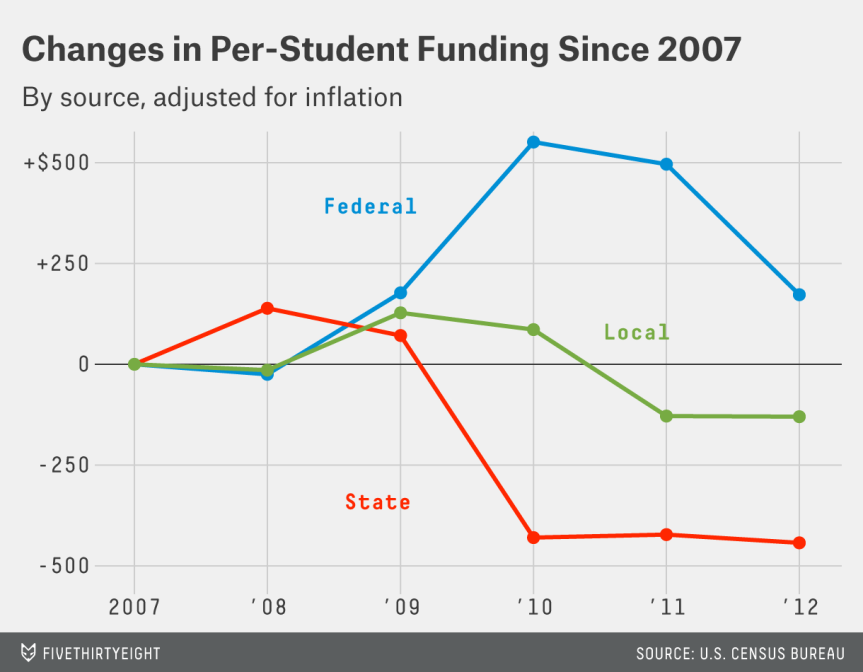
School Spending

A few years late:

U.S. schools actually weathered the recession itself relatively well. State funding, which accounts for about 45 percent of school revenues on average, fell sharply during the downturn, while local spending, which accounts for roughly another 45 percent, mostly from property taxes, was essentially flat. But federal stimulus dollars helped plug the gap, offsetting the worst of the state-level cuts. Both per-student spending and student-teacher ratios improved modestly during the recession.

Once the recession ended, however, so did the stimulus — long before state and local governments were ready to pick up the slack. Federal per-student spending fell more than 20 percent from 2010 to 2012, and it has continued to fall. State and local funding per student were essentially flat in 2012, the most recent year for which data is available.

Who Is Dave Brat? Ctd

Molly Redden and David Corn unpack Brat’s ideology:

A quick review of his public statements reveals a fellow who is about as tea party as can be. He appears to endorse slashing Social Security payouts to seniors by two-thirds. He wants to dissolve the IRS. And he has called for drastic cuts to education funding, explaining, “My hero Socrates trained in Plato on a rock. How much did that cost? So the greatest minds in history became the greatest minds in history without spending a lot of money.” An economics professor at Randolph-Macon College in central Virginia, Brat frequently has repeated the conservative canard that Freddie Mac and Fannie Mae brought down the housing market by handling the vast majority of subprime mortgages. That is, he absolves Big Finance and the banks of responsibility for the financial crisis that triggered the recession, which hammered middle-class and low-income families across the country. (In fact, as the housing bubble grew, Freddie and Fannie shed their subprime holdings, while banks grabbed more.)

Chris Mooney discovers that Brat is a climate change skeptic:

In a recent campaign event video (which has since been made private), Brat explains his free-marketeer perspective on environmental and energy problems. Naturally, he believes that American ingenuity will lead the way to a cleaner environment. But he also hints at a disbelief in the science of global warming, and alludes to a well-worn myth that has been widely used on the right to undermine trust in climate scientists – the idea that just a few decades ago, in the 1970s, climate experts all thought we were headed into “another Ice Age.”

John Cassidy deems Brat’s lack of a political record a campaign advantage:

Does he favor increasing the minimum wage, which would offer some direct help to low-paid American workers, or raising the debt ceiling to avoid a market meltdown? Asked about the minimum wage by NBC’s Chuck Todd on Wednesday morning, he waffled and changed the subject.

Republican leaders like Cantor have to give specific answers to these types of questions, and, occasionally, they are obliged to negotiate with the other party. Many Republican voters regard such maneuvers as betrayals: they are in no mood for compromise. To convince these voters that they are genuine conservatives, elected officials have to take extreme positions, such as advocating the repeal of Obamacare, opposing Roe v. Wade, and rejecting any pathway to citizenship for illegal aliens. That’s been the G.O.P.’s dilemma ever since 2008. Brat’s victory shows that it hasn’t gone away.

Wolfers defends Brat’s minimum-wage comments:

When an MSNBC interviewer asked David Brat, the economicsprofessor at Randolph-Macon College who toppled Eric Cantor in a primary challenge Tuesday, whether he opposed the minimum wage, he responded on Wednesday, “Um, I don’t have a well-crafted response on that one.”

The political class is billing it as a gaffe. But Mr. Brat’s fellow economists would probably be far more generous. Assessing the evidence on the effects of the minimum wage is a tricky business, and the evidence isn’t strong enough to support the certainties that pundits seem to demand.

Weigel draws a political analogy:

The quick rise of David Brat reminds me quite a lot of the slower rise of Ron Paul. In parts of 2007, I remember being one of two or three reporters in the room for some Ron Paul press conferences where he would bang on about the evils of the Federal Reserve. Who cared about such things?

Well, voters did. Voters, as Kristol understands and the WSJ stubbornly fails to, lurch toward populism in a time of economic want. Cantor couldn’t have been more vulnerable to a challenge. Brat, having beaten him, gets to define what Republican populism looks like in 2014.

Book Club: Looking With New Eyes

What have you discovered in your daily routine since reading On Looking, our second Book Club selection? Our host, Maria Popova of Brain Pickings, posed that question to Dish readers earlier this week:

Perhaps the greatest gift of a book club is that we get to share our private realities around a common point of interest – the book – and in the process enrich the collective experience. With that in mind, what is one facet of your day or aspect of your usual daily routine – your apartment, your commute, your dog walk route – that On Looking helped you see with new eyes?

Let us know by emailing bookclub@andrewsullivan.com and we’ll post the most interesting observations and photos. Buy the book here (or here for your Kindle) if you haven’t already. Karen Carlson was looking for “a quick, light, purely fun read” when she picked up the book last summer:

And it was a fun read, very much so – but it also sent me scurrying to google horowitz-onlooking Clochan na bhFomharach, a volcanic formation in Northern Ireland consisting of thousands of columns of basalt pushed out of the ground. And that’s just in a footnote. … “Minerals and Biomass,” her walk with geologist Sidney Horenstein of the American Museum of Natural History in New York City, is when I got curious about volcanic leftovers in Northern Ireland. …

What surprised me most was how enchanted I was by the second chapter: “Muchness,” guided by the expert eyes of Horowitz’ 19-month-old son. I’m fairly immune to the charms of children, but this was engaging and informative. Horowitz is trained in cognitive science and teaches animal behavior at Barnard, and here she weaves nuggets from developmental psychology in to explain her son’s adoption of a standpipe as a pet, and his reaction to shadows.

She adds, “This book was just the break I wanted: an almanac of captivating anecdotes which will stick with me – and who knows, maybe one day I’ll take a walk, myself.” That’s what we’re hoping some readers will do. And that’s just what Ambre Nicolson, also inspired by “Muchness,” decided to do with her own toddler. An excerpt from their sojourn around Cape Town:

14h00: “Beep beep!”

My son, like Alexandra’s, is head over heels for any form of wheeled transport. Within the first 30m of our journey he has pointed out a red bus, several taxis, a bicycle and a shiny bookclub-beagle-trblack motorbike. Later in our journey he will be stopped, spellbound for almost 10 minutes, by the sight of a reversing garbage truck. While my son loves cars, it has been shown that spending too much time in one leaves kids without a healthy sense of connection to place. American urban researcher Bruce Appleyard has shown that kids who have a “windshield perspective” are less able to accurately draw a map of where they live, whereas kids who walked or biked could produce accurate and detailed maps of their communities.

15h00: A bench, a well and a pond

He stops only long enough to take off his shoes before continuing into the gardens to try and climb a tree, throw sticks into the pond, scale a bench and scurry under it in search of another squirrel. When I see he’s trying to climb onto the edge of the old well, the bottom of which is a long way down and strewn with evil smelling rubbish I am quick to intervene.

At the same time I remember a recent Atlantic article written by Hanna Rosin, “The Overprotected Kid”, in which she shows how harmful it is for children never to exercise their risk taking skills. I decide the least I can do is show him the hazard. He stares into the darkness of the well for a couple of seconds before solemnly throwing his stick into the depths. Not long after that his pace starts to slow, followed by him halting, mid-stride, and reaching both arms up to me. Universal toddler code for “This walk is now finished.”

Kim West, a teacher, also related to On Looking:

Everyday, when my dog and I go for a walk, we travel the same route. Because I already know the way, sometimes I’m impatient, mostly because I’m bored. After reading Horowitz’s book, I have learned to enjoy our walks by slowing down, and pausing in the ordinary. When caught up in the frame of mind of going from one destination to another (home to the park, then back home again) it was easy for me to forget that for my dog, every walk is an adventure with different smells along the way.orwell-2

It made me realize that as a content expert, and a teacher with many years of experience, sometimes my lessons are just like my walks. I forget that because I already know the way, for my students learning can still be a new adventure. This reminds me to find the joy in the ordinary experience of learning: what did I first think and feel when I was introduced to this topic? Why does that matter? How can I make the experience that I once had as fulfilling and exhilarating for my students?

Now, when creating my road map, I don’t just think about the content. I think about what my students and I do and why that matters.

The book also inspired Belinda Farrell to slow down and open her eyes:

The specifics of the walks aren’t really important, but what this book made me think about was the quality of my own walking. Often I walk with a purpose: I am going somewhere. I walk up hills because I want the sense of achievement from reaching the top coupled with the reward of an amazing view. I walk to exercise, swiftly and with little care about where I’m going. I walk with earphones in my ear, listening to my own soundtrack and not the soundtrack of the world outside. Reading this book made me think of the pleasure of walking for the sake of walking, for the pleasure of the walk itself. I’d forgotten how much that could be a voyage of discovery.

Follow the whole Book Club discussion here.

American Fútbol

Soccer’s US fan base is growing, especially among young people:

Soccer (in the form of U.S. Major League Soccer) has caught up to Major League Baseball among young sports aficionados—both sports have captured 18 percent of 12- to 17-year-olds as fans—according to the 2014 ESPN Sports Poll, which tracks interest in major league sports. The rise of soccer coincides with a surprising fall in the popularity of baseball, which had a 25 percent avid interest rate among that same audience just two years ago. (Football and basketball come in higher at 39 and 30 percent respectively, and hockey is the worst bet at just eight percent and falling.)

Andrés Martinez sees this as good news for Americans’ engagement with the world and a sign that our sports chauvinism may be on the wane:

It’s hard to exaggerate how much soccer’s incursion into American life threatens to erode American exceptionalism, not to mention our traditional geographic illiteracy. American kids now routinely wear the jerseys of teams in places like Barcelona and Munich, much like their counterparts in the rest of the world. Soccer offers American sports fans a sense of global, not just national, connectedness.

For most of the 20th century, even when so much of our culture was being adopted by others, Americans were adamant about not reciprocating by adopting the world’s sport. The prevailing culture was suspicious of the game, which at times could seem futile. Imagine going an entire match without scoring! Or, worse, tying! It seemed the duty of patriotic Americans was to avoid soccer, and even ridicule it, as much as it was to refuse measuring in centigrade or meters. We compensated for our sports provincialism by calling the champions of our domestic sports leagues “world champions.”

But all that is changing. With the World Cup in the Americas for the first time in 20 years, the United States will experience this year’s tournament in a big way, and the exciting narratives that spin out of it will help bind young American fans to cheese-eating kids in Normandy, and elsewhere.