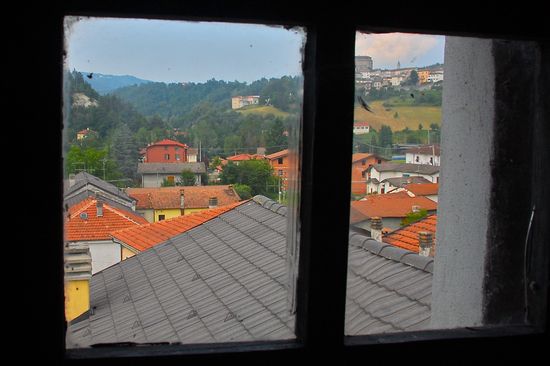
Leaving Afghanistan In 2011? Ctd

Gullivers-travels

Petraeus is pushing for a slower withdrawal. Joe Klein saw this coming:

It is the nature of David Petraeus to move mountains to achieve his mission–and the immediate mountain sitting in front of him is the Obama Administration's December policy review, which will determine how quickly we start to leave Afghanistan in July 2011.

Petraeus and Stanley McChrystal came away from the last policy review, in the fall of 2009, with the distinct impression that the 2011 date would not signal the beginnings of a precipitate bugout. I was told by Administration officials at the time that there might be NATO withdrawals in 7/11–the Germans from Mazar-e-Sharif in the north, for example–and some cosmetic American reductions, but the main fighting force in the Taliban-infested south and east would continue its work until the mission was accomplished.

Allahpundit:

I’m actually surprised that he’s starting to push this now; it makes more political sense for Obama to have him do it after the midterms, when there are no electoral consequences in asking to extend a war that’s increasingly identified with Democrats. Presumably he nixed that idea because the long-awaited Kandahar campaign is set to begin later this year and the optics of demanding more time in the middle of a tough battle might be awkward. Better to float the idea this summer, before the shooting starts, so that the public doesn’t read it as a desperation move taken in response to a hard fight later.

The NYT is losing faith:

[W]e are increasingly confused and anxious about the strategy in Afghanistan and wonder whether, at this late date, there is a chance of even minimal success.

Support For Marriage Equality Accelerating? Ctd

A reader writes:

Living in Arkansas, my husband and I have a perspective on the “marriage equality should be driven solely by state legislatures” argument that is surely shared by many gay couples in the Bible Belt and elsewhere.  Our state is a good 20 years away from majority approval of same sex marriage, and we know that as long as we live in Arkansas, we do so as two single, cohabiting men in the eyes of the state.  Therefore, we are faced with an impossible choice: (a) live alone, with no support system, in a state that recognizes our marriage, or (b) live in Arkansas, where we are offered zero protections as a couple, but we enjoy the love and support of our family and friends.  For heterosexual couples in all 50 states, Home = Security.  For same sex couples in 45 states, it is more like Home vs. Security.

On a daily basis, we are asked the same question by friends and foes alike: “What the hell are y’all doing in Arkansas?”  And our answer is plain and simple: Because this is our home.  This is where we belong.  And when we start a family, we want our children to enjoy the richness of a childhood filled with grandparents, aunts, uncles, cousins, nieces and nephews.  But unless those darned “activist judges” on the federal bench step in, planning for our future will continue to be an endless game of absurd tradeoffs and unsatisfying options. 

Past And Present, Ctd

694px-Prokudin-Gorskii-19-v2

A reader writes:

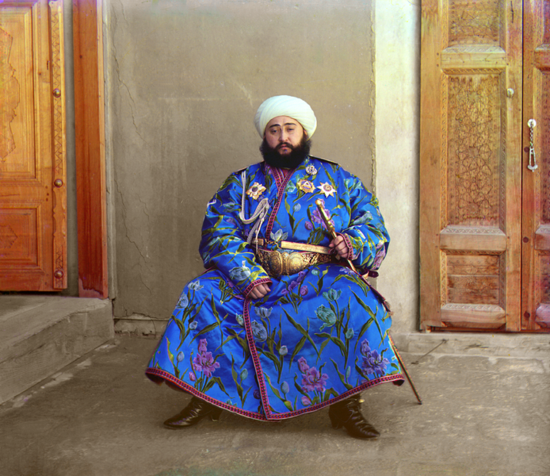
I'm not an expert, but to my untrained eye, those "color photos" look more like photochroms. Photochroms are a combination of photography and lithography, but aren't real color photos. Essentially, they are artificially colored black and white photos. For some awesome early color photography, check out the collection of photos by Sergei Mikhailovich Prokudin-Gorskii at Wikimedia Commons, Wikipedia's sister site for media. Each of these images was itself originally three monochromatic images taken in close succession, that were projected on top of each other. These were digitally combined by the Library of Congress, to wonderful effect.

(Photo: "A picture of Alim Khan (1880-1944), Emir of Bukhara, taken in 1911.")

The Other Sex Abuse Conspiracy

Eli Lehrer urges Congress and the Obama administration to move faster on efforts to stop prison rape. But they face many hurdles:

Particularly in the most chaotic prisons, turning a blind eye towards sexual abuse helps keep tensions between racial-supremacist gangs under control. In juvenile facilities, furthermore, a growing body of evidence of guards abusing their charges has some guards and administrators rightly nervous that tougher standards will reveal deeper problems. Finally, society’s refusal to take sexual abuse in detention seriously, combined with the utterly distasteful nature of the problem, makes it something that many would prefer to sweep under the rug. The slow pace of the process so far — for example, even though nobody openly opposes the idea of standards, getting Congress to approve exceedingly modest legislation took almost two years of work — shows that many would prefer that it remain sub rosa.

Do Prop 8 Proponents Have Standing To Appeal? Ctd

Be prepared for some fascinating right-wing cognitive dissonance. What happens when a conservative approach to jurisprudence, which often takes a very strict view of who has standing to appeal, meets the Christianist demand that gay people be ostracized in civil society. Walker, as throughout, has represented the real conservative position on this, and his denial of standing to the Prop 8 supporters is one which John Roberts has a history of backing. From Jeffrey Toobin's profile of Roberts last year:

One case that Roberts argued during his tenure in the Solicitor General’s office in George H. W. Bush’s Administration, Lujan v. National Wildlife Federation, seems to have had special resonance for him. The issue involved the legal doctrine known as “standing”—one of many subjects before the Supreme Court that appear to be just procedural in nature but are in fact freighted with political significance. “One of the distinctive things about American courts is that we have all these gatekeeper provisions that keep courts from getting involved in every single dispute,” Samuel Issacharoff, a professor at New York University School of Law, says. “The doctrine of standing says that you only want lawsuits to proceed if the plaintiffs are arguing about a real injury done to them, not simply that they

want to be heard on a public-policy question.” 

Liberals and conservatives have been fighting over standing for decades. “Standing is a technical legal doctrine, but it is shorthand for whether courts have a role in policing the conduct of government,” Issacharoff says. “Typically, the public-interest advocates, usually on the liberal side of the spectrum, favor very loose standing doctrines, and people who want to protect government from scrutiny, who tend to be on the conservative side, want to require more and more specific standing requirements.”

Lujan v. National Wildlife Federation was one of the Rehnquist Court’s most important standing cases. The environmental group had challenged the Reagan Administration’s effort to make as much as a hundred and eighty million acres of federal land available for mining. In an argument before the Court on April 16, 1990, Roberts said that the mere allegation that a member of the National Wildlife Federation used land “in the vicinity” of the affected acres did not entitle the group to standing to bring the case. “That sort of interest was insufficient to confer standing, because it was in no way distinct from the interest any citizen could claim, coming in the courthouse and saying, ‘I’m interested in this subject,’ ” Roberts told the Justices. By a vote of five to four, the Justices agreed with Roberts and threw out the case. According to Issacharoff, “Lujan was the first big case that said, Just because you are really devoted to a cause like the environment, that doesn’t mean we are going to let you into the courthouse.”

As a lawyer and now as Chief Justice, Roberts has always supported legal doctrines that serve a gatekeeping function. In DaimlerChrysler v. Cuno, a group of taxpayers in Toledo, Ohio, went to court to challenge local tax breaks that were given to the carmaker to expand its operations in the city; the Supreme Court held that the plaintiffs lacked standing. In a broadly worded opinion that relied in part on the Lujan case, Roberts suggested that most state and local activities were off limits to challenge from taxpayers. “Affording state taxpayers standing to press such challenges simply because their tax burden gives them an interest in the state treasury, ” Roberts wrote, “would interpose the federal courts as virtually continuing monitors of the wisdom and soundness of state fiscal administration, contrary to the more modest role Article III envisions for federal courts.” As usual with Roberts’s jurisprudence, the citizen plaintiffs were out of luck.

Quote For The Day

"In my own mind, I have the same political philosophy I've always had–basically libertarian but tempered by Burkean small-C conservatism. But I am no longer a member of the Republican Party and no longer consider myself part of the "conservative movement." That's not because I changed, but because I believe that they have. The Republican Party of today is not the party of Jack Kemp and Ronald Reagan that I was once a member of; it stands for nothing except the pursuit of power as an end in itself, with no concern whatsoever for what is right for the country. In a recent interview with The Economist magazine, I characterized the Republicans as the greedy, sociopathic party. I stand by that," – Bruce Bartlett, economic adviser under Reagan and H.W. Bush.

Do Prop 8 Proponents Have Standing To Appeal? Ctd

A reader writes:

Your attorney reader who weighed in on the standing of the Prop 8 proponents is mistaken in his prognosis of appellate outcome. "Insufficient assistance/inadequate counsel" is only an issue for which appellate courts remand in criminal cases, not civil ones such as the Prop 8 trial. Furthermore, Jerry Brown and the other non-intervenor defendants were all agents of California's executive branch, tasked with executing the laws of California as they see fit. There would be an enormous separation of powers issues, and likely federalism ones as well, if federal appellate courts ordered a state executive to change the way in which he executed the laws, especially if the law is of suspect constitutionality to begin with. Yes, Southern executives (governors, attorneys general, sheriffs, etc.) were ordered to change their ways when they were enforcing Jim Crow laws, but the difference between being ordered to stop discriminating and being ordered to start is certainly a salient one.

Vindicated

FingersMousaviMajidGetty

An Iranian reader writes:

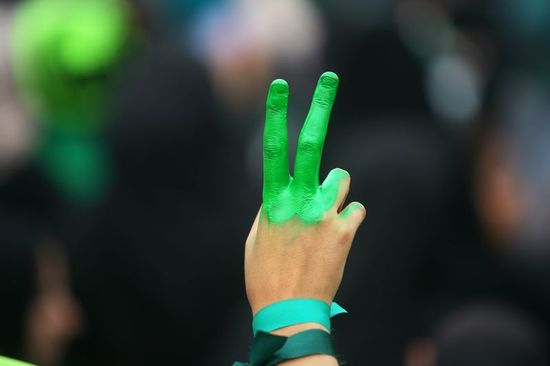
Last week the audio track of a senior Revolutionary Guard's speech was leaked. In the audio, you hear Gen. Moshfegh, the head of SAR ALLAH military base – which was in charge of "controlling" Tehran in the days after the election – give an extensive and detailed account of their pre-election preparations to stop Ahmadi Nejad's rivals.

Moshfegh describes all the methods employed to achieve their goal, from eavesdropping in every campaign/planning meeting that reformists held months before the election to how they interfered with all the SMS communications of Mousavi and Karoubi's observers on the day of the election. (Every candidate is, by law, allowed to send monitors to every polling station.) Moshfegh proudly brags about how they monitored every move the top Mousavi and Karoubi reformists made and how the Revolutionary Guards were victorious in preventing the reformists from coming to power.  Moshfegh says he believed reformists were trying to "defeat the supreme leader by defeating Ahmadi Nejad" … in their eyes Ahmadi  was not just a president, but his defeat would be a set back for Khamanei.

This is an extraordinary speech. It confirms all that the Green movement has been charging from day one.

The seven top reformist figures who have been in and out of jail over the last year (among them Tajzadeh, the former deputy interior ministry, and Amin Zadeh, the former deputy foreign ministry) made a very smart political move following the leak: In an open letter to the judiciary, they filed a law suit against Moshfegh for admitting to have been part of the orchestration of the election fraud and breaking every law in the book as far as eavesdropping/privacy is concerned. 

This has put the establishment in an uncomfortable position, as they cannot publicly defend the criminal actions this general proudly brags about and they obviously won't go after one their own, who was merely executing orders from the top to change the results of the election. 

On a side note, I wonder if has brought this to the attention of the Leveretts, who spent the good part of 2009 saying, "We don't have enough evidence that this election was stolen." Remember this article?

"Ahmadinejad won. Get over it."