Lessig On Obama

Very nicely put:

It's certainly not fair to criticize Obama for not being a Lefty. He wasn't ever a Lefty. He didn't promise to be a Lefty. And there's no reason to expect that he would ever become a Lefty.

But Lefties (like me) who criticize Obama are not criticizing him for failing our Lefty test. Our criticism is that Obama is failing the Obama test: That he is not delivering the Presidency that he promised…

Now I'm not sure whether it is leftist, or rightist, or centerist to govern through special interest deals. It certainly is Clintonist. It's precisely the administration that Hillary "lobbyists are people too" Clinton promised. And were she President, and had she done exactly what Obama has done, then no one, I included, would have any reason to criticize her.

But beefed up Clintonism is not what Obama promised. He promised to "take up the fight." His failure to deliver on that critical promise — the promised that distinguished him from his main primary rival — or even to try, is a failure that everyone, Lefties included, should be free to complain about without suffering the rage of Gibbs.

I am crestfallen over two profound issues: civil rights and accountability for war crimes. Maybe in the long run, it will come out all right. And I understand the necessity of pragmatism and the awful legacy this president inherited. But you cannot head up a government that uses evidence based on torture and remain the candidate so many of us supported in 2008. And you cannot actually take a position that is directly against the tide of history and morality on gay equality and pretend you are a new kind of politician, prepared to take on the fear of the far right that gripped the Clinton years. 

These are not questions that are susceptible to pragmatism alone. It is because many of us take this president's intellectual and moral integrity seriously that we find these compromises too much. Because they are not compromises. They are surrender.

“Depressing Because It Is So Persuasive” Ctd

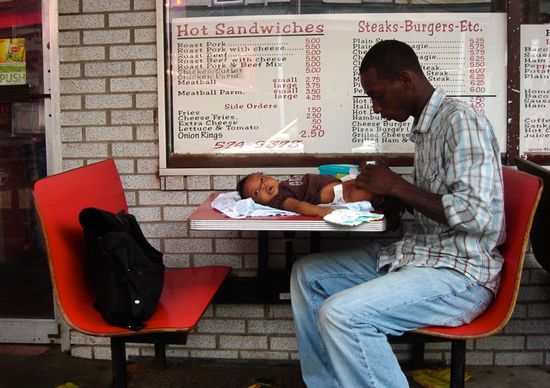
DSC03502

A reader writes:

I have to disagree strongly with the John McWhorter. His insistence that the failure of so many blacks to avoid the perils that come with not finishing high school and getting pregnant before marriage cannot be explained by structure or bigotry is too outrageous to let pass with no reply.  In fact they can be easily explained by structure (overt bigotry is probably not as much of a factor.)

The school systems in black neighborhoods are underfunded and undeniably worse on average than those in white neighborhoods.  The quality of the school, its teachers and leadership has a direct influence on graduation rates.  Sex ed and access to contraceptives are also far worse in black communities.  The public health failures come well before this for many black youth.  The failure to provide adequate health care and nutrition to black adolescents has been linked to the behavioral and learning disabilities so prevalent in black schools.  The diagnosis of a learning disability is one of the biggest predictors of eventually dropping out of school, particularly in poor urban schools.

But the biggest omission of all, particularly for someone who seems so emphatic that internal culture and family structure rule the day, is the impact that social structures have on families in black communities. 

McWhorter doesn't debate the well-established fact that employers "are less interested in people with names like Tomika," but insists that it can't account for the problem poverty in black communities.  Of course a child who grows up in poverty faces vastly increased chances of being poor as an adult, whether black or white.  If that child's parents faced difficulties finding work because, just as an example, their names sounded "too black," then that’s a structural reason why that child is more likely to grow up to be more than a white counterpart. 

Furthermore, the unequal application of the criminal justice system in black communities increases the likelihood that a black child will grow up without one parent.  This means that there's one less parent to earn an income, one less parent to instill the sort of discipline all children need to graduate school and avoid unplanned pregnancies.  Even if the incarceration only lasts briefly, it still means that once the parent is out of jail he or she will find it much harder find employment.

Another writes:

In contrast, middle-class kids in places like Scarsdale know that their education is a track to a job – maybe not to their dream job, but a reasonably good-paying, high-status job. (As your chart suggests). They see it all around them; they have the social connections to people in law firms and hospitals and businesses that are waiting to help them into reproducing middle class life; they are motivated to complete their educations, because they know that whole network of support and good jobs are waiting for them.  School is not entirely disjointed from the work it's supposed to lead to, for them, and their world has a complex and massive social infrastructure, educational infrastructure, and economic structure in place to support their path. 

For most young people in the tough, underfunded schools left to them in poor neighborhoods, school feels like a joke – unrelated to the world they have no choice but to try to survive in, with or without a poorly paying job.  The job is not the only way to survive, and it may not even look like the most promising path.  With little or no reliable infrastructure to support a middle class life, it would collapse.

If the only jobs that are available in your neighborhood, with a high school diploma, are minimum wage jobs that don't actually pay enough to meet minimal bills, and you also don't have the network to the other jobs, the world would look very different.  Having a baby will, at least, give you a clear role to play in your world, and can look like a reasonable response to the situation.  This does create a radically different subculture from the middle-class culture, but cultural change is not so easy to instigate, because, especially for the poor, these cultural patterns have been necessary for bare survival; because they are doing the work of a socioeconomic infrastructure that simply is not there.

(Photo by Nema Etebar via FILE Magazine.)

Ezra On Ross

A nice analogy:

America does not currently conceive of marriage in the way that Douthat and Tushnet would like it to conceive of marriage, and in the way it would need to conceive of marriage in order for there to be a good reason the institution can't accommodate gays. So to oppose gay marriage, Douthat and Tushnet must first construct an alternative version of marriage, and then argue that if real marriage opens to gays, that's another step away from the idealized marriage that would be closed to gays.

It's like partisans of VCRs opposing improvements to DVDs because they make the widespread resurrection of VHS unlikely.

It seems to me that we are witnessing the much faster collapse of the anti-gay marriage case – on logic and public opinion – that almost anyone anticipated. It is as if suddenly, one consensus has imploded and another begun.

Do Prop 8 Proponents Have Standing To Appeal? Ctd

A reader writes:

One might be tempted to call a decision by the 9th Circuit to dismiss an appeal for lack of standing "narrow," or "procedural." But in an an odd way, this possibility seems to get right to the heart of what the opposition has been saying all along.

After all, standing is determined by material harm. Your interests or your rights must have been diminished in some way in order to file suit to protect them. Now, the anti-8 plaintiffs filed suit against Schwarzenegger, so he was brought into the suit unwillingly. But it's the pro-8 crowd who wants to appeal. Denying standing would be, in effect, that their interests were not harmed by the decision of Judge Walker. That is, they lose nothing as a result of gay marriage being legal. In other words, the legality of gay marriage does not diminish the sanctity of straight marriage. Isn't that what we've been saying?

I don't believe it would function as precedent that would bind the Ninth Circuit in the future. But it's a hell of a slap in the face to reactionaries, when you get right down to it.

Another adds:

Your commenter about courts resolving cases based on standing is true and important for some less-obvious reasons (also, remember the Under God case was resolved by lack of standing without reaching the Under God issue).

If the Ninth Circuit denies the stay requested, either on merits of the stay or for lack of standing to appeal, it's game over, lights-out, thanks-for-playing because it will mean that more couples can marry between now and when/if the Supreme Court rules on the case and sends it back to District Court.  If the Supreme Court orders a re-trial, these additional merits will be further proof that the "world didn't end".  That was a crucial fact cited by Judge Walker in his opinion: between the initial state Supreme Court ruling and Prop 8, gays got married and the world didn't end.

Additionally, the appeals process for standing will take a year or two more to resolve, rather than the short months originally. 

The Daily Wrap

Today on the Dish, a majority of Americans supported gay marriage. Andrew responded to the poll, while readers snickered over the shape of the graph (and this one too). But Glenn Beck jumped on board, Rush Limbaugh honored the sanctity of marriage with his fourth, and Andrew replied to Ross on celibacy, monogamy, and the importance of integration, echoed by this reader's choice of home vs. security.

The base of the GOP was debased, a reader scoffed at the fight over the Mosque and over the confederate flag, and Liz Cheney made Bush look good. Andrew urged Obama to take the Tory line of attack; Damon Root justified the 14th amendment via supply and demand; and one reader contested that Bagram isn't that big. Islam-bashing didn't abate; immigrants were kidnapped; we debated torture, both at home and in Iran; and Dachau was once this idyllic field.

We heard kudos for TBD.com, learned what keeps poverty at bay, and readers responded to the unemployment chart of the day. The dream of libertarian parking reached San Francisco; Manning's suppressed sexual identity could have driven him to Wikileaks; and Mark Kleiman overhauled the war on drugs, but couldn't change the absurdity of this punishment. 

Pedestrian signs never looked so fun; a shirtless Conan stayed mysterious; and the bubble of Bush-era tax cuts were visualized here. Newborn pandas FOTD here, rural VFYW here, dogs wiping their bums MHB here, and creepy ad watch here. Yglesias nominee here and here, Moore award here, and Malkin nominee here. 

Email attachments polluted the earth, we pondered puppy mortality,and even monkeys grew tiny beards.

— Z.P.

The Unique Quality Of “Lifelong Heterosexual Monogamy” Ctd

[Re-posted from earlier today] PROP8JustinSullivan:Getty
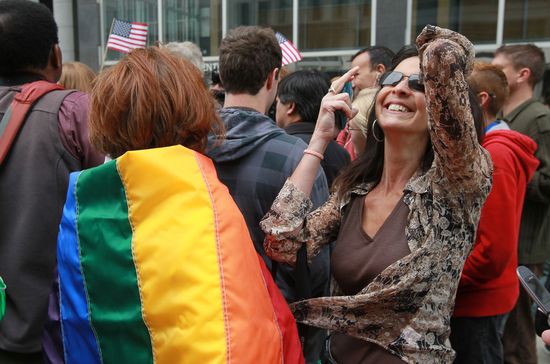
Ross responds to Serwer's objections, by citing the celibate lesbian Catholic, Eve Tushnet. It's a long and complicated post but it boils down to the need especially to regulate heterosexuality by providing a procreative life-long ideal that is unique to them. The strongest point, I think, is this:

If you have a unisex model of marriage, which is what gay marriage requires, you are no longer able to talk about marriage as regulating heterosexuality and therefore you’re not able to say: Look, there are things that are different about heterosexual and homosexual relationships. There are different dangers, there are different challenges, and, therefore, there are probably going to be different rules.

Ross sharpens this by noting that in Massachusetts and Spain, for example, there are now three kinds of marriages: gay male, lesbian and heterosexual. Experientially, these are different things because of the power of gender. I do not dispute this at all. Ross, I think, is particularly worried about monogamy in this context – because it is so unnatural a state for most of us. The threat to monogamy, of course, is not universally – but largely – a function of testosterone and evolutionary biology. And the heterosexual marriage ideal offers social status to males to stick to one woman for the sake of children (and his wife).

Of course, actual real life-long monogamy is relatively rare, especially if you take into account pre-marital sex. And therefore, the ideals of monogamy and hypocrisy are deeply entwined. But the social conservative will be fine with some measure of hypocrisy as a concession to human nature as long as the norm is enforced. I know of no more sophisticated treatment of this than Jon Rauch's here and most acutely here.

Will marriage that encompasses gays and lesbians undermine this?

The first thing to say is that lesbians seem to be far more eager to marry than gay men. Duh. It's not because they're lesbians, it's because they're women. It follows, however, that lesbian couples are likely to be more monogamous than most straight couples as well as more numerous than gay males ones. So adding lesbians to the mix actually reinforces monogamy as an ideal and feminizes marriage in ways that Ross would presumably favor.

Gay men? I think it's fair to say that the fact that they are men makes monogamy less likely than even straight marriages. If Eliot Spitzer had married another Eliot Spitzer, he may have had more sex on the downlow and spent a lot less money on hookers. Male-male marriages that survive are likelier to have some kind of informal level of permission and forgiveness and defensible hypocrisy on this score than most male-female marriages or female-female marriages, especially if the men marry young. I think the honesty within these relationships can actually be a good thing and can help sustain a life-long commitment rather than weaken it. But I can also see why it might worry Ross if this became publicly celebrated rather than privately tolerated. Given the way in which the straight family as a whole is involved in such marriages, I believe private toleration will likely prevail over public celebration. But the defensible hypocrisy of straight marriages may have an extra twist here.

But here's the thing: what, exactly, is the alternative in a world where openly gay people and couples exist?

Ross has never told us. But it seems to me from the logic of social conservatism that those most in danger of the social chaos social conservatives fear are those who would benefit most from being subjected to the cultural power of this institution. We know the consequences of marital breakdown for the black and urban poor: immiseration, poverty and dysfunction. We also know the consequences of a society that allows gay men sexual freedom, while denying them any social institutions to channel their love and desire: 300,000 young corpses. But the social conservative who insists that the family is vital for the black underclass somehow believes it is just as vital to deny it to gay men. In fact, social conservatives are intent on preventing this integrating institution from helping, guiding and ennobling a group most vulnerable to the consequences of emotional and sexual chaos. (David Brooks is a clear example of someone on the right who has actually grappled with this incoherence, which is why he supports marriage equality).

So we return to the actual world of modern reality, rather than the abstract ideology that Ross seeks vainly to re-impose on the planet from some vantage point in the 1940s. For Ross' ideology is premised, as Eve's is, on the notion that there is no need to find an answer to the questions that arise in a society where a visible, open and clear minority are proudly gay. It is premised on an era of the closet that simply no longer exists and cannot be reimposed without enormous cruelty and more state power than any real conservative would tolerate. And notice how this ideology of marriage must inevitably express itself in reality in the example of Eve Tushnet: gays have to be celibate their entire lives. We have to cease to exist, really, as sexual beings. That could never be the case in fact – hence the appalling pain and cruelty and misery homophobia inflicted on countless human beings for centuries. But now it is impossible even to pretend that this could be the case. And yet here is Ross still trumpeting it. 

He's trumpeting it, I guess, because what he is essentially arguing for is the imposition of one church's flawed and anachronistic ideology onto a society that does not hold it. What holds him back is his reluctance to challenge the Vatican's Humanae Vitae dogma, and his conflation of that with civil law.

Meanwhile, in the real world, where real conservatives live and think, where faithful Catholics have to look their gay brothers and sisters in the eye and tell them they have no place in the family or civil society, people's lives are to be lived. And they will be lived – more deeply and fruitfully and responsibly by being included within the rubric of civil society and family life – than by being excluded cruelly from both.

One day, in my view, the Vatican will catch up with modern Catholics in understanding this. One day.

(Photo: Justin Sullivan/Getty.)
Do Prop 8 Proponents Have Standing To Appeal? Ctd

This piece is the most informative I've found so far – and suggests that the Prop 8 proponents may well have no more recourse if the Ninth Circuit agrees with Walker that they have no standing to appeal. A reader writes:

As a trial attorney, I think people are smoking crack if they think the Supreme Court will approve gay marriage.

But here's the problem for the Supreme Court in overturning Judge Walker's decision (which they desperately want to do). There was almost no defense of Prop 8. Under the law Jerry Brown as state AG was supposed to mount a defense of Prop 8 which – like it or not – was the law of the state of CA. As a result Prop 8 got no real defense except from the intervenors who were a bunch of bumbling stumbling idiots. Their witnesses didn't show up, or gave confusing testimony, or were withdrawn at the last minute. There was almost no defense put on – true legal malpractice. Indigent defendants in minor cases get better defenses from public defenders.

Boies and Olson won by default. Do people really believe the most important social issue of our day is going to be decided on default, and the Supreme Court is just gonna say "ok whatever". Dream on.

My guess is the Supreme Court is going to remand this back to California federal court with instructions to the State of CA that it must mount a defense – most probably with outside counsel. Then there will be another trial, which given what we know of the 9th circuit will result in another pro-gay ruling (I hope). Then back through the appellate process and ultimately back to the SC again. Estimated time before the SC actually rules on the merits: five to six years.

And by that time public opinion will have changed (it's changing by the day), state laws will have changed, the makeup of the court may have changed. So we may have eventual victory. But the recent "victory" given to us by Judge Walker will never stand, and much as I hate to say it, probably shouldn't.

Another writes:

Judge Walker is saying that Prop 8 isn't even rationally related to a legitimate government purpose. But there's a wrinkle. Judge Walker and any lower court judge will be applying rational basis, true, but not any ordinary rational basis. Post Lawrence v. Texas and Romer v. Evans, rational basis has another requirement when it's applied to laws impacting sexual orientation — in those contexts, stigmatization or moral opprobrium alone are not legitimate government purposes (though they normally are).

So, the government has to indicate some legitimate purpose other than the moral police power to apply when restricting the rights that gay Americans can enjoy. The problem is, this theory, "rational basis with teeth," is very new, and found largely in Lawrence and Romer — opinions by Justice Kennedy. But, Kennedy giveth, and he taketh away. He's conditioned that "rational basis with teeth" test on a few preconditions. One of them is that it doesn't apply to marriage — "an institution the law protects."

If confronted with The Marriage Question, Kennedy could happily brush aside the parts of Lawrence and Romer that elevate rational basis as applied to sexual orientation, and strike the decision down, for Walker's failure to apply ordinary rational basis. That would be disappointing. But it would also be a new beginning.

On remand I suspect Judge Walker would find Prop 8 invalid even absent Romer and Lawrence (because it clearly is). Then we're in for another round of appeals!

Trust me, I'm a lawyer :)