Your Emails Are Polluting The Earth

Kiera Butler explains:

[E]mails—especially those with attachments—still use energy and create greenhouse gas emissions, even if you don't print them. … Part of the reason we have so much data has to do with redundancy: Let's say you take a picture and send it to 20 people. Each of those people then have to download it, which requires equipment—personal computers, servers, and storage centers. … All of a sudden there are 7,000 copies, and because of that there are 7,000 devices that are being run to support that data.

Chart Of The Day, Ctd

A reader writes:

You asked, "[W]hy the Democrats are under so much electoral pressure when so many people are doing fine in this economy, indeed enjoying hefty wage increases in an era of very low inflation."

I think the answer is  summarized in three words: real estate prices. Even those who are not unemployed, or who don't have stock market investments, have seen the value of their homes plummet by huge amounts in the last two years. For most of us, that's our primary savings and source of net worth. I know I've lost a huge amount of the equity in my home over the last three years, and that makes me very nervous. Even though I continue to work and earn, I'm not easeful about my position, and my own personal safety net. Until real estate prices recover at least somewhat, most people in this country, employed or not, will feel very uncertain of their economic position, and hence vulnerable to all kinds of rhetoric.

Another writes:

To counter Yglesias' point regarding social networks of college grads, he forgets about our families.  I am a college grad myself, and yes, most of my friendships are with other college grads.  However, I have many family members that are not college grads, and I hear about their plights constantly. 

For instance, my sister just ended an almost two-year unemployment stretch.  I've had to deal with countless phone calls from her crying and sobbing over her unemployment, thinking she was some kind of loser because she couldn't find a job.  Doesn't matter how irrational that thought is; it's still there.  And even though everyone in my social network and my pay has increased recently, I've had to give my sister plenty of financial and emotional support.  Therefore, this recession has been very real for me.

Another:

I think the histogram you published deserves some pushback. Unemployment may be significantly lower for those with Bachelor's degrees, probably because knowledge workers and professionals were less hard hit than some other sectors such as construction and retail. There's a difference, though, between hanging onto a job and finding one, and even for those with a college education it's not easy.

I graduated two months ago from a fairly pretentious university. From my cohort, virtually everyone is either going to grad school or has taken temporary summer jobs. The summer research job I had lined up fell through at the last minute so I went straight to job hunting. It's a hard slog. Many companies have shown an interest in me, but they're swamped with candidates, many of whom have 5 to 10 years more experience than I do. There's just no way they'll take a chance on a new graduate.

It's no cause for despair that finding a job is taking a while, but if graduates of a top-drawer university have to resort to teaching summer camp or taking unpaid internships, what's in it for everyone else?
“Depressing Because It Is So Persuasive”

John McWhorter reviews Race, Wrongs, and Remedies:

One of the most sobering observations made by [author Amy] Wax comes in the form of a disarmingly simple calculus presented first by Isabel Sawhill and Christopher Jencks. If you finish high school and keep a job without having children before marriage, you will almost certainly not be poor. Period. I have repeatedly felt the air go out of the room upon putting this to black audiences. No one of any political stripe can deny it. It is human truth on view. In 2004, the poverty rate among blacks who followed that formula was less than 6 percent, as opposed to the overall rate of 24.7 percent. Even after hearing the earnest musings about employers who are less interested in people with names like Tomika, no one can gainsay the simple truth of that advice. Crucially, neither bigotry nor even structural racism can explain why an individual does not live up to it.

Leaving Afghanistan In 2011? Ctd

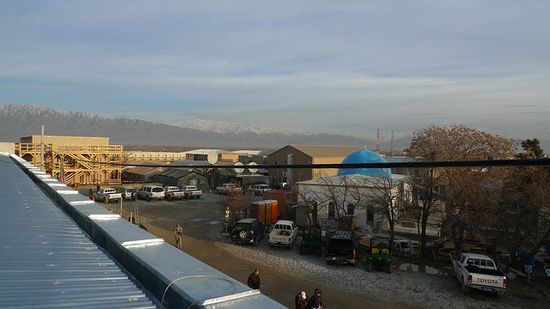
4833142499_2aa05acb10_z

A reader writes:

Contrary to Ackerman's report, Bagram really isn’t that big.  Seriously.  I live there, and I’ve been there for more than a year.  It’s crowded, surely, but it is not a “massive” base.  The crowding, IMO, is more a result of shitty planning on the part of base operations than because it has such a massive number of forces in it (everybody is packed into about two miles along Disney. The rest is more like an industrial park).  The traffic is, as Ackerman notes, absolutely ridiculous on Disney, but not because there is some overwhelming number of vehicles.  Rather, it’s because there are several crossing areas – the largest being between the PX on the west side of Disney, and Kohle DFAC, the main chow hall directly across the street on the east side of Disney – that cause traffic to have to stop for pedestrians for several minutes at a time.   During off hours, Disney is clear.

FT Hood in Texas – that’s massive.  I thought Camp Victory in Iraq was pretty big too, especially considering it butts right up against several other bases that in reality are all one base, they just have different names.  Victory and it’s sister bases *dwarf* Bagram.

I’m all for keeping Obama’s feet to the fire on our mindless efforts in Afghanistan, but let’s not devolve into hysterics and hyperbole. 

There’s a lot of people there, they fly a lot of flights in and out, but massive it is not.  The local community extends right up to the external fences – literally.  During my morning runs I pass Afghan children out tending to their flocks as they graze what little greenery there is.  I can hear the call to prayer from the mosque just outside the western side of the base, and I can see the mud buildings of the local population from where I sleep at night.  The base is also swarming with local nationals who work on post.  

My main point is that living on Bagram does not exactly give one a sense of being enmeshed inside some sort of imperial safe zone the way Victory did.  I feel acutely aware that it is a small island separated from the bad guys by only a chain link fence in a lot of areas.

(Photo of Bagram by Flickr user allgoodpeople)

The Daily Wrap

Today on the Dish, Ross embarked on a response to Prop 8 (the Dish's is forthcoming), which Andrew addressed from behind enemy lines. Vaughn Walker may not be gay; the case's video and document evidence went public; Newt lived a double life; and two countries with legalized gay marriage now straddle the U.S.

Andrew looked again at the pain of war, at the evil of the Taliban, and at what it is to suffer alone, while this reader took a different road.

On the Cordoba Mosque, Hitch mustered outrage, Pamela Geller bullied the MTA, and Chris Mohney took the absurdity of it all and ran with it. The recession was kinder to college graduates; Leonhardt's insights reverberated around the web; and Nate Silver suggested a tax on the super rich. We dished on the Gibbs/ Left fiasco, readers defended lifetime appointees to the Supreme Court, and police ducked cameras.

Kristol spawned a spawn of a spawn named Ben Quayle, the worst of the oil spill may be yet to come, and the insanity of immigration reform has just begun. We caught the scariest storm in Helsinki ever here, snacks hidden in beards here, prospects for Hillary in 2012 here, and the delusions of a Palinite blogger here. FOTD here, VFYW here, and a simply stunning MHB here.

Facebook stayed juvenile, black teenagers dominated Twitter, and we apologized to every Jewish kid out there who wants to be Lebron.

— Z.P.

Dissent Of The Day

A reader writes:

Like many people, I found your piece on the unique quality of heterosexual marriage very thorough and moving. But I wanted to draw your attention to a perhaps unintended consequence of your words. As a birth mother whose biological daughter was adopted three years ago, I felt stung by the phrase "we…look after our own biological children (and also those abandoned by their biological parents)."

I don't think you intended your words as a slight toward those who become pregnant and chose adoption, but they felt like one. Adopted children have not been abandoned; their birth parents have chosen to entrust them to the care of other people – people who are spiritually, financially, emotionally, and psychologically prepared for the task of parenthood, people who have made the choice to become parents. I have maintained close, warm contact with the parents of the little girl I gave birth to, and know of many cases of gay couples who remain in close, warm contact with the birth mothers of their children (Dan Savage is one such prominent example).

I suspect that you chose the word "abandoned" because it gives the sense that same-sex parents are stepping in where some biological, heterosexual parents have failed, because it strengthens the (true and important) narrative that same-sex marriage is actually a pro-family choice while pointing out that heterosexual coupling is both flawed and sometimes unreliable. But to me it seems vitally important that many birth mothers made a conscious, deliberate decision to place their biological offspring in the care of a same-sex couple. To discount that choice and what it means by calling these children "abandoned" is insensitive and misguided.

Born In The USA, Ctd

The Colbert Report Mon – Thurs 11:30pm / 10:30c
Citizenship Down – Akhil Amar
www.colbertnation.com
Colbert Report Full Episodes 2010 Election Fox News

Drum is not persuaded by Wilkinson's pro-immigration case against birthright citizenship:

I remember back in the thumbsucking years of the blogosphere we had a similar argument about gun control. The argument went like this: gun nuts are all afraid that the government is going to come and take away their guns. Sure, this is crazy, but it's what they think. So what if the Supreme Court ruled that gun ownership is an individual right under the Second Amendment? That would assure the gun folks that no one could take away their guns and might make them more amenable to some of the softer forms of firearm regulation that liberals support. I hardly need to tell you that this didn't happen.

In fact, I'm not sure you can find any example of that happening among either liberals or conservatives. Roe v. Wade didn't settle the abortion issue, the passage of Medicare didn't settle the healthcare issue, Reagan's tax cuts didn't satisfy the supply siders, etc. etc. Likewise, I don't think the end of birthright citizenship would slow down the immigration brawl even slightly, especially since I've long been convinced that the real hot button issue is cultural resentment and language angst, not anchor babies or low paid field workers.

Jason Kuznicki piles on:

[A] permanent, multi-generational class of non-citizens would just be fuel for the fire. Twenty years on, immigration foes will look at all the second- and third-generation non-citizens we’ve created, and the mass arrests and deportations will really begin in earnest. Not a problem I’d want to create.

Worse, by then the anti- side may even have a point. A permanently alienated underclass isn’t going to be so loyal or so invested in the American polity. They wouldn’t have any reason or need to be. The genius of birthright citizenship is that it changes the incentives for everyone involved. It says to all populations: You’ve got roughly twenty years to figure out how to live with one another, as citizens. Now get to work.

Reihan responds to Yglesias on the political viability of birthright reform. Colbert addressed the issue in fine form last night.

Extra Punishment, Ctd

A reader writes:

I may be exposing my ignorance, but my first reaction to the separation of HIV+ inmates from the general population is that it's a misguided attempt to deal with a particular long-term effect of rape and infection.  I'd be very interested in debating how to stop rape from being an ipso facto part of many people's sentences in this country.

Sara Mayeux of the Prison Law Blog addresses such concerns:

This is not at all to deny that HIV transmission among prisoners is a real and serious public health threat and one that prison officials should be doing everything they can to prevent. Indeed, the World Health Organisation has identified prisons as key sites for spreading the pandemic worldwide, given that prisons are characterized by “overcrowding, poor nutrition, limited access to health care, continued drug use, unsafe injecting practices, unprotected sex and tattooing.” But the idea, peddled by Jon Ozmint, that South Carolina can do nothing to prevent HIV transmission unless it is allowed to deny HIV-positive prisoners equal and humane treatment is simply unacceptable, which is precisely why, I assume, the DOJ Civil Rights Division is considering litigation.

She follows up here.

Prop 8 Motherlode

William Tam:

[T]he juxtaposition between what Dettmer reads into the record about Tam’s references to Satan and the way he was clearly coached to reply to expected question is just extraordinary. The most striking portion of the deposition, which was shown at trial, is Tam acknowledging the aforementioned  letter he had written urging a vote for Prop 8 in which he says that same sex marriage will lead to legal prostitution and legal sex with children