No Lifetime Tenure On SCOTUS, Ctd

counters Fallows:

I doubt that presidents, Senators, interest groups, and others would suddenly stop caring as much if justices served only 6 or 8 or 12 years. A lot of the divisiveness stems from party polarization in Congress, which is not likely to go away anytime soon. Under term limits, I would foresee an increasing number of equally divisive Court battles. Indeed, they might become even more divisive because leaders would know exactly when vacancies would arise, making them even more a dominant consideration in campaigns.

As I said in the earlier post, what bothers me the most about the current system is the arbitrary aspect: if Justices are fairly partisan (which is fine with me), then I'm not really sure that there's any decent justification for the random distribution of deaths and retirements across presidencies.  Of course, basically this is all just good August speculation; given that in practical terms reform is basically off the table, since it would require a Constitutional amendment, and that's not going to happen.

Nanny State Watch

The San Francisco Municipal Transportation Agency has banned movie ads displaying guns:

While the official poster for the film [The Other Guys] features a maniacal Ferrell and the menacing Wahlberg sailing through the air, guns drawn, the version in Muni stations features Ferrell brandishing a vial of pepper spray and Wahlberg relying upon his bare fists. This is not a coincidence.

Eugene Volokh finds the policy unconstitutional.

Face Of The Day

103328304

Pakistani flood victim Mohammed Nawaz hangs onto a moving raft as he is rescued by the Pakistan Navy August 10, 2010 in Sukkur, Pakistan. The country is suffering from the worst flooding in 80 years as the army and aid organizations are struggling to cope with the scope of the widespread disaster, which has killed at least 1,500 people and displaced millions. Meanwhile, Pakistanis have become more frustrated with the government's response and President Asif Ali Zardari's trip to Europe, as Islamic charities step up to gain local grassroots support as they did in the 2005 earthquake. By Paula Bronstein/Getty Images.

Extra Punishment

Adam Serwer on prison inmates with HIV:

Two states in the union, South Carolina and Alabama, segregate their HIV-positive inmates, a policy that is essentially a compound punishment on top of whatever sentence they've already received. They're forced to wear markers identifying their status, they're denied access to many of the same privileges and programs that inmates who aren't HIV positive have, including those that can contribute eligibility for early release. Being HIV positive means that they're forced to live under maximum-security conditions regardless of the severity of their crimes. A thief and a murderer are treated the same if the thief is HIV positive, where otherwise the thief might have been eligible for imprisonment in say, a medium-security facility. In addition to the individual rights violated by involuntary testing, an individual's status is also involuntarily disclosed to their friends and family members upon their placement in a segregated facility.

The Bipartisan Assault On Privacy

Tumblr_l3g68pewOa1qanb21o1_500

Glenn Greenwald writes in Cato Unbound on the rapid expansion of the digital surveillance state:

The spate of knee-jerk legislative expansions in the immediate aftermath of the 9/11 trauma — the USA-PATRIOT Act — has actually been exceeded by the expansions of the last several years — first secretly and lawlessly by the Bush administration, and then legislatively and out in the open once Democrats took over control of the Congress in 2006. Simply put, there is no surveillance power too intrusive or unaccountable for our political class provided the word “terrorism” is invoked to “justify” those powers.

The Unique Quality Of “Lifelong Heterosexual Monogamy” Ctd

A reader writes:

I disagree with probably 90% of what you post nowadays. I think you have gone unhinged on Palin and I think you give Obama way too much slack. Also, I come from a conservative Christian background, and for most of life opposing gay marriage has just been kind of something I believe without really knowing why; it just was. 

While my views have been shifting over the past few years, your post crystallized things for me in a way no New York Times essay ever could. Basically, I read your entry, then looked at your pictures and their corresponding captions. It almost made me cry. Throw out what I have personally felt about gay marriage, gay sex, etc.  Who am I, or anyone, to deny you and your family such happiness?  Why should I wish for you to be deprived of the gift of marriage?

Like I said, I often dislike your confrontational and personalized view of American politics. But I thank you for today's post. Getting past all the judicial, societal, and other arguments for and against gay marriage, the most powerful argument for marriage equality is that special day you documented in words and pictures.  I wish you and your husband all the happiness in the world.

I'm grateful that there are some things that are beyond politics. Or should be, anyway. God bless.

De-Personalizing Weddings, Ctd

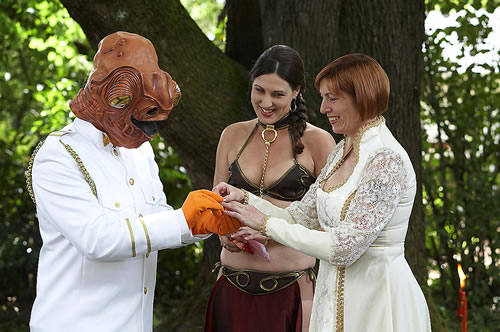
Wtf-wedding-starwars1

A reader writes:

I'd love to be rid of the "It's My Day!" foot-stomping as well, but I don't think you need to go as far as de-personalizing the wedding. I think we can distinguish between personalizing a wedding and going overboard with extravagant flourishes as some kind of symbolism about how glamorous The Event is supposed to be.

I see the wedding day as the rare time when nearly all of the people you care about (and who care about you) are assembled in the same place and get the chance to experience who you are as a couple and to see how much you really care for each other. I don't see how those two things take away from the seriousness of a marriage. There's a time and place for the couple to receive a lecture about how much work a marriage takes (and it does) — that time is well before the wedding date, and that place shouldn't require all of your family and friends to fly across the country to sit through it.

Another writes:

Your post makes a great point.  What I like about the common Catholic wedding ceremony is that people all make the same vows.  My parents made the same vows as my sister-in-law.  It is a common bond even if their ceremonies took place decades apart.

My wedding was less traditional – an Elvis impersonator in Vegas. 

While it was different, we did not have an opportunity to read our own vows.  Instead, 'Elvis' asked us to adopt each other's hound dogs, never leave each other's blue suede shoes out in the rain, and to never have a Blue Christmas without each other.  Most everyone in attendance laughed. Yet, in the almost 10 years as a married couple, we take those promises quite seriously.Standing in front of family and friends, we promised to accept and embrace our individuality, treat each other with kindness, and never be apart for the days that matter most.  That's how I see it. 

I still have the vows I had hoped to read to my wife on our wedding day.  (I re-read them on Saturday, in fact.)  They are not as good as what 'Elvis' asked us to say.  Not even close.

Another:

I went to a friend's wedding in Germany, where the civil ceremony is independent of any religious ceremony and trumps it.  You can have a religious ceremony if you want, but first you have to stand before a bureaucrat and register your marriage with the state.  (I think it works this way in other countries, too.)  Great model, if you ask me.

So, we all met at the courthouse in their small-ish village.  My German isn't great, but the civil ceremony involved reading the parts of the German constitution verbatim and outlined the social bond the couple was entering.  They signed some papers; we went to lunch.  (The couple is not religious, so there was no religious ceremony.)  That's about as impersonal a wedding as you can get.  Still, there is that deep connection to society.

Incidentally, they were presented an official family tree that stretched back ages and showed their two lines connected.  And I think they got a list of approved baby names.  Gotta love Germans. French friends, on the other hand, have all signed up for civil unions and foregone marriage.  I suspect that here are a lot of 20- and 30-somethings in France who will never be "married."  Why should they?

Another:

I got married in August of last year in a beautiful, traditional Anglican service (my parents are Anglican clergy) with ancient prayers, wedding anthems with the words from the Song of Songs sung from the choir loft, our clasped hands wrapped around my father's stole as he blessed our union. The only mention of my wife and I as a couple came in the sermon, which emphasized the importance of a lifetime of charitable love in bad and good times.

I felt for a long time very similar to Andrew Brown on the subject on the importance of a traditional, de-personalized wedding ceremony, until this summer after I attended the wedding of one of my best friends in France. On paper, the wedding had all the hallmarks of a ghastly modern ceremony: humanist celebrant, and a specially written, personalized service all about the couple.

But far from being a cheesy, cringe-inducing, egotistical "let's rub it in your face about how awesome our relationship is" wedding, the ceremony – essentially a forty-five minute speech given by the celebrant based on the sentiments of the couple themselves – featured a very realistic, sober-minded appraisal of the travails of a life lived together, and included some of the very themes Brown alluded to, especially how the "problems and difficulties of marriage are universal."  The underlying theme of the service struck me as making particular the universal value of marriage alluded to in my own wedding. If anything it was more effective because it signaled just how thoroughly the couple had thought these things through beforehand.

Ultimately, the style of wedding probably doesn't matter, but tempering your expectation of what the wedding will "magically" entail certainly does.

(Photo via Wedinator.  It's a trap!)

Leaving Afghanistan In 2011?

Bagramtwalls-660x495

The image above from Spencer Ackerman is the periphery of the massive new Bagram base for the new American empire in Southeast Asia. For some reason I don't believe the July 2011 deadline:

Step off a C-17 cargo plane, as I did very early Friday morning, and you see a flight line packed with planes. When I was last here two years ago, helicopters crowded the runways and fixed-wing aircraft were –- well, if not rare, still a notable sight. Today you’ve got C-17s, Predators, F-16s, F-15s, MC-12 passenger planes … I didn’t see any of the C-130 cargo craft, but they’re here somewhere.

More notable than the overstuffed runways is the over-driven road. Disney Drive, the main thoroughfare that rings the eight-square-mile base, used to feature pedestrians with reflective sashes over their PT uniforms carrying Styrofoam boxes of leftovers out of the mess halls. And those guys are still there.

But now the western part of Disney is a two-lane parking lot of Humvees, flamboyant cargo big-rigs from Pakistan known as jingle trucks, yellow DHL shipping vans, contractor vehicles and mud-caked flatbeds. If the Navy could figure out a way to bring a littoral-combat ship to a landlocked country, it would idle on Disney.

Expect to wait an eternity if you want to pull out onto the road. Cross the street at your own risk.

Then there are all the new facilities. West Disney has a fresh coat of cement –- something that’s easy to come by, now that the Turkish firm Yukcel manufactures cement right inside Bagram’s walls.

There on the flightline: the skeletons of new hangars. New towers with particleboard for terraces. A skyline of cranes. The omnipresent plastic banner on a girder-and-cement seedling advertising a new project built by cut-rate labor paid by Inglett and Stubbs International.

The US will be occupying Afghanistan for the rest of my life. If you think you have a say in the matter, think again.

Christianist Watch

"I think that it would be advisable [to prohibit gays from being foster parents]. I really do not think that we should have homosexuals guiding our children. I think that it’s a lifestyle that I don’t agree with. I realize a lot of people do. It’s my personal faith, religious faith, that I don’t believe that the people who do this should be raising our children. It’s not a natural thing. You need a mother and a father. You need a man and a woman. That’s what God intended," – Florida attorney general and gubernatorial candidate Bill McCollum.