Philosopher Slavoj Zizek explains the merger of charity and capitalism. Entertaining:
Author: Andrew Sullivan
If At First …
At the age of 6, James King announced his intention to become a novelist. And in his 50s, that was still the plan. Yes, he paid the bills (and two college tuitions) with his day job writing corporate training materials. But every morning at 5, he'd turn on the computer in his basement in Stamford, Conn., and after a few minutes of staring at the screen, spend the next couple of hours writing fiction no one ever wanted to buy.
Fifty-four book agents had taken a pass on his fourth unpublished novel when he happened upon a link to something called the Amazon Breakthrough Novel Award competition on one of those agent's Web sites. "What do I have to lose?" he asked his wife, strictly rhetorically. And this Monday, Aug. 9, as winner of that contest, which was entered by some 6,500 writers in 22 countries, James King's debut novel, "Bill Warrington's Last Chance," will be published by Viking.
Last Words, Ctd
The New Yorker's Book Bench highlights Last Words of the Executed and interviews the man behind the project, Robert K. Elder:
Modern last words tend to be more political, as illuminated by the passionate death-penalty debate in this country. During Prohibition, the condemned tended to blame their troubles on “liquor and bad women.” The largest shift, however, was the move from public to private executions behind prison walls. Those on the gallows, speaking to crowds, were in a very real way on a public stage. They would often offer advice, spiritual guidance—even sing hymns.
Behind prison walls, in some states, the condemned could speak directly to their family or the family of their victims. These last words tend to be more plainspoken, more intimate, and people are addressed directly and by name. You don’t find much of that before 1930.
Face Of The Day
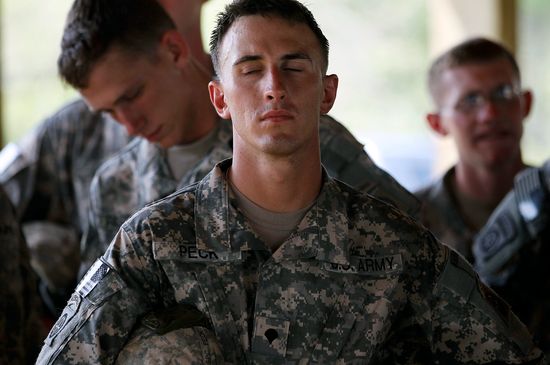
A paratrooper in the First Brigade of the US Army's 82nd Airborne Division stands in summer heat after a parachute training jump August 6, 2010 at Camp Mackall, a training ground of Fort Bragg, North Carolina. The First Brigade, which just returned from a year-long tour in Iraq, were required to take the parachute jump as part the 82nd Airborne regulations in keeping all paratroopers' jump training current. By Chris Hondros/Getty Images.
Creationism Lives
Science magazine obtained the numbers left out of the National Science Foundation's Science and Engineering Indicators report this year.
When presented with the statement “human beings, as we know them today, developed from earlier species of animals,” just 45 percent of respondents indicated “true.” Compare this figure with the affirmative percentages in Japan (78), Europe (70), China (69) and South Korea (64). Only 33 percent of Americans agreed that “the universe began with a big explosion.”
2053 Mushroom Clouds
Japanese artist Isao Hashimoto created an animation showing every nuclear bomb explosion from 1945 to 1998. It starts slow, but by the three minute mark the light show is incredible.
Mental Health Break
Watching time pass us by:
Clock from Philip Bloom on Vimeo.
The Violence In All Of Us
Courtney Martin makes various questionable assumptions in this article, but her basic point is valid:
According to new research unveiled this month, women were far more involved in the atrocities committed during the Holocaust than previously thought. Wendy Lower, an American historian living in Munich, uncovered that thousands of German women ("a conservative estimate") willingly went out to the Nazi-occupied eastern territories to take part in the "war effort," otherwise known as genocide.
This news is disturbing, to be sure, but it's also not surprising. Anyone who reacts with shock to the reality that women have the capacity to be immoral, malicious, and violent — just like the guys — hasn't paid enough attention in history class, much less to the nightly news.
The Medical Labels Bias
Dan Ariely recently did some research on it:
What I think this means (and we need more research on this) is that giving individuals a disorder-label causes others viewing them to place the blame on the disorder and not on the person. Think for example about a parent who is told that their kid has ADHD – would this parent blame themselves less than if they were told that their kid is an active difficult kid?
I think the answer is yes, and maybe this is one of the reasons that we as a society seem to be obsessed with diagnostic labels (other reasons include incentives for psychologists, medical companies etc).
What About The Shrimp?
The young Turk asks about the selective reading of biblical literalists (Timothy Kincaid made a related point in list form):
 The Dish