Not to defend Deepak Chopra, but Michael Shermer is just plain wrong when he asserts that Quantum Mechanics is not relevant to ordinary life and the notion of a objective, Newtonian reality. I suggest you read this very astute article on the work of Anton Zeilinger, one of the leading quantum physicists of our time. He explains how the old model of QM has been broken by experimental results, and that it really does imply that objective reality can no longer be considered valid even for large, everyday objects.
Another writes:
I can't speak to the Chopra's arguments, nor to Shermer's larger rebuttal, but when the latter writes, "But the world of subatomic particles has no correspondence with the world of Newtonian mechanics," he isn't really accurate and I don't think it forms a solid basis of rebuttal. Quantum mechanics describes results of Newtonian calculations accurately at scale. It's true that two different mathematics are at work, and that Newtonian mechanics cannot describe quantum systems, but quantum mechanics can accurately describe Newtonian systems.
I have been following the manufactured mosque controversy but not until last night was the depth of its penetration so apparent to me.
My wife and I went out to dinner with ten of our neighbors. Eight of our group identify strongly with the current mold of the Republican party. I cannot call them conservatives although that is assuredly how they would describe themselves. But their supple willingness to swallow the dyspeptic paranoia fed them by Palin, Gingrich, Cheney and their fellow travelers and then disgorge it as their own view no longer entitles them to the mantle of conservative, at least in my view.
At dinner, the Cordoba Mosque came up with the six of us at my end of the table. These five friends oppose the mosque to a person. They have no coherent argument as to why beyond what they have been fed, that this is an affront to the victims of 9/11.
But they do have an answer to first amendment issues. They contend, as have others, that somehow Islam is not covered under the Constitutional protections. While they did not exactly call Islam a cult rather than a religion, there was no doubt they do not feel it deserves the same consideration of Christianity and Judaism in the United States. All of them would contend that they are strict Constitutional constructionists but somehow believe that a faith followed by 1.5 billion worldwide is not a true religion.
They kept coming back to the "sacred ground" concept, that somehow this spot is sanctified, but only for non-Muslims. Never mind the followers of Islam that died in the towers. In their view no Muslim should be permitted to worship in this area.
Which led me to my final point and question. Muslims pray five times a day and at least two of those prayers (noon and afternoon) would take place during the workday. Since this ground is too holy to have an Islamic facility several blocks away, must they not then insist on a prohibition of the employment of Muslims in the new tower? After all, those prayers by those workers would be offered on the actual site of the tragedy, in multiple places in the 105 stories of the building.
There was some hemming and hawing but it was clear I had made no headway. It has gone far beyond the mosque, which is just a handy symbol those spouting these conspiracy theories upon which they can hang their foul arguments, petty fears and thinly veiled racist beliefs.
These people are my friends and shall remain so. But I wonder today: Have they been led in this direction or have they always held these views and were waiting for affirmation of them from those they see as national leaders.
I fear the answer to that question.
So do I. You know who doesn't fear the answer to that question – indeed relishes and desires it? Osama bin Laden.
Defining spirituality can be "like shoveling fog" but the Immanent Frame examines a resurgent group: the Spiritual But Not Religious. Is the religious right the cause?
The extent to which eschewing traditional religious teachings and practices has become “cool” in the present era is in part a legacy of the 1960s (when being countercultural became oddly de rigueur in certain circles), as well as a disorganized but palpable backlash against the moral absolutism of the religious Right…
How might SBNR individuals translate their belief systems, values, and practices into political attitudes and behaviors? I would like to posit several working hypotheses on this front, but first I wish to echo Joel Robbins’s assertion that the “metaphysicals” about whom Bender writes “understand their social lives in non-social terms.” We must approach the study of SBNR Americans with the understanding that (for the most part) they forego participation in the most common mode of social interaction in the United States: conventional religious worship. Thus, they voluntarily absent themselves from the social networks fostered in and by congregations and hence fail to receive the politically charged messages that many clergy deliver. This lack of connectedness, combined with the evident desire of SBNR persons to forge their own way in the world, outside of the rigid social and cultural boundaries that traditional religion tends to erect, suggests to me that SBNR Americans are unlikely to have any semblance of a clear or systematic political agenda.
That sounds about right to me. And it is the politicization of organized religion that has caused so many who are interested in the spiritual to abandon it. Because that politicization is mainly on the right, many of the SBNRs come off as liberal/liberaltarian in their views.
One thing worth noting: this is not new in American faith. Mysticism and individualism were core to the founders of this magazine. What, after all, was Emerson but a SBNR?
Gingrich seems determined to drag Saudi intolerance into the debate over the Cordoba Center. I’ll bite. Three years ago, I was studying in Israel and took a trip to Beirut to see the city for myself. There I encountered the Magen Avraham Synogogue in Wadi Abu Jamil, a neighborhood that used to be the Jewish Quarter in Beirut. The synagogue was dilapidated and decrepit. Plants grew through the floor and the building looked as if it were about to fall apart.
Recently, with Hezbollah approval, what remains of the Lebanese Jewish community and several outside sources have begun a restoration project. You can read about the project here and here. You can follow it on facebook here. If even Hezbollah allows a synagogue to be built in Beirut, maybe Gingrich should lay off the mosque in lower Manhattan. Surely that’s not too high a standard.
Mute the power-of-biology stuff … If our current sexual behavior is culturally flexible, as you rightly note, it cannot also be “powerless against our prehistoric predilections.” To ask, “If the nuclear triad is so deeply embedded in our nature, why are fewer and fewer of us choosing to live that way?” makes as little sense as to ask why, if meat-eating and hunting marked our past, more and more of us are choosing to do neither now.
Early modern curiosity was insatiable, never content with a single experience or object. Whereas Augustine linked curiosity to sensual lust and human depravity, Renaissance natural philosophers saw it as being driven by wonder and the engine of discovery.
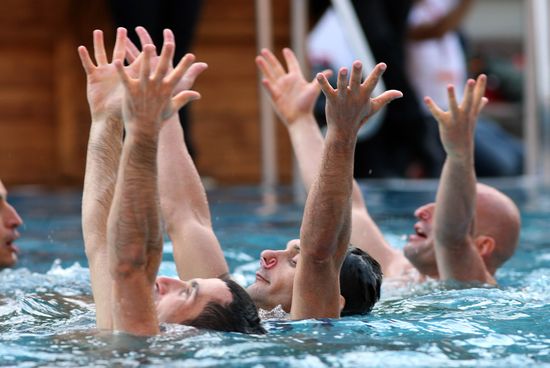
A team performs in the freestyle competition of the waterballet event on the pink friday party of the Gay Games in the western German city of Cologne on August 6 , 2010. Some 1,000 athletes compete in 35 disciplines during the week-long event. By Patrik Stollarz/AFP/Getty.

 The Dish