Dahlia Lithwick and Mike Riggs are in agreement: Real Housewives of Washington DC is unspeakably bad.
Author: Andrew Sullivan
Does It Matter That Walker Is Gay?
It's an interesting question, I suppose. Did it matter that Thurgood Marshall was black? Should he have recused himself from civil rights decisions that affected African-Americans? I can't see that many would agree with that, although the line of questioning from Republican senators in the Kagan hearings might give one pause. Gerard Bradley tries a more focused attempt to delegitimize the enormous victory yesterday for marriage equality:
When a judge is obliged to withdraw from a case due to a conflicting interest we call it “recusal.” Federal law requires that, whenever a judge knows that he has “any other interest [ that is, besides a financial interest] that could be substantially affected by the outcome of the proceeding” at hand, or when “his impartiality might reasonably be questioned”, he must recuse himself. I am not saying that Judge Walker should have refused himself in Perry v. Schwarzenegger. I am not saying so because nowhere (as far as I know) has Judge Walker volunteered or been made to answer questions about how the outcome of that case would affect his interest (whatever it is) in marrying, and thus his interest in the manifold tangible and intangible benefits of doing so. That is a conversation worth having.
So Bradley wants to raise the issue of Walker's alleged bias – without substantiating any claims to it – while not raising it. Leave this particular piece of passive aggression aside – and you find that the logical conclusion of preventing gay judges from adjudicating on questions to do with gay rights would be removing all gay people from the discussion. Every gay person might one day fall in love and want to get married. Some may choose not to (should they recuse themselves too?); some may believe it violates their faith (ditto); others may already be in such marriages in one of five states (ditto plus plus). Similarly, since we are debating the alleged superiority of heterosexual sexual orientation here, is not heterosexuality by the same reasoning also a conflict of interest? Or are gay rights only legitimate when they are supported by straight people?
And here's something that really does pose a dilemma for a free and fair society. On this issue, there is scarcely any opposition in the gay community. Yes, there are some debates about the role of courts, and strategy. But I know of almost no gay people who would disagree with the core arguments that Judge Walker elaborated upon. And so we really do get an almost exquisite example of a majority deciding the fate of an issue where the minority is united and clear. When Newt Gingrich speaks of the views of "the American people", he means heterosexuals.
That is also a conversation worth having.
Lebanon’s Itchy Trigger Finger
There is no excusing the senseless murder of an IDF soldier – shot while removing a tree on the Israeli side of the Israel-Lebanon border. It was obscuring a security camera (although why the camera could not be moved rather than the tree is the kind of question only Jon Stewart seems to ask). Stephen Walt echoes Juan Cole:
This incident underscores the fragility of the current peace between Israel and Lebanon. When security is precarious, military personnel will be more inclined to shoot first and ask questions later, and may also engage in provocative actions to show that they can't be intimidated. The problem is that this is all very risky, especially in this context.
Goldberg's take:
The Lebanese sniper who killed an IDF colonel was firing from 80 meters away; this was no mistake. The colonel, whose epaulets would be seen clear as day in the sniper scope, was targeted intentionally. And why were there so many journalists in the area, an otherwise quiet and distant stretch of border, far from Beirut? What I can't figure out yet is the why of this.
On That Iran Policy Briefing
Joe Klein got the same memo days ago:
The powerful bazaari community has been shocked not just by the universal support for the sanctions, but also by their comprehensive nature. Iranian ships are sitting at their docks because they international community is refusing to insure them. Banks that have done business with Iran in the past are refusing to do so now because the UN sanctions–that's right, those "weak" UN sanctions–target them as well. The Iranian economy, a stagflation fiasco before the sanctions, is cracking.
As a result, the Administration has been receiving all sorts of feelers–public and, for the first time, private–from the Iranians about resuming the negotiations on the nuclear program.
Toujours L’Audace!
Writers at Andrew Breitbart's Web site are still attacking Shirley Sherrod.
What Will Justice Kennedy Do?
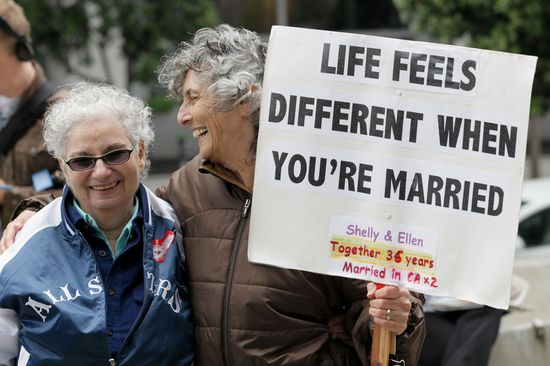
Silver tries to weigh the intangibles:
I'm not qualified to analyze the merits of Perry v. Schwarzenneger point of view from a legal positivist point of view, I will deign to take a crack at it from a legal realist frame. It seems to me that most of the "intangibles" bear upon Justice Kennedy in ways that favor his finding Constitutional protection for same-sex marriage. For one thing, he'll be 75 or 76 by the time the SCOTUS hears this case, and will probably be thinking about his legacy. Given that, in 50 years' time, American society will almost certainly regard the plaintiff's position (the Constitution does not permit discrimination in marriage on the basis of sexual orientation) as the right one, that legacy would be better served by casting the decisive vote in favor of the plaintiffs.
(Photo: Same-sex couple Shelly Bailes (L) and Ellen Pontac celebrate the ruling to overturn the ban on gay marriage outside of the Philip Burton Federal building August 4, 2010 in San Francisco, California. By Justin Sullivan/Getty Images)
The Facts, Ctd
Orin Kerr responds to a Dish reader:
The question is, how much will those factual findings matter on appeal?
If the Supreme Court agrees to hear the case, I don’t think the factual record will matter very much. I think that for three main reasons. First, the Justices will know that this case presents a defining moment for their respective tenures on the Court. This will be one of the biggest decisions of their careers, and its importance transcends a single trial before a single judge with a particular set of witnesses. These sorts of mega-big-picture cases tend rest less on the details of the factual record than other cases. Second, the Justices will certainly recognize the same point that Dahlia Lithwick and the Sullivan commenter made — that is, Judge Walker was trying to use his facts to make an argument designed to persuade the Justices to agree with him. For better or worse, I suspect a majority of the Justices will respond to that dynamic by significantly discounting those facts.
Kerr has further thoughts on the ruling here and here. What he seems to be saying is that the facts behind the arguments do not matter in the face of cultural politics. I'd say they have to matter, when adjudicating the rationality of a law that deprives a minority of core rights.
The View From Your Window

Budapest, Hungary, 5.03 pm
A Maximalist Decision?
Dale Carpenter is carefully reading the Prop 8 ruling:
My concerns about this decision outweigh what I see as its merits. In reading so far, I think a notable feature of Judge Walker’s decision is its judicial maximalism — a willingness to reach out and decide fundamental constitutional questions not strictly necessary to reach the result. It is also, in maximalist style, filled with broad pronouncements about the essential characteristics of marriage and confident conclusions about social science. This maximalism will make the decision an even bigger target for either the Ninth Circuit or the Supreme Court. If that’s right, it magnifies the potential for unintended and harmful consequences for gay-rights claims even beyond the issue of marriage. Think of a possible (but milder) anti-SSM version of Bowers v. Hardwick, which had consequences far beyond the constitutional affirmation of sodomy laws…
The decision, as I read it, relies directly or indirectly upon every prominent constitutional argument for SSM. One could say this is a strength of the decision. If a higher court doesn’t like one reason, it might accept another. But it is also a weakness of the decision, from a gay-rights litigation perspective, since it invites a higher court to address them all if it decides to reverse the result. A sweeping victory becomes a sweeping defeat.
I understand Dale's worries and his post is well worth reading closely. But even he believes a truly minimalist position would not have worked. And look: if the Supreme Court does not find a right to civil marriage for all citizens in the Constitution on equal protection or due process grounds, then we will be back to the state legislatures. What I think Dale under-estimates is the educative merits of this process, the reason that lies behind it, and the simple fact that this kind of inequality is incompatible, in my view, with a republic that treats equal protection and rationality seriously. And since this is our shared view, why not speak it?
Conviction matters. Conviction changes the world. Conviction has changed the world. If we had more of it, we could change America.
Prop 8 Reax
The web's best guide to all the opinion on the decision yesterday is here.
 The Dish